
Magazine Articles
Cari menurut
Pengunggahan Barusan
-
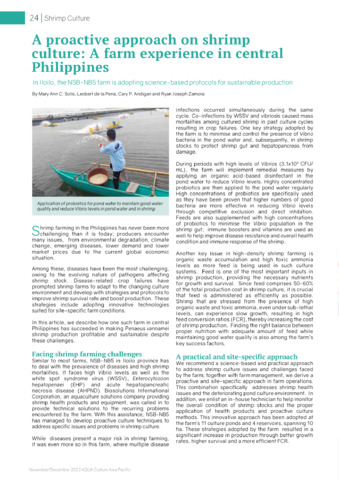
A proactive approach on shrimp culture: A farm experience in central Philippines
(Aqua Research Pte Ltd, 2022) -
Mussel culture gathers momentum in the Philippines
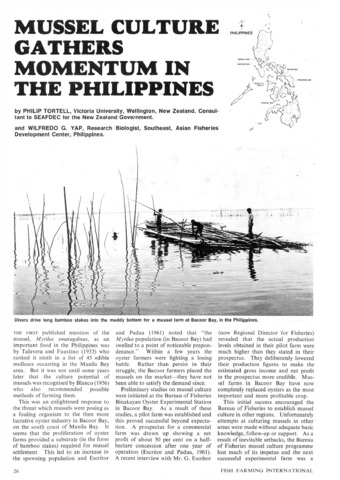
(Arthur J. Heighway Publications Ltd., 1976-12)Mussels (Mytilus smaragdinus) were posing a threat as fouling organisms in Bacoor Bay, on the south coast of Manila Bay but when attempts were made to market the mussel so much success was achieved that attempts to culture it were begun. A pilot farm was established; mussels now exceed oysters as the most important an profitable crop, 4 mussel projects have now been established, at Bacoor, Tinagong Dagat in northeast Panay, Jiabon in western Samar, and Panguil Bay in northwest Minanao. Projects of the Southeast Asian Fisheries Development Center (SEAFDEC) are also noted. The methods used in mussel culture are described; at Bacoor, Bamboo stakes are used as substrate. Cost and production estimates for a 1 ha farm using the bamboo stake substrate are given. -
The lowdown on world shrimp culture - II
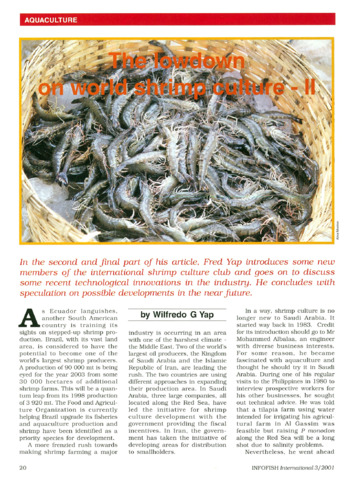
(INFOFISH, 2001)This paper introduces some new members of the international shrimp culture club and goes on to discuss some recent technological innovations in the industry, particularly the polyculture of tilapia (mainly Oreochromis mossambicus) and shrimp. -
The lowdown on world shrimp culture - I
(INFOFISH, 2001)Based on FAO time series data, in 1984 there were only 33 countries reporting farmed shrimp production. This increased to 51 in 1989 and rose to 60 in 1996. The world total shrimps and prawns production reached 1.114 million mt in 1998. This level represents more than a five-fold increase over the 1985 production of 213 640 mt. The outbreak of disease in shrimp farms has been a serious problem; the example of the white spot virus (WSSV) is given. The situation in two major shrimp producing countries, Thailand and Ecuador, is illustrated. -
Influence of water temperature on induced reproduction of milkfish during the off-season
; Mamauag, Roger Edward ; (Aqua Research Pte Ltd, 2022)
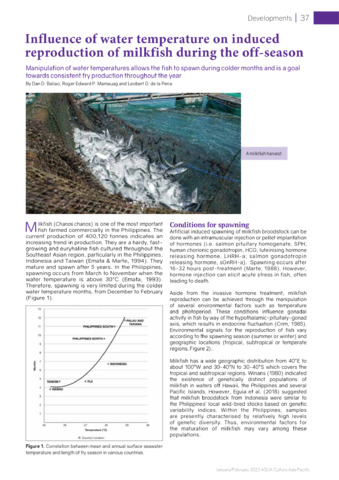
Scientific studies on milkfish’s induced spawning and larval rearing by increasing water temperature in tanks are very limited. In order to increase the production capacity of milkfish fingerlings, a preliminary experiment was conducted at the Southeast Asian Fisheries Development Center, Aquaculture Department (SEAFDEC/AQD). This study was on the effect of increased water temperature in milkfish broodstock and larval tanks during the cold and off-breeding season (October to February).
; (Aqua Research Pte Ltd, 2022)
Scientific studies on milkfish’s induced spawning and larval rearing by increasing water temperature in tanks are very limited. In order to increase the production capacity of milkfish fingerlings, a preliminary experiment was conducted at the Southeast Asian Fisheries Development Center, Aquaculture Department (SEAFDEC/AQD). This study was on the effect of increased water temperature in milkfish broodstock and larval tanks during the cold and off-breeding season (October to February). -
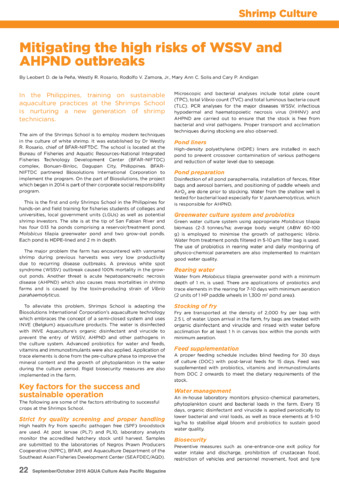
Mitigating the high risks of WSSV and AHPND outbreaks
(Aqua Research Pte Ltd, 2016) -
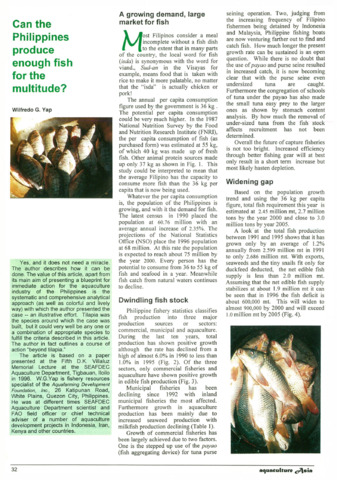
Can the Philippines produce enough fish for the multitude?
(Network of Aquaculture Centres in Asia-Pacific (NACA), 1997)Philippine fishery statistics classified fish production into 3 major production sources: commercial, municipal and aquaculture. Of these, only commercial fisheries and aquaculture have shown positive growth; municipal fisheries has been declining since 1992, with the inland sector being the most affected. Alternative ways to lighten the current fish supply crises are considered. It is believed that a sustainable option is to raise more fish, rather than merely hunt for them. An examination is made of available resources, including physical, technical and financial, which would enable increased production. Particular reference is made to increased tilapia production, but milkfish, carps, groupers and seabass are also considered. -
Good news for crab farmers
(Aqua Research Pte Ltd, 2020) -
SEAFDEC upgrades feed mill to boost production of low-cost aquaculture feeds
(Aqua Research Pte Ltd, 2020) -
SEAFDEC AQD: Facilities and activities
(World Aquaculture Society, 2002)As an R & D complex in aquaculture that can conduct replicated studies in marine waters, brackish water and freshwater, be it in aquaria, large tanks, earthen ponds or cages, there are not that many institutions in the world like the SEAFDEC Aquaculture Department (AQD). SEAFDEC AQD is one of four departments of the Southeast Asian Fisheries Development Center, a regional treaty organization with headquarters in Bangkok, Thailand. Starting with six countries when the SEAFDEC treaty was signed in 1969, SEAFDEC now includes Brunei Darusalam, Cambodia, Indonesia, Japan, Malaysia, Myanmar, the Philippines, Singapore, Thailand and Vietnam. The other three SEAFDEC departments are the Training Department (TD) in Thailand, the Marine Fisheries Research Department (MFRD) in Singapore and the Marine Fishery Resources Development and Management Department (MFRDMD) in Malaysia. Among the four departments, the Aquaculture Department, established in 1973 and hosted by the government of the Philippines, is the largest. -
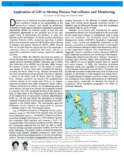
Application of GIS in shrimp disease surveillance and monitoring
(National Mapping and Resource Information Authority, 2009) -
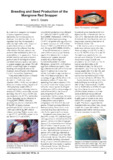
Breeding and seed production of the mangrove red snapper
(Network of Aquaculture Centers, 2002) -
Seed production of the crucifix crab Charybdis feriatus
; Quinitio, Emilia T.; (Network of Aquaculture Centers, 2002)
-
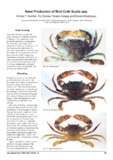
Seed production of mud crab Scylla spp.
Quinitio, Emilia T.; ; (Network of Aquaculture Centers, 2002)
Mud crab farming is an important source of income for fish farmers in the Philippines. The expanding export market for mud crab as an alternative for shrimp has led to intensified collection of wild seed for grow-out and has threatened the wild stocks. To ensure the sustainability of crab farming and reduce the fishing pressure on wild stocks, the SEAFDEC Aquaculture Department developed a technology for large-scale production of juvenile mud crabs, Scylla serrata (giant mud crab), S. olivacea (orange mud crab) and S. tranquebarica (purple mud crab). -
Seaweed production: Farming Kappaphycus in the Philippines
(Global Aquaculture Alliance, 2002) -
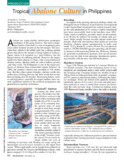
Tropical abalone culture in Philippines
(Global Aquaculture Alliance, 2001) -
DNA markers help manage Nile tilapia stocks
Eguia, Maria Rowena R.; (Global Aquaculture Alliance, 2006)
Determining changes in the genetic diversity of selected hatchery stocks through DNA-level polymorphisms analysis provides aquaculturists with a means to monitor inbreeding, control loss of genetic diversity, and achieve sustainable levels of genetic gain in the development of improved stocks. Tests with selected and domesticated tilapia stocks in the Philippines revealed variability between marker system results. -
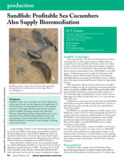
Sandfish: Profitable sea cucumbers also supply bioremediation
(Global Aquaculture Alliance, 2011)Sandfish, a type of sea cucumber, are both a high-value culture species and one that supports the aquaculture of other fish species by cleaning up waste on the bottoms of ponds or sea cages. Hatchery and nursery technologies for sandfish are being continuously refined by Vietnam’s Research Institute of Aquaculture No. 3, the Southeast Asian Fisheries Development Center and their partners. These technologies have also been initially transferred to the private sector through a training course and manual. -
Searching for ecological ways to reduce WSSV impact
; Tendencia, Eleonor; ; (Network of Aquaculture Centres in Asia-Pacific, 2014)
White spot syndrome virus (WSSV) has brought financial losses to all shrimp farming systems, and lately the “Early Mortality Syndrome” (EMS) or more accurately termed Acute Hepatopancreatic Necrosis Disease (AHPND) have added to the threats to shrimp farming in South Asia. Most studies on WSSV have been done in tanks with species other than Penaeus monodon. Several studies of RESCOPAR aimed to study WSSV epidemiology in on-farm situations and find ecological means of disease prevention or control. To achieve these goals experimental, cross-sectional, longitudinal and case studies were carried out by PhDs in Indonesia, the Philippines (Tendencia, 2012) and Vietnam. -
Sandfish culture technology developed
(Manila Bulletin Publishing Corporation, 2011-02)






 RSS 1.0