Mud crab (Scylla serrata) culture in tidal flats with existing mangroves


Share
抄録
The performance of the mud crab Scylla serrata (Forsskal) in 200 m2 pens installed in tidal flats with existing mangroves was determined in a factorial experiment with stocking density (0.5 or 1.5/m2) and feed (salted fish by-catch or a mixed diet of 75% salted brown mussel flesh and 25% salted fish by-catch) as main factors. Duration of the experiment was 160 days. Results showed no interaction between feed and stocking density so data were pooled for each feed and stocking density treatment. There was no significant differences in growth, feed conversion ratio (FCR), survival, and production among two types of feed. Regardless of feed, the FCR was significantly more efficient and survival significantly higher at 0.5 than at 1.5/m2 stocking density. Growth, however, was not significantly different. Cost-return analysis on a per crop/200 m2 basis showed that the use of either of the two stocking density levels with either of the two types of feed was economically viable with a return on capital investment of 65-87%. Partial budgeting analysis, however, revealed that net earnings were increased by P1,128.00 if crabs were stocked at 1.5/m2 and P881.00 if fed a mixed diet of 75% salted brown mussel flesh and 25% salted fish by-catch compared with crabs stocked at 0.5/m2 and fed salted fish by-catch alone.
Suggested Citation
Triño, A. T., & Rodriguez, E. M. (2000). Mud crab (Scylla serrata) culture in tidal flats with existing mangroves. In J. H. Primavera, L. M. B. Garcia, M. T. Castaños, & M. B. Surtida (Eds.), Mangrove-Friendly Aquaculture: Proceedings of the Workshop on Mangrove-Friendly Aquaculture organized by the SEAFDEC Aquaculture Department, January 11-15, 1999, Iloilo City, Philippines (pp. 171-176). Tigbauan, Iloilo, Philippines: Aquaculture Department, Southeast Asian Fisheries Development Center.
Type
Conference paperISBN
9718511423Collections
Related items
Showing items related by title, author, creator and subject.
-
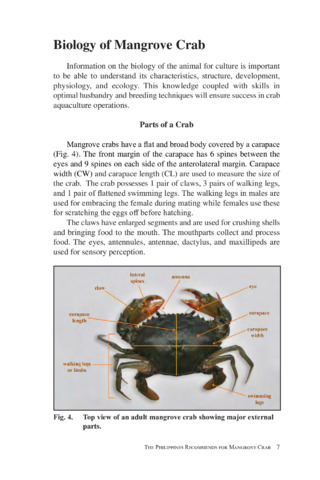
[The Philippines recommends for mangrove crab:] Biology of mangrove crab
(DOST-PCAARRD, 2021) -
The reestablishment of mangrove crabs (Scylla spp.) in an abandoned pond following natural mangrove recolonization
Lebata-Ramos, Ma. Junemie Hazel ; ; Sibonga, Rema (Wiley, 2024-01)
Scylla spp. are among the most economically important fisheries resources derived from the mangroves. However, the widespread mangrove destruction resulted in the loss of habitat, thus the dwindling capture production of many mangrove-associated faunas. Although studies have shown that Scylla populations have reestablished in mangrove-reforested areas, this study was the first in a mangrove-recolonized abandoned pond in the Philippines. Six fishers conducted standardized fishing every spring tide of the month using cylindrical bamboo traps. All crabs caught from July 2010 to December 2011 were recorded for species, sex, sexual maturation of females, carapace width (CW), and body weight (BW). Total landings comprised 14,262 crabs weighing 1,743 kg; 79.67% Scylla olivacea, 20.18% S. tranquebarica, and 0.15% S. serrata. CW ranged 3.1–17.1 cm and BW 10–1,250 g, with the male crabs comprising 39.23–64.65% of the monthly landings and the females distributed as 19.88–45.01% immature, 0.50–16.57% mature, 0.45–16.02% gravid, and less than 0.10% spent crabs. Monthly landings ranged 254–1,231 pcs of crabs or 32.38–160.59 kg. The monthly mean catch per unit effort (CPUE), in terms of number, was 0.101 ± 0.01–0.456 ± 0.02 crab gear−1 day−1 (max = 1.13), while in terms of biomass, 12.86 ± 0.84–54.36 ± 3.16 g gear−1 day−1 (max = 112.50). Length–weight relationships of S. olivacea and S. tranquebarica are expressed as W = 0.224967L2.9864 (r2 = 94.08%, p < 0.001; n = 11,363) and W = 0.173409L3.1074 (r2 = 92.71%, p < 0.001; n = 2,878), respectively. This study revealed that Scylla spp. could reestablish in mangrove-recolonized abandoned ponds.
; ; Sibonga, Rema (Wiley, 2024-01)
Scylla spp. are among the most economically important fisheries resources derived from the mangroves. However, the widespread mangrove destruction resulted in the loss of habitat, thus the dwindling capture production of many mangrove-associated faunas. Although studies have shown that Scylla populations have reestablished in mangrove-reforested areas, this study was the first in a mangrove-recolonized abandoned pond in the Philippines. Six fishers conducted standardized fishing every spring tide of the month using cylindrical bamboo traps. All crabs caught from July 2010 to December 2011 were recorded for species, sex, sexual maturation of females, carapace width (CW), and body weight (BW). Total landings comprised 14,262 crabs weighing 1,743 kg; 79.67% Scylla olivacea, 20.18% S. tranquebarica, and 0.15% S. serrata. CW ranged 3.1–17.1 cm and BW 10–1,250 g, with the male crabs comprising 39.23–64.65% of the monthly landings and the females distributed as 19.88–45.01% immature, 0.50–16.57% mature, 0.45–16.02% gravid, and less than 0.10% spent crabs. Monthly landings ranged 254–1,231 pcs of crabs or 32.38–160.59 kg. The monthly mean catch per unit effort (CPUE), in terms of number, was 0.101 ± 0.01–0.456 ± 0.02 crab gear−1 day−1 (max = 1.13), while in terms of biomass, 12.86 ± 0.84–54.36 ± 3.16 g gear−1 day−1 (max = 112.50). Length–weight relationships of S. olivacea and S. tranquebarica are expressed as W = 0.224967L2.9864 (r2 = 94.08%, p < 0.001; n = 11,363) and W = 0.173409L3.1074 (r2 = 92.71%, p < 0.001; n = 2,878), respectively. This study revealed that Scylla spp. could reestablish in mangrove-recolonized abandoned ponds. -
Aqua-mangrove integrated farming: Shrimp and mud crab culture in coastal and inland tidal flats with existing reforested or natural growth of mangroves
(Aquaculture Department, Southeast Asian Fisheries Development Center, 2000)Throughout the tropics, mangroves are being destroyed at an increasing rate for the development of aquaculture ponds. In the Philippines, for instance, mangroves were about 400,000 to 500,000 ha in 1918 but were reduced to 100,564 ha in 1987. On the average, about 3,500 ha of mangroves are lost every year in the country to accommodate the aquaculture industry (Baconguis et al., 1990). Loss of mangroves means loss of habitat, fishery, income, and livelihood for many coastal inhabitants. The annual catches of major fishing grounds in the Philippines were positively correlated with the areas of existing mangroves (Bagarinao, 1998). Restoration programs of the government such as mangrove reforestation and afforestation were attempted but could not catch up with the unending destruction. An alternative source of income which is directly supportive of resource management was therefore proposed to mitigate ecosystem degradation with the fisher communities in mind. Fishing villages in the Philippines are generally located in the fringes of arable land along coastal plains and are dependent on fishing as a source of income. The common denominator of these villages is the presence of large areas of tidal flats with existing mangroves. To utilize the aquaculture potential of these mangroves, aqua-mangrove integrated farming development projects were introduced to provide alternative livelihood for the fishers in the village. This integrated approach to conservation and utilization of mangrove resource allows for maintaining a relatively high level of integrity in the mangrove area while capitalizing on the economic benefits of brackishwater aquaculture. The projects took off from the concept of co-management, that is, taking into account the partnership between the local community, the local government unit, and the SEAFDEC Aquaculture Department (SEAFDEC/AQD) in the management of the project.