
Mangrove Friendly Aquaculture
Browse by
Proceedings of the Workshop on Mangrove-Friendly Aquaculture organized by the SEAFDEC Aquaculture Department, January 11-15, 1999, Iloilo City, Philippines
The proceedings has three review papers on the mangroves of Southeast Asia, silvofisheries, and Indonesia's integrated mangrove forest and aquaculture systems. The rest of the papers, all on mangrove-friendly aquaculture efforts are from the Philippines, Japan, Thailand, Vietnam, Malaysia, Brunei Darussalam, Indonesia, and Cambodia. All the countries represented had varied methodologies, with Cambodia in its initial stages while some countries like Indonesia and Thailand have tested methodologies. The proceedings include a tabulation of the reported mangrove-friendly technology by country -- e.g. silvofisheries in ponds (mangrove and fish/shrimp/mudcrab) and pens (mangrove and mudcrab). The workshop recommendations are classified into three major topics: problems associated with mangroves, problems associated with aquaculture practices, and socioeconomic and cultural issues.
Contents
- Publisher's note
- Foreword
- Background of the workshop
- Review papers
-
Mangroves of Southeast Asia
J. Honculada-Primavera -
Silvofishery: an aquaculture system harmonized with the environment
F. Takashima -
Integrated mangrove forest and aquaculture systems in Indonesia
W.J. Fitzgerald Jr
-
Mangroves of Southeast Asia
- Country efforts on mangrove-friendly aquaculture
-
Japan: mangrove areas and their utilization
M. Minagawa -
Philippines: mangrove-friendly aquaculture
S. Aypa and S. Baconguis -
Thailand: mangrove-friendly shrimp farming
S. Tanan and A. Tansutapanich -
Viet Nam: Mangrove-friendly aquaculture
T. Luu -
Malaysia: mangrove-friendly aquaculture
P.S. Choo and S.A. Raihan -
Brunei Darussalam: mangrove-friendly aquaculture
L. Abdul Hamid -
Indonesia: mangrove-friendly aquaculture
S. Sukardjo -
Cambodia: mangrove-friendly aquaculture
S. Sreymom -
Myanmar: mangrove-friendly aquaculture
U. Win
-
Japan: mangrove areas and their utilization
- SEAFDEC/AQD experience papers
-
Marine fishes and coastal resource management: mangrove-friendly development strategies
L.M.aB. Garcia, J.D. Toledo, and R.F. Agbayani -
Property rights and collective action in the management of mangrove ecosystems: implications of the adoption of mangrove friendly-aquaculture
R.F. Agbayani -
Mud crab (Scylla serrata) culture in tidal flats with existing mangroves
A.T. Triño and E.M. Rodriguez -
Mangrove-associated mollusc research at SEAFDEC/AQD
T.R. de Castro-Mallare -
SEAFDEC/AQD experience in mangrove-friendly aquaculture training and extension
R.F. Agbayani and K.G. Corre
-
Marine fishes and coastal resource management: mangrove-friendly development strategies
- Available mangrove-friendly technologies
- Workshop recommendations
- List of participants and observers
- Acknowledgments
Recent Submissions
-
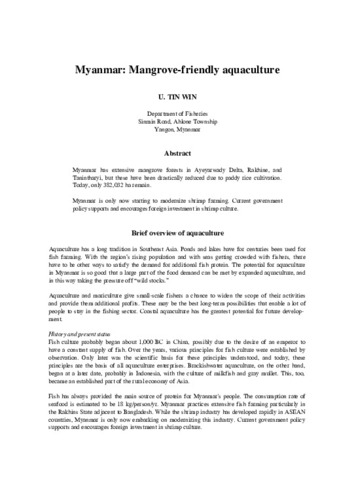
Myanmar: Mangrove-friendly aquaculture
(Aquaculture Department, Southeast Asian Fisheries Development Center, 2000)Myanmar has extensive mangrove forests in Ayeyarwady Delta, Rakhine, and Tanintharyi, but these have been drastically reduced due to paddy rice cultivation. Today, only 382,032 ha remain. Myanmar is only now starting to modernize shrimp farming. Current government policy supports and encourages foreign investment in shrimp culture. -
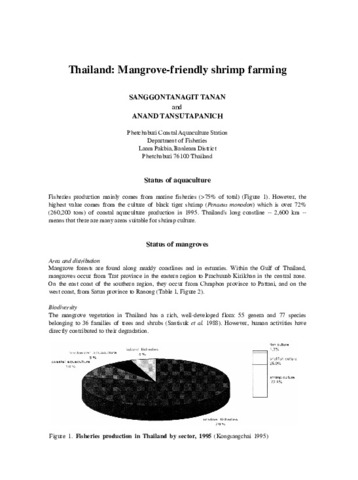
Thailand: Mangrove-friendly shrimp farming
(Aquaculture Department, Southeast Asian Fisheries Development Center, 2000) -
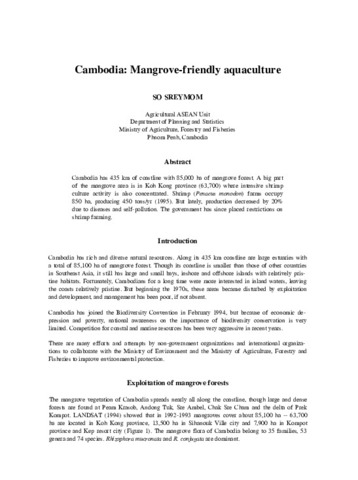
Cambodia: Mangrove-friendly aquaculture
(Aquaculture Department, Southeast Asian Fisheries Development Center, 2000)Cambodia has 435 km of coastline with 85,000 ha of mangrove forest. A big part of the mangrove area is in Koh Kong province (63,700) where intensive shrimp culture activity is also concentrated. Shrimp (Penaeus monodon) farms occupy 850 ha, producing 450 tons/yr (1995). But lately, production decreased by 20% due to diseases and self-pollution. The government has since placed restrictions on shrimp farming. -
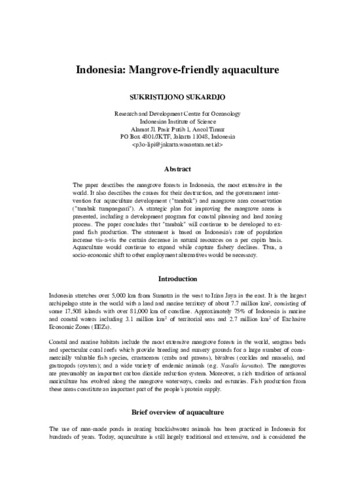
Indonesia: Mangrove-friendly aquaculture
(Aquaculture Department, Southeast Asian Fisheries Development Center, 2000)The paper describes the mangrove forests in Indonesia, the most extensive in the world. It also describes the causes for their destruction, and the government intervention for aquaculture development ("tambak") and mangrove area conservation ("tambak tumpangsari"). A strategic plan for improving the mangrove areas is presented, including a development program for coastal planning and land zoning process. The paper concludes that "tambak" will continue to be developed to expand fish production. The statement is based on Indonesia's rate of population increase vis-a-vis the certain decrease in natural resources on a per capita basis. Aquaculture would continue to expand while capture fishery declines. Thus, a socio-economic shift to other employment alternatives would be necessary. -
Viet Nam: Mangrove-friendly aquaculture
(Aquaculture Department, Southeast Asian Fisheries Development Center, 2000) -
Philippines: Mangrove-friendly aquaculture
(Aquaculture Department, Southeast Asian Fisheries Development Center, 2000)Mangrove areas in the Philippines were once considered vast tracts of wasteland that can be developed into other land uses. The economic "advantages" associated with such exploitation were considered socially "valuable" to human communities. Such advantages and exploitation, however, are now questioned, with the cost to society reevaluated. This paper discusses the factors causing mangrove deforestation with emphasis on aquaculture. Existing and future programs like the government's Coastal Resource Management project for the implementation of mangrove-friendly aquaculture are presented. Research needs and problems affecting mangrove management are likewise discussed. -
Integrated mangrove forest and aquaculture systems in Indonesia
(Aquaculture Department, Southeast Asian Fisheries Development Center, 2000)Silvofisheries is a form of integrated mangrove tree culture with brackishwater aquaculture. It is a form of low input sustainable aquaculture. This integrated approach to conservation and utilization of the mangrove resource allows for maintaining a relatively high level of integrity in the mangrove area while capitalizing on the economic benefits of brackishwater aquaculture. Silvofisheries is being promoted in Indonesia as part of a mangrove rehabilitation, conservation and management program. Pond-based silvofisheries follow three design models: (1) the basic “empang parit” model that is essentially identical to an extensive aquaculture pond with maintenance of mangrove trees on the central platform; (2) modification of the basic model to include a dike constructed around the treed central platform so that the water level within the mangrove area and the open water perimeter culture area can be controlled separately; and (3) further modification of the second model to completely separate the open water culture area from the mangrove area by a gated dike with the pond culture area consolidated to a square or rectangular shape at the end of the enclosed diked area. The ratio of mangrove tree to open water culture area is 8:2 to 6:4. In addition, various methods of minimizing the costs associated with pond construction are being considered. This includes the cultivation of mangrove crabs (Scylla sp.) in pens. The State Forestry Company in Indonesia has successfully developed and implemented silvofisheries sites (e.g., 6,000 ha in West Java-Cikiong with 1,508 farmers; 5,300 ha in Blanakan with 2,060 farmers). A conditional lease program with non-government organizations providing technical assistance to farmers has been successful. This program exemplifies what can be accomplished in mangrove rehabilitation and management within a controlled and enforced program. Production and financial return from silvofishery varies with the system, site characteristics, the level of energy input (mainly from mangrove litter - green manure) and utilization by cultured species, among other factors. Annual profit of up to $2,000/ha/yr for a milkfish and shrimp polyculture silvofisheries system has been reported. There is a need to refine data and analysis, since all costs are often not included, and revenue projections are often based on expected production rather than actual production. Farm interviews in West Java showed a range in gross income from $313 to $946/ha/yr while net profit per individual farm (1.5-10 ha farm size) ranged from $943 to $1,558/farm/yr. There was greater production effort per unit area by farmers with smaller farms. Individual silvofishery farmers often combine incomes from multiple sources. The application of silvofisheries practices requires reasonable measures of caution as with any activity in an environmentally sensitive area as the mangroves. Additional important considerations in the development of silvofisheries as part of an activity within the mangrove ecosystem include the issues of land ownership, integrated coastal zone planning and development, comparative economic assessment, systems models, optimizing use of inputs, selection of mangrove tree and aquaculture species, better understanding of trophic production and food web utilization, and improvement of economic return. -
Silvofishery: An aquaculture system harmonized with the environment
(Aquaculture Department, Southeast Asian Fisheries Development Center, 2000)Mangrove forests are valuable biologically and economically, but these have been decreasing yearly. It is usually converted into human settlement and for brackishwater aquaculture. To arrest the massive decrease of mangrove forests, reforestation of mangroves has been done but most failed because of conflict among users. To resolve such problems, a system that combines utilization and conservation called silvofisheries has been introduced. Costs-and-returns of silvofishery ponds per year differ depending on scale and type of species cultured. The following are necessary to maintain the silvofishery pond in good condition: good site and design, suitable vegetation, high economic value of target organisms, good water quality and quantity, and optimal rearing conditions (stocking density, adequate feeding, etc.). -
Japan: Mangrove areas and their utilization
(Aquaculture Department, Southeast Asian Fisheries Development Center, 2000)Although Japan has large-scale aquaculture, there is no aquaculture development in mangrove areas because the total area is small (553 ha) and strictly protected. Mangroves are preserved in comparatively good condition. Future development of aquaculture in mangrove areas is considered small-scale. Rather than aquaculture, Japan practices enhancement and management of wild fisheries. Tourism is another industry that would have an important role in mangrove utilization. But basic research on mangrove ecosystems is essential prior to determining policies for utilization of mangrove areas. International cooperative research work is important to encourage mangrove-friendly aquaculture and protect the environment. -
Brunei Darussalam: Mangrove-friendly aquaculture
(Aquaculture Department, Southeast Asian Fisheries Development Center, 2000)Aquaculture in Brunei Darussalam is quite recent compared to other countries. Cage culture of marine fishes and pond culture of marine shrimp are popular. Mangrove area utilized for aquaculture (shrimp ponds) is very minimal, 190 ha of the total 18,418 ha. This report describes the status of mangroves and practices of aquaculture in Brunei Darussalam. -
Malaysia: Mangrove-friendly aquaculture
(Aquaculture Department, Southeast Asian Fisheries Development Center, 2000)The paper describes some mangrove-friendly aquaculture activities that are practiced in Malaysia. Among these are the culture of cockle and oyster, semi-intensive culture of tiger prawn, fish cage culture, and pen culture of mud crab. Policies, regulations, future directions and priority areas in research and development that can contribute to sustainable mangrove utilization are discussed. -
Mangrove-Friendly Aquaculture : Proceedings of the Workshop on Mangrove-Friendly Aquaculture organized by the SEAFDEC Aquaculture Department, January 11-15, 1999, Iloilo City, Philippines
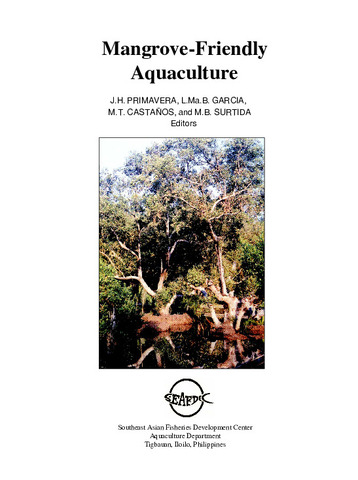
(Aquaculture Department, Southeast Asian Fisheries Development Center, 2000)The proceedings have three review papers on the mangroves of Southeast Asia, silvofisheries, and Indonesia's integrated mangrove forest and aquaculture systems. The rest of the papers, all on mangrove-friendly aquaculture efforts are from the Philippines, Japan, Thailand, Vietnam, Malaysia, Brunei Darussalam, Indonesia, and Cambodia. All the countries represented had varied methodologies, with Cambodia in its initial stages while some countries like Indonesia and Thailand have tested methodologies. The proceedings include a tabulation of the reported mangrove-friendly technology by country -- e.g. silvofisheries in ponds (mangrove and fish/shrimp/mudcrab) and pens (mangrove and mudcrab). The workshop recommendations are classified into three major topics: problems associated with mangroves, problems associated with aquaculture practices, and socioeconomic and cultural issues. -
SEAFDEC/AQD experience in mangrove-friendly aquaculture training and extension
(Aquaculture Department, Southeast Asian Fisheries Development Center, 2000)SEAFDEC Aquaculture Department (SEAFDEC/AQD) is mandated to develop human resources and disseminate and exchange information in aquaculture. Towards this direction, AQD’s recent thrusts are focused on the verification, packaging, and commercialization of the technologies developed through research. AQD disseminates and exchanges information on aquaculture research and technology through training, extension services, community-based projects and mass media. Through these strategies, AQD aims to reach out to more clientele which include among other sectors the private industry, research and academic institutions, regional and international organizations, policy-makers, non-government organizations, resource managers, SEAFDEC member-countries, local and national government and the fisherfolk. For the past two years, the scope of training courses and extension services of AQD have been expanded from technological viability to sustainability i.e., technological feasibility, economic viability, environmental sustainability and social equity. To attain sustainable aquaculture the following elements were considered: status of technology, conditions of the coastal resources, socio-economic attributes of the community and other stakeholders and institutional arrangements on sustainable aquaculture. Starting 1997, subjects on mangrove-friendly aquaculture and coastal resource management were incorporated into the curriculum of training courses. These courses are the following:- Third Country Training Program on Coastal Aquaculture and Resource Management for trainees from Asian countries
- On-site Training on Sustainable Aquaculture and Coastal Resource Management in Vietnam
- Sustainable Aquaculture and Coastal Resource Management for extension workers and fishery school teachers
-
Mangroves of Southeast Asia
(Aquaculture Department, Southeast Asian Fisheries Development Center, 2000)This paper provides an introduction to Southeast Asian mangroves covering taxonomy, distribution and ecological factors; discusses mangrove goods and services and their valuation; and recommends guidelines for mangrove conservation and management, including mangrove-friendly aquaculture. -
Marine fishes and coastal resource management: mangrove-friendly development strategies
Garcia, Luis Maria ; ; (Aquaculture Department, Southeast Asian Fisheries Development Center, 2000)
Recent statistics of fishery production in the Philippines reveal outputs that are either declining (municipal fishery) or levelling off (commercial fishery and aquaculture). These trends are, in part, a reflection of the serious effects of unregulated economic activities in the coastal zone. The degradation of coastal ecosystems means a loss of livelihood among many communities of impoverished fishers as catches from municipal waters have declined over the years. Considering that mangroves, seagrasses, and coral reefs are vulnerable to anthropogenic perturbations, several development strategies are presented to meet the twin issues of ecosystem conservation and food security for coastal fishing communities. Mariculture, searanching, habitat alteration and restoration are a few of these strategies. Our recent experience in village-based reef resource management in Mararison Island, central Philippines may likewise be a viable option in the management of shoreward ecosystems (mangroves and seagrasses). In particular, the establishment of a marine reserve in the island may find some relevant applications in mangrove management and development.
; ; (Aquaculture Department, Southeast Asian Fisheries Development Center, 2000)
Recent statistics of fishery production in the Philippines reveal outputs that are either declining (municipal fishery) or levelling off (commercial fishery and aquaculture). These trends are, in part, a reflection of the serious effects of unregulated economic activities in the coastal zone. The degradation of coastal ecosystems means a loss of livelihood among many communities of impoverished fishers as catches from municipal waters have declined over the years. Considering that mangroves, seagrasses, and coral reefs are vulnerable to anthropogenic perturbations, several development strategies are presented to meet the twin issues of ecosystem conservation and food security for coastal fishing communities. Mariculture, searanching, habitat alteration and restoration are a few of these strategies. Our recent experience in village-based reef resource management in Mararison Island, central Philippines may likewise be a viable option in the management of shoreward ecosystems (mangroves and seagrasses). In particular, the establishment of a marine reserve in the island may find some relevant applications in mangrove management and development. -
Property rights and collective action in the management of mangrove ecosystems: Implications of the adoption of mangrove friendly-aquaculture
(Aquaculture Department, Southeast Asian Fisheries Development Center, 2000)The SEAFDEC/AQD experience in Malalison Island on the Community Fishery Resources Management Project is well used in the Aklan project on community-based mangrove-friendly aquaculture. The territorial use rights in fisheries that was implemented in Malalison has become a model in investigating property rights regime in state-owned mangrove areas in Ibajay, Aklan. The concept of property rights as a management strategy in arresting the further destruction of mangroves and rehabilitating destroyed mangrove forest requires the collective effort of different users and stakeholders. There is a need to balance environmental conservation and food security in the management of mangrove resources. -
Mangrove-associated mollusc research at SEAFDEC/AQD
(Aquaculture Department, Southeast Asian Fisheries Development Center, 2000)Mollusc research at the Aquaculture Department of the Southeast Asian Fisheries Development Center started in 1975 and focused on two commercially important mangrove-associated bivalves, the slipper-shaped oyster (Crassostrea iredalei) and the green mussel (Perna viridis). Studies conducted were on spatfall forecasting to increase collection of seeds from the wild; improvement of farming techniques; seed production in the hatchery; bivalve sanitation; and transplantation. These studies have led to the development of a suitable spat collector for oyster and mussel; promotion of the raft culture method for oysters and mussels to prevent siltation of growing areas, including a low-cost raft design for this purpose; refinement of transplantation techniques to increase production and to grow osyters and mussel in suitable areas without natural populations; and desgin of a prototype low-cost depuration unit. A socio-economic study of oyster and mussel farming practices in Western Visayas provided information on current farming practices and profitability. A study done on the use of green mussel as biofilter in a semi-intensive shrimp pond showed that shrimp stocked with mussels grew faster than those without. A study on the biology and fishery of the "imbao" Anodontia edentula, another mangrove-associated bivalve, is ongoing. Spawning has been achieved in the laboratory and larval stages monitored were first polar body, 2-cell stage, morula, ciliated gastrula, trocophore, veliger, and pediveliger. -
Mud crab (Scylla serrata) culture in tidal flats with existing mangroves
(Aquaculture Department, Southeast Asian Fisheries Development Center, 2000)The performance of the mud crab Scylla serrata (Forsskal) in 200 m2 pens installed in tidal flats with existing mangroves was determined in a factorial experiment with stocking density (0.5 or 1.5/m2) and feed (salted fish by-catch or a mixed diet of 75% salted brown mussel flesh and 25% salted fish by-catch) as main factors. Duration of the experiment was 160 days. Results showed no interaction between feed and stocking density so data were pooled for each feed and stocking density treatment. There was no significant differences in growth, feed conversion ratio (FCR), survival, and production among two types of feed. Regardless of feed, the FCR was significantly more efficient and survival significantly higher at 0.5 than at 1.5/m2 stocking density. Growth, however, was not significantly different. Cost-return analysis on a per crop/200 m2 basis showed that the use of either of the two stocking density levels with either of the two types of feed was economically viable with a return on capital investment of 65-87%. Partial budgeting analysis, however, revealed that net earnings were increased by P1,128.00 if crabs were stocked at 1.5/m2 and P881.00 if fed a mixed diet of 75% salted brown mussel flesh and 25% salted fish by-catch compared with crabs stocked at 0.5/m2 and fed salted fish by-catch alone.


 RSS 1.0