Pagdumala sa uma sa guso ug mga lakang para sa bayo-sekuridad: Semilya, mga peste ug sakit-sakit, mga risgo ug pagdumala niini

ดู/
วันที่
2021-03Page views
891ASFA keyword

AGROVOC keyword
Taxonomic term

เมตาดาต้า
แสดงระเบียนรายการเต็มShare
Description
Gisulat kining brosyur matapos ang upat ka tuig nga panukiduki sa ‘GlobalSeaweedSTAR Philippine Team’ sa industriya sa guso sa Pilipinas gamit ang simple nga sinultian nga daling masabtan sa mga layko. Kini magahatag ug higayon sa lain-laing mga hingtungdan sa industriya sa guso aron masabtan ug mapatuman ang mga lakang sa pagpanguma sa guso sa puntong biyolohikal, ekolohikal ug pisyolohikal ug sa aquakultura; ug sa punto sa pagtuki sa mga 'social network' a industriya sa guso, lakip ang mga risgo ug mga estratehiya sa pagdumala sa mga risgo sa pagpanguma sa guso. Kining brosyur nagalakip usab ug mga rekomendasyon alang sa paghimo sa mga balaod ilabi na sa mga lakang sa bayo-sekuridad aron mapunggan, malikayan o maminusan ang mga insidente sa pagdagsang sa sakit, maminusan ang mga risgo o peligro sa produksyon ug pagpamaligya, ug sa pagmugna ug mga estratehiya sa pagdumala sa mga risgo o peligro nga giatubang sa industriya. Kining mga palisiya nga ipatuman nga naka-base sa kahibalo sa syensya makatabang aron makab-ot ang mas malig-on, dili makadaot sa kinaiyahan ug malungtaron nga industriya sa guso sa Pilipinas.
การอ้างอิง
Mateo, J. P., Faisan Jr., J. P., Sibonga, R. C., Suyo, J. G. B., Luhan, M. R. J., Ferriols, V. M. E. N., & Hurtado, A. Q. (2021). Pagdumala sa uma sa guso ug mga lakang para sa bayo-sekuridad: Semilya, mga peste ug sakit-sakit, mga risgo ug pagdumala niini (E. G. de Jesus-Ayson, Trans.). United Kingdom Research and Innovation-Global Challenge Research Fund (UKRI-GCRF); Institute of Aquaculture, University of the Philippines Visayas-GlobalSeaweedSTAR-Philippines.
Type
BookISBN
9789719136569คอลเลกชัน
- Books and Book Chapters [123]
Related items
Showing items related by title, author, creator and subject.
-
Pangangasiwa sa taniman at mga hakbang pangbayo-sekyuridad para sa Eucheumatoids: Mga kultibar, peste at sakit, mga risgo o peligro at mga paraan sa pangasiwaan nito
; Faisan, Joseph P., Jr.Ang polyeto na ito ay inihanda at isinulat ng GlobalSeaweedSTAR Philippine Team sa payak na lengwahe matapos ang apat na taong pananaliksik sa industriya ng pag-aalaga ng mga halamang-dagat sa Pilipinas. Nais nito na ... ; Sibonga, Rema ; ; ; ; (United Kingdom Research and Innovation-Global Challenge Research Fund (UKRI-GCRF), 2021-03)
-
Series: Aquaculture extension manual; No. 68
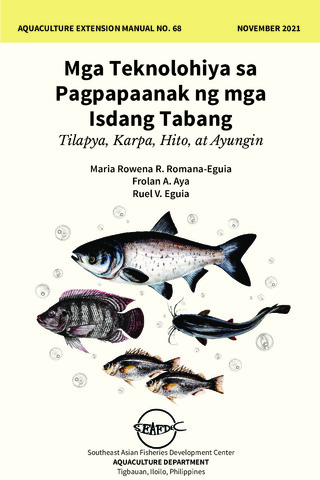
Mga teknolohiya sa pagpapaanak ng mga isdang tabang: Tilapya, karpa, hito, at ayungin
Romana-Eguia, Maria Rowena R.Ang babasahing ito ay isinulat upang ipamahagi sa mga mambabasa ang simpleng kaalaman sa pagpapaanak at pagpaparami ng mga isdang tabang tulad ng tilapya, karpa, hito, at ayungin. Ang mga teknolohiyang may kinalaman sa ...; Aya, Frolan ; (Aquaculture Department, Southeast Asian Fisheries Development Center, 2021-08)
-
Characterization of wild eucheumatoids from Visayas, Philippines as inferred from the mitochondrial cox2-3 spacer sequence
Sibonga, Rema; Brakel, Janina ; Gachon, Claire ; Faisan, Joseph P., Jr. ; Brodie, Juliet ; Ward, Georgia ; Ferriols, Victor Marco Emmanuel ; Luhan, Maria Rovilla ; (University of the Philippines Visayas, 2022)
Eucheumatoids are the major seaweed species cultivated in most coastal areas in the Philippines, being a major source of income for many families. Seaweed farmers face issues such as lack of good quality cultivars and the presence of diseases and epiphytes in the cultivated stocks. This study characterizes the wild eucheumatoids, which are potential sources of cultivars that might be resistant to diseases and epiphytes. Wild eucheumatoids were collected from Iloilo (N=18), Guimaras (N=10), and Bohol (N=20), Philippines. Gross morphology was described, and a 10-mm apical tip was excised for DNA extraction. PCR amplification and sequencing using cox2-3 spacer genetic markers were done. Based on sequence data, 5 species can be identified from the Visayas region: the commercially cultivated Kappaphycus alvarezii (Iloilo, Bohol), K. striatus (Iloilo, Guimaras), and Eucheuma denticulatum (Iloilo, Bohol) and the currently uncultivated K. cottonii (Iloilo) and Kappaphycus sp. (Iloilo, Bohol). Haplotype network analysis identifies individuals of K alvarezii and E. denticulatum as haplotype E3 and E13, respectively, which are haplotypes previously reported from seaweed farms and globally distributed for cultivation purposes. The K. striatus from Iloilo and Guimaras are identified as haplotype E89, and the K. cottonii from Iloilo is haplotype E108 which has been described previously from seaweed farms and wild populations, respectively. Interestingly, Kappaphycus sp. from Iloilo and Bohol are identified as haplotype GUI1 initially described in 2014 and yet to be identified up to the species level. Our study shows that purely morphological identification is not sufficient to reliably identify species, thus highlighting the need to employ molecular techniques supporting strain selection. In summary, it reveals a rich diversity of wild eucheumatoids in the Visayas region of the Philippines. In-vitro studies need to reveal the performance of individuals from these wild populations but highlight a great potential for the development of new cultivars.