
Efficacy of tilapia oral vaccine coupled with a nanocomposite biomaterial as carrier for vaccine delivery
Download URL
www.fao.org日付
2021-12Page views
1,139ASFA keyword

AGROVOC keyword
Taxonomic term

Geographic names

Metadata
アイテムの詳細レコードを表示するShare
抄録
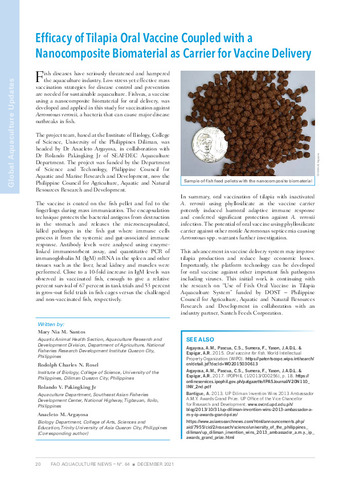
Fish diseases have seriously threatened and hampered the aquaculture industry. Low stress yet effective mass vaccination strategies for disease control and prevention are needed for sustainable aquaculture. Fishvax, a vaccine using a nanocomposite biomaterial for oral delivery, was developed and applied in this study for vaccination against Aeromonas veronii, a bacteria that can cause major disease outbreaks in fish. The project team, based at the Institute of Biology, College of Science, University of the Philippines Diliman, was headed by Dr. Anacleto Argayosa, in collaboration with Dr. Rolando Pakingking Jr. of SEAFDEC Aquaculture Department.
The project was funded by the Department of Science and Technology, Philippine Council for Aquatic and Marine Research and Development, now the Philippine Council for Agriculture, Aquatic and Natural Resources Research and Development.
Suggested Citation
Santos, M. N., Rosel, R. C. N., Pakingking, R. V., Jr., & Argayosa, A. (2021). Efficacy of tilapia oral vaccine coupled with a nanocomposite biomaterial as carrier for vaccine delivery. FAO Aquaculture News , (64), 20. http://hdl.handle.net/10862/6343
Type
magazineArticleCollections
このファイルには次のライセンスファイルが添付されています。

Except where otherwise noted, this item's license is described as Attribution-NonCommercial-ShareAlike 3.0 IGO
Related items
Showing items related by title, author, creator and subject.
-
Immuno-response in tilapia Sarotherodon niloticus vaccinated with Edwardsiella tarda by hyperosmotic infiltration method
(Elsevier, 1986)Sarotherodon niloticus with average weight of 28.42 ± 1.87g were immunized with formalin-killed Edwardsiella tarda using the hyperosmotic infiltration method. Test fish maintained in 30 l aquaria were grouped into four treatments. Group 1 and 2 were exposed to a single hyperosmotic treatment on day 0. Group 1 was bled on day 14 and group 2 was bled on day 28. Group 3 was given hyperosmotic treatments twice: on day 0 and day 14 and bled on day 28. Group 4 was an untreated control bled on day 28. All sera were analyzed for agglutinating antibody titer against E. tarda flagellar and somatic antigens. Results showed that flagellar and somatic agglutinin titers in all treatments were not statistically significant. Likewise, infection experiments where test fish were challenged with intraperitoneal injection of the test bacterium showed that the vaccination experiment did not effectively protect the test fish from infection by Edwardsiella tarda. -
Viral diseases of shrimp in the Philippines
(Research Signpost, 2015)Shrimp is a high-value commodity and one of the major aquaculture species in the world, including the Philippines. The shrimp farming industry is dominated by the black tiger shrimp Penaeus monodon and the Pacific white shrimp, Penaeus vannamei. Intensification in shrimp aquaculture to meet the global demand resulted to several socio-economic and biophysical production bottlenecks. Consequently, the issues besetting the industry had raised several questions on its sustainability. In particular, viral diseases remain a constant threat and a significant concern in many shrimp producing countries especially in the developing world. In this chapter, current knowledge on major viral pathogens affecting shrimp aquaculture in the Philippines is presented and discussed. The discussion is focused on white spot syndrome virus (WSSV), monodon baculovirus (MBV), infectious hypodermal and hematopoietic necrosis virus (IHHNV), hepatopancreatic parvovirus (HPV). yellow head virus (YHV), and taura syndrome virus (TSV). Updates on their clinical signs, transmission and distribution are presented. Records of incidence in the Philippines are provided as well. The second half of the chapter discusses some of the methods how to control viral diseases in shrimp farming with a particular focus on vaccination, biosecurity and diagnostics. -
Immune responses of Asian sea bass, Lates calcarifer Bloch, against an inactivated betanodavirus vaccine
Pakingking, Rolando V., Jr. ; ; ; ; ; (Blackwell Publishing, 2009)
Asian sea bass, Lates calcarifer (Bloch), exhibited strong immune responses against a single injection of the formalin-inactivated red-spotted grouper nervous necrosis virus (RGNNV), a betanodavirus originally isolated in Japan. Fish produced neutralizing antibodies at high titre levels from days 10 (mean titre 1:480) to 116 (1:1280), with the highest titre at day 60 post-vaccination (1:4480). When fish were challenged with the homologous RGNNV at day 54 post-vaccination, there were no mortalities in both the vaccinated and unvaccinated control fish. However, a rapid clearance of the virus was observed in the brains and kidneys of vaccinated fish, followed by a significant increase in neutralizing-antibody titres. Furthermore, the vaccine-induced antibodies potently neutralized Philippine betanodavirus isolates (RGNNV) in a cross-neutralization assay. The present results indicate the potential of the formalin-inactivated RGNNV vaccine against viral nervous necrosis (VNN) of Asian seabass.
; ; ; ; ; (Blackwell Publishing, 2009)
Asian sea bass, Lates calcarifer (Bloch), exhibited strong immune responses against a single injection of the formalin-inactivated red-spotted grouper nervous necrosis virus (RGNNV), a betanodavirus originally isolated in Japan. Fish produced neutralizing antibodies at high titre levels from days 10 (mean titre 1:480) to 116 (1:1280), with the highest titre at day 60 post-vaccination (1:4480). When fish were challenged with the homologous RGNNV at day 54 post-vaccination, there were no mortalities in both the vaccinated and unvaccinated control fish. However, a rapid clearance of the virus was observed in the brains and kidneys of vaccinated fish, followed by a significant increase in neutralizing-antibody titres. Furthermore, the vaccine-induced antibodies potently neutralized Philippine betanodavirus isolates (RGNNV) in a cross-neutralization assay. The present results indicate the potential of the formalin-inactivated RGNNV vaccine against viral nervous necrosis (VNN) of Asian seabass.


