Grow-out culture of the abalone Haliotis asinina in Guimaras, Philippines: Comparison of tubes and drums as culture containers and the effects of serpulid infestation
閲覧/開く
日付
2025-02-06Page views
1,911ASFA keyword

AGROVOC keyword
Taxonomic term

Geographic names

Metadata
アイテムの詳細レコードを表示するShare
抄録
This study compared tubes and drums as containers for the grow-out culture of abalone Haliotis asinina using mixed seaweeds and formulated diet as feed. The recycled drums were newly tested containers for abalone culture as the cheaper and larger alternative. However, on the 10th month of culture, serpulids (Pomatoceros sp. and Spirorbis sp.) were observed on the abalone shells; hence, the 12-month culture was extended to 16 months to observe further the effects of these ectoparasites on the growth and survival of abalone. Throughout the culture period, abalone reared in tubes had significantly higher mean shell length and body weight than those reared in drums, measuring 45.42 ± 0.36 mm, 23.40 ± 0.99 g, and 41.45 ± 0.23 mm, 18.26 ± 0.40 g at harvest, respectively. Mean growth rates of those in tubes were significantly higher than those in drums before serpulid infestation but did not differ during months of infestation. Survival was consistently higher in tubes than drums, except during May–September 2023. At harvest, survival in tubes was 46.7 ± 11.0%, 37.8 ± 5.9% in drums. Daily water temperature ranged 28.00–32.33 °C, salinity 16.00–34.37 ppt. Monthly readings (ppm) of dissolved oxygen ranged 3.1–7.4, sulfide 0.00–0.73, phosphate 0.01–0.87, nitrate 0.00–0.99, nitrite 0.00–0.22, and total suspended solids 0.22–4.83. In April–October 2023, serpulids became prevalent (tubes = 31.5 ± 3.4%; drums = 38.3 ± 3.4%) when mean DO was significantly lower and sulfide higher than in June 2022-March 2023. These fluctuations in water parameters may have triggered the infestation, resulting in lower growth rates and abalone survival. But, despite these fluctuations and infestations, tubes remained a better culture container for the abalone.
Contributes to SDGs
Keywords
Culture containers Haliotis asinina Pomatoceros sp. Spirorbis sp. Serpulid ectoparasites SEAFDEC/AQD
Suggested Citation
Lebata-Ramos, M. J. H., & Solis, E. F. (2025). Grow-out culture of the abalone Haliotis asinina in Guimaras, Philippines: Comparison of tubes and drums as culture containers and the effects of serpulid infestation. Aquaculture International , 33(3), 175. https://doi.org/10.1007/s10499-025-01855-7
Type
ArticleISSN
0967-6120; 1573-143XCollections
- Journal Articles [1266]
Related items
Showing items related by title, author, creator and subject.
-
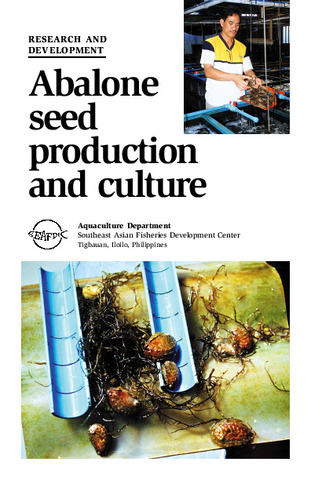
Abalone seed production and culture
(Aquaculture Department, Southeast Asian Fisheries Development Center, 2000)Details the research conducted at AQD for the tropical abalone Haliotis asinina. AQD has developed the rudiments of a hatchery protocol. -
Research on seaweeds and mollusks
(Aquaculture Department, Southeast Asian Fisheries Development Center, 1995)Research on seaweeds focused on the carrageenan-producing Kappaphycus alvarezii and the agar-producing Gracilaria spp. Growth of K. alvarezii was better on horizontal lines than on vertical or cluster lines from bamboo rafts. All morphotypes (brown green, and red) grew faster at 50 cm than at 100 cm below the water surface, but the green morphotype showed better carrageenan properties. A socioeconomic survey of K. alvarezii farming in Panagatan Cays, Antique revealed that a farmer has an average annual production of 3 tons/ha (dry) with the fixed bottom and hanging longline methods. Three species of Gracilaria in natural beds in lloilo showed monthly variations in biomass and agar quality; G. heteroclada had the highest biomass and gel strength. When this species was grown in tanks, growth and agar sulfate content were influenced by the interaction of light, salinity, and nutrients. Enriched and unenriched stocks of G. heteroclada differed in agar quality. When G. heteroclada was grown with the tiger shrimp Penaeus monodon in extensive ponds, the highest growth rate and production were obtained at the seaweed stocking density of 250 g/m2; this was in November when average water temperature, transparency, and salinity were low. Salinity tolerance varies among Gracilaria species.Oyster (Crassostrea iredalei) and mussel (Perna viridis) farming in Western Visayas were assessed in 1992 in terms of the culture methods, socioeconomics, marketing, and profitability. A more localized survey of oyster and mussel fanning was conducted through rapid rural appraisal in two coastal towns in 1993. A farmer-participatory study followed in 1994 for the culture of oysters, mussels, seaweeds, and rabbitfishes in a river mouth in Dumangas, lloilo. Green mussel, brown mussel (Modiolus metcalfei), and seaweeds transplanted to Dumangas from Capiz have reproduced. In another study, the green mussel was tested as a biological filter in tiger shrimp ponds; shrimps stocked with mussels grew better than those without. A nationwide survey on the Placuna placenta fishery in 1993 showed 27 remaining 'kapis' beds; many others have been depleted due to excessive gathering, pollution, siltation, and trawling. Broodstocks are being developed to produce 'kapis' seed for grow-out and restocking. For the first time at AQD, adult donkey-ear abalone Haliotis asinina from the wild spawned naturally in laboratory tanks. Juvenile abalones can be successfully grown on Gracilaria or abalone diet. -
Stock enhancement of threatened species in Southeast Asia
; ; Quinitio, Emilia T. ; ; Lebata, Ma. Junemie Hazel L. ; ; Garcia, Luis Maria ; Primavera, Jurgenne (Taylor & Francis, 2008)
Natural populations of global inshore fisheries are coming under heavy pressure, primarily due to overexploitation and habitat degradation. Stock enhancement of hatchery-reared seeds is perceived as an alternative strategy to enhance the regeneration process. The Aquaculture Department of the Southeast Asian Fisheries Development Center in the Philippines has been implementing activities related to stock enhancement of donkey’s ear abalone (Haliotis asinina), mud crabs (Scylla spp.), giant clam (Tridacna gigas), seahorses (Hippocampus spp.). Seed production techniques for abalone including a diet tagging method were established and juvenile abalone were released and monitored in a marine protected area. Mud crabs conditioned before release had higher recapture rates compared to the non-conditioned crabs, which can be translated to higher survivorship. Giant clams stocked at 8-10 cm shell length have higher survival 4 mo after stocking (90%), with initial mortalities occurring within the first few days due to transportation stress. Seed production trials for seahorse have begun.
; ; Lebata, Ma. Junemie Hazel L. ; ; Garcia, Luis Maria ; Primavera, Jurgenne (Taylor & Francis, 2008)
Natural populations of global inshore fisheries are coming under heavy pressure, primarily due to overexploitation and habitat degradation. Stock enhancement of hatchery-reared seeds is perceived as an alternative strategy to enhance the regeneration process. The Aquaculture Department of the Southeast Asian Fisheries Development Center in the Philippines has been implementing activities related to stock enhancement of donkey’s ear abalone (Haliotis asinina), mud crabs (Scylla spp.), giant clam (Tridacna gigas), seahorses (Hippocampus spp.). Seed production techniques for abalone including a diet tagging method were established and juvenile abalone were released and monitored in a marine protected area. Mud crabs conditioned before release had higher recapture rates compared to the non-conditioned crabs, which can be translated to higher survivorship. Giant clams stocked at 8-10 cm shell length have higher survival 4 mo after stocking (90%), with initial mortalities occurring within the first few days due to transportation stress. Seed production trials for seahorse have begun.