The decline of native fishes and fisheries and the rise of aquaculture in lakes and rivers in the Philippines


Date
2001Author

Page views
13,597ASFA keyword

AGROVOC keyword
Taxonomic term

Geographic names

Metadata
Show full item recordShare
Abstract
This paper reviews historical and recent data on biodiversity, fisheries, exotic fishes, and aquaculture in Philippine lakes and rivers. The country's lakes and rivers are poor in primary freshwater fishes because the Philippines' only connection with the Asian mainland had been through land bridges between Borneo, the Sulu islands, Mindanao, Palawan and Mindoro - in which islands endemic carps have evolved. Philippine lakes and rivers instead have secondary freshwater fishes such as gobies, migratory marine fishes such as mullets, and some snails, clams, and prawns. Most lakes and rivers have been severely degraded and their biodiversity reduced by siltation, pollution, overfishing, and the establishment of exotic fishes from other countries or elsewhere in the country. Many fishes first described in the Philippines in 1910-1940 by Seale, Herre, and Filipino ichthyologists have not been collected in recent years. The Laguna de Bay fishery in the early 1960s was largely dependent on the 'ayungin' Therapon plumbeus, 'biyang puti' Glossogobius giurus, and the 'kanduli' Arius manilensis that together comprised 95% of the annual 83,000 mt; another 19,000 mt came from shrimps and 245,000 mt from snails. Fishing and snail-dredging were so intense that catches declined and the whole lake fishery collapsed around 1970. After the collapse, the primary production of the lake increased and milkfish and tilapia became natural choices for aquaculture. Lake Lanao became famous for its species flock of 18 endemic carps, but these are now extinct, except perhaps two species. In 1963, these carps contributed 981 mt to the fishery, other native fishes 269 mt, shrimps and snails 257 mt, and introduced fishes 479 mt. Twenty years later, endemic carps have made up only 92 mt, native fishes 141 mt, shrimps and snails 164 mt, and introduced fishes 312 mt of the harvest from the lake. The 'kadurog' G. giurus, probably stocked in the lake with milkfish larvae in 1955, proliferated in the 1960s and apparently drove the endemic carps to extinction. The 'katolong' Hypseleotris agilis was first seen in the lake in 1977 and has since outcompeted the 'kadurog'. In Lakes Taal and Naujan, migratory marine fishes have been caught by fish corrals set across the outlets, but the catch along Pansipit River has fallen since the turn of the century and that in Butas River fell from 62 mt in 1977 to 17 mt in 1983. Catches of the endemic sardine Harengula tawilis in Lake Taal fluctuated between 4,400 mt in 1983 to 11,300 mt in 1990 and 1,400 mt in 1994. Cage culture of tilapia and milkfish has been going on in Lake Taal for 10 years. In Lakes Buhi and Bato, the endemic 'sinarapan' Mistichthys luzonensis almost disappeared due to fine-net fishing and tilapia stocking; catches have been 50-90 mt in 1983-93 but zero in 1994.
Description
Abstract only.
Suggested Citation
Bagarinao, T. U. (2001). The decline of native fishes and fisheries and the rise of aquaculture in lakes and rivers in the Philippines (Abstract only). In C. B. Santiago, M. L. Cuvin-Aralar & Z. U. Basiao (Eds.), Conservation and Ecological Management of Philippine Lakes in Relation to Fisheries and Aquaculture (p. 151). Tigbauan, Iloilo, Philippines: Aquaculture Department, Southeast Asian Fisheries Development Center; Los Baños, Laguna, Philippines: Philippine Council for Aquatic and Marine Research and Development (PCAMRD), Department of Science and Technology; Quezon City, Philippines: Bureau of Fisheries and Aquatic Resources (BFAR), Department of Agriculture, Quezon City, Philippines.
Type
Conference paperISBN
9718511539Related items
Showing items related by title, author, creator and subject.
-
Series: Summary of Proceedings No. 1/2013;
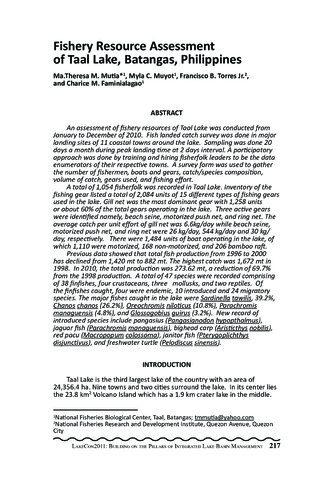
Fishery resource assessment of Taal Lake, Batangas, Philippines
(PCAARRD-DOST, 2013)An assessment of fishery resources of Taal Lake was conducted from January to December of 2010. Fish landed catch survey was done in major landing sites of 11 coastal towns around the lake. Sampling was done 20 days a month during peak landing time at 2 days interval. A participatory approach was done by training and hiring fisherfolk leaders to be the data enumerators of their respective towns. A survey form was used to gather the number of fishermen, boats and gears, catch/species composition, volume of catch, gears used, and fishing effort. A total of 1,054 fisherfolk was recorded in Taal Lake. Inventory of the fishing gear listed a total of 2,084 units of 15 different types of fishing gears used in the lake. Gill net was the most dominant gear with 1,258 units or about 60% of the total gears operating in the lake. Three active gears were identified namely, beach seine, motorized push net, and ring net. The average catch per unit effort of gill net was 6.6kg/day while beach seine, motorized push net, and ring net were 26 kg/day, 544 kg/day and 30 kg/day, respectively. There were 1,484 units of boat operating in the lake, of which 1,110 were motorized, 168 non-motorized, and 206 bamboo raft. Previous data showed that total fish production from 1996 to 2000 has declined from 1,420 mt to 882 mt. The highest catch was 1,672 mt in 1998. In 2010, the total production was 273.62 mt, a reduction of 69.7% from the 1998 production. A total of 47 species were recorded comprising of 38 finfishes, four crustaceans, three mollusks, and two reptiles. Of the finfishes caught, four were endemic, 10 introduced and 24 migratory species. The major fishes caught in the lake were Sardinella tawilis, 39.2%, Chanos chanos (26.2%), Oreochromis niloticus (10.8%), Parachromis managuensis (4.8%), and Glossogobius guirus (3.2%). New record of introduced species include pangasius (Pangasianodon hypopthalmus), jaguar fish (Parachromis managuensis), bighead carp (Aristicthys nobilis), red pacu (Macropopum colossoma), janitor fish (Pterygoplichthys disjunctivus), and freshwater turtle (Pelodiscus sinensis). -
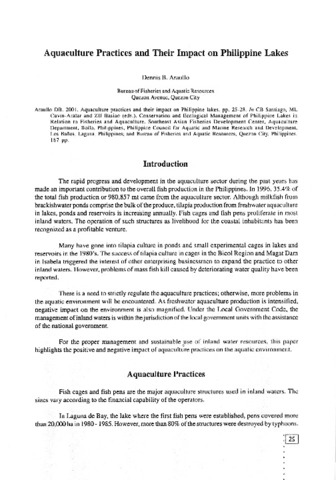
Aquaculture practices and their impact on Philippine Lakes
(Aquaculture Department, Southeast Asian Fisheries Development Center; Philippine Council for Aquatic and Marine Research and Development (PCAMRD), Department of Science and Technology; Bureau of Fisheries and Aquatic Resources, 2001)The rapid progress and development in the aquaculture sector during the past years has made an important contribution to the overall fish production in the Philippines. In 1996, 35.4% of the total fish production or 980,857 mt came from the aquaculture sector. Although milkfish from brackishwater ponds comprise the bulk of the produce, tilapia production from freshwater aquaculture in lakes, ponds and reservoirs is increasing annually. Fish cages and fish pens proliferate in most inland waters. The operation of such structures as livelihood for the coastal inhabitants has been recognized as a profitable venture. Many have gone into tilapia culture in ponds and small experimental cages in lakes and reservoirs in the 1980's. The success of tilapia culture in cages in the Bicol Region and Magat Dam in Isabela triggered the interest of other enterprising businessmen to expand the practice to other inland waters. However, problems of mass fish kill caused by deteriorating water quality have been reported. There is a need to strictly regulate the aquaculture practices; otherwise, more problems in the aquatic environment will be encountered. As freshwater aquaculture production is intensified, negative impact on the environment is also magnified. Under the Local Government Code, the management of inland waters is within the jurisdiction of the local government units with the assistance of the national government. For the proper management and sustainable use of inland water resources, this paper highlights the positive and negative impact of aquaculture practices on the aquatic environment. -
Series: Summary of Proceedings No. 1/2013;
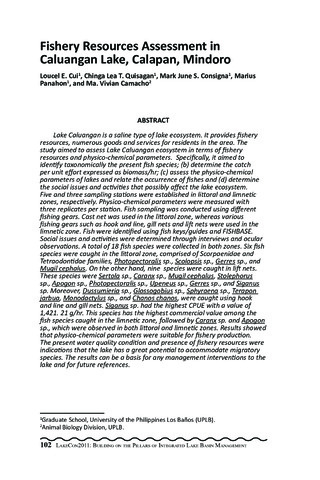
Fishery resources assessment in Caluangan Lake, Calapan, Mindoro
(PCAARRD-DOST, 2013)Lake Caluangan is a saline type of lake ecosystem. It provides fishery resources, numerous goods and services for residents in the area. The study aimed to assess Lake Caluangan ecosystem in terms of fishery resources and physico-chemical parameters. Specifically, it aimed to identify taxonomically the present fish species; (b) determine the catch per unit effort expressed as biomass/hr; (c) assess the physico-chemical parameters of lakes and relate the occurrence of fishes and (d) determine the social issues and activities that possibly affect the lake ecosystem. Five and three sampling stations were established in littoral and limnetic zones, respectively. Physico-chemical parameters were measured with three replicates per station. Fish sampling was conducted using different fishing gears. Cast net was used in the littoral zone, whereas various fishing gears such as hook and line, gill nets and lift nets were used in the limnetic zone. Fish were identified using fish keys/guides and FISHBASE. Social issues and activities were determined through interviews and ocular observations. A total of 18 fish species were collected in both zones. Six fish species were caught in the littoral zone, comprised of Scorpaenidae and Tetraodontidae families, Photopectoralis sp., Scolopsis sp., Gerres sp., and Mugil cephalus. On the other hand, nine species were caught in lift nets. These species were Sertola sp., Caranx sp., Mugil cephalus, Stolephorus sp., Apogon sp., Photopectoralis sp., Upeneus sp., Gerres sp., and Siganus sp. Moreover, Dussumieria sp., Glossogobius sp., Sphyraena sp., Terapon jarbua, Monodactylus sp., and Chanos chanos, were caught using hook and line and gill nets. Siganus sp. had the highest CPUE with a value of 1,421. 21 g/hr. This species has the highest commercial value among the fish species caught in the limnetic zone, followed by Caranx sp. and Apogon sp., which were observed in both littoral and limnetic zones. Results showed that physico-chemical parameters were suitable for fishery production. The present water quality condition and presence of fishery resources were indications that the lake has a great potential to accommodate migratory species. The results can be a basis for any management interventions to the lake and for future references.