Conference Proceedings: Recent submissions
141-160 / 767
-
Biology and status of aquaculture for giant clams (Tridacnidae) in the Ryukyu Islands, southern Japan
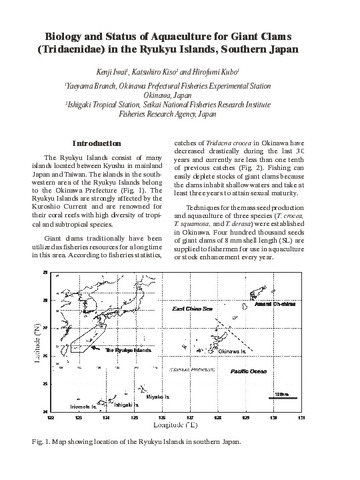
(Aquaculture Department, Southeast Asian Fisheries Development Center, 2006)The Ryukyu Islands consist of many islands located between Kyushu in mainland Japan and Taiwan. The islands in the south-western area of the Ryukyu Islands belong to the Okinawa Prefecture. The Ryukyu Islands are strongly affected by the Kuroshio Current and are renowned for their coral reefs with high diversity of tropical and subtropical species. Giant clams traditionally have been utilized as fisheries resources for a long time in this area. According to fisheries statistics, catches of Tridacna crocea in Okinawa have decreased drastically during the last 30 years and currently are less than one tenth of previous catches. Fishing can easily deplete stocks of giant clams because the clams inhabit shallow waters and take at least three years to attain sexual maturity. Techniques for the mass seed production and aquaculture of three species (T. crocea, T. squamosa, and T. derasa) were established in Okinawa. Four hundred thousand seeds of giant clams of 8 mm shell length (SL) are supplied to fishermen for use in aquaculture or stock enhancement every year. This paper will review the (1) biology of giant clams, (2) present status of aquaculture of giant clams in Okinawa, and (3) other studies on giant clams in southern Japan. -
Proceedings of the Regional Technical Consultation on Stock Enhancement for Threatened Species of International Concern, Iloilo City, Philippines, 13-15 July 2005
(Aquaculture Department, Southeast Asian Fisheries Development Center, 2006)This 150-page book documents the proceedings of an experts' consultation held at AQD in July 2005. It contains nine review papers and seven country papers. -
Status of the Mekong giant catfish, Pangasianodon gigas Chevey, 1930 stock enhancement program in Thailand
(Aquaculture Department, Southeast Asian Fisheries Development Center, 2006)The Mekong giant catfish (Pangasianodon gigas Chevey, 1930) is one of the largest freshwater fish in the world, measuring up to 3 m in length and weighing in excess of 300 kg. It is endemic to the Mekong River Basin area. It is found in Tonle Sap Lake, Tonle Sap River, and the Mekong River. It is not known to occur in the upper 2,000 km of the Mekong River. The current extent of occurrence is estimated at around 4,150 km. Historical reports indicate that the species was abundant in the early 1900s with 40-50 fish caught yearly in Nong Khai Province, north-east Thailand. However, since that time the number of fish caught has declined. This paper discusses several important information about Mekong Giant Catfish, such as rarity and size, natural food, natural spawning season and spawning grounds, and age and size at first maturity. Moreover, the breeding program and the stock enhancement activities of the Thai Department of Fisheries were also presented in the paper. -
An uncertain future for seahorse aquaculture in conservation and economic contexts
(Aquaculture Department, Southeast Asian Fisheries Development Center, 2006)Seahorses (family Syngnathidae, genus Hippocampus) have set precedents globally. They were among the first marine fishes of commercial importance to be listed on both the IUCN Red List and CITES Appendix II. Overfishing and non-selective fishing are two agents in their depletion, so management is clearly needed. We here outline what is known about these fishes and their trade, before considering the potential role the culture and release could play in rebuilding wild populations. -
Acclimatization and stocking of fry
(1974) -
Sugpo fry production at MSU-IFRD
(1974) -
Evaluation of the training program
(1974) -
Pond design and construction
(1974)