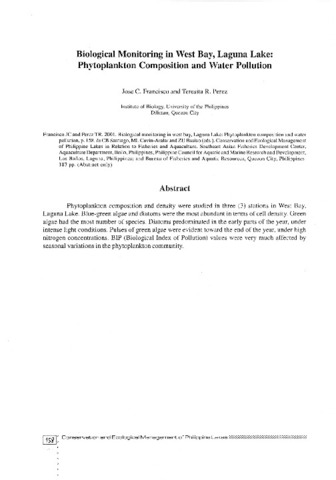
Biological monitoring in west bay, Laguna Lake: Phytoplankton composition and water pollution


Share
Abstract
Phytoplankton composition and density were studied in three (3) stations in West Bay, Laguna Lake. Blue-green algae and diatoms were the most abundant in terms of cell density. Green algae had the most number of species. Diatoms predominated in the early parts of the year, under intense light conditions. Pulses of green algae were evident toward the end of the year, under high nitrogen concentrations. BIP (Biological Index of Pollution) values were very much affected by seasonal variations in the phytoplankton community.
Description
Abstract only.
Suggested Citation
Francisco, J. C., & Perez, T. R. (2001). Biological monitoring in west bay, Laguna Lake: Phytoplankton composition and water pollution (Abstract only). In C. B. Santiago, M. L. Cuvin-Aralar, & Z. U. Basiao (Eds.), Conservation and Ecological Management of Philippine Lakes in Relation to Fisheries and Aquaculture (p. 158). Tigbauan, Iloilo, Philippines: Aquaculture Department, Southeast Asian Fisheries Development Center; Los Baños, Laguna, Philippines: Philippine Council for Aquatic and Marine Research and Development (PCAMRD), Department of Science and Technology; Quezon City, Philippines: Bureau of Fisheries and Aquatic Resources (BFAR), Department of Agriculture, Quezon City, Philippines.
Type
Conference paperISBN
9718511539Related items
Showing items related by title, author, creator and subject.
-
Water quality in Imbang river, Negros Occidental: effluents and pollutant loads from agriculture, sugar mills, households, and shrimp farms
(Bureau of Agricultural Research, Department of Agriculture, 2007)An ecological assessment of Imbang River in Negros Occidental was undertaken from December 1992 to February 1995. The effluents from sugar mills, households, shrimp farms, sugarcane plantations and rice fields were characterized and their pollutant loads estimated. Water quality and invertebrate assemblages were analyzed at several sites along the river to determine the environmental status. Results showed significant seasonal and site variations in water quality along Imbang River. The dry season, coinciding with the milling season, was the more critical time of the year as water quality tended to deteriorate. The segments of the river near the sugar mills and households had the poorest water quality. Sugar mill effluents had high water temperature (average 33oC but as high as 50oC), low dissolved oxygen, high total solids, the highest settleable solids (average 2.5 and as high as 17 m/l), and the highest biochemical oxygen demand (average 259 ppm but as high as 14,800 ppm BOD). Domestic effluents had low pH, high ammonia, very high BOD, plus detergents or surfactants and high levels of fecal coliform bacteria. Agricultural runoff had high nitrate, high total solids, and the highest total suspended solids (average 296 ppm but as high as 5,095 ppm TSS). Shrimp ponds used saline water of average 23 ppt, and had the highest total solids (average 23,456 ppm and as high as 57,400 ppm). By far the major contributor of pollutant loads into Imbang River was agriculture, due to its huge areal extent and huge volume of water use and run-off. Agricultural run-off carried the highest annual loads of 7,858 kg phosphate; 6,495 kg ammonia; 794 kg nitrite; 67,212 kg nitrate; 16,987 metric tons settleable solids; 16,800,000 mt total solids, and 11,890,000 mt total suspended solids; but only 297 mt BOD. Sugar mill effluents had the highest BOD load (1,583 mt/yr) and also had high nutrient loads. Household effluents contributed the second largest loads of solids next to agriculture, and also added surfactants (966 kg/yr) and fecal coliforms into the river. The six shrimp farms at the lower reaches of Imbang River were a minor contributor of pollutants into the river, annually adding about 891 kg ammonia; 1,077 kg phosphate; and 181,325 mt total solids. -
Mercury levels in the sediment, water, and selected finfishes of Laguna Lake, the Philippines
(Elsevier, 1990)Monthly samples of sediment, water and commercially important species of fish, primarily Oreochromis niloticus and Chanos chanos , plus a few other species, were collected from the West Bay area of Laguna Lake, The Philippines from January to December 1987. Mercury levels were determined in all samples by cold vapor atomic absorption spectrophotometry. Results showed that sediment samples contained mercury levels ranging from 26.7 to 117 ppb. Mercury levels in water samples were low, ranging from below detectable to 0.5670 ppb. The mercury levels in the water were negatively correlated with conductivity and dissolved oxygen and positively correlated with turbidity. The mercury burden of the fish species samples was below the maximum permissible level set by the WHO and USFDA of 0.05 ppm. No direct correlation was observed between mercury levels in sediment and water, water and fish and sediment and fish. -
Water quality assessment of the Langat River, Selangor, Malaysia using the natural algal periphyton community and laboratory bioassays of two Chlorella species
(Aquaculture Department, Southeast Asian Fisheries Development Center, 1990)The physico-chemical conditions in 10 sampling stations off the headwaters of the Langat River, Selangor, Malaysia were studied. Monitoring was done twice a month from June to December 1980. Changes in water quality were observed downstream. A total of 35 taxa of periphyton in four main divisions of algae were identified. The decrease in the number of species in downstream stations could be due to changes in the river rather than to chemical pollution. Two species of Chlorella , namely, C. pyrenoidosa and C. vulgaris , were grown in filtered river water obtained from the different sampling stations to assess their growth responses. Results suggest that pollution in the Langat River was caused mainly by heavy siltation rather than chemical pollutants.