A review of mangrove rehabilitation in the Philippines: successes, failures and future prospects

ดู/
วันที่
2008ผู้เขียน
Page views
9,495ASFA keyword

AGROVOC keyword
Taxonomic term

เมตาดาต้า
แสดงระเบียนรายการเต็มShare
นามธรรม
From half a million hectares at the turn of the century, Philippine mangroves have declined to only 120,000 ha while fish/shrimp culture ponds have increased to 232,000 ha. Mangrove replanting programs have thus been popular, from community initiatives (1930s-1950s) to government-sponsored projects (1970s) to large-scale international development assistance programs (1980s to present). Planting costs escalated from less than US$100 to over $500/ha, with half of the latter amount allocated to administration, supervision and project management. Despite heavy funds for massive rehabilitation of mangrove forests over the last two decades, the long-term survival rates of mangroves are generally low at 10-20%. Poor survival can be mainly traced to two factors: inappropriate species and sites selection. The favored but unsuitable Rhizophora are planted in sandy substrates of exposed coastlines instead of the natural colonizers Avicennia and Sonneratia. More significantly, planting sites are generally in the lower intertidal to subtidal zones where mangroves do not thrive rather than the optimal middle to upper intertidal levels, for a simple reason. Such ideal sites have long been converted to brackishwater fishponds whereas the former are open access areas with no ownership problems. The issue of pond ownership may be complex and difficult, but such should not outweigh ecological requirements: mangroves should be planted where fishponds are, not on seagrass beds and tidal flats where they never existed. This paper reviews eight mangrove initiatives in the Philippines and evaluates the biophysical and institutional factors behind success or failure. The authors recommend specific protocols (among them pushing for a 4:1 mangrove to pond ratio recommended for a healthy ecosystem) and wider policy directions to make mangrove rehabilitation in the country more effective.
Description
SEAFDEC main author. CC covered journal. Open Access Journal. Full text available.
การอ้างอิง
Primavera, J., & Esteban, J. M. A. (2008). A review of mangrove rehabilitation in the Philippines: successes, failures and future prospects. Wetlands Ecology and Management , 16(5), 345-358. https://doi.org/10.1007/s11273-008-9101-y
Type
ArticleISSN
0923-4861คอลเลกชัน
- Journal Articles [1266]
Related items
Showing items related by title, author, creator and subject.
-
Mangroves as nurseries: Shrimp populations in mangrove and non-mangrove habitats
(Elsevier, 1998)A total of 4845 penaeids belonging to nine species—Metapenaeus anchistus, M. ensis, M. moyebi, M. philippinensis, Penaeus merguiensis, P. monodon, P. semisulcatus, P. latisulcatus and Metapenaeopsis palmensis—were collected by pocket seine monthly over 13 months from mangrove and non-mangrove sites in Guimaras, Philippines. The restricted distribution of the three dominant species—M. ensisandP. merguiensisto the brackish water riverine mangrove, andM. anchistusto the high-salinity island mangrove and tidal flat—is probably related to different salinity and substrate preferences. Abundance and size composition of the major species suggest a strong nursery role for the riverine mangrove (high juvenile densities, relatively small sizes year-round), limited nursery use of the island mangrove (fewer shrimps, larger size ranges, presence of maturing females) and a non-nursery use (e.g. foraging) in the tidal flat. Penaeid recruitment to the river had two peaks in November and May when the average salinity was ∼20 (Practical Salinity Scale) and water temperatures were high (30–31 °C). The spatio-temporal pattern of penaeid species in Guimaras shows partitioning across habitats and seasonal recruitment influenced by physical and biological factors. -
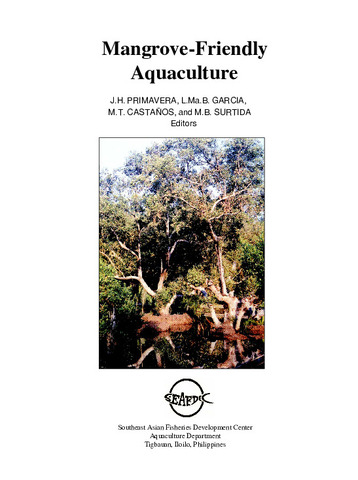
Mangrove-Friendly Aquaculture : Proceedings of the Workshop on Mangrove-Friendly Aquaculture organized by the SEAFDEC Aquaculture Department, January 11-15, 1999, Iloilo City, Philippines
(Aquaculture Department, Southeast Asian Fisheries Development Center, 2000)The proceedings have three review papers on the mangroves of Southeast Asia, silvofisheries, and Indonesia's integrated mangrove forest and aquaculture systems. The rest of the papers, all on mangrove-friendly aquaculture efforts are from the Philippines, Japan, Thailand, Vietnam, Malaysia, Brunei Darussalam, Indonesia, and Cambodia. All the countries represented had varied methodologies, with Cambodia in its initial stages while some countries like Indonesia and Thailand have tested methodologies. The proceedings include a tabulation of the reported mangrove-friendly technology by country -- e.g. silvofisheries in ponds (mangrove and fish/shrimp/mudcrab) and pens (mangrove and mudcrab). The workshop recommendations are classified into three major topics: problems associated with mangroves, problems associated with aquaculture practices, and socioeconomic and cultural issues. -
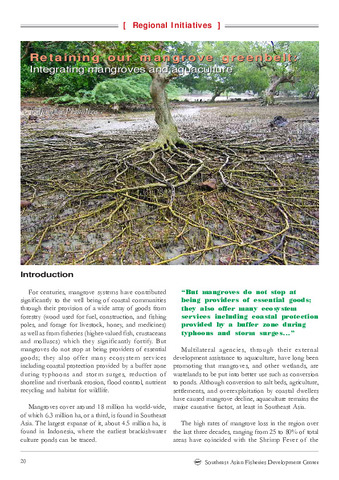
Retaining our mangrove greenbelt: Integrating mangroves and aquaculture
Primavera, Jurgenne (Secretariat, Southeast Asian Fisheries Development Center, 2004)
Although multilateral agencies in Southeast Asia have long been promoting that mangroves, and other wetlands, are wastelands to be put into better use, such as conversion to ponds. However, there is a need for Mangrove Friendly Aquaculture (MFA) technology in the intertidal forest, or swamp, which does not require the clearing of trees. MFA may be defined on 2 levels: 1) silvofisheries or aquasilviculture, where the low density culture of crabs, shrimps and fish is integrated with mangroves; and, 2) mangrove filters where mangrove forests are used to absorb the excess nutrients in the effluents from high-density culture ponds. A review is made of MFA practices belonging to the first category. Discussion is on a country basis, moving from traditional systems in Indonesia, to the introduced technologies in Indonesia, Vietnam, the Philippines and Malaysia. It is hoped that this review will be of use to scientists, aquaculturists, policy makers and governmental/NGOs interested in making aquaculture more ecologically sound and socially responsible.
(Secretariat, Southeast Asian Fisheries Development Center, 2004)
Although multilateral agencies in Southeast Asia have long been promoting that mangroves, and other wetlands, are wastelands to be put into better use, such as conversion to ponds. However, there is a need for Mangrove Friendly Aquaculture (MFA) technology in the intertidal forest, or swamp, which does not require the clearing of trees. MFA may be defined on 2 levels: 1) silvofisheries or aquasilviculture, where the low density culture of crabs, shrimps and fish is integrated with mangroves; and, 2) mangrove filters where mangrove forests are used to absorb the excess nutrients in the effluents from high-density culture ponds. A review is made of MFA practices belonging to the first category. Discussion is on a country basis, moving from traditional systems in Indonesia, to the introduced technologies in Indonesia, Vietnam, the Philippines and Malaysia. It is hoped that this review will be of use to scientists, aquaculturists, policy makers and governmental/NGOs interested in making aquaculture more ecologically sound and socially responsible.