Mapping gendered spaces for sandfish resource management in Guimaras, Philippines


Share
Abstract
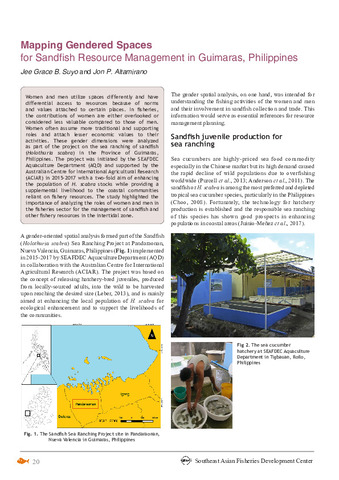
Women and men utilize spaces differently and have differential access to resources because of norms and values attached to certain places. In fisheries, the contributions of women are either overlooked or considered less valuable compared to those of men. Women often assume more traditional and supporting roles and attach lesser economic values to their activities. These gender dimensions were analyzed as part of the project on the sea ranching of sandfish (Holothuria scabra) in the Province of Guimaras, Philippines. The project was initiated by the SEAFDEC Aquaculture Department (AQD) and supported by the Australian Centre for International Agricultural Research (ACIAR) in 2015-2017 with a two-fold aim of enhancing the population of H. scabra stocks while providing a supplemental livelihood to the coastal communities reliant on fishery resources. The study highlighted the importance of analyzing the roles of women and men in the fisheries sector for the management of sandfish and other fishery resources in the intertidal zone.
Suggested Citation
Suyo, J. G. B., & Altamirano, J. P. (2018). Mapping gendered spaces for sandfish resource management in Guimaras, Philippines. Fish for the People , 16(2), 20-25. http://hdl.handle.net/20.500.12066/1380
Type
magazineArticleISSN
1685-6546Koleksi
- Fish for the People [41]
Related items
Showing items related by title, author, creator and subject.
-
Organization and development of stock enhancement in Japan
(Aquaculture Department, Southeast Asian Fisheries Development Center, 2006)In the 1960s, the Japanese economy was starting to industrialize. The rapid increase in business investment in new factories and equipment stimulated a yearly economic growth rate of approximately 12% (METI 1970). However, these developments have disrupted coastal landscapes through land reclamation and industrial effluents (Fishery Agency 1980a). Furthermore, overfishing has accelerated with increased consumer spending and demand for fish protein. Consequently, coastal fish resources such as red sea bream (Pagrus major), kuruma prawn (Marsupenaeus japonicus) and swimming crab (Portunus trituberculatus) have been depleted and income of coastal fisherfolk has decreased (Fishery Agency, 1980). Under such conditions, the Japanese government initiated the Stock Enhancement Program in 1963 (Fishery Agency, 1980; Imamura, 1999). The program initially targeted red sea bream and kuruma prawn in the Seto Inland Sea in southern Japan which covers almost 3,000 islands (Imamura, 1999). Because the fundamental concept of stock enhancement programs was to compensate juvenile loss caused by high larval mortality in the ocean, development of mass juvenile production techniques was emphasized (Fishery Agency 1980a; Matsuoka, 1989). Therefore, the release of juveniles became a typical form of stock enhancement in Japan. The current number of target species for stock enhancement has increased to almost 80 species. Stock enhancement is undertaken by both the national government and local governments together with conservation of fishing ground and regulation of fish catches for resource management (Resource Association 1983a; Imamura 1999; Fishery Agency 2000; JASFA 2003a). This article reports the present status of stock enhancement in Japan from the organizational and technical viewpoints. -
Thailand's concerns in endangered species and stock enhancement
(Aquaculture Department, Southeast Asian Fisheries Development Center, 2006)The paper provides a comprehensive list of endangered freshwater, brackishwater, and marine aquatic species in Thailand. The Thai Department of Fisheries is breeding some of the endangered species under the “Rehabilitation of Thai Local Fishes and Aquatic Animals Project.” Some of these species are bred for restocking in the wild. -
Endangered fish species and seed release strategies in Vietnam
(Aquaculture Department, Southeast Asian Fisheries Development Center, 2006)World economic growth has led to considerable changes in the ecosystem in many places and has raised concerns on global resource management particularly aquatic animal resources and their living environment. In Vietnam, aquatic animal resources play an important role in the national economy and are one of the targets for economic development. However, under high population pressure, high demand for seafood has resulted in unfavorable living environment. Aquatic animal resource has been over-exploited and in some places reported to be declining; hence some species have become extinct or endangered. This paper provides a list some endangered freshwater, brackishwater, and marine species. Moreover, the seed production activities and the release strategies for resource conservation of the government of Vietnam are also presented.