SEAFDEC/AQD Institutional Repository: Recent submissions
Now showing items 1321-1340 of 4221
-
Acute hepatopancreatic necrosis disease (AHPND) outbreaks in Penaeus vannamei and P. monodon cultured in the Philippines
; ; ; Amar, Edgar C. ; ; ; ; ; (Inter Research, 2015)
Acute hepatopancreatic necrosis disease (AHPND) has recently emerged as a serious disease of cultured shrimp. It has also been described as early mortality syndrome (EMS) due to mass mortalities occurring within 20 to 30 d after stocking of ponds with postlarvae. Here, Penaeus vannamei and Penaeus monodon from shrimp farms in the Philippines were examined for the toxin-producing strain of Vibrio parahaemolyticus due to AHPND-like symptoms occurring in marketable size shrimp. In the P. vannamei, histology revealed typical AHPND pathology, such as sloughing of undifferentiated cells in the hepatopancreatic tubule epithelium. Analysis using the IQ2000 AHPND/EMS Toxin 1 PCR test generated 218 bp and 432 bp amplicons confirmative of the toxin-producing strain of V. parahaemolyticus among shrimp sampled from 8 of 9 ponds. In the P. monodon, histology revealed massive sloughing of undifferentiated cells of the hepatopancreatic tubule epithelium in the absence of basophilic bacterial cells. PCR testing generated the 2 amplicons confirmatory for AHPND among shrimp sampled from 5 of 7 ponds. This study confirms the presence of AHPND in P. vannamei and P. monodon farmed in the Philippines and suggests that the disease can also impact late-stage juvenile shrimp.
; ; ; ; ; (Inter Research, 2015)
Acute hepatopancreatic necrosis disease (AHPND) has recently emerged as a serious disease of cultured shrimp. It has also been described as early mortality syndrome (EMS) due to mass mortalities occurring within 20 to 30 d after stocking of ponds with postlarvae. Here, Penaeus vannamei and Penaeus monodon from shrimp farms in the Philippines were examined for the toxin-producing strain of Vibrio parahaemolyticus due to AHPND-like symptoms occurring in marketable size shrimp. In the P. vannamei, histology revealed typical AHPND pathology, such as sloughing of undifferentiated cells in the hepatopancreatic tubule epithelium. Analysis using the IQ2000 AHPND/EMS Toxin 1 PCR test generated 218 bp and 432 bp amplicons confirmative of the toxin-producing strain of V. parahaemolyticus among shrimp sampled from 8 of 9 ponds. In the P. monodon, histology revealed massive sloughing of undifferentiated cells of the hepatopancreatic tubule epithelium in the absence of basophilic bacterial cells. PCR testing generated the 2 amplicons confirmatory for AHPND among shrimp sampled from 5 of 7 ponds. This study confirms the presence of AHPND in P. vannamei and P. monodon farmed in the Philippines and suggests that the disease can also impact late-stage juvenile shrimp. -
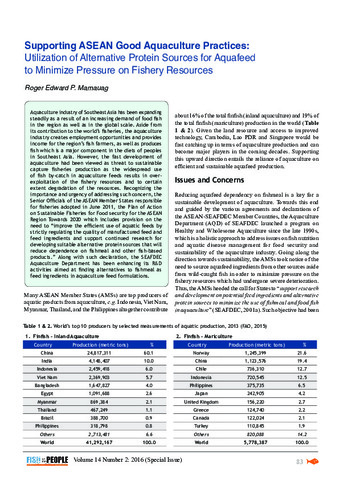
Supporting ASEAN good aquaculture practices: Utilization of alternative protein sources for aquafeed to minimize pressure on fishery resources
Mamauag, Roger Edward (Secretariat, Southeast Asian Fisheries Development Center, 2016)
Aquaculture industry of Southeast Asia has been expanding steadily as a result of an increasing demand of food fish in the region as well as in the global scale. Aside from its contribution to the world’s fisheries, the aquaculture industry creates employment opportunities and provides income for the region’s fish farmers, as well as produces fish which is a major component in the diets of peoples in Southeast Asia. However, the fast development of aquaculture had been viewed as threat to sustainable capture fisheries production as the widespread use of fish by-catch in aquaculture feeds results in overexploitation of the fishery resources and to certain extent degradation of the resources. Recognizing the importance and urgency of addressing such concern, the Senior Officials of the ASEAN Member States responsible for fisheries adopted in June 2011, the Plan of Action on Sustainable Fisheries for Food security for the ASEAN Region Towards 2020 which includes provision on the need to “improve the efficient use of aquatic feeds by strictly regulating the quality of manufactured feed and feed ingredients and support continued research for developing suitable alternative protein sources that will reduce dependence on fishmeal and other fish-based products.” Along with such declaration, the SEAFDEC Aquaculture Department has been enhancing its R&D activities aimed at finding alternatives to fishmeal as feed ingredients in aquaculture feed formulations. -
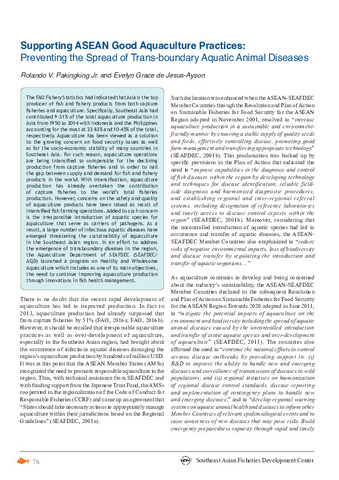
Supporting ASEAN good aquaculture practices: Preventing the spread of trans-boundary aquatic animal diseases
Pakingking, Rolando V., Jr.; (Secretariat, Southeast Asian Fisheries Development Center, 2016)
The FAO Fishery Statistics had indicated that Asia is the top producer of fish and fishery products from both capture fisheries and aquaculture. Specifically, Southeast Asia had contributed 9-31% of the total aquaculture production in Asia from 1950 to 2014 with Indonesia and the Philippines accounting for the most at 23-63% and 10-45% of the total, respectively. Aquaculture has been viewed as a solution to the growing concern on food security issues as well as for the socio-economic stability of many countries in Southeast Asia. For such reason, aquaculture operations are being intensified to compensate for the declining production from capture fisheries and in order to nail the gap between supply and demand for fish and fishery products in the world. With intensification, aquaculture production has already overtaken the contribution of capture fisheries to the world’s total fisheries production. However, concerns on the safety and quality of aquaculture products have been raised as result of intensified fish farming operations. Added to such concern is the irresponsible introduction of aquatic species for aquaculture that serve as carriers of pathogens. As a result, a large number of infectious aquatic diseases have emerged threatening the sustainability of aquaculture in the Southeast Asian region. In an effort to address the emergence of transboundary diseases in the region, the Aquaculture Department of SEAFDEC (SEAFDEC/AQD) launched a program on Healthy and Wholesome Aquaculture which includes as one of its main objectives, the need to continue improving aquaculture production through innovations in fish health management. -
Philippine National Standard: Live, chilled/frozen grouper
(Bureau of Agriculture and Fisheries Standards, 2009)This Philippine National Standard for live, chilled/frozen grouper identifies the Philippine species of grouper, specifies their essential composition and quality factors (including size classification and quality characteristics), provides the presentation, packaging and labeling requirements, indicates the methods sampling, examination and analyses, and defines the types of defectives. It is hoped that this standard accomplishes our two pronged goal of protecting consumer health and making the Philippine fish and fishery products globally competitive. -
Photosynthetic responses of ‘Neosiphonia sp. epiphyte-infected’ and healthy Kappaphycus alvarezii (Rhodophyta) to irradiance, salinity and pH variations
(Springer Verlag, 2016)Understanding the physiological condition of seaweeds as influenced by biotic and abiotic stress is vital from the perspective of massive expansion and sustainability of seaweed-based industries. The photosynthetic responses ofNeosiphonia sp. epiphyte-infected (INF) and healthy (HEA) Kappaphycus alvarezii under various combinations of irradiance, salinity and pH were studied using photosynthesis-irradiance (P-E) curves. Measurements of algal photosynthetic rates, expressed in terms of amount of oxygen production per fresh weight biomass per unit time (mg O2 g−1 FW h−1), were carried out using the light-dark bottle technique. Neosiphonia-infected K. alvarezii (INF) had lower photosynthetic rates than healthy ones (HEA). Similarities (p > 0.05) in light-saturated photosynthesis rates (Pmax) and significant differences (p < 0.05) in initial slope of curve (α) between INF and HEAK. alvarezii suggest that both samples are adapted to similar light conditions and differs only on photosynthetic efficiency. Low Pmax (0.7–2.0 mg O2 g−1 FW h−1) and high initial saturation irradiances (Ek = 90–519 μmol photons m−2 s−1) of INF seaweeds resulted to their low photosynthetic efficiency (α = 0.002–0.010). Such decline in α is attributed to the epiphyte, as Neosiphonia sp. covered almost the entire surface of K. alvarezii. An increase in chlorophyll-a (35–42.1 vs. 27.7–31.5 μg g−1 FW, HEA) and phycobilin (1.96–2.39 vs. 1.16–1.58 mg g−1 FW, HEA) contents was also observed in INF samples, suggesting acclimation to low-irradiance conditions, as a result of competition for light between the epiphyte and host. Both INF and HEA K. alvarezii also exhibited broad photosynthetic tolerance to short-term changes in irradiance, with no photoinhibition at the highest irradiance of 850 μmol photons m−2 s−1. K. alvarezii had a euryhaline photosynthetic response, with optimum salinity of 35 psu. Photosynthetic rates increased with decreasing pH, revealing K. alvarezii’s ability to modify its photosynthetic affinity for acidic seawater conditions; yet, their underlying mechanism of response to pH shifts still need to be further examined. -
Growth and feed performance, digestibility and acute stress response of juvenile grouper (Epinephelus fuscoguttatus) fed diets with hydrolysate from milkfish offal
Mamauag, Roger Edward; (Wiley, 2017)
Nutritional qualities of fish processing by-products can further be improved through enzymatic hydrolysis. The objective of this study was to elucidate the efficacy of hydrolysed milkfish offal at different inclusion levels when fed to juvenile grouper, Epinephelus fuscoguttatus, with an initial body weight of 2.88 ± 0.06 g. The animals were fed for 56 days with seven diets supplemented with 0 (control), 5%, 15% and 25% of milkfish offal (MO) and milkfish offal hydrolysate (MOH). The diets were formulated to be isonitrogenous (45%) and isolipidic (11%). The diets were assigned to 21 tanks (15 fish per tank) with each diet having three replicates. Results from the experimental trials indicated that feed conversion efficiency, feed intake and weight gain of fish significantly (P < 0.05) improved when fed diets with MOH. No significant differences within the rest of the dietary treatments were observed. Survival rate (>90%) did not differ in all the dietary treatments. Proximate composition (crude protein, crude fat and ash) indicated no significant difference among fish fed from all the dietary treatments. Apparent digestibility of MOH indicated a 95% and 66% digestibility for protein and dry matter respectively. Plasma stress parameters (cortisol and glucose) were not influenced by the dietary treatment when fish were subjected to an acute stressor (5-min chasing). Liver morphology indicated normal hepatocyte shape and the presence of lipid droplets in fish fed from all the dietary treatments. The results indicated that milkfish offal processed as hydrolysate can be utilized in grouper diets and can promote growth and feed efficiency when supplied at 10–15%. -
Use of thraustochytrid Schizochytrium sp. as source of lipid and fatty acid in a formulated diet for abalone Haliotis asinina (Linnaeus) juveniles
(Springer Verlag, 2016)The effects of using thraustochytrid Schizochytrium sp. as source of lipid and fatty acids in a formulated diet on growth, survival, body composition, and salinity tolerance of juvenile donkey’s ear abalone, Haliotis asinina, were investigated. Treatments consisted of diets either containing a 1:1 ratio of cod liver oil (CLO) and soybean oil (SBO) (Diet 1) or thraustochytrid (Diet 2) as source of lipid and fatty acids at 2 % level. Natural diet Gracilariopsis heteroclada (Diet 3) served as the control. No significant difference in growth was observed in abalone fed Diet 3 (SGR: 5.3 % BW day−1; DISL: 265 μm day−1) and Diet 2 (SGR: 5.2 % BW day−1; DISL: 255 μm day−1). Survival ranged from 78 to 85 % for all treatments and was not significantly different from each other. A 96-h salinity stress test showed highest survival of 84 % in abalone fed Diet 2 compared with those fed diets 1 and 3 (42 %). The high growth rate of abalone fed Diet 2 and high tolerance to low salinity could be attributed to its high DHA content (8.9 %), which resulted to its high DHA/EPA ratio of 10.5 %. These fatty acids play a significant role in abalone nutrition. The fatty acid profile of abalone meat is a reflective of the fatty acid profile of the oil sources in the diet. The present study suggests that the use of Schizochytrium oil in lieu of CLO and SBO can support good growth of abalone which is comparable with abalone fed the natural seaweeds diet. -
Survival and settlement rates of Haliotis asinina larvae at different salinity levels
(IAMURE Multidisciplinary Research, 2013)The study was conducted to determine the optimum salinity levels (24 ppt, 28 ppt, 32 ppt, 36 ppt and 40 ppt) for the survival and settlement rates of H. asinina in a complete randomized design with three replicates each. The experimental animals were reared in 15 glass aquaria for the first run and in plexiglass for the second run. Feeding of Navicula spp. was done once a day. Temperature and dissolved oxygen were monitored throughout the experiment. Data were analyzed using One-Way ANOVA to determine significant difference among treatments at 0.05 level of significance using Social Package for Social Science. Result of the first run showed that 32 ppt had the highest mean survival (1.50%) and mean settlement rate (1.84%). Similar result was also observed in 32 ppt with highest mean survival (9.72%) and mean settlement rate (16.42%). Significant difference existed among treatments during the second run of the experiment. Results showed that 28 ppt and 32 ppt were the optimum salinity levels for survival and settlement rate of H. asinina. Further study should be conducted to determine the tolerance and settlement rates of H. asinina larvae to lower salinities until it reaches juvenile stage with first respiratory pore appearing. -
Philippine National Standard: Dried anchovies
(Bureau of Agriculture and Fisheries Standards, 2016)This PNS for dried anchovies aims to provide a common understanding on the scope of the standard, product description, process description, essential composition and quality factors, food additives, contaminants, hygiene and handling, packaging and labeling, methods of sampling, examination and analysis, definition of defectives and lot acceptance. -
Philippine National Standard: Pasteurized crab meat
(Bureau of Agriculture and Fisheries Standards, 2016)This PNS for pasteurized crab meat aims to provide a common understanding on the scope of the standard, product description, process description, essential composition and quality factors, food additives, contaminants, hygiene and handling, packaging and labeling, methods of sampling, examination and analysis, definition of defectives and lot acceptance. -
Philippine National Standard: Live mangrove crab
(Bureau of Agriculture and Fisheries Standards, 2016)This PNS for live mangrove crab aims to provide a common understanding on the scope of the standard, product description, process description, essential composition and quality factors, food additives, contaminants, hygiene and handling, packaging and labeling, methods of sampling, examination and analysis, definition of defectives and lot acceptance. -
Seaweed production: Farming Kappaphycus in the Philippines
(Global Aquaculture Alliance, 2002) -
Tropical abalone culture in Philippines
(Global Aquaculture Alliance, 2001) -
DNA markers help manage Nile tilapia stocks
Eguia, Maria Rowena R.; (Global Aquaculture Alliance, 2006)
Determining changes in the genetic diversity of selected hatchery stocks through DNA-level polymorphisms analysis provides aquaculturists with a means to monitor inbreeding, control loss of genetic diversity, and achieve sustainable levels of genetic gain in the development of improved stocks. Tests with selected and domesticated tilapia stocks in the Philippines revealed variability between marker system results. -
Sandfish: Profitable sea cucumbers also supply bioremediation
(Global Aquaculture Alliance, 2011)Sandfish, a type of sea cucumber, are both a high-value culture species and one that supports the aquaculture of other fish species by cleaning up waste on the bottoms of ponds or sea cages. Hatchery and nursery technologies for sandfish are being continuously refined by Vietnam’s Research Institute of Aquaculture No. 3, the Southeast Asian Fisheries Development Center and their partners. These technologies have also been initially transferred to the private sector through a training course and manual. -
Environmental control of annual reproductive cycle and spawning rhythmicity of spinefoots
(Graduate School of Kuroshio Science, Kochi University, 2015)Many teleost fishes inhabiting shallow tropical waters exhibit synchronous spawning around species-selective lunar phases during their spawning season. For example, ovaries of the goldlined spinefoot (Siganus guttatus) develop during a single period each year from June to July in the Ryukyu Islands, Japan, while those of the goldlined spinefoot in the Karimunjawa Archipelago, Indonesia, develop twice a year from March to May, and then again from September to November. Increases in photoperiod and water temperature are possible cues for the initiation of reproductive activity in the populations around the Ryukyu Islands, while the transition between the rainy and dry season may trigger the initiation of reproductive activity in the Karimunjawa Archipelago populations. Moreover, the goldlined spinefoot releases its gametes around the first quarter moon period of the lunar phase, and since the lunar phase is consistent within the Indo-Pacific Ocean, this species can likely perceive cues from the moon and transcribe them as internal signals. In fact, periodical changes in moonlight intensity are expressed as changes in the plasma levels of melatonin, an endogenous transmitter of environmental light/dark cycles. In addition, the mRNA expression levels of clock genes of neural tissues [Cryptochrome (Cry3) and Period (Per2)] change according to changes in the lunar cycle. To date, how the lunar cycle may affect endogenous reproductive processes in fish is not fully understood. However, knowledge of lunar spawning periodicity in commercially important species may help in the management of fisheries resources, determining where and when to prohibit fishing (e.g., time and area closures), as well as promoting efficient aquaculture techniques for inducing synchronous spawning. -
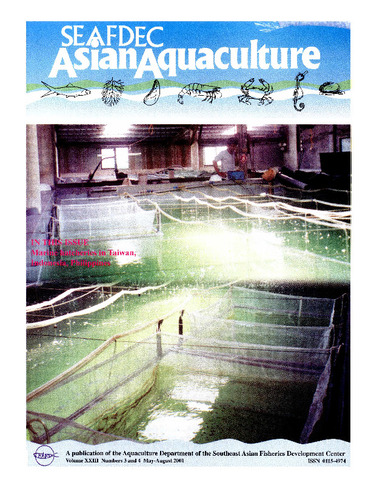
SEAFDEC Asian Aquaculture Volume 23(3-4) May-August 2001
(Aquaculture Department, Southeast Asian Fisheries Development Center, 2001)In this issue: marine hatcheries in Taiwan, Indonesia, Philippines. -
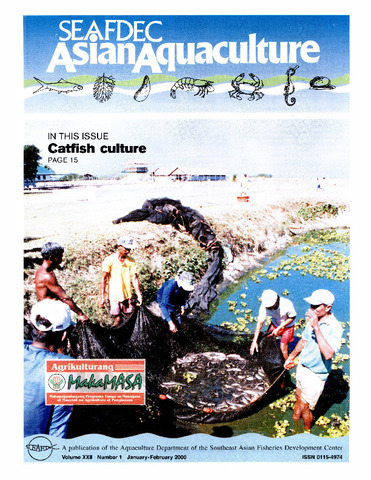
SEAFDEC Asian Aquaculture Volume 22(1) January - February 2000
(Aquaculture Department, Southeast Asian Fisheries Development Center, 2000)In this issue: Catfish culture -
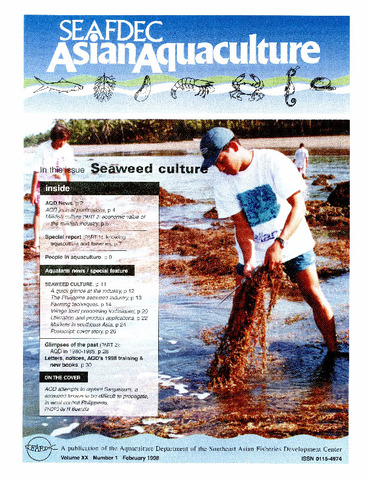
SEAFDEC Asian Aquaculture Volume 20(1) February 1998
(Aquaculture Department, Southeast Asian Fisheries Development Center, 1998)In this issue: Seaweed culture -
Series: Aquaculture extension manual; No. 63
Seed production of milkfish Chanos chanos Forsskal
(Aquaculture Department, Southeast Asian Fisheries Development Center, 2016)A 26-page manual describing the site selection, hatchery design, spawning, larval rearing, natural food production, and economic analysis for milkfish.