SEAFDEC/AQD Institutional Repository: Recent submissions
1341-1360 / 4221
-
Series: Aquaculture extension manual; No. 62
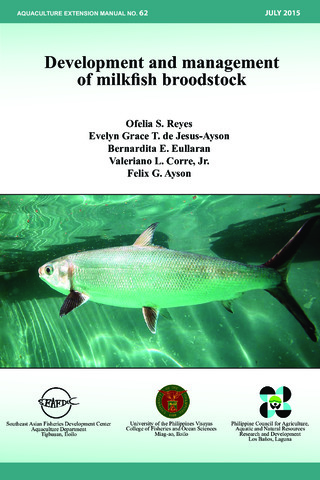
Development and management of milkfish broodstock
(Aquaculture Department, Southeast Asian Fisheries Development Center, 2015)The manual provides developed and refined techniques for collection and transport of spawned eggs and larvae, as well as larval rearing. It also describes the necessary facilities for maintaining milkfish broodstock. Guidelines on transporting broodstock, performing biopsy to determine sex of spawners, collecting and cleaning eggs, packing and transporting eggs to hatchery, incubating and hatching eggs, and packing and transporting of larvae are also provided in the manual. The importance of nutritional quality of the diet in relation to the performance of the milkfish broodstock and quality of resulting eggs and larvae is also explained in the manual. Broodstock feeds are enriched with vitamin C, beta-carotene, and other nutrients for better reproductive performance of broodstock and better egg and larval quality. It also offers formula to initially estimate the number of spawned eggs and determine the hatching rate. The manual guides stakeholders and operators who are interested in setting up breeding facilities for milkfish. -
Series: Aquaculture extension manual; No. 22
Pag-aalaga ng tilapya
; Eguia, Maria Rowena R. (Aquaculture Department, Southeast Asian Fisheries Development Center, 2007)
The manual discusses tilapia culture methods in concrete tanks, netcages, and fishponds. It details the species of tilapia cultured in the Philippines, which include Oreochromis nilotucus, O.mossambicus, O.aureus. It covers the following: site selection; construction of netcages and its modules; fishpond construction and pond preparation; criteria for fry selection; stocking; netcage and pond management including water quality management; and harvest. The manual also lists the agencies involved in tilapia research and development in the Philippines; defines some technical terms in a glossary, and lists some useful references.
(Aquaculture Department, Southeast Asian Fisheries Development Center, 2007)
The manual discusses tilapia culture methods in concrete tanks, netcages, and fishponds. It details the species of tilapia cultured in the Philippines, which include Oreochromis nilotucus, O.mossambicus, O.aureus. It covers the following: site selection; construction of netcages and its modules; fishpond construction and pond preparation; criteria for fry selection; stocking; netcage and pond management including water quality management; and harvest. The manual also lists the agencies involved in tilapia research and development in the Philippines; defines some technical terms in a glossary, and lists some useful references. -
Series: Aquaculture extension manual; No. 61
Soft-shell crab production using hatchery-reared mud crab
(Aquaculture Department, Southeast Asian Fisheries Development Center; Philippine Council for Agriculture, Aquatic and Natural Resources Research and Development (PCAARRD), 2015)"The production of soft-shell crabs is well established in other Asian countries but its sustainability is already being threatened due to the decreasing mud crab population in the wild where the seedstocks are sourced. In the Philippines, production of soft-shell crabs has only been practiced recently due to lack of seedstock and technology. Sourcing of crablets from the natural environment is not encouraged due to dwindling populations of all sizes of mud crabs. Instead, it is recommended that crablets for soft-shell crab production come from hatcheries. The project on soft-shell mud crab production at SEAFDEC/AQD started in 2012 and was later funded by the Philippine Council for Agriculture, Aquatic and Natural Resources Research and Development of the Department of Science and Technology. The project is adopting the individual crab culture sytem of Thailand and Myanmar in pilot-scale and uses hatchery-reared crablets grown to 60-100 g in earthen ponds and stocked in trays. The pilotscale soft-shell production set-up is showcased at the Dumangas Brackishwater Station of SEAFDEC/AQD using crab boxes available in the country. Various sectors are interested to learn how soft-shell crabs are produced. Hence, the previous manual on Soft-shell Mud Crab Farming by Emilia T. Quinitio and May Myat Noe Lwin published in 2009 was revised to include the recent refinements using hatchery-reared crabs and locally available materials. This manual includes sections on the biology of mud crab, how to set-up the facility, management of soft-shell crab production and the cost and return analysis. We hope that various sectors will benefit from this revised manual" -- Foreword -
Field guide to mangrove identification and community structure analysis
Lebata-Ramos, Ma. Junemie Hazel (Aquaculture Department, Southeast Asian Fisheries Development Center, 2013)
The mangrove field guide is a 32-page field guide with a one page introduction on mangroves, followed by a key to mangrove genera and species (with colored pictures of the whole plant and plant parts), then a definition of important terms used in the key, species code for use during mangrove community structure, instructions on how to conduct mangrove community structure analysis plus the formulas for the different indices (relative density, dominance, frequency; importance value and species diversity) and a sample data sheet. The guide, measuring 9 cm x 14 cm, is printed on PVC material hence it can get wet, soaked or be left in the water for days. -
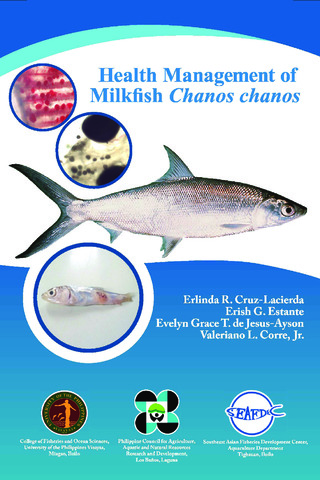
Health management of milkfish Chanos chanos
(Aquaculture Department, Southeast Asian Fisheries Development Center, 2015-06)This monograph provides updated information on diseases of marine and brackishwater cultured milkfish in the Philippines. The information presented here is largely based on the results of a three-year research project on milkfish at the University of the Philippines Visayas funded by the Department of Science and Technology (DOST). The project involved surveillance and monitoring of hatchery, nursery and grow-out operations for occurrence of diseases as well as on disease diagnosis, prevention and control. Previously documented reports in the Philippines and in other documents, both published and unpublished, are also included in this monograph. The diseases are discussed on a culture phase basis, that is, disease problems encountered in hatchery-reared larvae and fry are listed first, followed by diseases observed in fingerlings and juveniles grown in nursery and grow-out culture areas, and adult stages maintained in broodstock facilities. Information regarding the causative agent, diagnostic procedures, and methods of prevention and control for each disease are provided, if available. -
Handbook of mangroves in the Philippines - Panay
Primavera, Jurgenne; Sadaba, Resurreccion ; Lebata, Ma. Junemie Hazel L. ; Altamirano, Jon (Aquaculture Department, Southeast Asian Fisheries Development Center, 2004)
A 106-page guide is a user-friendly presentation of technical botanical description and illustrations of Philippine mangrove species in Panay Island, Guimaras and Aurora Province. Vegetative and reproductive structures of 34 mangrove species that are readily observed in the field are emphasized and presented in color photographs and as graphic icons. Also discussed: importance of mangroves; mangrove decline and legislation; conservation and rehabilitation; and mangrove-friendly aquaculture. -
Series: Aquaculture extension manual; No. 60
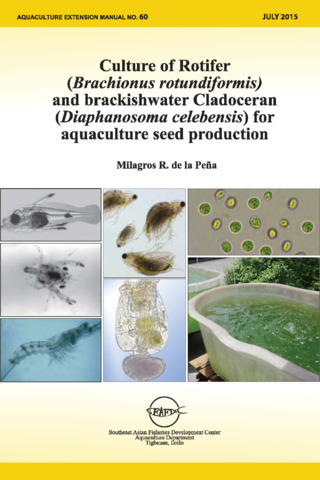
Culture of rotifer (Brachionus rotundiformis) and brackishwater cladoceran (Diphanosoma celebensis) for aquaculture seed production
(Aquaculture Department, Southeast Asian Fisheries Development Center, 2015)A 32-page manual with topics on the biology and cultivation techniques of zooplankton. -
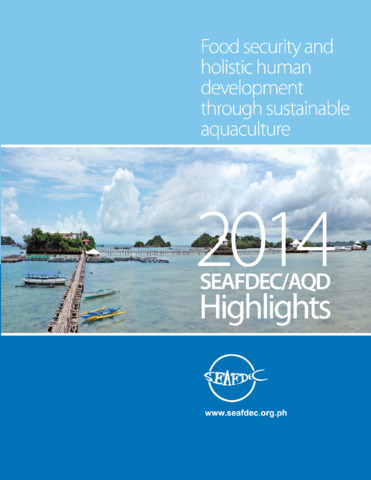
2014 SEAFDEC/AQD highlights
(Aquaculture Department, Southeast Asian Fisheries Development Center, 2015)The SEAFDEC Aquaculture Department is mandated to: 1) conduct scientific research to generate aquaculture technologies appropriate for Southeast Asia; 2) develop managerial, technical and skilled manpower for the aquaculture sector; and, 3) disseminate and exchange aquaculture information. The Aquaculture Department in the Philippines maintains 4 stations: the Tigbauan Main Station and Dumangas Brackishwater Station in Iloilo; the Igang Marine Station in Guimaras; and, the Binangonan Freshwater Station in Rizal. Highlights are provided of the seven research programmes and activities conducted by the department during the year 2014. -
2013 SEAFDEC/AQD highlights
(Aquaculture Department, Southeast Asian Fisheries Development Center, 2014)The SEAFDEC Aquaculture Department is mandated to: 1) conduct scientific research to generate aquaculture technologies appropriate for Southeast Asia; 2) develop managerial, technical and skilled manpower for the aquaculture sector; and, 3) disseminate and exchange aquaculture information. The Aquaculture Department in the Philippines maintains 4 stations: the Tigbauan Main Station and Dumangas Brackishwater Station in Iloilo; the Igang Marine Station in Guimaras; and, the Binangonan Freshwater Station in Rizal. Highlights are provided of the seven research programmes and activities conducted by the department during the year 2013. -
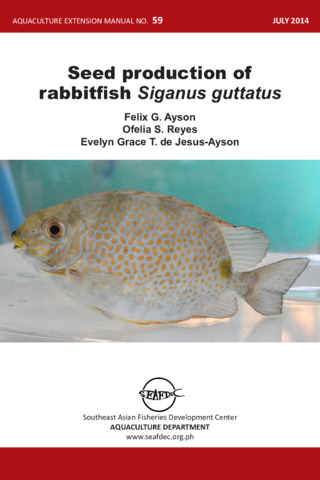
Series: Aquaculture extension manual; No. 59
Seed production of rabbitfish Siganus guttatus
(Aquaculture Department, Southeast Asian Fisheries Development Center, 2014)This manual is mainly intended to serve as a practical guide to fishfarmers and other stakeholders interested to venture in operating a rabbitfish hatchery. It details site selection, hatchery design & layout, and protocols in broodstock management, spawning, larval rearing, and harvest & transport. It has also a section on natural food production for rabbitfish larvae. -
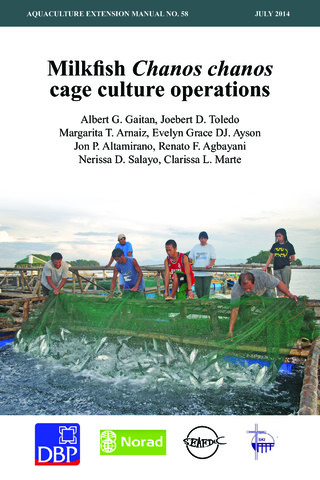
Series: Aquaculture extension manual; No. 58
Milkfish Chanos chanos cage culture operations
(Aquaculture Department, Southeast Asian Fisheries Development Center, 2014)A 42-pages extension manual describing the biology, fingerling production, site selection, cage design and construction, measurement & analysis of water & sediment quality parameters and economic analysis. -
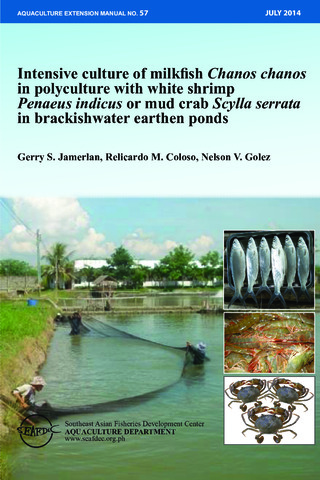
Series: Aquaculture extension manual; No. 57
Intensive culture of milkfish Chanos chanos in polyculture with white shrimp Penaeus indicus or mud crab Scylla serrata in brackishwater earthen ponds
(Aquaculture Department, Southeast Asian Fisheries Development Center, 2014)A 30-page extension manual describing the biology, site selection, pond management and harvest & post-harvest of milkfish intensive polyculture in earthen pond. -
Series: Aquaculture extension manual; No. 56
Hatchery production of snubnose pompano Trachinotus blochii Lacepede
(Aquaculture Department, Southeast Asian Fisheries Development Center, 2014)A 26-page extension manual describing the biology, broodstock acquisition & management, larval rearing, harvest & transport and prevention of diseases & parasites in hatchery production of pompano. -
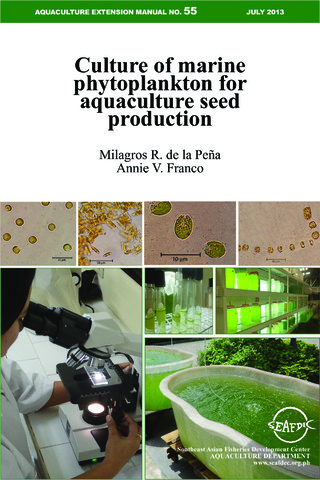
Series: Aquaculture extension manual; No. 55
Culture of marine phytoplankton for aquaculture seed production
(Aquaculture Department, Southeast Asian Fisheries Development Center, 2013)The 32-page extension manual describes the biology, culture techniques and maintenance and mass propagation of 12 phytoplankton species used as live feed in marine hatcheries. -
Parasites of window-pane oyster (Placuna placenta Linnaeus, 1758) from Trapiche, Oton in west central Philippines
(College of Agriculture, University of the Philippines Los Baños, 2015)Parasitology of edible and commercially valuable window-pane oysters (Placuna placenta L.) using gross macroscopic examination and histology was conducted. To screen for the presence of parasites, wild oysters were collected monthly from January 2008 to December 2008 from Trapiche, Oton in west central Philippines. Thirty live adult oysters with shell length (SL) of 52-89 mm were hand-picked monthly. Gross observation showed the presence of pea crabs (Pinnotheres sp.) in the mantle cavity of the oysters. The overall prevalence and intensity of P. placenta with pea crabs were 4.44% and 1, respectively. Histological examination revealed the occurrence of Tylocephalum sp. (prevalence and intensity of the parasites were 1.66 % and 0.5, respectively) in connective tissues around the digestive gland. Tylocephalum sp. was found surrounded by hemocytic infiltration. Ciliates (Ancistroma sp.) were also observed in the gills with overall prevalence of 38.83% and intensity of 7.51. Larval stages of trematodes of Bucephalus sp. (prevalence, 18.83%; intensity of 1.5) were found in the connective tissues of the female gonad. The study presents a documentation of parasites of P. placenta in the Philippines. -
AQD Matters 2015 November - December
(Aquaculture Department, Southeast Asian Fisheries Development Center, 2015) -
AQD Matters 2015 September - October
(Aquaculture Department, Southeast Asian Fisheries Development Center, 2015) -
AQD Matters 2015 July - August
(Aquaculture Department, Southeast Asian Fisheries Development Center, 2015) -
AQD Matters 2015 May - June
(Aquaculture Department, Southeast Asian Fisheries Development Center, 2015) -
AQD Matters 2015 March - April
(Aquaculture Department, Southeast Asian Fisheries Development Center, 2015)