SEAFDEC/AQD Institutional Repository: Recent submissions
2381-2400 / 4221
-
Cambodia: Mangrove-friendly aquaculture
(Aquaculture Department, Southeast Asian Fisheries Development Center, 2000)Cambodia has 435 km of coastline with 85,000 ha of mangrove forest. A big part of the mangrove area is in Koh Kong province (63,700) where intensive shrimp culture activity is also concentrated. Shrimp (Penaeus monodon) farms occupy 850 ha, producing 450 tons/yr (1995). But lately, production decreased by 20% due to diseases and self-pollution. The government has since placed restrictions on shrimp farming. -
Indonesia: Mangrove-friendly aquaculture
(Aquaculture Department, Southeast Asian Fisheries Development Center, 2000)The paper describes the mangrove forests in Indonesia, the most extensive in the world. It also describes the causes for their destruction, and the government intervention for aquaculture development ("tambak") and mangrove area conservation ("tambak tumpangsari"). A strategic plan for improving the mangrove areas is presented, including a development program for coastal planning and land zoning process. The paper concludes that "tambak" will continue to be developed to expand fish production. The statement is based on Indonesia's rate of population increase vis-a-vis the certain decrease in natural resources on a per capita basis. Aquaculture would continue to expand while capture fishery declines. Thus, a socio-economic shift to other employment alternatives would be necessary. -
Viet Nam: Mangrove-friendly aquaculture
(Aquaculture Department, Southeast Asian Fisheries Development Center, 2000) -
Philippines: Mangrove-friendly aquaculture
(Aquaculture Department, Southeast Asian Fisheries Development Center, 2000)Mangrove areas in the Philippines were once considered vast tracts of wasteland that can be developed into other land uses. The economic "advantages" associated with such exploitation were considered socially "valuable" to human communities. Such advantages and exploitation, however, are now questioned, with the cost to society reevaluated. This paper discusses the factors causing mangrove deforestation with emphasis on aquaculture. Existing and future programs like the government's Coastal Resource Management project for the implementation of mangrove-friendly aquaculture are presented. Research needs and problems affecting mangrove management are likewise discussed. -
Integrated mangrove forest and aquaculture systems in Indonesia
(Aquaculture Department, Southeast Asian Fisheries Development Center, 2000)Silvofisheries is a form of integrated mangrove tree culture with brackishwater aquaculture. It is a form of low input sustainable aquaculture. This integrated approach to conservation and utilization of the mangrove resource allows for maintaining a relatively high level of integrity in the mangrove area while capitalizing on the economic benefits of brackishwater aquaculture. Silvofisheries is being promoted in Indonesia as part of a mangrove rehabilitation, conservation and management program. Pond-based silvofisheries follow three design models: (1) the basic “empang parit” model that is essentially identical to an extensive aquaculture pond with maintenance of mangrove trees on the central platform; (2) modification of the basic model to include a dike constructed around the treed central platform so that the water level within the mangrove area and the open water perimeter culture area can be controlled separately; and (3) further modification of the second model to completely separate the open water culture area from the mangrove area by a gated dike with the pond culture area consolidated to a square or rectangular shape at the end of the enclosed diked area. The ratio of mangrove tree to open water culture area is 8:2 to 6:4. In addition, various methods of minimizing the costs associated with pond construction are being considered. This includes the cultivation of mangrove crabs (Scylla sp.) in pens. The State Forestry Company in Indonesia has successfully developed and implemented silvofisheries sites (e.g., 6,000 ha in West Java-Cikiong with 1,508 farmers; 5,300 ha in Blanakan with 2,060 farmers). A conditional lease program with non-government organizations providing technical assistance to farmers has been successful. This program exemplifies what can be accomplished in mangrove rehabilitation and management within a controlled and enforced program. Production and financial return from silvofishery varies with the system, site characteristics, the level of energy input (mainly from mangrove litter - green manure) and utilization by cultured species, among other factors. Annual profit of up to $2,000/ha/yr for a milkfish and shrimp polyculture silvofisheries system has been reported. There is a need to refine data and analysis, since all costs are often not included, and revenue projections are often based on expected production rather than actual production. Farm interviews in West Java showed a range in gross income from $313 to $946/ha/yr while net profit per individual farm (1.5-10 ha farm size) ranged from $943 to $1,558/farm/yr. There was greater production effort per unit area by farmers with smaller farms. Individual silvofishery farmers often combine incomes from multiple sources. The application of silvofisheries practices requires reasonable measures of caution as with any activity in an environmentally sensitive area as the mangroves. Additional important considerations in the development of silvofisheries as part of an activity within the mangrove ecosystem include the issues of land ownership, integrated coastal zone planning and development, comparative economic assessment, systems models, optimizing use of inputs, selection of mangrove tree and aquaculture species, better understanding of trophic production and food web utilization, and improvement of economic return. -
Silvofishery: An aquaculture system harmonized with the environment
(Aquaculture Department, Southeast Asian Fisheries Development Center, 2000)Mangrove forests are valuable biologically and economically, but these have been decreasing yearly. It is usually converted into human settlement and for brackishwater aquaculture. To arrest the massive decrease of mangrove forests, reforestation of mangroves has been done but most failed because of conflict among users. To resolve such problems, a system that combines utilization and conservation called silvofisheries has been introduced. Costs-and-returns of silvofishery ponds per year differ depending on scale and type of species cultured. The following are necessary to maintain the silvofishery pond in good condition: good site and design, suitable vegetation, high economic value of target organisms, good water quality and quantity, and optimal rearing conditions (stocking density, adequate feeding, etc.). -
Japan: Mangrove areas and their utilization
(Aquaculture Department, Southeast Asian Fisheries Development Center, 2000)Although Japan has large-scale aquaculture, there is no aquaculture development in mangrove areas because the total area is small (553 ha) and strictly protected. Mangroves are preserved in comparatively good condition. Future development of aquaculture in mangrove areas is considered small-scale. Rather than aquaculture, Japan practices enhancement and management of wild fisheries. Tourism is another industry that would have an important role in mangrove utilization. But basic research on mangrove ecosystems is essential prior to determining policies for utilization of mangrove areas. International cooperative research work is important to encourage mangrove-friendly aquaculture and protect the environment. -
Brunei Darussalam: Mangrove-friendly aquaculture
(Aquaculture Department, Southeast Asian Fisheries Development Center, 2000)Aquaculture in Brunei Darussalam is quite recent compared to other countries. Cage culture of marine fishes and pond culture of marine shrimp are popular. Mangrove area utilized for aquaculture (shrimp ponds) is very minimal, 190 ha of the total 18,418 ha. This report describes the status of mangroves and practices of aquaculture in Brunei Darussalam. -
Malaysia: Mangrove-friendly aquaculture
(Aquaculture Department, Southeast Asian Fisheries Development Center, 2000)The paper describes some mangrove-friendly aquaculture activities that are practiced in Malaysia. Among these are the culture of cockle and oyster, semi-intensive culture of tiger prawn, fish cage culture, and pen culture of mud crab. Policies, regulations, future directions and priority areas in research and development that can contribute to sustainable mangrove utilization are discussed. -
Larviculture of marine species in Southeast Asia: current research and industry prospects
(Elsevier, 2003)The increased requirement for food fish, the lucrative market for expensive seafood, and the need to conserve marine resources, have motivated the rapid pace of larviculture research in Southeast Asia. Various research and academic institutions in Southeast Asia such as the Southeast Asian Fisheries Development Center Aquaculture Department (SEAFDEC AQD) are carrying out research on commercially important marine species including 10 fish, 6 crustacean, and 7 mollusk species. Since fry availability is a major constraint in the development of culture systems, a major research thrust of SEAFDEC AQD is the development of commercially viable technologies for breeding and seed production of commercially important marine fish and crustaceans such as milkfish, groupers, snappers and mud crabs, in addition to the production of fry and juveniles of endangered and depleted species such as the sea horse and the tropical abalone for stock enhancement and sea ranching. Although hatchery production of milkfish and sea bass are now commercially viable enterprises, research is being pursued to improve fry quality through feed supplementation and to lower production cost by using alternative live or artificial feeds. Larviculture techniques are being developed for technically demanding species such as groupers and snappers. The recent success in larviculture of the mud crab Scylla serrata is expected to stimulate the growth of the mud crab industry in the region. Similarly, encouraging developments in the breeding and larviculture of the sea horse and mollusks such as the tropical abalone will provide the necessary support to carry out future stock enhancement and sea ranching programs for these species. -
Tank culture of Gracilaria heteroclada (Zhang et Xia)
(College of Agriculture and Central Experiment Station, University of the Philippines Los Baños, 2003)Culture conditions in tanks were manipulated to improve the growth and agar quality of Gracilaria heteroclada Zhang et Xia. Specific growth rates during culture ranged from -0.51% to 1.40% and gel strength of agar from 439 to 2155 g cm-2. G. heteroclada at a stocking density of 2kg ton-1 and fertilized with ammonium chloride at 40 mg L-1 grew best when water was changed once a month and ammonium chloride was replenished at 20 mg L-1 after water change. When water was not changed, good growth was observed in plants supplied with 1 mg L-1 diammonium phosphate on the 3rd wk of culture. -
Growth and fatty acid production of thraustochytrids from Panay mangroves, Philippines
(Mushroom Research Foundation, 2003)Optimization of culture conditions with regard to the combined effects of salinity and temperature on biomass and fatty acid production of four thraustochytrid isolates were undertaken. Two strains of Schizochytrium mangrovei (IAo-1 and IXm-6), and one isolate each of Schizochytrium sp. (BSn-1) and Thraustochytrium sp. (IRa-8), isolated from fallen mangrove leaves, were used in this study. Results of the physiological study show that the best growth condition for Schizochytrium isolates was at a salinity range of 15-30 ‰ at 20-30°C, while that for Thraustochytrium sp. was at 22.5-30 ‰ at 25°C. Highest biomass production was 350 mg 50 mL-1 for Schizochytrium spp., and 133 mg 50 mL-1 for Thraustochytrium sp. Total lipid content (% freeze-dried biomass) ranged from 16.0-33.2% for S. mangrovei, 13.0-39.1% for Schizochytrium sp., and 11.4-37.5% for Thraustochytrium sp. Highest lipid production was observed at 15-22.5 ‰ salinity (25°C) for S. mangrovei, and at 15 ‰ (25°C) for Schizochytrium sp. and Thraustochytrium sp. Palmitic acid (16:0) and docosahexaenoic acid (DHA; 22:6n3) were the major components of the total fatty acid (TFA) content, comprising about 39-42% and 24-35%, repectively. -
The Leiognathus aureus complex (Perciformes: Leiognathidae) with the description of a new species
(Ichthyological Society of Japan, 2003)Taxonomic analysis of a group of morphologically similar ponyfishes (Perciformes: Leiognathidae) establishes a complex comprising three valid species: Leiognathus aureus Abe and Haneda, 1972, widely distributed in the western Pacific Ocean (Taiwan, Philippines, Thailand, Singapore, Indonesia, and northern Australia); L. hataii Abe and Haneda, 1972, currently known only from Ambon, Indonesia; and L. panayensis sp. nov. Kimura and Dunlap, currently known only from Panay Island, the Philippines. The L. aureus complex can be defined by the following combination of characters: mouth protruding forward, not downward; small but sharp conical teeth uniserially on jaws; a black line between lower margin of eye and lower jaw articulation; and lateral line incomplete, ending below posterior part of dorsal fin base or on anterior caudal peduncle. Leiognathus hataii differs from both L. aureus and L. panayensis in having a large dark blotch below the spinous dorsal fin base and fewer counts of scales (lateral line scales 50–58 vs. 64–85 in the latter two species; scales above lateral line 7–10 vs. 12–18; scales below lateral line 22–26 vs. 30–41). Leiognathus panayensis is distinguished from L. aureus in having a deeper body (41–51% SL vs. 35–45% SL in the latter), long posterior limb of maxilla (21–25% HL vs. 15–23% HL), wholly scaled belly (vs. naked along preanal median keel), and a dark blotch on nape (vs. absent). -
Distribution of an oxytetracycline resistance determinant tet(34) among marine bacterial isolates of a Vibrio species
(Nakanishi Printing Co, 2003)The distribution of tet(34) was examined among oxytetracycline (OTC) resistant Vibrio strains isolated from Japan, Korea and the Philippines. tet(34) was detected in 10 isolates (6 in fish, 4 in seawater) from Japan and Korea, suggesting that it is widely distributed among fish and seawater bacteria in these countries. Ninety-eight percent of the Vibrio strains in the Philippines were sensitive to OTC, but none of the 60 isolates from the Philippines. The minimum inhibitory concentration (MIC) of OTC-resistant isolates increased 2 to 8 fold in the presence of Mg2+, and MICs were higher in the Japanese and Korean isolates than the Philippine isolates. The MIC for furaltadone (FD) was low in Japanese (23.9%) isolates at over 3.1 μg/ml and high in Korean (50%) and Philippine (56.7%) isolates. This was probably due to the different frequency of use of FD in these countries. Sequences of 16S rDNA of tet(34)-positive isolates were 100% identical, suggesting that tet(34) is conveyed in a particular Vibrio species. -
Series: Aquaculture extension manual; No. 26
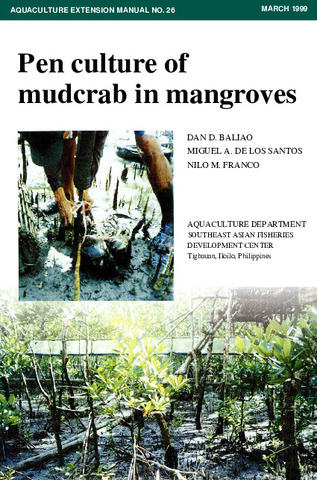
Pen culture of mudcrab in mangroves
(Aquaculture Department, Southeast Asian Fisheries Development Center, 1999)This manual, describing the pen culture of mudcrab (Scylla spp) in mangroves, is intended for the use of fishfarmers and aquaculturists, extensionists, and students of aquaculture, not only in the Philippines but also in other mudcrab-producing countries in Southeast Asia. It covers the following: Site selection; Installation of net enclosure; Materials; Rearing operation; Feeds and feeding; Stock sampling; Water quality and pen management; Harvesting; and, marketing. -
Tolerance of seahorse Hippocampus kuda (Bleeker) juveniles to various salinities
(Blackwell Publishing, 2003)In line with current conservation efforts, some success in the captive breeding of the seahorse Hippocampus kuda (Teleostei: Syngnathidae) has been achieved. To evaluate the salinity tolerance of these hatchery-bred juveniles, 9-week-old H. kuda were transferred without prior acclimatization from ambient full strength seawater (32–33 ppt) to salinities ranging from freshwater to 85 ppt. Survival, growth, and total body water content were determined after 4 and 18 days of exposure. Juvenile H. kuda are able to survive in dilute seawater (15 ppt) for at least 18 days without any compromise in growth (both wet and dry body weight), survival, and total body water. Fish abruptly transferred to freshwater succumbed within 4–24 h, while survival of 5 ppt-reared fish decreased to ca. 65% in 18 days. Although 10 ppt-reared seahorses had growth and survival comparable with the control (30 ppt seawater), total body water was significantly elevated indicating reduced adaptability. The upper limit of H. kuda salinity tolerance was 50 ppt. Fish reared at salinities ≥55 ppt succumbed within 24 h. Like several other marine teleosts, growth and survival of juvenile H. kuda tended to peak in diluted seawater salinities of 15 and 20 ppt. These results indicate the possibility of growing hatchery-bred H. kuda in brackishwater environments. -
Shell marking by artificial feeding of the tropical abalone Haliotis asinina Linne juveniles for sea ranching and stock enhancement
(Blackwell Publishing, 2003)A method of marking abalone (Haliotis asinina Linne) for sea ranching and stock enhancement purposes was developed. Three-month-old abalone juveniles (11.8-mm shell length, 0.28 g) were fed artificial diets for 1, 2, or 3 weeks. The width of the bluish-green shell band produced by abalone juveniles was 1.7, 2.6, and 4.2 mm after 1, 2, or 3 weeks of feeding respectively. The growth and survival of juveniles fed artificial diets did not differ from that of juveniles fed the seaweed Gracilariopsis bailinae (control). Feeding the diet-fed juveniles with the seaweed thereafter produced the natural brownish shell, thus forming a sandwiched bluish-green band. An experimental release in outdoor tanks with natural growth of seaweeds and diatoms, and in a marine reserve showed that the shell band remained clear and distinct, indicating the usefulness of this shell marking method in sea ranching and stock enhancement of abalone. -
Transport of hatchery-reared and wild grouper larvae, Epinephelus sp.
(Elsevier, 2003)Optimum packing conditions for the transport of hatchery-reared and wild grouper larvae were investigated under simulated condition or actual air transport. Simulation of transport motion was done through the use of an electric orbit shaker to identify the best packing conditions for the transport of grouper larvae at various ages. Simulated transport was conducted in hatchery-reared grouper larvae at day 35 (mean TL=14.73 mm), 45 (mean TL=15.23 mm) and 60 (mean TL=28.16 mm) at packing densities of 50, 100 and 200 larvae l−1 and at high (28 °C) or low (23 °C) temperatures. Packing density of 50 larvae l−1 was best for 45- and 60-day-old larvae 8 h transport at low temperature. However, packing density could be increased to a maximum of 100 larvae l−1 8 h transport at 23 °C with mortality rates ranging from 2.3% to 5.3%. The increase in total NH3 level was dependent on temperature, packing density and size of larvae. High packing density (100–200 larvae l−1) and temperature (28 °C) resulted in increased NH3 level and mortality rates during transport. In addition, regardless of the temperature, NH3 levels were consistently higher for 60-day-old larvae. Day-60 grouper larvae displayed strong resistance to handling/mechanical stress compared to 35-day-old larvae probably because most are already fully metamorphosed at this stage. Based on these results, a packing density of 50 larvae l−1, a temperature of 23 °C and larval age of 60 days were considered as the best transport conditions for hatchery-reared grouper larvae. When these transport conditions were used in experiment 2, for 26-day-old hormone-metamorphosed, 60-day-old naturally metamorphosed or 60-day-old pre-metamorphosing hatchery-reared grouper larvae, a 100% survival rate was attained in all treatments. Seven days of hormone (T3) treatment did not accelerate metamorphosis of wild-caught transparent grouper larvae (tinies) significantly. Survival rates of hormone-treated transparent tinies (H-tinies), untreated black tinies (B-tinies) and untreated transparent tinies (T-tinies) were also similar after 8–9 h air transport (experiment 3). The results of the current study suggest that T3 treatment did not affect the performance of hatchery-reared and wild-caught transparent tinies/larvae during transport. In addition, mass mortalities of these transported tinies during the nursery phase were associated with nutritional aspect and the sudden confinement of these undomesticated wild-caught grouper to small space rather than transport or hormone treatment effects. -
Advanced broodstock diets for the mangrove red snapper and a potential importance of arachidonic acid in eggs and fry
(Springer Verlag, 2003)Mangrove red snapper fed advanced broodstock diets containing squid meal and squid oil exhibited higher hatching rates, cumulative survival and survival activity index than those fed a basal diet or a basal diet supplemented with mixture of antioxidants. On the other hand, fatty acid analyses of ovaries and fry of wild fish and eggs and larvae of broodstock fed raw fish revealed high arachidonic acid (ARA) and docosahexaenoic acid (DHA) levels and relatively lower eicosapentaenoic acid (EPA) levels consequently showing high ARA/EPA and DHA/EPA ratios compared to cold water species. This suggests that ARA may be nutritionally more important for egg and larval development and survival in tropical marine fish and its supplementation in broodstock diets may enhance reproductive performance of mangrove red snapper. -
A practical broodstock diet for the mangrove red snapper, Lutjanus argentimaculatus
(Elsevier, 2003)A practical broodstock diet (39% protein, 8.6% lipid) was formulated for the mangrove red snapper as part of a project to ensure consistent production of good quality eggs and larvae through broodstock nutrition. Reproductive performance of mangrove red snapper broodstock fed practical diet (n=14 females) was enhanced in comparison to those fed raw fish (n=12 females). Broodstock fed practical diet had total egg production of 82.34 million from 68 spawns for two spawning seasons while broodstock fed raw fish produced 77.64 million eggs from 66 spawns. Mean percent of egg viability, hatching rates and percent of normal larvae did not vary between the two groups. However, broodstock fed the practical diet had higher mean cumulative survival rate of eggs to normal larvae (40.4%) than that of broodstock fed raw fish (35.2%). Also, survival activity index (4.08) of broodstock fed practical diet was higher than that of broodstock fed raw fish (2.97). The results clearly indicate the improvement of reproductive performance of mangrove red snapper fed practical diet. Further studies should focus on the specific nutrients that can ensure consistent production of high quality eggs and larvae of the mangrove red snapper to support its aquaculture.