SEAFDEC/AQD Institutional Repository: Recent submissions
2841-2860 / 4221
-
Series: Aquaculture extension manual; No. 16
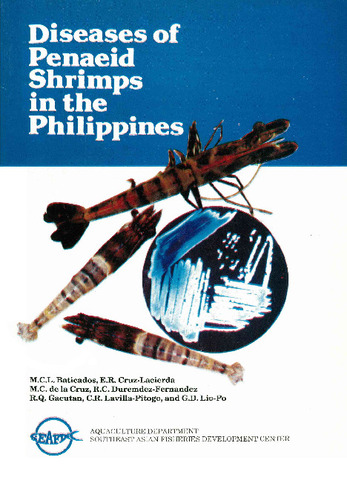
Diseases of penaeid shrimps in the Philippines
(Aquaculture Department, Southeast Asian Fisheries Development Center, 1990)The manual provides information on the diseases that affect the 3 major species of shrimps culture in the Philippines: Penaeus monodon, P. merguiensis and P. indicus. It includes the common name of the disease, causative agent, species affected, stages affected, gross signs, effects on the host and methods of prevention and treatment. -
Series: Technical report / SEAFDEC Aquaculture Department; No. 1
Development of a brood stock of the jumbo tiger prawn, Penaeus monodon Fabricius
(Aquaculture Department, Southeast Asian Fisheries Development Center, 1976)The full-scale cultivation of sugpo, P. monodon Fabricius, could only be realized if there is an assurance of continuous supply of fry. Obviously, a steady supply will depend largely on the availability of spawners. In December 1975, roughly after 2 1/2 years of intensive study, for the first time in the world, SEAFDEC Aquaculture Department has succeeded in inducing P. monodon to mature and produce normally the first generation of postlarval fry, thereby successfully effecting the completion of P. monodon's life cycle while in captivity. Another significant study the Department has initially carried out which could help augment and stabilize the supply of spawners and eventually stimulate the establishment of more prawn hatcheries and the development of ponds for prawn culture as a major export-oriented, dollar-earning industry, is the possible development of ovarian rematuration of spent spawners. -
Series: Aquaculture extension manual; No. 14 | NACA training manual series; No. 1
Shrimp hatchery design, operation and management
(Network of Aquaculture Centres in Asia, 1986)Details are given of factors to be taken into account for successful hatchery operation. The following aspects are covered: 1) site selection; 2) hatchery design and construction; 3) life cycle; 4) preparation of broodstock for spawning; 5) larval feed; 6) spawning, hatching and larval rearing facilities; 7) spawner selection and egg collection 8) nauplii hatching and transportation; 9) larval rearing; 10) routine hatching, management; 11) port-larvae nursery; and 12) larval harvesting and transportation. -
Series: Technical report / SEAFDEC Aquaculture Department; no. 6
A study on the milkfish fry fishing gears in Panay Island, Philippines
; Bagarinao, Teodora ; (Aquaculture Department, Southeast Asian Fisheries Development Center, 1980)
This study was conducted to obtain information for evaluating the present fry fishing practices and for understanding the behaviour of the fry. A description of the milkfish, Chanos chanos, fry fishing gears is presented. Each gear is illustrated and its operation explained.
; (Aquaculture Department, Southeast Asian Fisheries Development Center, 1980)
This study was conducted to obtain information for evaluating the present fry fishing practices and for understanding the behaviour of the fry. A description of the milkfish, Chanos chanos, fry fishing gears is presented. Each gear is illustrated and its operation explained. -
Series: Technical report / SEAFDEC Aquaculture Department; No. 4
Traditional devices and gear for collecting fry of "sugpo" giant tiger prawn, Penaeus monodon in the Philippines
(Aquaculture Department, Southeast Asian Fisheries Development Center, 1980)Eight typical devices and gears for catching the wild fry of the giant tiger prawn, Penaeus monodon, locally called sugpo are described and illustrated. There are three stationary ones vis. fry lure, fry filter net and set fry trap, and five mobile ones viz. scoop net, fry scare line, fry seine, triangular net, and fry bulldozer. These have been used traditionally in the Philippines. This design and manner of operation are adapted to the behaviors and habits of the sugpo fry such as clinging and incursion with the incoming tidal current in mangrove creeks or at the mouth of the brackish river. -
Series: Technical report / SEAFDEC Aquaculture Department; no. 8
Weather observation at Tigbauan, Iloilo, Philippines from 1977 to 1980
(Aquaculture Department, Southeast Asian Fisheries Development Center, 1981)The observations include: (1) air and sea water temperatures; (2) cloud cover; (3) rainfall; (4) wind direction and speed; (5) salinity; (6) sea wave condition. -
Series: Aquaculture extension manual; No. 4
Milkfish culture in brackishwater ponds
(Aquaculture Department, Southeast Asian Fisheries Development Center, 1979)The manual is intended as a guide for operation in milkfish farming. It is presented under the following major sections: 1) Handling of fry - counting, storage and transport; 2) Pond layout and construction - selection of farm site, layout, construction, plan and specification; 3) Pond operation, culture and management - nursery pond management and rearing pond operation; 4) Harvest and post-harvest - harvest, post harvest, and processing; and 5) Economics and costing - cost of construction, cost of operation, and production/yield. -
Effect of a diet lacking in vitamin and mineral supplements on growth and survival of Penaeus monodon juveniles in a modified extensive culture system
(Elsevier, 1995)Penaeus monodon postlarvae (mean weight 6 mg) were reared in 330 m2 earthen ponds for 120 days at a stocking density of 7.5 m−2, following a modified extensive culture system where natural food organisms are available. Two diets were tested, one with vitamin and mineral supplements and the other without. The results showed that growth, survival, apparent food conversion ratio (FCR), net production, and net cost of production were not significantly different between the two diets. The difference in cost of production between the diets appeared to be lower in shrimp fed a diet without vitamin and mineral supplements. The favorable cost difference of P8.00 kg−1 shrimp produced would make it more profitable to use a diet that contained no vitamin and mineral supplements in a modified extensive culture system. -
Changes induced in the gills of milkfish (Chanos chanos Forsskål) fingerlings after acute exposure to nifurpirinol (Furanace; P-7138)
(Springer Verlag, 1995)The need for a chemotherapeutant used specifically for fish disease became increasingly apparent with intensive fish culture practices, and with the possibility of bacterial resistance against drugs used for human and animal medicine (Austin 1985). With this in mind, Nifurpirinol (trade name Furanace; P-7138) was developed by the Dainippon Pharmaceutical Co., Ltd., Japan, and is currently manufactured in the United States as Prefuran. Studies have proven that the drug is effective against bacterial and fungal pathogens in a wide variety of aquatic animals. Most of the Nifurpirinol studies done in the past have dealt on its antimicrobial activity, tissue uptake, and effective treatment levels ranging from 0.5-2.5 mg/L. The 96-hr median lethal concentration (LC50) to channel catfish (Ictalurus punctatus Rafinesque) has also been determined at 0.945-1.90 mg/L, and at 1.70 mg/L for milkfish, Chanos chanos Forsskaal. However, there have only been two studies that have examined the histological effects on treated fish. Histopathologically, Mitchell et al. (1978) found hypertrophy and hyperplasia of the lamellar epithelium in channel catfish gills exposed to 0.5 mg/L for 4 d or longer at 24 plus or minus 2 degree C, while Amend and Ross (1970) working at 21 plus or minus 1 degree C observed no apparent changes in the gills of coho salmon (Oncorhynchus kisutch) exposed intermittently to 1 mg/L of Nifurpirinol. This paper describes the histological changes observed in the gills of milkfish fingerlings used in static, 96-hr Nifurpirinol toxicity tests. Milkfish was used because of its economic importance as a widely cultured food fish in Asia. The gills were chosen as target organs. -
Milt-egg ratio in artificial fertilization of the Asian freshwater catfish, Clarias macrocephalus, injected salmon gonadotropin-releasing hormone analogue and domperidone
; ; Garcia, Luis Maria; (Cambridge University Press, 1995)
The author deals with the catfish Clarias macrocephalus which are artificially fertilized by inducing females to spawn using various hormones. This paper investigates the effect of Ovaprim on milt production and fertilizing ability of Clarias macrocephalus and determines the optimal milt-egg ratio required for artificial fertilization. Materials and methods used are: fish collection and handling, hormone administration, preparation of testicular homogenate, measurement of sperm density, dry fertilization, statistical analysis. -
Growth and production of milkfish (Chanos chanos) in brackishwater ponds: effects of dietary protein and feeding levels
(Elsevier, 1995)The most economical combination of dietary protein and feeding levels for milkfish culture in brackishwater ponds was determined. Milkfish juveniles (average weight, 5 g) were stocked at 7000/ ha and fed two diets containing 24% or 31% dietary protein at 2 or 4% of body weight. There was no interaction between feeding level and dietary protein on growth, feed efficiency, and energy assimilation of milkfish. This indicates that the response of milkfish to change in protein levels is not influenced by ration size. Regardless of protein levels, the final weight, weight gain, specific growth rate, and production of milkfish were significantly higher (α = 0.05) when fed at 4% body weight than at 2%. As culture progresses, differences in weights of fish fed varying protein levels were still insignificant. This could be attributed to the balanced amino acid profile of both diets. The higher growth at the 4% feeding level could be due to the higher amount of amino acids available for protein synthesis. Higher energy assimilated by milkfish at higher feeding rate demonstrates that energy supply also influences growth. Partial budgeting analysis shows that bigger profits can be earned by using a 24% protein diet with balanced amino acids at a feeding rate of 4% of body weight. The greater amount of feed given at higher rate can be compensated by faster growth and higher production. -
Participation of women in oyster and mussel farming in Western Visayas, Philippines
(Blackwell Publishing, 1995)This paper provides baseline information on the involvement of women in small-scale coastal aquaculture such as the farming of slipper oyster, Crassostrea iredalei (Faustino 1933), and green mussel, Perna viridis (Linnaeus 1758). Data were gathered during a socio-economic survey of oyster and mussel farming in Western Visayas, Philippines conducted from July to December 1991.There were 175 respondents interviewed; 18.5% and 2.4% of oyster and mussel farmers were females. Fishing and related activities were the major source of livelihood for the majority of oyster and mussel farmers. In 1990, 79.4% and 69.8% of oyster and mussel farmers earned an annual income of less than P30 000 (1 USS P23). Based on the 1988 (latest data available) poverty threshold of P2654 (monthly) for Western Visayas, 80.4% and 71.7% of oyster and mussel farmers lived below poverty level in 1990. of 175 respondents. 79.3% and 48.2% of oyster and mussel farmers indicated that their household members participated in farming activities. More female household members were involved in oyster farming compared with mussel farming. Harvesting in mussel farming and both harvesting and marketing in oyster farming generated the widest participation among female household members. -
Series: Aquaculture extension manual; No. 5
Farming of prawns and shrimps
; ; Primavera, Jurgenne (Aquaculture Department, Southeast Asian Fisheries Development Center, 1983)
The manual provides information on the culture of shrimps and prawns. Considerations regarding farm sites, pond specifications, pond ecosystems and differences between prawn and milkfish culture are examined. Seed supply, farm management practices and economic aspects are detailed. -
Series: Aquaculture extension manual; No. 8
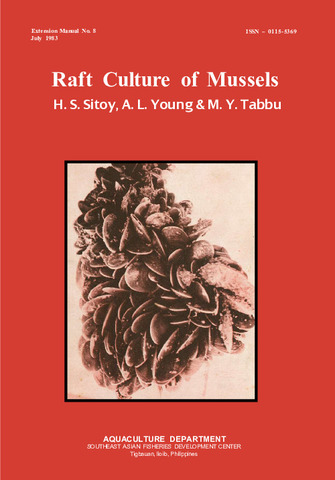
Raft culture of mussels
(Aquaculture Department, Southeast Asian Fisheries Development Center, 1983) -
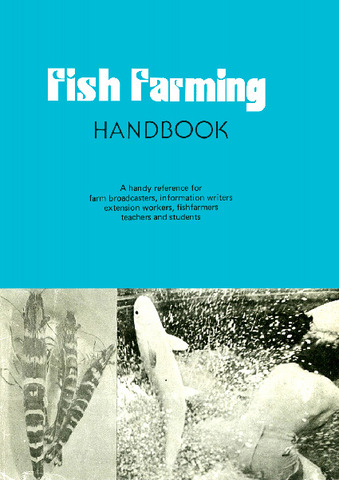
Fish farming handbook
(Aquaculture Department, Southeast Asian Fisheries Development Center, 1980)A handy reference for farm broadcasters, information writers, extension workers, fishfarmers, teachers, and students. -
Diel activity patterns in Metapenaeus and Penaeus juveniles
Primavera, Jurgenne; Lebata, J. (Springer Verlag, 1995)
Small (5–10.9 mm carapace length), medium (11–15.9 mm), and large (16–20.9 mm) juveniles of Metapenaeus anchistus, Metapenaeus sp., Penaeus monodon and P. merguiensis were stocked individually in glass tanks provided with sand substrate, sea water, artificial bamboo shelter, aeration and food. The seven activity types (recorded for each shrimp hourly for 24 h) were classified as below (burrowing) or above substrate (swimming, walking, stationary, in shelter, feeding and cleaning). Shrimp juveniles exhibited a strong diel periodicity — emergence and activity at night and burrowing in the day. The chi-square test showed that type of activity (above/below substrate) was associated with period (light/dark). Diurnal burrowing was greater among Metapenaeus than Penaeus; inversely, above substrate activities were more frequent for Penaeus species compared to Metapenaeus. Feeding was the major above substrate and nocturnal activity for M. anchistus, Metapenaeus sp. and P. monodon. Only P. Monodon used the shelter consistently. Frequency of the 7 activity types was dependent on juvenile size for Penaeus, e.g., the preference for shelters shifted to burrowing with increase in size in P. monodon. Results are discussed in relation to the importance of mangrove habitats in providing shelter to penaeids, in particular the mangrove-associated P. monodon and P. merguiensis. -
Mangroves and brackishwater pond culture in the Philippines
Primavera, Jurgenne (Springer Verlag, 1995)
Around 50% of mangrove loss in the Philippines can be traced to brackishwater pond construction. The decrease in mangroves from 450 000 ha in 1920 to 132 500 ha in 1990 has been accompanied by expansion of culture ponds to 223 000 ha in 1990. The history of fishpond development in the country includes a government-sponsored fishpond boom in the 1950-g and 1960s, the proconservation decade of the 1970s followed by a shrimp fever in the 1980s. Production from brackisshwater ponds has increased from 15 900 mt worth P7.6 million in 1938 to 267 000 mt valued at P6.5 billion in 1990. On the other hand, the maximum valuation of over $11 000 ha−1 yr−1 for unmanaged and managed mangrove forests makes them economically on par with the most profitable pond farming systems. The loss of mangrove systems and their varied goods and services is the single most important consequence of brackishwater pond culture in the Philippines. Moreover, intensive shrimp farming is associated with other ecological and socioeconomic effects such as pollution of coastal waters and decline in domestic food crops. New legislation and enforcement of existing laws, conservation of remaining mangroves, massive rehabilitation of denuded mangrove areas, and promotion of sustainable aquaculture and fisheries are recommended. -
Foregut evacuation, return of appetite and gastric fluid secretion in the tropical freshwater crayfish, Cherax quadricarinatus
(Elsevier, 1995)The effects of animal size and feeding frequency on the foregut evacuation rates by Cherax quadricarinatus, that fed voluntarily on pellet food (meal size eaten, 1.3–1.4% body weight), were determined using a modified serial slaughter method. Evacuation rates did not differ significantly between size-groups (medium, large) and between feeding frequency-groups (fed daily, fed every second day). However, models that best described the evacuation process were different for each group (i.e., linear model for the crayfish fed daily, arcsine model for those fed every second day). This variation indicates the potential for a crayfish to regulate its digestion processes according to food availability. Faecal production rates did not differ significantly between feeding frequencies. Return of appetite, measured in terms of voluntary feed intake at bi-hourly intervals following satiation meals, was shown to be related to the foregut evacuation process, but it was probably the supply of fresh gastric fluid after ca. 4 h following a meal which mainly influenced the increase of appetite. The rapid return of appetite in crayfish implies that they can resume feeding while a considerable proportion of an earlier meal is still being processed in the foregut. This indicates that crayfish are capable of optimising the frequency of feeding during active foraging periods. -
Series: Aquaculture extension pamphlet / SEAFDEC Aquaculture Department; No. 3
Recommended practices for disease prevention in prawn and shrimp hatcheries
(Aquaculture Department, Southeast Asian Fisheries Development Center, 1989)Disease in prawn is any abnormal condition which may affect adversely the appearance, growth, and function of the animal. It may or may not result in mortalities. Disease outbreaks occur commonly in different culture systems such as hatcheries and grow-out ponds. Disease develops through the interaction of the prawn (the host), the causal agent (the pathogen), and the environment. In the presence of a susceptible host, a pathogen and predisposing environmental conditions (poor water quality, inadequate food, frequent handling, overstocking), disease is very likely to occur. Improved environmental conditions, healthy prawns and absence of disease agents would therefore lessen the chance of a disease outbreak. The causal agents may be pathogenic organisms (viruses, bacteria, fungi, protozoa, helminths, microcrustaceans) or nonpathogenic adverse environmental conditions (extreme temperatures, low oxygen levels, chemical poisons). Living disease agents cause infectious disease which generally result in gradual mortalities. Non-living disease agents cause non-infectious diseases that result in sudden mass mortalities. The environment determines the balance between the prawn as host and the disease agent. Microorganisms are always present in the water and some of them cause disease only when the prawn has been weakened through exposure to stressful environmental conditions. Hatchery personnel should realize that they themselves could transmit disease through their contaminated hands, clothing, and footwear. Equipment such as water pumps, blowers, pipes, and materials such as scoop nets, water hoses, pails, glasswares are also possible carriers of disease agents. Spawners, live natural food like diatoms, rotifers and brine shrimp, and artificial diets could also be vehicles of disease transmission. The prawn culturist, thus, must be able to manage the environment and make it favorable for the prawn. Hatchery management should, therefore, include operation procedures that will reduce the possibility of disease development during larval rearing. This manual recommends practices for disease prevention to prawn hatchery operators and technicians. -
Series: Aquaculture extension pamphlet / SEAFDEC. Aquaculture Department; No. 2
Feeding prawns for grow-out culture
(Aquaculture Department, Southeast Asian Fisheries Development Center, 1989)