SEAFDEC/AQD Institutional Repository: Recent submissions
2861-2880 / 4221
-
Carrageenan properties and proximate composition of three morphotypes of Kappaphycus alvarezii Doty (Gigartinales, Rhodophyta) grown at two depths
(Walter de Gruyter, 1995)Three morphotypes (brown, green and red) of Kappaphycus alvarezii grown at two depths were evaluated for carrageenan properties and proximate composition. The green morphotype was significantly different from the brown and red in all carrageenan properties except for sulfate content at 50 cm below the water surface; and significantly different only from the brown at 100 cm. Except for ash content and nitrogen free extract there were no significant differences in proximate composition (nitrogen, crude protein, crude fat, crude fiber) among the three morphotypes. -
Series: Aquaculture extension pamphlet; No. 1
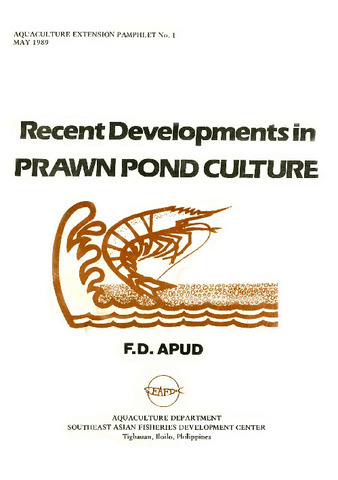
Recent developments in prawn pond culture
(Aquaculture Department, Southeast Asian Fisheries Development Center, 1989)This document presents the recommended methodology, nominal projections and partial costs and returns, for extensive prawn culture at two production objectives, and semi-intensive culture with costs and returns breakdown for three production targets. Intensive prawn culture procedures are not discussed. Extensive Prawn Culture System I projects a production yield of about 110 to 160 kg/ha/crop or more in four months and survival rate of from 65 to 70%. The extensive Prawn Culture System II aims for a production rate of about 230 kg/ha/crop in four months at about 70% survival with expected average body weight of about 25 grams. The procedures indicated have been verified and are now widely practiced. Production targets under the Semi-intensive Prawn Culture System I range from 350 to 500 kg/ha in four months at survival rate of about 70 to 75% and expected average size at harvest of about 28 to 30 pcs/kg. This method has been confirmed at different collaborative sites using the modified SEAFDEC diet developed by the Feed Development staff of the SEAFDEC Aquaculture Department. -
Formation of acid sulfate soil and its implications to brackishwater ponds
(Elsevier, 1995)Acid sulfate soil formation was observed experimentally during leaching of pyritic soil material. Pyritic soil was saturated with distilled water in glass columns and treated under waterlogged and drained conditions. Waterlogged was inundated and had overlying water of 2-cm depth above soil surface. Temporal changes of various chemicals and physical characteristics of the soil and leachates were determined at 10-day leaching intervals. Results showed that strong acidification of soil in drained column but not in waterlogged was due to pyrite (FeS2) oxidation and the consequent production of sulfuric acid (H2SO4). As oxidation progressed, acidification influenced the pH, and increased the solubility of aluminum (Al) and iron (Fe). The loss of potassium (K) and sulfur (S) fractions was also enhanced by acidification. Strong acidic condition in drained columns slightly changed the texture of the soil to more clay, but was not enough to alter the mineral composition of the soil. Periodic leaching was found effective in increasing soil pH, but some essential nutrients were also removed, thus, the need for fertilization scheme during amelioration. In prospective ponds, pyritic soil should be tilled and dried for 2–3 weeks, then flushed and drained repeatedly until pH > 5 is obtained. Repeated lime incorporation should be done in the amelioration until high pH values are obtained. In existing ponds, formation of acid sulfate soil could be avoided by not excessively turning and exposing the pond bottom. -
Exploitation of the window-pane shell Placuna placenta in the Philippines
(Elsevier, 1995)The window-pane shell Placuna placenta or 'kapis' has great economic importance in the Philippines. The translucent shell is used in the manufacture of lampshades and other shellcraft items exported to Europe, USA and Japan. Due to its high demand, excessive and uncontrolled gathering of kapis has been noted over the past years. Its possible depletion has been a concern; thus, a nationwide survey on the status of the fishery was conducted in 1993. There are 27 kapis beds in the Philippines, six of which are considered the major sources of kapis shells. Kapis shells are gathered by (1) handpicking (in shallow areas); (2) compressor diving (in deeper areas); and (3) dredging. Because of open access to the fishery, anybody can exploit the resource. Kapis stocks are declining in most beds, while in others they are already low as a result of excessive gathering, pollution, siltation, and destructive methods of fishing such as trawling. To prevent further depletion, establishment of sanctuaries, bans on trawling and other destructive means of fishing, strict enforcement of existing regulations, community-based fishery management, and further research on seed production, restocking, and transplantation are recommended. -
Rapid rural appraisal and participatory research in the Philippines
(Oxford University Press, 1995)Rapid Rural Appraisal (RRA) was conducted in the fishing village of Lakaran, in the municipality of Dumangas, Iloilo province to identify the resources, livelihood, problems, opportunities, and socioeconomic condition of the villagers prior to the conduct of farmer participatory research on mussel farming. RRA tools such as the construction of the village transect, seasonal calendar and wealth ranking were used. -
Growth and survival of juvenile tiger shrimp fed diet where fish meal is partially replaced with papaya (Carica papaya L.) or camote (Ipomea batatas Lam.) leaf meal
(Society of Israeli Aquaculture and Marine Biotechnology, 1995)Fish meal is the major protein source in shrimp and fish diets but its continuous use would make it scarce and expensive. There are, however, potential substitutes like soybean or leaf meals. Papaya or camote leaf meals have not been tested as partial replacement for fish meal in diets for tiger shrimp. Thus, two feeding trials were made to test diets with leaf meals against a control shrimp diet. Both experiments used 50 mg shrimp stocked at 10 per 40 liters of sea water following standard water management. Trial 1 had diets containing either 17% soaked or unsoaked camote leaf meal or 16% papaya leaf meal. Results indicated that weight gain, specific growth rate and feed conversion ratio of the unsoaked papaya were similar to the control, higher than the unsoaked camote, but not significantly different (α= 0.05) from the soaked camote and papaya groups. Survival was not significantly different among treatments. Trial 2 used the best diet from Trial 1 - unsoaked papaya leaf meal - at 16%, 19% or 22% of the diet. The weight gain (1846%) of the shrimp fed 16% papaya leaf meal was not significantly different (α= 0.05) from the control 2034% but higher than the 22% group (1535%). Therefore, papaya leaf meal can partially replace (10%) animal protein in shrimp diets and serve as a source of exogenous proteolytic enzyme. However, its efficacy in culturing shrimp in ponds must be tested. -
The effect of tank color and rotifer density on rotifer ingestion, growth and survival of milkfish (Chanos chanos) larvae
(San Carlos Publications, University of San Carlos, 1995)The effect of tank color on rotifer ingestion, early growth and survival of milkfish larvae was assessed. The larvae were stocked at 30/L in 200-L fiberglass tanks coated black or unpainted (tan). Larvae were fed rotifers at densities of 5, 10, and 15/ml. Growth and survival were higher in black tanks than in tan tanks. Rotifers ingested were also higher in larvae reared in black tanks. In black tanks, the survival of the larvae was enhanced at high rotifer density of 15/ml. Rotifer ingestion and growth of larvae improved at higher feeding levels. -
Resistance to a heavy metal mixture in Oreochromis niloticus progenies from parents chronically exposed to the same metals
(Elsevier, 1995)Adult Oreochromis niloticus were mass spawned in concrete tanks. The one-month old progenies (F1) were exposed for two months to a mixture of 0.01 mg L−1 Hg, 0.1 mg L−1 Cd and 1.0 mg L−1 Zn. The survivors were grown to sexual maturity in a natural environment (lake). The fish were spawned and the progenies (F2) of the exposed F1 (EF1) were exposed to another mixture of the three metals: 3.0 mg L−1 Zn, 0.30 mg L−1 Cd and 0.01 mg L−1 Hg, both in a static and static-renewal system. Another group of F2 from unexposed F1 (UF1) received the same treatment. Results showed that in both exposure systems, survival of the F2 of EF1 was significantly higher (P<0.05) than those from UF1. The medial lethal time (LT50) of the F2's were estimated from the time-response curve following regression analysis: 5.16 days (F2 of UF1) and 9.03 days (F2 of EF1) in the static exposure experiment; 3.34 days (F2 of UF1) and 5.52 days (F2 of EF1) in the static-renewal run. Exposure of the parental stock resulted in the culling out of individuals which were more susceptible to the heavy metals. The more resistant members of the population (survivors) which have the ability to adapt to the toxicants were able to pass on the resistance to their offspring. The results are supported by other studies in the field which demonstrate high resistance in populations of organisms living in contaminated sites. -
Effect of stocking density and nutrients on the growth and agar gel of Gracilariopsis bailinae (Gracilariales, Rhodophyta)
(San Carlos Publications, University of San Carlos, 1995)The effect of additional nutrients and varying stocking densities (500, 1000, and 2000 g m-2) on the growth and physical properties of Gracilariopsis bailinae was determined. Growth was significantly higher (L = 0.05) at a stocking density of 500g both in enriched (3.5%/day) and unenriched (1.9%/day) treatment, but growth was not significantly different between 1000 and 2000g density. A decreasing growth rate was observed with increasing stocking density. Significant differences in gel strength and gelling temperatures were observed only at 2000 g m-2 both in enriched and unenriched treatment. Results of the study showed that additional nutrients are necessary for the growth of G. bailinae and its agar quality. -
Effect of dietary protein to energy ratios on growth, survival, and body composition of juvenile Asian seabass, Lates calcarifer
(Elsevier, 1995)The optimum protein-to-energy (P/E) ratio for juvenile sea bass (body weight, 1.34 ± 0.01 g) was determined using practical diets in a 3 × 3 factorial experiment. Three protein levels (35, 42.5 or 50%) and three lipid levels (5, 10 or 15%) at a fixed carbohydrate level of 20% were tested. P/E ratios of the diets ranged from 104 to 157 mg protein/kcal. The fish were reared for 54 days in 60-liter flow-through tanks with seawater at 32 p.p.t. and 29 °C. Fish fed the diet containing 50% protein and 15% lipid (P/E ratio of 125 mg/kcal) showed the highest weight gain and specific growth rate. Those fed the diet with 42.5% protein and 10% lipid (P/E ratio of 128 mg/kcal) showed comparable growth rate and significantly better condition factor, protein efficiency ratio and apparent protein retention. Fish given diets containing 35% protein showed the poorest growth. Those fed diets with 5% lipid regardless of the protein content showed abnormal reddening of the fins, indicating essential fatty acid deficiency. Body fat increased with fat content of the diet and was inversely related to moisture. Fish given the diet containing 35% protein and 5% fat had the lowest body fat content and the highest ash and water content. The diet containing 42.5% protein and 10% lipid with P/E ratio of 128 mg protein/kcal was found to be optimum for juvenile seabass under the experimental conditions used in the study. -
Spawning and larval development of a tropical abalone Haliotis asinina (Linne)
(Science and Technology Information Institute, 1995)Dessication, thermal shock, ultraviolet-irradiated seawater, and hydrogen peroxide, singly or in combination, failed to induce the tropical abalone, Haliotis asinina to spawn viable number of eggs or sperm. However, natural spontaneous spawnings occurred frequently and fertilized eggs with an average size of 180 µm were obtained. Trochophore larvae hatched 5.2-5.6 h after fertilization (27.7-30.2°C). Veliger larvae were observed 8 h after fertilization and achieved creeping ability 30 h after fertilization. Competent larvae settled within 2-3 d on prepared diatom plates and juveniles forming the first respiratory pore were observed after 30 d. -
Use of the golden apple snail, cassava, and maize as feeds for the tiger shrimp, Penaeus monodon, in ponds
(Elsevier, 1995)Penaeus monodon stocked in ponds at 8000/ha were fed four types of farm-made feeds starting on day 16 of a 4-month culture period. The feeds were golden apple snail alone or in combination with cooked cassava or maize, or maize only. Mixed feeds resulted in significantly higher production, growth, and better size-frequency distribution of shrimp. Survival (88–99%) was not significantly different among the treatments. Maize alone or snails alone were inadequate. Presumably, the high amount of carbohydrate in cassava (92%) or maize (87%) provided the needed energy, and the high protein content of golden snail (54%) was available for growth. The fatty acid profile of the golden snail shows that it is a good source of 18:2n-6, 18:3n-3, and 20:5n-3 which are essential fatty acids for P. monodon. The golden snail, with an essential amino acid index (EAAI) of 0.84, is a useful alternative source of protein for tiger shrimp. Feeding shrimps with golden snails and cassava yielded the highest net income (P48797/ha-crop) and return on investment (ROI = 206%) better than feeding with maize alone (net income = P23190/ha-crop; ROI = 120%), an industry practice. If shrimp farmers use golden snails as direct feed or as a feed ingredient, the problem of snail infestation in ricefields may be reduced. Snails will no longer be viewed as pests but rather as a resource which has economic value. -
Growth responses of Spirulina platensis to some physico-chemical factors and the kinetics of phosphorus utilization
(Japanese Society of Fisheries Science, 1995)The growth responses of Spirulina platensis NIES-46, a brackishwater strain originally isolated from Lake Texcoco Mexico, to some physico-chemical factors and nutrients were investigated. The optimum conditions for growth were the following: light intensity of 160 µE m-2 sec-1, temperature of 30°C, pH 10, and chlorinity of 0.55‰. NIES-46 strain could utilize both inorganic and organic phosphorus sources. Values on the different growth parameters for orthophosphate and other organic phosphorus sources were as followings: half-saturation constant of 0.02-0.07 mg-P/l; maximum growth rate of 0.8-1.0/d; minimum cell quota of 0.08-0.32 pg-P/cell, and level for saturated growth yield of 0.3-1.0 mg-P/l. The result that this species utilized effectively a rather wide range of both inorganic and organic phosphorus and showed a high growth rate suggests that mass production of this species is possible by recycling organic waste. -
Cortisol stimulates the size and number of mitochondrion-rich cells in the yolk-sac membrane of embryos and larvae of tilapia (Oreochromis mossambicus) in vitro and in vivo
(John Wiley and Sons, 1995)The effect of cortisol and thyroid hormones on the activity of mitochondrion-rich (MR) cells in the yolk-sac membrane of tilapia (Oreochromis mossambicus) embryos and larvae was investigated. MR cells were identified by the fluorescent mitochondrial stain DASPEI. Yolk-sac membranes from 4-day-old embryos in fresh water (FW) were incubated for 24 h in medium supplemented with cortisol, thyroxine (T4), or triiodothyronine (T3). Treatment with cortisol at 0.1 μ/ml and higher significantly increased the population of MR cells and the intensity of fluorescence compared with the control, whereas MR cell size was not affected. Treatments with T4 and T3 did not affect MR cell density, size, or intensity of fluorescence. Four-day-old embryos in FW were immersed for 10 days in FW supplemented with cortisol, T4, or T3. A significant increase in MR cell size was observed starting on day 3 after treatment with 100 μ/ml cortisol. Treatment with lower doses of cortisol produced increases in the cell size on later days. Density of MR cells was significantly increased only on day 9. Treatment with T4 produced inconsistent results. Treatment with T3 did not affect MR cell size or density at any time. None of the three hormones affected the intensity of fluorescence of MR cells. The stimulatory activity of cortisol on MR cells in the yolk-sac membrane suggests that cortisol, present in the yolk of tilapia embryos and larvae, may be involved in osmoregulation during the early life stages of fish. -
Economic analysis of prawn (Penaeus monodon) culture in the Philippines, I. Hatchery operations
(Asian Fisheries Society, 1995)High prices of prawn (Penaeus monodon) fry, profitability of hatchery operations, and a low cost hatchery design introduced by the Southeast Asian Fisheries Development Center attracted millions of dollars of investments in the mid-1980s. When export prices for prawn fell dramatically in 1989, demand for fry dropped as most prawn growers stopped operations or reduced stocking densities. Natural calamities – typhoons, earthquakes and volcanic eruptions – further depressed conditions in the hatchery sector. This paper presents an economic analysis of hatchery operations in the Philippines using data gathered through interviews and structured questionnaires in 1992. Economic indicators estimated include: investment requirements, unit cost, benefit over cost ratios, and internal rates of return. Breakeven and sensitivity analyses of operating hatcheries were employed to determine the degree of risk and changes in profitability levels associated with different scales of operation given changes in output price, input price and production level. Results indicate that net income per production run was positive for all scales of hatchery operation in spite of the current adverse market conditions. New hatchery investments, however, should be made in medium- and small-scale facilities because these have a better chance to survive worsening market conditions and periodic spawner shortages. Medium-size operations provide the best returns, and large-scale operations showed negative returns. Large-scale hatcheries are operating below capacity due to scarcity of spawners and low market demand. -
The sea turtles captured by coastal fisheries in the northeastern Sulu Sea, Philippines: Documentation, care, and release
Bagarinao, Teodora (Herpetological Conservation and Biology, 2011)
This paper presents the first substantive data on sea turtles in the northeastern Sulu Sea. Working with fishers and government, the Southeast Asian Fisheries Development Center (SEAFDEC FishWorld) documented 109 juvenile and adult sea turtles captured or stranded around Panay and Guimaras Islands, Philippines from 2001 to mid- 2011. These included 65 Green Turtles (Chelonia mydas), 15 Hawksbill Turtles (Eretmochelys imbricata), 24 Olive Ridley Turtles (Lepidochelys olivacea), three Leatherback Turtles (Dermochelys coriacea), and two Loggerhead Turtles (Caretta caretta). From the four fishing villages within 1 km of FishWorld came 29 Green Turtles, eight Olive Ridleys, and one specimen each of the three other species. Approximately 77% of the Green Turtles were caught in nearshore fish corrals, mostly between October and May; whereas, 75% of the Olive Ridley Turtles were caught in offshore gill nets and long lines between April and October. Seventy-nine captured turtles were released, 73 of them with inconel flipper tags. Several turtles died from entanglement, serious injuries, slaughter for market, or diseases. An Olive Ridley Turtle and three Green Turtles were seen nesting at three beaches in southern and western Panay. Nesting of Hawksbill Turtles has been recorded at secluded beaches in Lawi, Guimaras about every three years; several batches of hatchlings have been raised by local residents before being released. Size-specific growth rates of Green Turtles and Hawksbill Turtles were highest among post-hatchlings and decreased sharply with size among juveniles and adults.
(Herpetological Conservation and Biology, 2011)
This paper presents the first substantive data on sea turtles in the northeastern Sulu Sea. Working with fishers and government, the Southeast Asian Fisheries Development Center (SEAFDEC FishWorld) documented 109 juvenile and adult sea turtles captured or stranded around Panay and Guimaras Islands, Philippines from 2001 to mid- 2011. These included 65 Green Turtles (Chelonia mydas), 15 Hawksbill Turtles (Eretmochelys imbricata), 24 Olive Ridley Turtles (Lepidochelys olivacea), three Leatherback Turtles (Dermochelys coriacea), and two Loggerhead Turtles (Caretta caretta). From the four fishing villages within 1 km of FishWorld came 29 Green Turtles, eight Olive Ridleys, and one specimen each of the three other species. Approximately 77% of the Green Turtles were caught in nearshore fish corrals, mostly between October and May; whereas, 75% of the Olive Ridley Turtles were caught in offshore gill nets and long lines between April and October. Seventy-nine captured turtles were released, 73 of them with inconel flipper tags. Several turtles died from entanglement, serious injuries, slaughter for market, or diseases. An Olive Ridley Turtle and three Green Turtles were seen nesting at three beaches in southern and western Panay. Nesting of Hawksbill Turtles has been recorded at secluded beaches in Lawi, Guimaras about every three years; several batches of hatchlings have been raised by local residents before being released. Size-specific growth rates of Green Turtles and Hawksbill Turtles were highest among post-hatchlings and decreased sharply with size among juveniles and adults. -
Controlled release of testosterone and estradiol-17 β from biodegradable cylinders
(Controlled Release Society, 1994)A controlled release device for the hormones, testosterone and estradiol-17 β, was developed by coating a melt extruded hormone/poly (ϵ-caprolactone) cylinder with pure polylactide. Since testosterone and estradiol-17β have much higher permeabilities in poly (ϵ-caprolactone) than in polylactide, they primarily permeate through the open ends of the cylinder, with little release through the polylactide wall. By changing the cylinder length, the release rate and duration could be adjusted. The release followed Pick's diffusion equation for a drug loading below its solubility in poly (ϵ-caprolactone) or Higuchi's equation for a drug loading above the solubility. The diffusion coefficients of testosterone and estradiol-17β in poly (ϵ-caprolactone) were estimated as \((8.31 \pm 3.12) \times 10^{−18}\) and \((0.728 \pm 0.250) \times 10^{-18} cm^{2}/s\), respectively. -
Accumulation and excretion of metal granules in the prawn, Penaeus monodon, exposed to water-borne copper, lead, iron and calcium
; Quinitio, Emilia T. (Elsevier, 1994)
Juveniles of the giant tiger prawn, Penaeus monodon, were exposed for 10 days to 1 mg/l copper, lead, iron or calcium in order to investigate the formation and accumulation of metal granules in major soft tissues as well as their excretion from the body. Metal deposition was investigated by histochemistry and electron microscopy in the hepatopancreas and surrounding organs and tissues like the stomach, midgut, anterior midgut caecum, thoracal antennal gland extensions, haematopoietic tissue, and interspersed musculature, connective tissue and pigment tissue. The abundance of metal granules varied greatly between the metals and the tissues. Iron and calcium deposits were found in none of the tissues investigated. Copper granules were accumulated in high quantity in the hepatopancreas tubules, were scarce in the antechamber of the hepatopancreas, the anterior midgut and the anterior midgut caecum, and were lacking in the other tissues. The amount and size of copper granules increased along the hepatopancreas tubules in accordance with the cells' age. The granules were released by discharge of senescent hepatopancreas cells in the antechamber region and were added to the faeces. Lead granules were primarily found in the thoracal extensions of the antennal gland. In the hepatopancreas they occurred only in very small quantities, and in the other organs and tissues they were absent. In the antennal gland, the lead granules were individually discharged into the gland lumen by apocrine secretion and excreted with the urine. The observed ability of Penaeus monodon to detoxify and remove metals like copper and lead by granule formation and excretion and to prevent other metals like iron from entrance into major soft tissues corroborate that decapods are no suitable organisms for a long-term biomonitoring of heavy metal pollution. -
Induction of sex inversion in juvenile grouper, Epinephelus suillus, (Valenciennes) by injections of 17α-Methyltestosterone
; Garcia, Luis Maria; (The Ichthyological Society of Japan, 1994)
Four groups of two-year old juvenile groupers (Epinephelus suillus), each with 8-9 individuals of mean body weight (BW) 1.2 kg, were treated with 17α-methyltestosterone (MT). MT was injected intramuscularly within the range of 0.5-5.0 mg kg-1 BW every 15 days. Gonadal biopsy and stripping of the abdomen was done every 15 days, the fish being sacrificed after six or twelve injections. Initial controls had immature ovaries containing primary oocytes in lamellae that extended into the central lumen. After six injections, proliferation of stromal and gonial cells were observed in all fish sampled. Regardless of treatment, gonad sections of fish with a minimum BW of 1.2 kg showed degeneration of primary oocytes and the presence of spermatogenic cells. Milt was also present in larger-sized fish (BW: 1.5 kg) given 0, 0.5 and 1.0mg MTkg-1 BW, after such fish had received an accumulated dose of 5 or 12mg MTkg-1 BW. However, gonad sections of smaller-sized fish following these treatments contained only primary oocytes and gonial cells after six (BW: 0.7-1.0kg) or twelve (BW: 0.6-1.3 kg) injections. In contrast, all fish treated with 5 mg MT kg-1 BW had testes in active spermatogenesis after six (BW: 1.2-1.6 kg) or twelve (BW: 0.8 kg) injections. Gonad weight and gonadosomatic index values decreased during consecutive sampling. Induction of female-to-male sex inversion in juvenile E. suillus by MT was probably synergistic with age and size. -
Acute toxicity of nifurpirinol, a fish chemotherapeutant, to milkfish (Chanos chanos) fingerlings
(Springer Verlag, 1994)Nifurpirinol (trade name Furanace and originally known as P-7138), is a nitrofuran derivative synthesized by the Dainippon Pharmaceutical Co. Ltd., Japan, and was developed exclusively as a broad-spectrum antibiotic for fish and other aquatic organisms (Shimizu and Takase 1967). It has been shown to have bactericidal and fungicidal action in vitro and in vivo (Shimizu and Takase 1967; Amend and Ross 1970; Pearse et al. 1974; Mitchell and Plumb 1980), and was used because of its excellent potential in controlling prawn diseases (Delves-Broughton 1974; Gacutan and Llobrera 1977). Milkfish (Chanos chanos Forsskal) is a widely-reared species and a very important aquaculture food crop in most parts of Southeast Asia. Thus, it was the logical choice as test animal for investigating the LC50 toxicity levels of nifurpirinol (6-hydroxymethyl-2-[2-(5-nitro-2-furyl) vinyl] pyridine) after 96 hr exposure. Changes in the normal gill architecture of milkfish after exposure to the drug were also studied (Tamse et al., in preparation).