SEAFDEC/AQD Institutional Repository: Recent submissions
3281-3300 / 4221
-
Spontaneous maturation and spawning of milkfish in floating net cages
(Elsevier, 1986)Milkfish (Chanos chanos Forsskal) reared from wild-caught fry and from hatchery-bred fry matured at 3.5-5.5 years (2.3-4.9 kg). Maturation and spawning of the hatcherybred fish marks the first time the milkfish life-cycle has been completed in captivity. Milkfish at various stages of gonadal development were obtained in July-October 1980 and March-June 1981 derived from wild-caught fry, and in February-June 1983 from the hatchery-bred fish. The fish were held in floating net cages 9 m and 10 m diameter by 3 m deep, located in 7 m deep water off Igang, Guimaras Island, Philippines. Annual ranges of temperature and salinity were 25-33°C and 25-38 ppt, respectively. The fish were fed commercial feed pellet (42% protein) at 1.5-2% of body weight twice daily. Sexual maturation occurred during the natural breeding season of wild milkfish in the nearby waters. Gonadosomatic index (GSI) of mature males was 0.32-3.95 (wild-caught, 0.32-3.95; hatchery-bred, 1.71-3.85). For mature females it was 1.24-8.12 (wildcaught, 1.56-7.62; hatchery-bred, 1.24-8.12). Two spawnings were recorded in August 1980 and eight in May-July 1981 from the broodstock derived from wild-caught fry, with 342-6293 eggs collected from each spawning, while 14 spawnings were observed in May-June 1983 from the hatchery-bred fish, with 770-114 000 eggs collected. The time of spawning was between 23.00 and 02.00 h. Fertilization rate was 55-99% for the broodstock from wild-caught fry and 47-100% for the hatchery-bred fish. Hatch rate varied from 9 to 80%. Factors affecting spontaneous maturation, spawning and rematuration are discussed. Although slight improvements in egg collection were obtained, further innovations in egg collecting techniques will have to be developed. The results indicate the potential for hatchery production of milkfish fry from captive broodstock and for restocking of waters deprived of naturally occurring fry. -
The milkfish seed resources survey in Sri Lanka: Status, problems and recommendations
Bagarinao, Teodora (Ministry of Fisheries and Aquatic Resources, Sri Lanka, 1986)
A summary is provided of information concerning the milkfish (Chanos chanos) seed resources of Sri Lanka, highlighting problems related to seed collection. Various recommendations are made to overcome these problems and the following areas are covered: logistic aspects; technical aspects; seed supply; demand for seed; uneven sizes of seed; storage techniques; mortality; collection season; shore waters and other new collection grounds; development of collection methods and gear; and, identification of milkfish fry.
(Ministry of Fisheries and Aquatic Resources, Sri Lanka, 1986)
A summary is provided of information concerning the milkfish (Chanos chanos) seed resources of Sri Lanka, highlighting problems related to seed collection. Various recommendations are made to overcome these problems and the following areas are covered: logistic aspects; technical aspects; seed supply; demand for seed; uneven sizes of seed; storage techniques; mortality; collection season; shore waters and other new collection grounds; development of collection methods and gear; and, identification of milkfish fry. -
Studies on the chronic soft-shell syndrome in the tiger prawn, Penaeus monodon Fabricius, from brackishwater ponds
(Elsevier, 1986)Prawn culture is becoming more widespread in the Philippines. In recent years, prawn production in brackishwater ponds has been adversely affected by a chronic soft-shell syndrome. A field survey of prawn ponds in the island of Panay showed that occurrence of soft-shelled prawns could be predicted with 98% accuracy under poor soil and water conditions in the ponds. Some management practices were also highly correlated with the soft-shell syndrome. Soft- and hard-shelled prawns collected during the survey were analyzed for calcium and phosphorus levels. In soft-shelled prawns, calcium and phosphorus levels were significantly higher in the hepatopancreas, and phosphorus was significantly lower in the exoskeleton than in hardshelled prawns. Chitinoclastic bacteria, Vibrio and Aeromonas, were isolated from soft-shelled prawns but experimental infection with these species to induce soft-shelling gave largely negative results. Laboratory experiments using an organostannous pesticide revealed that a 96-h exposure to at least 0.0154 ppm of the pesticide could result in soft-shelling of 47-60% of the prawns. Soft-shelled prawns were fed various quantities of frozen mussel meat for 4 weeks to find out if soft-shelling could be reversed by dietary manipulation. Successful reversal of soft-shelling, general improvement of shell quality, and best growth and survival rates were observed in prawns fed a 14% mussel meat diet. -
The length-weight relationship, food habits and condition factor of wild juvenile milkfish in Sri Lanka
Bagarinao, Teodora; (Elsevier, 1986)
Wild juvenile milkfish (Chanos chanos) were obtained from Negombo lagoon in September 1984. Thirty-one specimens (92–186 mm FL) had a fork length-body weight relationship of log W = −5.6083 + 3.2598 log L. These fish were caught in the early morning and had empty guts. The mean condition factor (K) was 8.7. The intestine length to fork length ratio (I) was 3.7. Two large specimens (245 mm and 340 mm FL) caught around mid-day from the ocean off Negombo had full guts. Food was mostly blue-green algae, diatoms and detritus, with a number of copepods and nematodes. These fish had K values of 11.7 and 13.6 and I values of 8.1 and 8.5. The age and the month of spawning of these fish were back-calculated using known milkfish growth rates. It seems that in Sri Lanka, milkfish spawn from January to at least November. -
Growth, survival and macronutrient composition of Penaeus monodon Fabricius larvae fed with Chaetoceros calcitrans and Tetraselmis chuii
(Elsevier, 1982)Penaeus monodon larvae were reared from zoea1 (Z1) to mysis3 (M3) using two different algal feeds, Chaetocero calcitrans and Tetraselmis chuii. Artemia nauplii were added to both treatments at mysis2. Mean survival and growth rates in both treatments were different at 5% level of significance on the second and third day of culture, but did not differ during the mysis stage and the end of the 8-day culture period. Z3 and M3 larvae fed with C. calcitrans had a lower crude protein but a higher lipid content than T. chuii-fed larvae. Differences in carbohydrate content were noticed in M3 larvae. The implication of the findings are discussed. -
The effects of artificial diets on fry production and growth of Oreochromis niloticus breeders
(Elsevier, 1985)Tilapia breeders were fed with pelleted supplemental diets containing 20 or 40% crude protein at a daily feeding rate of 1% of fish biomass for 24 weeks in cages and tanks. Breeders were weighed and fry were collected at 3-week intervals. The 40% protein diet consistently gave the highest fry production and growth of breeders. The 20% protein diet gave variable results; fry production and growth were comparable to those of breeders fed with the 40% protein diet in some trials but significantly low in others. Breeders without supplemental feeding invariably had the least number of fry and the lowest body weights. -
Weaning of hatchery-bred milkfish larvae from live food to artificial diets
; Bagarinao, Teodora (Elsevier, 1984)
Two-week old milkfish (Chanos chanos ) larvae (7.5 mm standard length, 2.3 mg wet body weight) previously fed only rotifers were weaned abruptly to six artificial diets (commercial feed TP, artificial plankton AS and BP, experimental SEAFDEC diets CT and CB, and moist egg diet) with control larvae fed Artemia nauplii. Survival rates ranged from 38% on moist egg diet to 63% on BP, with 42% in the control. On day 43, larvae attained mean lengths of 7.7 mm on moist egg diet to 13.4 mm on Artemia , with no significant differences between diets. The mean wet weights were highest in larvae fed Artemia (77.8 mg). Results show the feasibility of weaning (gradually) even younger milk-fish larvae in hatcheries, using artificial diets. -
Small scale tilapia cage technology adopted in fishing villages in Laguna Lake, Philippines
(Elsevier, 1984)A small-scale tilapia cage project was tested in two fishing villages in the Philippines. The results showed that household incomes of participating families increased from P6183 to P41 768 per year, and household savings from about zero to P71.02 per day. Participating families consequently purchased gear for sustenance fishing, and luxury goods for their households. -
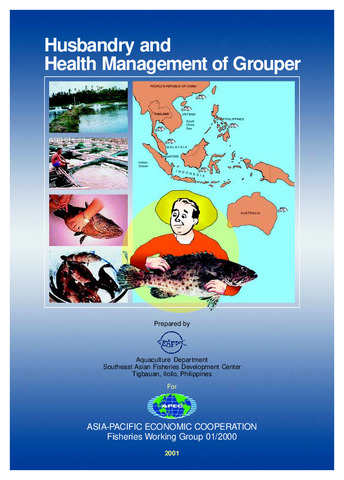
Husbandry and health management of grouper
(Asia-Pacific Economic Cooperation; Aquaculture Department, Southeast Asian Fisheries Development Center, 2001)The groupers (Family Serranidae) are among the most popular species in the live reef food fish industry in the Asia-Pacific region. Groupers are generally fast growing, hardy, suitable for intensive culture, and with excellent characteristics for processing. The high demand for these fishes is due to their unique culinary attributes and scarcity. In 1997, the Asia-Pacific region contributed about 90% to the total world aquaculture production. The regional production of farmed grouper was estimated at 15,000 tons, with China as the biggest producer contributing 8,000 tons followed closely by Indonesia. Other countries in the region commonly produce 1,000-2,000 tons annually in 1990- 1997. Groupers are generally cultured in floating net cages or earthen ponds, but cage culture is more common in Southeast Asia. Grouper pond production is becoming an attractive alternative to intensive shrimp culture in countries where management problems have forced growers to abandon shrimp farming. Although grouper culture is widespread in Asia and the Pacific, its continued development is constrained by the limited availability of fingerlings. Most economies, with the recent exception of Chinese Taipei, rely almost totally on wild-caught fry and fingerlings for stocking. This demand for wild seeds has led to unsustainable and illegal collection practices such as the use of cyanide to capture large numbers of seed with relatively less investment in time and effort. The inadequate supply of seed is further aggravated by the lack of appropriate handling techniques during collection, transport and storage of collected fish, and sometimes by an unregulated management of the wild stocks. There is also the lack of appropriate techniques for efficient grouper culture to marketable sizes. A major production constraint is heavy mortality of groupers during the collection and culture phases due to handling stress and diseases. The utilization of non-destructive devices for grouper collection, proper fish handling and increased efficiency in culture management can result to socio-economic and environmental benefits. A well-developed grouper culture operation complemented by appropriate wild grouper fishery management can provide sustainable employment to many people – from marginal fishers to farmers to traders. Grouper fisheries based on illegal or destructive fishing practices underlines the urgent need for habitat protection and sustainable utilization of natural resources. The objective of this manual is to provide a farmer-friendly practical guide for grouper farmers in the Asia-Pacific economies. It is hoped that this manual will enhance farmers’ ability to culture and handle grouper, as well as to prevent and manage disease outbreaks. -
Series: Technical report / SEAFDEC Aquaculture Department; No. 2
An annotated list of scientific and english common names of commercially important penaeid prawns and shrimps
(Aquaculture Department, Southeast Asian Fisheries Development Center, 1977)There are 318 species of penaeid shrimps (Family Penaeidae) recorded in the world, of which about 80 species are placed under exploitation in fishing industry and/or cultivated artificially. The species under the genus Penaeus are particularly favored for human consumption because of their larger size and palatability and are therefore exposed to extensive capture by fishing boats. The shrimp fishing industry has developed in various parts of coastal waters worldwide extending from the temperate to tropical zones in both hemispheres. The nations engaged in shrimp fishing are numerous; Japan, U.S.A., Mexico, Thailand, India, lead in terms of volume of catch. Japan, for instance one of the large shrimp consuming nations in the world, has been dispatching shrimp fishing boats to many countries whether on her own capital or in joint ventures. Japan annually imports some 100,000 tons of frozen shrimp of which penaeids rank first in quantity. Meanwhile, the demand for shrimp is expected to rise in the years to come. The shrimp fishing industry and its operation are conducted and managed naturally, as indicated above, under international agreement. However, confusions arise particularly regarding the common names of shrimp caught or the products. It is evident that many commercial species of penaeids are given common names which differ from one country to another. For instance, the so-called "white shrimp" adopted by commercial circles includes nine different species. Understandably, these nine species, aside form being closely related biologically, are characterized by whitish coloration of the body. The present list was compiled to show the status of shrimp nomenclature, based on available literature, giving scientific names and English common names adopted or applied. The present article is written in the hope that the common names of penaeid shrimp shall be standardized internationally at least in English. Needless to say, the standardization will contribute greatly to world trading, as well as to scientific studies. -
Larval and early juvenile fishes associated with milkfish fry at Malandog, Hamtik, Antique
(Fisheries Research Society of the Philippines, 1983)From 5 May 1981 to 7 November 1981 a total of 122,841 specimens of milkfish fry and early juvenile fishes was collected with the use of a milkfish fry sweeper. Of these, 66,361 or 54.02% consisted of early juvenile stages of 30 species of finfish and the rest were 56,480 milkfish fry of 45.98% of the total collection. The most abundant finfish excluding milkfish fry was Ambassis sp. comprising 59.43% of the total fish catch, followed by Elops machnata, 12.7%; Sillago sihama, 8.66% Gobiidae, 6.11%; Therapon jarbua, 5.49% Stolephorus sp., 2.06%; Chonoporus sp., 1.53%; Mullet, 0.97% and Scatophagus argus, 0.32%. The rest of the species combined comprised less than 1%. Water temperature, pH and dissolved oxygen (D.O.) showed inverse relationships with fish abundance at the early hours of the day (0800H-1200H) but incosistent correlations were noted during night time when these parameters were rather constant. Salinity did not show any correlation to fish abundance although more species were collected after a heavy downpour. Fish catch was higher during low tide than at high tide. -
Effect of varying dietary crude protein levels on spawning frequency and growth of Sarotherodon niloticus breeders
(Fisheries Research Society of the Philippines, 1983)Four-month-old S. niloticus breeders were fed with dry pellets containing 20 to 50% crude protein in two separate experiments. Their frequency of spawning and their growth in length and weight were determined over a 16-week period for each experiment. Spawning frequency and total growth (body weight gain plus total weight of eggs collected) of females had a tendency to increase as the dietary crude protein level increased to 50%. However, there were no significant differences (P0.05) among mean spawning frequencies and mean numbers of eggs per spawning. Although better growth was obtained with higher dietary crude protein, there was no significant correlation between a brooder’s weight and the number of eggs spawned each time. There was an increase in mean weight gain of the males as the dietary crude protein increased up to 50%. Weight gains of fish fed with 50% crude protein were 48.7% and 73.8% greater in Experiment I and II, respectively, than those fed with 20% crude protein. -
Some histological observations on the opaque eyes of milkfish Chanos chanos Forskal
(Fisheries Research Society of the Philippines, 1983)In a study on energy-protein requirements of milkfish fingerlings using semi-purified diets, several gross observations were made on individual milk-fish such as fin and tail rot, yellowish coloration of the abdomen, opacity and swollen adipose membrane of the eyes. The latter abnormality occurred four to five weeks after feeding semi-purified diets. Milkfish eyes with the abnormality were processed for histological analysis. Opacity of the cornea and lens and degeneration of the eye tissues, thickening of the corneal epthelium and oedema of the stromal layers were seen. Necrosis of the iris, slight thickening of the lens capsule, detachment and destruction of the retinal layers were also observed. -
Dietary crude protein requirement of Tilapia nilotica fry
(University of the Philippines at Los Baños, 1982)Tilapia fry were stocked at three per liter in wooden tank compartments or glass aquaria filled with 50 or 35 l of fresh water in three separate feeding trials. The fry were fed isocaloric practical diets containing 20, 25, 30, and 35% crude protein at 15% of fish biomass daily for seven weeks in the first tow trials. Another set of diets containing 20, 25, 30, 35, 40, 45, and 50% crude protein were fed to fry for eight weeks in trial 3. Although treatment means were not significantly different (P< 0.05), weight gains of the fry in trials 1 and 2 were related directly to increasing crude protein levels up to 35%. Weight gain in trial 3, however, was significantly high (P < 0.05) at 35% protein level. Moreover, maximum increases in total length and most efficient feed conversions were invariably attained at 35% protein. Higher protein levels gave much poorer growth. Survival rate at 35% protein was significantly high (P < 0.05) compared to 20% (trial 1) or 30% (trial 2) protein level. In trial 3, survival at 35% protein was not significantly different from all other treatments. Maximum growth, best feed conversion, and high survival were attained with the 35% protein diets. -
Fry-to-fingerling production of Tilapia nilotica in aquaria using phytoplankton as natural feed
(University of the Philippines at Los Baños, 1982)Two experiments were conducted to demonstrate the efficiency of phytoplankton as natural feed in fry-to-fingerling production of Tilapia nilotica . In the first experiment, growth and survival rates of fry given a sustained supply of algae increased considerably over the control fed with rice bran. In the second experiment, T. nilotica were grown in "green" water with phytoplankton concentrations adjusted to the following densities (cells/ml): high, 150-175 x 10 super(3); moderate, 90-120 x 10 super(3); and low, 50-60 x 10 super(3). Increasing the algal densities in the rearing medium enhanced growth of fry. Highest weight increments were obtained with high and moderate phytoplankton concentrations. -
Management of brackishwater pond for milkfish fingerling production in Sri Lanka
(Ministry of Fisheries and Aquatic Resources, 1982)The author reviews the present methods of milkfish (Chanos chanos) fry collection and presents his observations and recommendations of improvement. -
Milkfish fry and fingerling resources of Sri Lanka
(Ministry of Fisheries and Aquatic Resources, 1982)Sri Lanka has the milkfish (Chanos chanos) seed and water resources for the development of milkfish aquaculture as a new industry. Milkfish fry and fingerlings are present in all surveyed coastal wet lands, but are abundant in Mannar and Puttalam regions. The species enter tidal pools as larvae and develop into juveniles of about 50 mm. FL in one month. The fry and fingerlings are caught with seine net in tidal pools, transported in plastic bags and stocked in ponds and/or lakes. Mortality ranges 2-100% during transport; 2-15% during acclimatization; and 40-50% after 3 weeks in holding tanks. Careful handling and the application of appropriate transportation, acclimatization and nursing procedures would reduce mortality considerably. -
Gum arabic, carrageenan of various types and sago palm starch as binders in prawn diets
(Fisheries Research Society of the Philippines, 1982)Sago palm starch, gum arabic and three types of carrageenan (EPT-2, St-0008-29 & St-008-30A) were tried as binders in a practical diet. EPT-2 carrageenan gave consistently better water stability than the other binders in both steamed and unsteamed pellets after 24 hours. Although water stability of the unsteamed pellets was lower than steamed pellets, those made with EPT-2 had higher water stability (53.4%) than those prepared with the other binders. -
Evaluation of milkfish (Chanos chanos Forskal) and prawn (Penaeus monodon Fabricus) in polyculture system
(Fisheries Research Society of the Philippines, 1982)The growth, survival and profitability of milkfish (C. chanos ) and prawn (Penaeus monodon ) (averaging 3.1 g and 0.3 g, respectively) grown in five different combinations for 100 days in 500-m super(2) brackishwater ponds in the SEAFDEC Station at Leganes, Iloilo, Philippines were assessed. The treatments with three replicates each were (I) 2,000 milkfish/ha; (II) 4,000 milkfish/ha; (III) 6,000 prawns/ha; (IV) 2,000 milkfish with 6,000 prawns/ha; and (V) 4,000 milkfish with 6,000 prawns/ha. the competition of prawns to milkfish as expressed by the competition index (CI) was 0.03 and 0.15 compared to the competition exerted by milkfish to prawn (0.48 and 0.67). Mean weight gain of milkfish at 2,000/ha was significantly higher (L = 0.05) than those at 4,000/ha in both monoculture and polycuture systems. the monoculture of prawn (III) was significantly higher (L = 0.05) than that of prawns in polyculture with milkfish (IV and V). Likewise, prawns stocked with milkfish at a lower stocking density (IV) grew signficicantly faster than those at higher stocking density (V). -
Effects of increased stocking density and supplemental feeding on the production of milkfish fingerlings
(Fisheries Research Society of the Philippines, 1982)Experiments were conducted in twelve 144 sq. m. brackishwater ponds at Leganes Research Station, SEAFDEC, to determine the effect of increased stocking density and supplemental feeding on milkfish fingerling production. Two stocking densities (50 and 75 fry/sq. m.) with and without supplemental feeding with rice bran and a formulated diet were tested in a completely randomized design with three replicates. Results showed that increased stocking density from 50 fry/ sq. m. to 75 fry/sq. m. fed with rice bran gave a mean survival rate of 71.50%. Growth, measured in terms of weight and length, was not significantly different between treatments. Profitability of increased stocking density and supplemental feeding are discussed.