SEAFDEC/AQD Institutional Repository: Recent submissions
3401-3420 / 4221
-
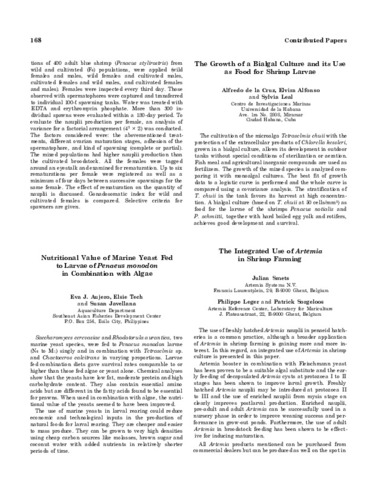
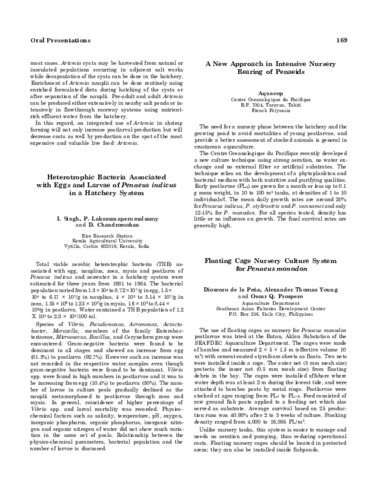
The integrated use of artemia in shrimp farming
(Aquaculture Department, Southeast Asian Fisheries Development Center, 1985)The use of freshly hatched Artemia nauplii in penaeid hatcheries is a common practice, although a broader application of Artemia in shrimp farming is gaining more and more interest. In this regard, an integrated use of Artemia in shrimp culture is presented in this paper. Artemia booster in combination with Fleischmann yeast has been proven to be a suitable algal substitute and the early feeding of decapsulated Artemia cysts at protozoea I to II stages has been shown to improve larval growth. Freshly hatched Artemia nauplii may be introduced at protozoea II to III and the use of enriched nauplii from mysis stage on clearly improves postlarval production. Enriched nauplii, pre-adult and adult Artemia can be successfully used in a nursery phase in order to improve weaning success and performance in grow-out ponds. Furthermore, the use of adult Artemia in broodstock feeding has been shown to be effective for inducing maturation. All Artemia products mentioned can be purchased from commercial dealers but can be produced as well on the spot in most cases. Artemia cysts may be harvested from natural or inoculated populations occurring in adjacent salt works while decapsulation of the cysts can be done in the hatchery. Enrichment of Artemia nauplii can be done routinely using enriched formulated diets during hatching of the cysts or after separation of the nauplii. Pre-adult and adult Artemia can be produced either extensively in nearby salt ponds or intensively in flowthrough raceway systems using nutrient-rich effluent water from the hatchery. In this regard, an integrated use of Artemia in shrimp farming will not only increase postlarval production but will decrease costs as well by production on the spot of the most expensive and valuable live food: Artemia. -
Heterotrophic bacteria associated with eggs and larvae of Penaeus indicus in a hatchery system
(Aquaculture Department, Southeast Asian Fisheries Development Center, 1985)Total viable aerobic heterotrophic bacteria (THB) associated with egg, nauplius, zoea, mysis and postlarva of Penaeus indicus and seawater in a hatchery system were estimated for three years from 1981 to 1984. The bacterial population varied from 1.3 × 10⁴ to 8.72 × l07/g in egg, 1.5 × 10⁴ to 6.17 × 10⁷/g in nauplius, 4 × 10³ to 3.14 × 10⁷/g in zoea, 1.35 × 10⁶ to 1.25 × 10⁸/g in mysis, 1.6 × 10⁵ to 8.44 × 10⁶/g in postlarva. Water contained a THB population of 1.2 X 10⁵ to 2.8 × 10⁸/100 ml. Species of Vibrio, Pseudomonas, Aeromonas, Acineto-bacter, Moraxella, members of the family Enterobac-teriaceae, Micrococcus, Bacillus, and Coryneform group were encountered. Gram-negative bacteria were found to be dominant in all stages and showed an increase from egg (81.3%) to postlarva (92.7%). However such an increase was not recorded in the respective water samples even though gram-negative bacteria were found to be dominant. Vibrio spp. were found in high numbers in postlarvae and it was to be increasing from egg (10.4%) to postlarva (80%). The number of larvae in culture pools gradually declined as the nauplii metamorphosed to postlarvae through zoea and mysis. In general, coincidence of higher percentage of Vibrio spp. and larval mortality was recorded. Physico-chemical factors such as salinity, temperature, pH, oxygen, inorganic phosphorus, organic phosphorus, inorganic nitrogen and organic nitrogen of water did not show much variation in the same set of pools. Relationship between the physico-chemical parameters, bacterial population and the number of larvae is discussed. -
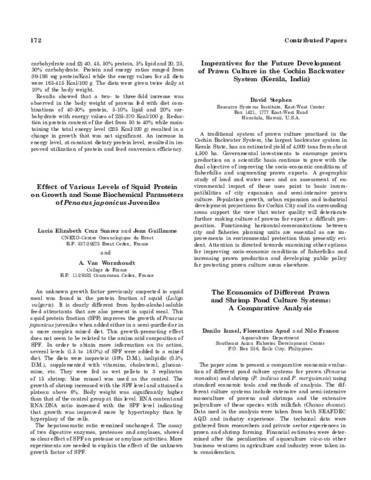
Imperatives for the future development of prawn culture in the Cochin backwater system (Kerala, India)
(Aquaculture Department, Southeast Asian Fisheries Development Center, 1985)A traditional system of prawn culture practised in the Cochin Backwater System, the largest backwater system in Kerala State, has an estimated yield of 4,000 tons from about 4,500 ha. Governmental investments to encourage prawn production on a scientific basis continue to grow with the dual objective of improving the socio-economic conditions of fisherfolks and augmenting prawn exports. A geographic study of land and water uses and an assessment of environmental impact of these uses point to basic incompatibilities of city expansion and semi-intensive prawn culture. Population growth, urban expansion and industrial development projections for Cochin City and its surrounding areas support the view that water quality will deteriorate further making culture of prawns for export a difficult proposition. Functioning horizontal-communications between city and fisheries planning units are essential as are improvements in environmental protection than presently evident. Attention is directed towards examining other options for improving socio-economic conditions of fisherfolks and increasing prawn production and developing public policy for protecting prawn culture areas elsewhere. -
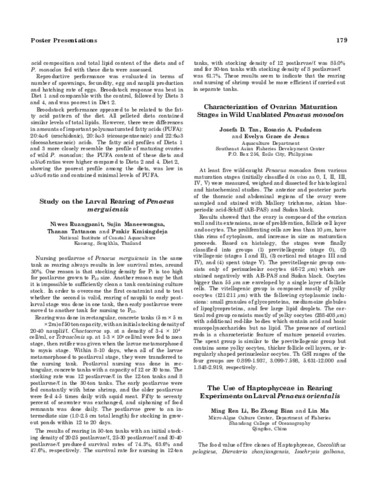
Study on the larval rearing of Penaeus merguiensis
(Aquaculture Department, Southeast Asian Fisheries Development Center, 1985)Nursing postlarvae of Penaeus merguiensis in the same tank as rearing always results in low survival rates, around 30%. One reason is that stocking density for P1 is too high for postlarvae grown to P20 size. Another reason may be that it is impossible to sufficiently clean a tank containing culture stock. In order to overcome the first constraint and to test whether the second is valid, rearing of nauplii to early postlarval stage was done in one tank, then early postlarvae were moved to another tank for nursing to P20. Rearing was done in rectangular, concrete tanks (5 m × 5 m × 2m) of 50 ton capacity, with an initial stocking density of 20-40 nauplii/ℓ. Chaetoceros sp. at a density of 3-4 × 10⁴ cell/ml, or Tetraselmis sp. at 1-3 × 10⁴ cell/ml were fed to zoea stage, then rotifer was given when the larvae metamorphosed to mysis stage. Within 8-10 days, when all of the larvae metamorphosed to postlarval stage, they were transferred to the nursing tank. Postlarval nursing was done in rectangular, concrete tanks with a capacity of 12 or 30 tons. The stocking rate was 12 postlarvae/ℓ in the 12-ton tanks and 8 postlarvae/ℓ in the 30-ton tanks. The early postlarvae were fed constantly with brine shrimp, and the older postlarvae were fed 4-5 times daily with squid meat. Fifty to seventy percent of seawater was exchanged, and siphoning of food remnants was done daily. The postlarvae grew to an intermediate size (1.0-2.5 cm total length) for stocking in grow-out ponds within 12 to 20 days. The results of rearing in 50-ton tanks with an initial stocking density of 20-25 postlarvae/ℓ, 25-30 postlarvae/ℓ and 30-40 postlarvae/ℓ produced survival rates of 74.3%, 63.6% and 47.6%, respectively. The survival rate for nursing in 12-ton tanks, with stocking density of 12 postlarvae/ℓ was 85.0% and for 30-ton tanks with stocking density of 8 postlarvae/ℓ was 61.7%. These results seem to indicate that the rearing and nursing of shrimp would be more efficient if carried out in separate tanks. -
Larval growth and survival optima for four species of penaeids from Australia, as indicated by their distribution and abundance in the field
(Aquaculture Department, Southeast Asian Fisheries Development Center, 1985)Prawn catches from tropical northern Australia are dominated by four species of prawns: Penaeus merguiensis, P. semisulcatus, P. esculentus and P. latisulcatus. Three of the species (P. merguiensis, P. semisulcatus and P. latisulcatus) are widespread throughout the Indo-Pacific, while P. esculentus is endemic to northern and eastern Australia. The species appear, however, to have well defined and limited distribution on a smaller scale. Surveys of the larvae in the Gulf of Carpentaria, northern Australia, have shown both spatial and temporal heterogeneity in the abundance of all four of these species. Assessing the temperatures and salinities in which the larvae were caught may be a realistic indicator of conditions suitable for reproduction, as well as growth and survival of the larvae. Means of these distributions may be deemed optima and ranges indicate tolerances. Most of the larvae of all four species are found in water above 26°C and 31 ppt. However, the mean temperatures and salinities vary significantly between species. P. merguiensis has the lowest salinity optimum (31.8 ppt) and the highest temperature optimum (29.0°C). the other three species are similar for both temperature and salinity optima. P. latisulcatus has the lowest temperature optimum of 27.4°C compared with P. semisulcatus at 27.9°C and P. esculentus at 28.5°C. The salinity optima for these three species are almost indentical at approximately 33.2 ppt. While the ranges of temperatures of all four species are similar (21.5-30.6°C), the ranges of salinities in which the lar-vae are found coincide with the size of the biogeographic distribution of the species. The three widespread species have large salinity ranges: P. merguiensis, 26.2-34.9 ppt P. semisulcatus, 27.8-34.9 ppt: and P. latisulcatus, 28.6-34.9 ppt. The Australian endemic, P. esculentus, has the smallest and highest range, 30.1-34.6 ppt. This apparent inability of P. esculentus to tolerate low salinity water may restrict dispersal during the larval stages. -
Induction to ovary maturation by ablation in the pink shrimp Penaeus notialis
(Aquaculture Department, Southeast Asian Fisheries Development Center, 1985)A partial unilateral ablation was carried out on immature females of the pink shrimp Penaeus notialis. They were maintained in 1,600 ℓ asbestos-cement tanks together with apparently mature males, not submitted to treatment, at a ratio of 2 females: 1 male. A quick development of the ovary was attained, which did not present significant differences in average diameter of the ovocytes in the anterior, median, and posterior lobes, and with similar histological characteristics to those described for naturally mature females. Viable spawnings were obtained three days after the treatment and onwards. The larvae obtained showed normal activity and development. -
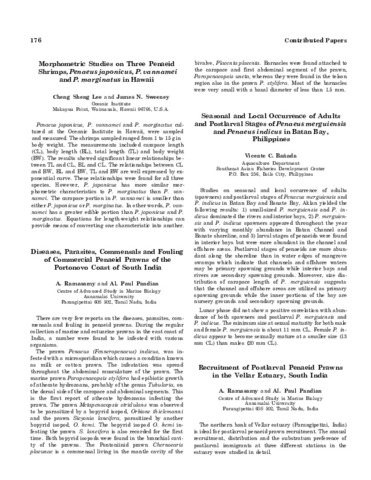
Recruitment of postlarval penaeid prawns in the Vellar estuary, South India
(Aquaculture Department, Southeast Asian Fisheries Development Center, 1985)The northern bank of Vellar estuary (Parangipettai, India) is ideal for postlarval penaeid prawn recruitment. The annual recruitment, distribution and the substratum preference of postlarval immigrants at three different stations in the estuary were studied in detail. Among the postlarvae of Penaeus, P. (Fenneropenaeus) indicus was dominant followed by P. (Penaeus) monodon, P. (P.) semisulcatus, P. (F.) merguiensis and P. (Melicertus) latisulcatus. In Metapenaeus, postlarvae of M. monoceros were abundant followed by M. dobsoni, M. affinis, M. bre-vicornis and M. lysianassa. Two peaks were observed in the postlarval penaeid prawn population. In P (F.) indicus and P. (P.) monodon, the primary peak occurred from January to April and the secondary peak from July to September. In M. monoceros and M. dobsoni, the primary peak was from March to May and the secondary peak from August to September. The postlarvae of P. (F.) indicus, P. (P.) monodon, M. monoceros and M. dobsoni were available throughout the year while the others were seasonal. The distribution of postlarvae in the estuary is related to the type of substratum, salinity and temperature. The postlarval population declined during the northeast monsoon (November-December) and in peak summer (May-June). Their abundance decreased in the lower salinity areas of the upper reaches of the estuary. -
A preliminary economic analysis for extensive and semi-intensive shrimp culture in South Carolina, U.S.A.
(Aquaculture Department, Southeast Asian Fisheries Development Center, 1985)South Carolina has some 28,500 ha of impounded coastal wetlands. These impoundments are remnants of the rice culture industry of the 19th century and are now of interest for waterflow management and possibly aquaculture. The purpose of this study was to evaluate and compare the potential for extensive commercial culture of shrimp in salt-marsh impoundments with that for semi-intensive production of shrimp in highland ponds. A hypothetical farm consisting of four 8-ha impoundments or ponds was chosen as the basis for the analysis, and it was assumed that only one crop of shrimp could be produced per year. Two alternative strategies for stocking the impoundments were evaluated: option 1, stock by natural recruitment via tide gates; option 2, stock at low density (25,000/ha) with hatchery-reared postlarvae. Highland ponds were to be stocked at a density of 75,000 PL/ha with hatchery-reared animals. Major fixed costs other than land purchase were considered, including renovation of existing impoundments by cross-diking to form 8-ha units and addition of extra tide gates. Estimates of annual and variable costs for postlarvae (where applicable), feed, labor, chemicals, pumping, supplies, vehicle use, mowing, interest, overhead, and miscellaneous items were also included in the analysis. Results indicated that extensive shrimp culture in salt water impoundments is likely to be a break-even or profitable activity for production levels of 90 kg whole shrimp/ha for stocking option 1, while option 2 would require yields of ≥225 kg/ha. In comparison, semi-intensive culture in highland ponds is likely to be successful if yields of ≥ 800 kg/ha are obtained. This preliminary analysis suggests that both extensive and semi-intensive culture of shrimp may be economically feasible in South Carolina, but this potential is as yet un-proven and shrimp aquaculture must be considered a high risk venture in this area. -
Culture of blue shrimp, Penaeus stylirostris in Sonora, Mexico
(Aquaculture Department, Southeast Asian Fisheries Development Center, 1985)The Centro de Investigaciones Cientificas y Tecnologicas de la Universidad de Sonora has been conducting research on the culture of the blue shrimp Penaeus stylirostris since 1972. Most of the programs carried out are related to intensive culture in the Puerto Peñasco facilities. However, some experiments on semi-intensive and extensive culture have been conducted since 1975. This paper describes the principal aspects of the technology developed; spawners, larval culture, nursery, growth, feed, environmental parameters, water supply and others. While in intensive culture it is possible to attain over 5 kg shrimp/m2, in semi-intensive systems about 1 kg/m2 is obtained. The intensive system uses raceways for the grow-out of shrimp, the semi-intensive and extensive systems use ponds. -
Effect of temperature and salinity on the hatching of eggs and larval development of sugpo, Penaeus monodon
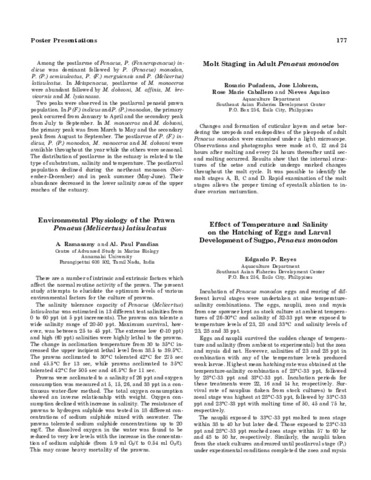
(Aquaculture Department, Southeast Asian Fisheries Development Center, 1985)Incubation of Penaeus monodon eggs and rearing of different larval stages were undertaken at nine temperature-salinity combinations. The eggs, nauplii, zoea and mysis from one spawner kept as stock culture at ambient temperatures of 26-30°C and salinity of 32-33 ppt were exposed to temperature levels of 23, 28 and 33°C and salinity levels of 23, 28 and 33 ppt. Eggs and nauplii survived the sudden change of temperature and salinity (from ambient to experimental) but the zoea and mysis did not. However, salinities of 23 and 28 ppt in combination with any of the temperature levels produced weak larvae. Highest mean hatching rate was obtained at the temperature-salinity combination of 23°C-33 ppt, followed by 28°C-33 ppt and 33°C-33 ppt. Incubation periods for these treatments were 22, 16 and 14 hr, respectively. Survival rate of nauplius (taken from stock cultures) to first zoeal stage was highest at 28°C-33 ppt, followed by 33°C-33 ppt and 23°C-33 ppt with molting time of 50, 45 and 75 hr, respectively. The nauplii exposed to 33°C-33 ppt molted to zoea stage within 38 to 40 hr but later died. Those exposed to 23°C-33 ppt and 28°C-33 ppt reached zoea stage within 57 to 60 hr and 48 to 50 hr, respectively. Similarly, the nauplii taken from the stock cultures and reared until postlarval stage (P1) under experimental conditions completed the zoea and mysis stages in 9 to 11 days at 28°C C-33 ppt, 7 to 9 days at 33°C-33 ppt, and 13 to 15 days at 23°C-33 ppt. Statistical analysis showed that salinity had highly significant effect on rates of hatching of eggs and survival from nauplius to first zoeal stage but not temperature although the latter had an apparent effect. However, both factors affected time of hatching of eggs and time of molting from nauplius to zoea. Interaction effect was significant only on rate and time of hatching. Different sources (spawners) of eggs and nauplii did not have significant effect on time of hatching and molting from nauplius to zoea, but significantly affected the hatching rate of eggs and survival rate of nauplii to zoea stage. -
Induced ovarian maturation and rematuration by eyestalk ablation of Penaeus monodon collected from Indian ocean (Phuket province) and Songkhla lake
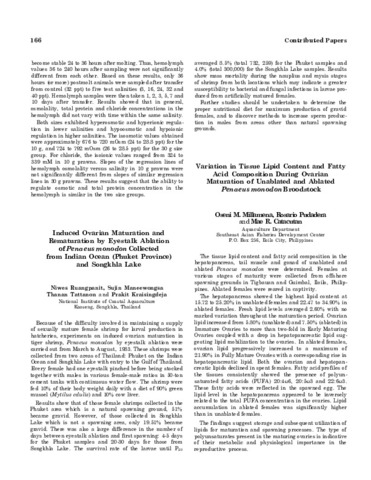
(Aquaculture Department, Southeast Asian Fisheries Development Center, 1985)Because of the difficulty involved in maintaining a supply of sexually mature female shrimp for larval production in hatcheries, experiments on induced ovarian maturation in tiger shrimp, Penaeus monodon by eyestalk ablation were carried out from March to August, 1983. These shrimps were collected from two areas of Thailand: Phuket on the Indian Ocean and Songkhla Lake with entry to the Gulf of Thailand. Every female had one eyestalk pinched before being stocked together with males in various female-male ratios in 50-ton cement tanks with continuous water flow. The shrimp were fed 10% of their body weight daily with a diet of 90% green mussel (Mytilus edulis) and 10% cow liver. Results show that of those female shrimps collected in the Phuket area which is a natural spawning ground, 51% became gravid.However, of those collected in Songkhla Lake which is not a spawning area, only 19.51% became gravid. There was also a large difference in the number of days between eyestalk ablation and first spawning: 4-5 days for the Phuket samples and 20-30 days for those from Songkhla Lake. The survival rate of the larvae until P20 averaged 8.5% (total 732, 259) for the Phuket samples and 4.0% (total 300,000) for the Songkhla Lake samples. Results show mass mortality during the nauplius and mysis stages of shrimp from both locations which may indicate a greater susceptibility to bacterial and fungal infections in larvae produced from artificially matured females. Further studies should be undertaken to determine the proper nutritional diet for maximum production of gravid females, and to discover methods to increase sperm production in males from areas other than natural spawning grounds. -
The use of microencapsulated feeds to replace live food organisms in shrimp hatcheries
(Aquaculture Department, Southeast Asian Fisheries Development Center, 1985)An adequate supply of hatchery produced shrimp fry is the major constraint to the intensification and growth of shrimp culture practices. If even 20% of the more than 500,000 ha of the world's existing tropical and sub-tropical brackishwater ponds were to stock at the relatively low density of 50,000 fry/ha/year, it would take thousands of new hatcheries to produce the 25 billion fry required. The availability of artificially produced diets to replace cultured live food organisms would alleviate many of the problems currently limiting shrimp hatchery production by: (i) reducing the level of technical skill required to operate a hatchery; (ii) assuring a reliable supply of a nutritionally balanced larval feed; (iii) reducing sources of contamination and larval disease; and (iv) simplifying hatchery design and capital cost requirements, thereby facilitating small scale hatchery development. Aquatic farms has been working with the Mars Microencapsulation Research Group (MMRG) to develop techniques for adapting current shrimp hatchery technology and design so that MMRG feeds can be used in existing hatcheries as a live feed replacement. Feeding trials have been conducted in commercial hatcheries in Hawaii, Malaysia and Thailand. The results of these trials and the techniques employed are discussed. Growth and survival of larvae fed microencapsulated diets as total or partial replacement of live foods was comparable to larvae cultured in control tanks using the standard operating procedures of the hatchery in which the trials were conducted. In trials to date, larval survival from nauplii to postlarvae has been as high as 70%. -
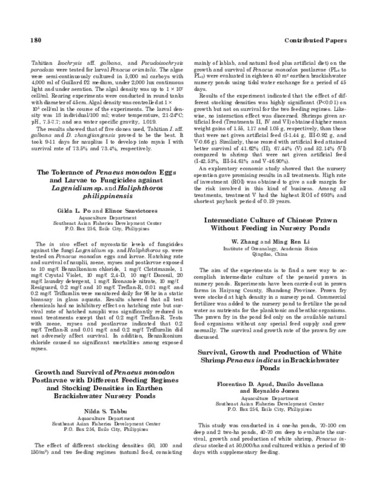
The tolerance of Penaeus monodon eggs and larvae to fungicides against Lagenidium sp. and Haliphthoros philippinensis
(Aquaculture Department, Southeast Asian Fisheries Development Center, 1985)The in vivo effect of mycostatic levels of fungicides against the fungi Lagenidium sp. and Haliphthoros sp. were tested on Penaeus monodon eggs and larvae. Hatching rate and survival of nauplii, zoeae, myses and postlarvae exposed to 10 mg/ℓ Benzalkonium chloride, 1 mg/ℓ Clotrimazole, 1 mg/ℓ Crystal Violet, 10 mg/ℓ 2,4-D, 10 mg/ℓ Daconil, 20 mg/ℓ laundry detergent, 1 mg/ℓ Econazole nitrate, 10 mg/ℓ Resiguard, 0.2 mg/ℓ and 10 mg/ℓ Treflan-R, 0.01 mg/ℓ and 0.2 mg/ℓ Trifluralin were monitored daily for 96 hr in a static bioassay in glass aquaria. Results showed that all test chemicals had no inhibitory effect on hatching rate but survival rate of hatched nauplii was significantly reduced in most treatments except that of 0.2 mg/ℓ Treflan-R. Tests with zoeae, myses and postlarvae indicated that 0.2 mg/ℓ Treflan-R and 0.01 mg/ℓ and 0.2 mg/ℓ Trifluralin did not adversely affect survival. In addition, Benzalkonium chloride caused no significant mortalities among exposed myses. -
Diseases, parasites, commensals and fouling of commercial Penaeid prawns of the Portonovo coast of South India
(Aquaculture Department, Southeast Asian Fisheries Development Center, 1985)There are very few reports on the diseases, parasites, commensals and fouling in penaeid prawns. During the regular collection of marine and estuarine prawns in the east coast of India, a number were found to be infested with various organisms. The prawn Penaeus (Fenneropenaeus) indicus, was infested with a microsporidian which causes a condition known as milk or cotton prawn. The infestation was spread throughout the abdominal musculature of the prawn. The marine prawn Parapenaeopsis stylifera had epibiotic growth of athecate hydrozoans, probably of the genus Tubularia, on the dorsal side of the carapace and abdominal segments. This is the first report of athecate hydrozoans infesting the prawn. The prawn Metapenaeopsis stridulans was observed to be parasitized by a bopyrid isopod, Orbione thielemanni and the prawn Sicyonia lancifera, parasitized by another bopyrid isopod, O. kemi. The bopyrid isopod O. kemi infesting the prawn S. lancifera is also recorded for the first time. Both bopyrid isopods were found in the branchial cavity of the prawns. The Pontoniinid prawn Chernocaris placunae is a commensal living in the mantle cavity of the bivalve, Placenta placenta. Barnacles were found attached to the carapace and first abdominal segment of the prawn, Parapenaeopsis uncta, whereas they were found in the telson region also in the prawn P. stylifera. Most of the barnacles were very small with a basal diameter of less than 1.5 mm. -
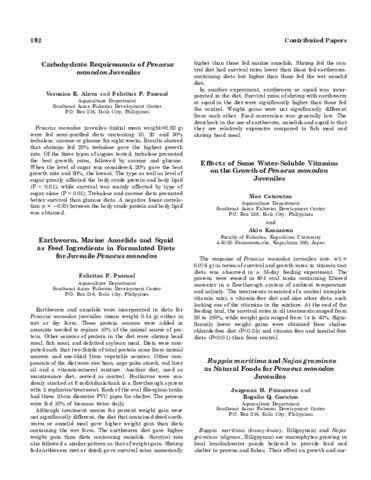
Ruppia maritima and Najas graminea as natural foods for Penaeus monodon juveniles
; Primavera, Jurgenne (Aquaculture Department, Southeast Asian Fisheries Development Center, 1985)
Ruppia maritima (kusay-kusay, Hiligaynon) and Najas graminea (digman, Hiligaynon) are macrophytes growing in local brackishwater ponds believed to provide food and shelter to prawns and fishes. Their effect on growth and survival of Penaeus monodon juveniles (PL50; carapace length, 4.01 mm; body weight, 0.053 g) were studied in 80-ℓ glass aquaria. The treatments were: (a) a commercial pellet (40% protein); (b) live Ruppia; (c) decaying Ruppia; (d) live Najas; and (e) decaying Najas. The pellet was offered to satiety (approx. 100% of body weight) twice daily. Live Ruppia and Najas were transplanted in the aquaria using pond soil a week prior to the experiment. Decaying Ruppia and Najas were transferred from ponds. Salinity was maintained at 15 ppt and 50% of the water was changed regularly. Highly significant differences (P < 0.01) in mean carapace length (CL) and mean body weight (BW) on the 10th, 20th and 30th days were observed among treatments. Increase in CL was fastest with decaying Najas and slowest in live Ruppia (14% vs. 17% after 30 days). Growth with decaying Ruppia was comparable to pellets on the 10th and 20th days but was faster after 30 days. Body weight on all sampling days was highest in decaying Najas and lowest in live Ruppia. Percentage increases were 122, 273 and 565% on the 10th, 20th and 30th days, respectively, with decaying Najas. Those given live Ruppia registered increases of 11, 67 and 94%, respectively. The rapid growth rate of animals on decaying Najas was compensated negatively by a low survival rate (31%), significantly lower than on live Najas (100%). Other survival percentages were: decaying Ruppia, 59% and pellet, 53%.
(Aquaculture Department, Southeast Asian Fisheries Development Center, 1985)
Ruppia maritima (kusay-kusay, Hiligaynon) and Najas graminea (digman, Hiligaynon) are macrophytes growing in local brackishwater ponds believed to provide food and shelter to prawns and fishes. Their effect on growth and survival of Penaeus monodon juveniles (PL50; carapace length, 4.01 mm; body weight, 0.053 g) were studied in 80-ℓ glass aquaria. The treatments were: (a) a commercial pellet (40% protein); (b) live Ruppia; (c) decaying Ruppia; (d) live Najas; and (e) decaying Najas. The pellet was offered to satiety (approx. 100% of body weight) twice daily. Live Ruppia and Najas were transplanted in the aquaria using pond soil a week prior to the experiment. Decaying Ruppia and Najas were transferred from ponds. Salinity was maintained at 15 ppt and 50% of the water was changed regularly. Highly significant differences (P < 0.01) in mean carapace length (CL) and mean body weight (BW) on the 10th, 20th and 30th days were observed among treatments. Increase in CL was fastest with decaying Najas and slowest in live Ruppia (14% vs. 17% after 30 days). Growth with decaying Ruppia was comparable to pellets on the 10th and 20th days but was faster after 30 days. Body weight on all sampling days was highest in decaying Najas and lowest in live Ruppia. Percentage increases were 122, 273 and 565% on the 10th, 20th and 30th days, respectively, with decaying Najas. Those given live Ruppia registered increases of 11, 67 and 94%, respectively. The rapid growth rate of animals on decaying Najas was compensated negatively by a low survival rate (31%), significantly lower than on live Najas (100%). Other survival percentages were: decaying Ruppia, 59% and pellet, 53%. -
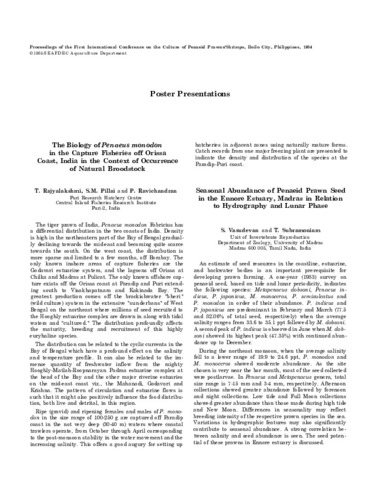
The biology of Penaeus monodon in the capture fisheries off orissa coast, India in the context of occurrence of natural broodstock
(Aquaculture Department, Southeast Asian Fisheries Development Center, 1985)The tiger prawn of India, Penaeus monodon Fabricius has a differential distribution in the two coasts of India. Density is high in the northeastern part of the Bay of Bengal gradually declining towards the mid-east and becoming quite scarce towards the south. On the west coast, the distribution is more sparse and limited to a few months, off Bombay. The only known inshore areas of capture fisheries are the Godavari estuarine system, and the lagoons off Orissa at Chilka and Madras at Pulicat. The only known offshore capture exists off the Orissa coast at Paradip and Puri extending south to Visakhapatnam and Kakinada Bay. The greatest production comes off the brackishwater "bheri" (wild culture) system in the extensive "sunderbans" of West Bengal on the northeast where millions of seed recruited to the Hooghly estuarine complex are drawn in along with tidal waters and "cultured." The distribution profoundly affects the maturity, breeding and recruitment of this highly euryhaline species. The distribution can be related to the cyclic currents in the Bay of Bengal which have a profound effect on the salinity and temperature profile. It can also be related to the immense quantity of freshwater inflow from the mighty Hooghly-Matlah-Roopnarayan Padma estuarine complex at the head of the Bay and the other major riverine estuaries on the mid-east coast viz., the Mahanadi, Godavari and Krishna. The pattern of circulation and estuarine flows is such that it might also positively influence the food distribution, both live and detrital, in this region. Ripe (gravid) and ripening females and males of P. monodon in the size range of 100-250 g are captured off Paradip coast in the not very deep (30-40 m) waters where coastal trawlers operate, from October through April corresponding to the post-monsoon stability in the water movement and the increasing salinity. This offers a good augury for setting up hatcheries in adjacent zones using naturally mature forms. Catch records from one major freezing plant are presented to indicate the density and distribution of the species at the Paradip-Puri coast. -
Lecithin requirement of Penaeus monodon juveniles
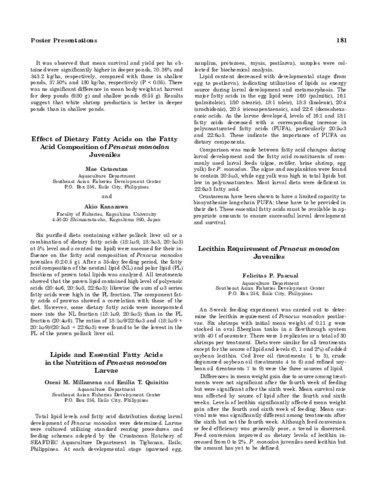
(Aquaculture Department, Southeast Asian Fisheries Development Center, 1985)An 8-week feeding experiment was carried out to determine the lecithin requirement of Penaeus monodon postlarvae. Six shrimps with initial mean weight of 0.11 g were stocked in oval fiberglass tanks in a flowthrough system with 40 ℓ of seawater. There were 5 replicates or a total of 30 shrimps per treatment. Diets were similar for all treatments except for the source of lipid and levels (0, 1 and 2%) of added soybean lecithin. Cod liver oil (treatments 1 to 3), crude degummed soybean oil (treatments 4 to 6) and refined soybean oil (treatments 7 to 9) were the three sources of lipid. Differences in mean weight gain due to source among treatments were not significant after the fourth week of feeding but were significant after the sixth week. Mean survival rate was affected by source of lipid after the fourth and sixth weeks. Levels of lecithin significantly affected mean weight gain after the fourth and sixth week of feeding. Mean survival rate was significantly different among treatments after the sixth but not the fourth week. Although feed conversion or feed efficiency was generally poor, a trend is discerned. Feed conversion improved as dietary levels of lecithin increased from 0 to 2%. P. monodon juveniles need lecithin but the amount has yet to be defined. -
Environmental physiology of the prawn Penaeus (melicertus) latisulcatus
(Aquaculture Department, Southeast Asian Fisheries Development Center, 1985)There are a number of intrinsic and extrinsic factors which affect the normal routine activity of the prawn. The present study attempts to elucidate the optimum levels of various environmental factors for the culture of prawns. The salinity tolerance capacity of Penaeus (Melicertus) latisulcatus was estimated in 13 different test salinities from 0 to 60 ppt (at 5 ppt increments). The prawns can tolerate a wide salinity range of 20-50 ppt. Maximum survival, however, was between 25 to 45 ppt. The extreme low (0-10 ppt) and high (60 ppt) salinities were highly lethal to the prawns. The change in acclimation temperature from 30 to 35°C increased the upper incipient lethal level from 38.5 to 39.5°C. The prawns acclimated to 30°C tolerated 42°C for 275 sec and 45.5°C for 13 sec, while prawns acclimated to 35°C tolerated 42°C for 505 sec and 46.5°C for 11 sec. Prawns were acclimated to a salinity of 26 ppt and oxygen consumption was measured at 5, 15, 26, and 38 ppt in a continuous water-flow method. The total oxygen consumption showed an inverse relationship with weight. Oxygen consumption declined with increase in salinity. The resistance of prawns to hydrogen sulphide was tested in 18 different concentrations of sodium sulphide mixed with seawater. The prawns tolerated sodium sulphide concentrations up to 20 mg/ℓ. The dissolved oxygen in the water was found to be reduced to very low levels with the increase in the concentration of sodium sulphide (from 5.9 ml O2/ℓ to 0.54 ml O2/ℓ). This may cause heavy mortality of the prawns. -
Lipids and essential fatty acids in the nutrition of Penaeus monodon larvae
(Aquaculture Department, Southeast Asian Fisheries Development Center, 1985)Total lipid levels and fatty acid distribution during larval development of Penaeus monodon were determined. Larvae were cultured utilizing standard rearing procedures and feeding schemes adopted by the Crustacean Hatchery of SEAFDEC Aquaculture Department in Tigbauan, Iloilo, Philippines. At each developmental stage (spawned egg, nauplius, protozoea, mysis, postlarva), samples were collected for biochemical analysis. Lipid content decreased with developmental stage (from egg to postlarva), indicating utilization of lipids as energy source during larval development and metamorphosis. The major fatty acids in the egg lipid were 16:0 (palmitic), 16:1 (palmitoleic), 18:0 (stearic), 18:1 (oleic), 18:3 (linolenic), 20:4 (arachidonic), 20:5 (eicosapentaenoic), and 22:6 (docosahexa-enoic acids. As the larvae developed, levels of 16:1 and 18:1 fatty acids decreased with a corresponding increase in polyunsaturated fatty acids (PUFA), particularly 20:5ω3 and 22:6ω3. These indicate the importance of PUFA as dietary components. Comparison was made between fatty acid changes during larval development and the fatty acid constituents of commonly used larval feeds (algae, rotifer, brine shrimp, egg yolk) for P. monodon. The algae and zooplankton were found to contain 20:5ω3, while egg yolk was high in total lipids but low in polyunsaturates. Most larval diets were deficient in 22:6ω3 fatty acid. Crustaceans have been shown to have a limited capacity to biosynthesize long-chain PUFA; these have to be provided in their diet. These essential fatty acids must be available in appropriate amounts to ensure successful larval development and survival. -
Variation in tissue lipid content and fatty acid composition during ovarian maturation of unablated and ablated Penaeus monodon broodstock
(Aquaculture Department, Southeast Asian Fisheries Development Center, 1985)The tissue lipid content and fatty acid composition in the hepatopancreas, tail muscle and gonad of unablated and ablated Penaeus monodon were determined. Females at various stages of maturity were collected from offshore spawning grounds in Tigbauan and Guimbal, Iloilo, Philippines. Ablated females were reared in captivity. The hepatopancreas showed the highest lipid content at 15.72 to 25.20% in unablated females and 22.47 to 34.90% in ablated females. Fresh lipid levels averaged 2.60% with no marked variation throughout the maturation period. Ovarian lipid increased from 5.80% (unablated) and 7.50% (ablated) in Immature Ovaries to more than two-fold in Early Maturing Ovaries coupled with a drop in hepatopancreatic lipid suggesting lipid mobilization to the ovaries. In ablated females, ovarian lipid progressively increased to a maximum of 21.90% in Fully Mature Ovaries with a corresponding rise in hepatopancreatic lipid. Both the ovarian and hepatopancreatic lipids declined in spent females. Fatty acid profiles of the tissues consistently showed the presence of polyunsaturated fatty acids (PUFA) 20:4ω6, 20:5ω3 and 22:6ω3. These fatty acids were reflected in the spawned egg. The lipid level in the hepatopancreas appeared to be inversely related to the total PUFA concentration in the ovaries. Lipid accumulation in ablated females was significantly higher than in unablated females. The findings suggest storage and subsequent utilization of lipids for maturation and spawning processes. The type of polyunsaturates present in the maturing ovaries is indicative of their metabolic and physiological importance in the reproductive process.