SEAFDEC/AQD Institutional Repository: Recent submissions
3441-3460 / 4221
-
The response of Penaeus monodon juveniles to varying protein/energy ratios in test diets
(Aquaculture Department, Southeast Asian Fisheries Development Center, 1985)The response of Penaeus monodon juveniles (0.71±0.11 g) to varying protein/energy ratios in test diets was determined. Purified diets consisting of different levels of protein, lipid and carbohydrates were formulated. Two sets of experiments were conducted with the following diet combinations: (1) 30, 30, 50% protein, 5, 10, 15% lipid and 0, 10, 20% carbohydrate and (2) 40, 45, 50% protein, 5% lipid and 20, 25, 30% carbohydrate. Protein and energy ratios ranged from 89-198 mg protein/Kcal while the energy values for all diets were 165-415 Kcal/100 g. The diets were given twice daily at 10% of the body weight. Results showed that a two- to three-fold increase was observed in the body weight of prawns fed with diet combinations of 40-50% protein, 5-10% lipid and 20% carbohydrate with energy values of 285-370 Kcal/100 g. Reduction in protein content of the diet from 50 to 40% while maintaining the total energy level (285 Kcal/100 g) resulted in a change in growth that was not significant. An increase in energy level, at constant dietary protein level, resulted in improved utilization of protein and feed conversion efficiency. -
Effect of dietary fatty acids on the fatty acid composition of Penaeus monodon juveniles
(Aquaculture Department, Southeast Asian Fisheries Development Center, 1985)Six purified diets containing either pollack liver oil or a combination of dietary fatty acids (18:1ω9, 18:3ω3, 20:5ω3) at 5% level and a control (no lipid) were assessed for their influence on the fatty acid composition of Penaeus monodon juveniles (0.2-0.5 g). After a 35-day feeding period, the fatty acid composition of the neutral lipid (NL) and polar lipid (PL) fractions of prawn total lipids was analyzed. All treatments showed that the prawn lipid contained high level of polyenoic acids (20:4ω6, 20:5ω3, 22:6ω3); likewise the sum of ω3 series fatty acids were high in the PL fraction. The component fatty acids of prawns showed a correlation with those of the diet. However, some dietary fatty acids were incorporated more into the NL fraction (18:1ω9, 20:5ω3) than in the PL fraction (20:4ω6). The ratios of 18:1ω9/22:6ω3 and (18:1ω9 + 20:1ω9)/(20:5ω3 + 22:6ω3) were found to be the lowest in the PL of the prawn pollack liver oil. -
Factors affecting maturation and spawning of Penaeus esculentus in the laboratory
(Aquaculture Department, Southeast Asian Fisheries Development Center, 1985)Adult tiger prawns Penaeus esculentus were held in laboratory tanks under varying conditions of tank size, density, temperature and photoperiod for assessment of ovarian maturation and spawning. Both eyestalk ablated and intact females were studied. Maturation and spawning of intact females was favored by conditions of warm temperature (26°C) and long days (14.5 hr), whereas ovary maturation did not occur at lower temperature (20°C) and short days (12 hr). Tank size was a critical factor with intact females as maturation and spawning required a large tank (4 m2). Spawning did not occur in small tanks (1 m2) despite ideal temperature and photoperiod conditions. Unilaterally ablated females matured and spawned under both short day-cold temperature conditions and in small tanks, but the success rate was greater under long day-warm temperature conditions in large tanks. Intact females required 40-60 days before onset of ovary maturation, whereas ablated females showed maturation to ovary stage III approximately 20 days after ablation. Mating success was severely limited under small tank conditions but occurred normally in the large tanks. -
Water quality criteria for farming the grass shrimp, Penaeus monodon
(Aquaculture Department, Southeast Asian Fisheries Development Center, 1985)Physiological and growth effects of pH, salinity, temperature, heavy metals, pesticides and others on juvenile grass shrimp Penaeus monodon have been investigated to determine the biologically safe concentrations. Optimal pH, salinity and temperature are found to be in the range of 8.0-8.5, 15-25 ppt, and 28-33°C, respectively. A dissolved oxygen concentration of 3.7 ppm seems to be the critical oxygen pressure to support the normal life of grass shrimp. To avoid poor survival and retarded growth, the recommended level for each pollutant are: heavy metals, 0.0025 ppm Hg, 0.1 ppm Cu, 0.15 ppm Cd, 0.25 ppm Zn; pesticides, 0.0004 ppb parathion, 0.001 ppb malathion, 0.008 ppb rotenone, 0.01 ppb Azodrin, 0.033 ppb Saturn, 0.01 ppb paraquat, 0.01 ppb Endosulfan, 1 ppb Butachlor; surfactants, 0.1 ppm Dunall OSE, 0.2 ppm BP 1100, 0.5 ppm Seagreen 805; and others, 0.033 ppm H2S, 0.1 ppm NH3. -
The growth of a bialgal culture and its use as food for shrimp larvae
(Aquaculture Department, Southeast Asian Fisheries Development Center, 1985)The cultivation of the microalga Tetraselmis chuii with the protection of the extracellular products of Chlorella kessleri, grown in a bialgal culture, allows its development in outdoor tanks without special conditions of sterilization or aeration. Fish meal and agricultural inorganic compounds are used as fertilizers. The growth of the mixed species is analyzed comparing it with monoalgal cultures. The best fit of growth data to a logistic curve is performed and the whole curve is compared using a covariance analysis. The stratification of T. chuii in the tank favors its harvest at high concentration. A bialgal culture (based on T. chuii at 50 cells/mm3) as food for the larvae of the shrimps Penaeus notialis and P. schmitti, together with hard boiled egg yolk and rotifers, achieves good development and survival. -
Floating cage nursery culture system for Penaeus monodon
(Aquaculture Department, Southeast Asian Fisheries Development Center, 1985)The use of floating cages as nursery for Penaeus monodon postlarvae was tried at the Batan, Aklan Substation of the SEAFDEC Aquaculture Department. The cages were made of bamboo and measured 2 × 5 × 1.5 m (effective volume 10 m3) with cement-coated styrofoam sheets as floats. Two nets were installed inside a cage. The outer net (3 mm mesh size) protects the inner net (0.5 mm mesh size) from floating debris in the bay. The cages were installed offshore where water depth was at least 2 m during the lowest tide, and were attached to bamboo posts by metal rings. Postlarvae were stocked at ages ranging from PL5 to PL16. Feed consisted of raw ground fish paste applied to a feeding net which also served as substrate. Average survival based on 25 production runs was 40.98% after 2 to 3 weeks of culture. Stocking density ranged from 4,000 to 16,895 PL/m3. Unlike nursery tanks, this system is easier to manage and needs no aeration and pumping, thus reducing operational costs. Floating nursery cages should be located in protected areas; they can also be installed inside fishponds. -
Carbohydrate requirements of Penaeus monodon juveniles
(Aquaculture Department, Southeast Asian Fisheries Development Center, 1985)Penaeus monodon juveniles (initial mean weight=0.62 g) were fed semi-purified diets containing 10, 20 and 30% trehalose, sucrose or glucose for eight weeks. Results showed that shrimps fed 20% trehalose gave the highest growth rate. Of the three types of sugars tested, trehalose promoted the best growth rates, followed by sucrose and glucose. When the level of sugar was considered, 20% gave the best growth rate and 30%, the lowest. The type as well as level of sugar greatly affected the body crude protein and body lipid (P < 0.01), while survival was mainly affected by type of sugar alone (P < 0.01). Trehalose and sucrose diets promoted better survival than glucose diets. A negative linear correlation (r = —0.70) between the body crude protein and body lipid was obtained. -
Survival, growth and production of white shrimp Penaeus indicus in brackishwater ponds
(Aquaculture Department, Southeast Asian Fisheries Development Center, 1985)This study was conducted in 4 one-ha ponds, 70-100 cm deep and 2 two-ha ponds, 40-70 cm deep to evaluate the survival, growth and production of white shrimp, Penaeus indicus stocked at 50,000/ha and cultured within a period of 90 days with supplementary feeding. It was observed that mean survival and yield per ha obtained were significantly higher in deeper ponds, 70.36% and 343.2 kg/ha, respectively, compared with those in shallow ponds, 37.50% and 180 kg/ha, respectively (P < 0.05). There was no significant difference in mean body weight at harvest for deep ponds (9.80 g) and shallow ponds (9.55 g). Results suggest that white shrimp production is better in deeper ponds than in shallow ponds. -
A new approach in intensive nursery rearing of penaeids
(Aquaculture Department, Southeast Asian Fisheries Development Center, 1985)The need for a nursery phase between the hatchery and the growing pond to avoid mortalities of young postlarvae, and provide a better assessment of stocked animals is general in crustacean aquaculture. The Centre Oceanologique du Pacifique recently developed a new culture technique using strong aeration, no water exchange and no external filter or artificial substrates. The technique relies on the development of a phytoplankton and bacterial medium with both nutritive and purifying qualities. Early postlarvae (PL3) are grown for a month or less up to 0.1 g mean weight, in 10 to 100 m3 tanks, at densities of 1 to 10 individuals/ℓ. The mean daily growth rates are around 20% for Penaeus indicus, P. stylirostris and P. vannamei and only 12-15% for P. monodon. For all species tested, density has little or no influence on growth. The final survival rates are generally high. -
Seasonal and local occurrence of adults and postlarval stages of Penaeus merguiensis and Penaeus indicus in Batan bay, Philippines
(Aquaculture Department, Southeast Asian Fisheries Development Center, 1985)Studies on seasonal and local occurrence of adults (spawners) and postlarval stages of Penaeus merguiensis and P. indicus in Batan Bay and Banate Bay, Aklan yielded the following results: 1) small-sized P. merguiensis and P. indicus dominated the rivers and interior bays, 2) P. merguiensis and P. indicus spawners appeared throughout the year with varying monthly abundance in Batan Channel and Banate shoreline, and 3) larval stages of penaeids were found in interior bays but were more abundant in the channel and offshore areas. Postlarval stages of penaeids are more abundant along the shoreline than in water edges of mangrove swamps which indicate that channels and offshore waters may be primary spawning grounds while interior bays and rivers are secondary spawning grounds. Moreover, size distribution of carapace length of P. merguiensis suggests that the channel and offshore areas are utilized as primary spawning grounds while the inner portions of the bay are nursery grounds and secondary spawning grounds. Lunar phase did not show a positive correlation with abundance of both spawners and postlarval P. merguiensis and P. indicus. The minimum size at sexual maturity for both male and female P. merguiensis is about 11 mm CL. Female P. indicus appear to become sexually mature at a smaller size (13 mm CL) than males (20 mm CL). -
Nutritional value of marine yeast fed to larvae of Penaeus monodon in combination with algae
(Aquaculture Department, Southeast Asian Fisheries Development Center, 1985)Saccharomyces cerevasiae and Rhodotorula aurantica, two marine yeast species, were fed to Penaeus monodon larvae (N6 to M1) singly and in combination with Tetraselmis sp. and Chaetoceros calcitrans in varying proportions. Larvae fed combination diets gave survival rates comparable to or higher than those fed algae or yeast alone. Chemical analyses show that the yeasts have low fat, moderate protein and high carbohydrate content. They also contain essential amino acids but are different in the fatty acids found to be essential for prawns. When used in combination with algae, the nutritional value of the yeasts seemed to have been improved. The use of marine yeasts in larval rearing could reduce economic and technological inputs in the production of natural foods for larval rearing. They are cheaper and easier to mass produce. They can be grown to very high densities using cheap carbon sources like molasses, brown sugar and coconut water with added nutrients in relatively shorter periods of time. -
The production economics of an integrated prawn hatchery-floating nursery project
(Aquaculture Department, Southeast Asian Fisheries Development Center, 1985)The paper aims to present an economic evaluation of an integrated prawn (Penaeus monodon) hatchery-floating nursery project using standard economic tools and methods of analysis. The data used in the analysis were taken from SEAFDEC AQD experience at the Batan, Aklan Research Substation hatchery-floating nursery project. The technical bases were gathered from researchers after the peculiarities of aquaculture vis-a-vis other business ventures in agriculture and industry were taken into consideration. The study shows that an integrated hatchery-floating nursery project is a profitable culture system. The rate of return on investment for this integrated project ranges from 29 to 47% while payback period ranges from 1.8 to 2.6 years. A separate economic analysis of a hatchery project and a floating nursery was also undertaken to determine the profitability of independently operating each subsystem. The analysis shows better results for the floating nursery subsystem as compared to the hatchery subsystem. Return on investment and payback period for the floating nursery range from 23 to 78% and 1 to 3 years, respectively, while those for the hatchery range from 20 to 36% and 2.3 to 3.7 years, respectively. -
Effects of diet on reproductive performance of ablated Penaeus monodon broodstock
(Aquaculture Department, Southeast Asian Fisheries Development Center, 1985)Four practical diets were compared for their effects upon ovarian maturation and spawning of ablated Penaeus monodon broodstock. Diets were formulated based upon the fatty acid profile of wild P. monodon. Diets 1 and 3 were cod liver oil-based while Diets 2 and 4 were soybean oil-based. Experimental treatments consisted of each of the formulated diets given in combination with natural food (squid, mussel, and annelids). An all-natural diet served as control. The fatty acid composition and total lipid content of the diets and of P. monodon fed with these diets were assessed. Reproductive performance was evaluated in terms of number of spawnings, fecundity, egg and nauplii production and hatching rate of eggs. Broodstock response was best in Diet 1 and comparable with the control, followed by Diets 3 and 4, and was poorest in Diet 2. Broodstock performance appeared to be related to the fatty acid pattern of the diet. All pelleted diets contained similar levels of total lipids. However, there were differences in amounts of important polyunsaturated fatty acids (PUFA): 20:4ω6 (arachidonic), 20:5ω3 (eicosapentaenoic) and 22:6ω3 (docosahexaenoic) acids. The fatty acid profiles of Diets 1 and 3 more closely resemble the profile of maturing ovaries of wild P. monodon; the PUFA content of these diets and ω3/ω6 ratios were higher compared to Diets 2 and 4. Diet 2, showing the poorest profile among the diets, was low in ω3/ω6 ratio and contained minimal levels of PUFA. -
Advances in shrimp culture in China
(Aquaculture Department, Southeast Asian Fisheries Development Center, 1985)Shrimp experimental ecology studies and the shrimp farming industry in China developed rapidly in the 1970's, and great strides have been made in the mass production of shrimp fry and the growing-out of marketable size shrimp since 1978. The total production of artificially reared shrimp fry and cultivated shrimp increased dramatically in the last few years. The improvement of water quality management and feed supply in larval rearing have resulted in increased production of shrimp fry up to 100,000-200,000 or even 300,000 fry/m3. Advances in the nutritional physiology and biochemistry of the digestive enzymes of juvenile and adolescent shrimp have enabled us to develop different kinds of for mulated feeds with high efficiency and low cost. Techniques for the transplantation and propagation of small benthic crustaceans (e.g. Corophium spp.) or polychaetes (e.g. Nereis spp.) to increase the benthos biomass for natural food of juvenile shrimp in nursery ponds have been developed and successfully practised. Improvement of culture techniques including shrimp pond management, has decreased the mortality of juvenile and young shrimp and increased yields of cultivated shrimp in the country. Highest production of 9,000 kg/ha has been achieved in the semi-intensive culture pond. -
Economics of shrimp culture in Asia
(Aquaculture Department, Southeast Asian Fisheries Development Center, 1985)There is a common belief that the demand for shrimp is so strong that the future of shrimp culture is very bright. However, there is a problem here. The Japanese market for shrimp has been expanding over the past 20 years, and the amount of imported shrimp has reached its ceiling. Since 1980, the amount imported has been 160,000 tons with some allowance. It will be rather difficult to exceed this level with the present price. It is very clear that if imports of shrimp rise above this level, inventory will rapidly increase and price will go down severely. Considering this situation, it is very important to reduce the cost of cultured shrimp because of severe competition in the market. Various shrimp culture systems in Japan and Southeast Asia are described. They range from extensive to intensive systems. An analysis of their economics reveals some interesting facts. The downward trend of the rate of cost per kilogram in intensive culture is very slow compared to those in extensive and semi-intensive culture while the productivity is rising. This is because in intensive pond culture, the ratio of variable cost to total cost is rather high and variable cost does not change as the productivity rises. In the case of extensive pond culture, the ratio of fixed cost to total cost is rather high, so the decrease in fixed cost per kilogram is very high in accordance with the rise of productivity. Therefore, by simply increasing the productivity slightly, the extensive pond can cut its production cost significantly. If the price of shrimp in the market goes down, the intensive pond system will face extinction since it is difficult to cut production cost. Cost forecast for cultured shrimp seems to indicate that extensive and semi-intensive methods will become dominant in the Asian region. Presently, productivity of these systems are low but can be greatly improved by using the "continuing method" and "circulating method" of pond management. The continuing method calls for stocking of different-sized shrimp which will be harvested on a staggered basis. The circulating method employs various sizes of compartments and the stock is moved from densely stocked small compartments to progressively larger grow-out ponds. There has been a rapid expansion of tiger shrimp culture in Taiwan and Southeast Asia recently for the following reasons: (1) high growth rate; (2) high price and broad market; (3) development of technology for hatching and rearing of seedling; and (4) comparative ease with which technical help in culture is obtained from Taiwan and Japan. However, there is a significant demerit. It is not easy in some regions to obtain seedling due to their high price. The supply of seedling of tiger shrimp is absolutely insufficient because of the shortage of mature shrimp. On the other hand, it is easy to get white shrimp seedling at a low price in these regions. In addition to this, the growth rate of white shrimp is similar up to a body length of 12-13 cm in 80-90 days rearing. Cheap cost and a large supply of seedling will easily compensate for the small size. It is therefore important to expand white shrimp culture in Asia. The bright future of white shrimp due to its low production cost is presented in this paper with some data and calculations. -
Overview of penaeid shrimp culture in Asia
(Aquaculture Department, Southeast Asian Fisheries Development Center, 1985)Marine shrimp farming is a century-old practice in some Asian countries. Past sluggish development of the industry is mainly due to the inadequacy of hatchery technology resulting in inconsistent and insufficient supply of shrimp fry hence offsetting large scale development of the industry. Recent success in hatchery techniques coupled with high market demand have generated world-wide interest in developing shrimp farms in Asia. This paper attempts to make an in-depth review of the various aspects confronting the development and expansion of the shrimp farming industry. The cultural significance of the various penaeid shrimps cultivated in Asia (Penaeus monodon, P. japonicus, P. indicus, P. merguiensis and P. orientalis) is critically reviewed in relation to other subtropical species such as P. stylirostris and P. van-namei successfully cultivated in South America. The major constraints confronting large scale cultivation of P. monodon and other commonly important species are discussed and research gaps outlined. Present status of hatchery techniques is discussed and the need for standardization of viable techniques for technology packaging and verification is highlighted to ensure reliable source of seed supply. The various problems in hatchery development, including development of artificial larval feeds, are emphasized. This paper attempts to compare the technological and financial inputs in high technology with traditional farming practices in the region. The grow-out technology in relation to farming intensity and level of investment are outlined with special reference to the socio-economic condition in Asia. The need to develop viable and appropriate shrimp farming technology within the technical and financial capabilities of the rural small shrimp growers is discussed. -
Economics of penaeid culture in the Americas
(Aquaculture Department, Southeast Asian Fisheries Development Center, 1985)Shrimp culture in the Americas began in the early 1970's and has experienced rapid growth in some Latin American countries. Currently, Latin America produces one-third of all cultured shrimp with Ecuador as the leading country in the world. Availability of postlarvae and a favorable year-round climate have been the most important factors causing a "Gold Rush" expansion in Ecuador. The long-term potential for shrimp mariculture in Latin America is promising. Projections for 1990 production of cultured shrimp by Latin American countries are between 60,000-70,000 metric tons (mt). Shrimp culture in the United States has begun with the entry of a few small firms. In this paper, investment and production costs are examined for a semi-intensive farm that purchases postlarvae and operates in the southern United States. Total investment decreases as pond size increases for a given size facility. Investment per kilogram of annual average production ranges from just under US $20.00 for a 20-surface ha farm using 2-ha ponds to $80.00 for a 400-ha system using 20-ha ponds. Operation costs per kilogram decline as the size of the system and the size of the ponds increase. It costs $10.10 to produce one kilogram of shrimp on a 20-surface ha farm using 2-ha ponds compared to $5.50 on a 400-surface ha farm using 20-ha ponds. In comparing the operation of a semi-intensive 200-ha farm in Ecuador with a similar farm in the United States, costs of production were $3.12 and $5.83 per kilogram, respectively. The after-tax internal rate of return (IRR) was 59% in Ecuador and 21% in the United States. These IRR's were calculated under the assumption that production, costs and prices received are constant over the investment period (10 years) considered. When risk and timing of investment are considered, these IRR's are reduced. -
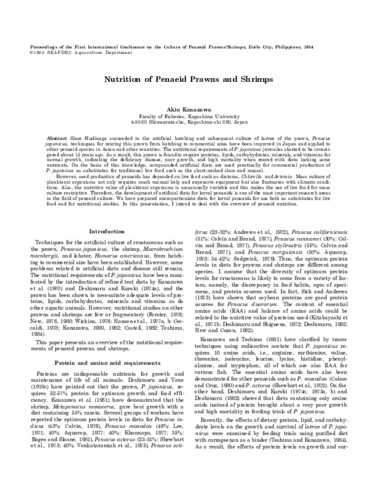
Nutrition of penaeid prawns and shrimps
(Aquaculture Department, Southeast Asian Fisheries Development Center, 1985)Since Hudinaga succeeded in the artificial hatching and subsequent culture of larvae of the prawn, Penaeus japonicus, techniques for rearing this prawn from hatching to commercial sizes have been improved in Japan and applied to other penaeid species in Asian and other countries. The nutritional requirements of P. japonicus juveniles started to be investigated about 15 years ago. As a result, this prawn is found to require proteins, lipids, carbohydrates, minerals, and vitamins for normal growth, indicating the deficiency disease, poor growth, and high mortality when reared with diets lacking some nutrients. On the basis of this knowledge, compounded artificial diets are used practically for commercial production of P. japonicus as substitutes for traditional live food such as the short-necked clam and mussel. However, seed production of penaeids has depended on live food such as diatoms, Chlorella and Artemia. Mass culture of planktonic organisms not only requires much manual help and expensive equipment but also fluctuates with climatic conditions. Also, the nutritive value of planktonic organisms is occasionally variable and this makes the use of live food for mass culture restrictive. Therefore, the development of artificial diets for larval penaeids is one of the most important research areas in the field of penaeid culture. We have prepared microparticulate diets for larval penaeids for use both as substitutes for live food and for nutritional studies. In this presentation, I intend to deal with the overview of penaeid nutrition. -
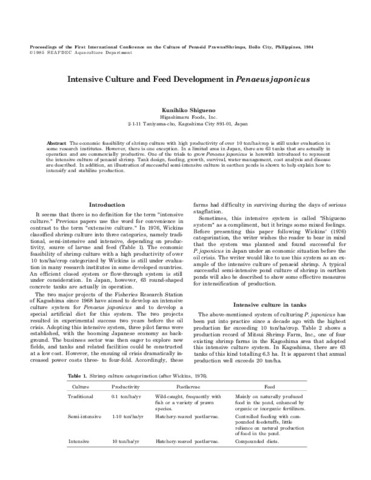
Intensive culture and feed development in Penaeus japonicus
(Aquaculture Department, Southeast Asian Fisheries Development Center, 1985)The economic feasibility of shrimp culture with high productivity of over 10 ton/ha/crop is still under evaluation in some research institutes. However, there is one exception. In a limited area in Japan, there are 63 tanks that are actually in operation and are commercially productive. One of the trials to grow Penaeus japonicus is herewith introduced to represent the intensive culture of penaeid shrimp. Tank design, feeding, growth, survival, water management, cost analysis and disease are described. In addition, an illustration of successful semi-intensive culture in earthen ponds is shown to help explain how to intensify and stabilize production. -
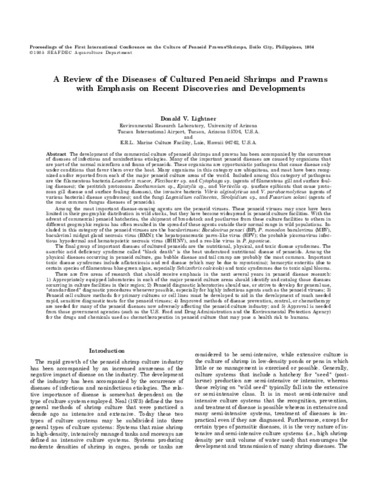
A review of the diseases of cultured penaeid shrimps and prawns with emphasis on recent discoveries and developments
(Aquaculture Department, Southeast Asian Fisheries Development Center, 1985)The development of the commercial culture of penaeid shrimps and prawns has been accompanied by the occurrence of diseases of infectious and noninfectious etiologies. Many of the important penaeid diseases are caused by organisms that are part of the normal microflora and fauna of penaeids. These organisms are opportunistic pathogens that cause disease only under conditions that favor them over the host. Many organisms in this category are ubiquitous, and most have been recognized and/or reported from each of the major penaeid culture areas of the world. Included among this category of pathogens are the filamentous bacteria Leucothrix mucor, Flexibacter sp. and Cytophaga sp. (agents of filamentous gill and surface fouling diseases); the peritrich protozoans Zoothamnium sp., Epistylis sp., and Vorticella sp. (surface epibionts that cause protozoan gill disease and surface fouling diseases), the invasive bacteria Vibrio alginolyticus and V. parahaemolyticus (agents of various bacterial disease syndromes); and the fungi Lagenidium callinectes, Sirolpidium sp., and Fusarium solani (agents of the most common fungus diseases of penaeids). Among the most important disease-causing agents are the penaeid viruses. These penaeid viruses may once have been limited in their geographic distribution in wild stocks, but they have become widespread in penaeid culture facilities. With the advent of commercial penaeid hatcheries, the shipment of broodstock and postlarvae from these culture facilities to others in different geographic regions has often resulted in the spread of these agents outside their normal range in wild populations. Included in this category of the penaeid viruses are the baculoviruses: Baculovirus penaei (BP), P. monodon baculovirus (MBV), baculoviral midgut gland necrosis virus (BMN); the hepatopancreatic parvo-like virus (HPV); the probable picornavirus infectious hypodermal and hematopoietic necrosis virus (IHHNV), and a reo-like virus in P. japonicus. The final group of important diseases of cultured penaeids are the nutritional, physical, and toxic disease syndromes. The ascorbic acid deficiency syndrome called "black death" is the best understood nutritional disease of penaeids. Among the physical diseases occurring in penaeid culture, gas bubble disease and tail cramp are probably the most common. Important toxic disease syndromes include aflatoxicosis and red disease (which may be due to mycotoxins); hemocytic enteritis (due to certain species of filamentous blue-green algae, especially Schizothrix calcicola) and toxic syndromes due to toxic algal blooms. There are five areas of research that should receive emphasis in the next several years in penaeid disease research: 1) Appropriately equipped laboratories in each of the major penaeid culture areas should identify and catalog those diseases occurring in culture facilities in their region; 2) Penaeid diagnostic laboratories should use, or strive to develop for general use, "standardized" diagnostic procedures whenever possible, especially for highly infectious agents such as the penaeid viruses; 3) Penaeid cell culture methods for primary cultures or cell lines must be developed to aid in the development of much needed rapid, sensitive diagnostic tests for the penaeid viruses; 4) Improved methods of disease prevention, control, or chemotherapy are needed for many of the penaeid diseases now adversely affecting the penaeid culture industry; and 5) Approval is needed from those government agencies (such as the U.S. Food and Drug Administration and the Environmental Protection Agency) for the drugs and chemicals used as chemotherapeutics in penaeid culture that may pose a health risk to humans.