SEAFDEC/AQD Institutional Repository: Recent submissions
401-420 / 4221
-
Effects of feeding rate and sediment depth on the survival, growth performance, and biomass of mud polychaete Marphysa iloiloensis from early juvenile to adult in grow-out tanks
Mandario, Mary Anne ; ; (Elsevier, 2022-02-15)
Polychaete aquaculture has progressed in some countries to meet the high demand of fish bait and aquaculture industries. However, knowledge on the aquaculture requirements of polychaetes in the grow-out is still scarce. The present study aimed to determine the optimal feeding rate (FR) and sediment depth (SD) for the grow-out culture of mud polychaete Marphysa iloiloensis from early juvenile to adult stage. The effects of two FRs (50 and 100 g m−2) with three different levels of SD (2, 3, and 5 cm) on M. iloiloensis survival, growth performance, and biomass were evaluated. The study was performed in a 2 × 3 factorial experiment using completely randomized design with four replicates per treatment that lasted 120 days. Early juveniles (30 days old) were stocked in glass tanks at 1000 individuals m−2 and grown for 120 days (herein refer as 'adult', with musculature and capable of reproduction). Regardless of FR, M. iloiloensis had the highest survival of 45 ± 2% in 5 cm SD but statistically comparable to 3 cm SD (34 ± 5%), while survival was significantly lowest in 7 cm SD (26 ± 3%). The levels of nitrite (NO2) and total ammonia nitrogen (TAN) was significantly higher in the rearing water of 100 g m−2 FR than in 50 g m−2 FR. Higher FR resulted to poor water quality and appeared to contribute to the low M. iloiloensis survival in 100 g m−2 FR. Growth performance was similar among treatments. There was a significant interaction between FR and SD on M. iloiloensis biomass (p < 0.05). In 50 g m−2 FR, no difference was observed in the different levels of SD while in 100 g m−2 FR, biomass was significantly higher in 5 cm SD than in 7 cm SD (p < 0.05). M. iloiloensis biomass in 50 g m−2 FR was higher compared to 100 g m−2 FR, regardless of the SD. Overall, the culture of M. iloiloensis using 50 g m−2 FR in 3–5 cm SD showed the best survival and biomass. Based on these findings, it is recommended that the grow-out culture of M. iloiloensis from early juvenile to adult should follow the 50 g m−2 FR and should be done in tanks with 3–5 cm SD to improve production.
; ; (Elsevier, 2022-02-15)
Polychaete aquaculture has progressed in some countries to meet the high demand of fish bait and aquaculture industries. However, knowledge on the aquaculture requirements of polychaetes in the grow-out is still scarce. The present study aimed to determine the optimal feeding rate (FR) and sediment depth (SD) for the grow-out culture of mud polychaete Marphysa iloiloensis from early juvenile to adult stage. The effects of two FRs (50 and 100 g m−2) with three different levels of SD (2, 3, and 5 cm) on M. iloiloensis survival, growth performance, and biomass were evaluated. The study was performed in a 2 × 3 factorial experiment using completely randomized design with four replicates per treatment that lasted 120 days. Early juveniles (30 days old) were stocked in glass tanks at 1000 individuals m−2 and grown for 120 days (herein refer as 'adult', with musculature and capable of reproduction). Regardless of FR, M. iloiloensis had the highest survival of 45 ± 2% in 5 cm SD but statistically comparable to 3 cm SD (34 ± 5%), while survival was significantly lowest in 7 cm SD (26 ± 3%). The levels of nitrite (NO2) and total ammonia nitrogen (TAN) was significantly higher in the rearing water of 100 g m−2 FR than in 50 g m−2 FR. Higher FR resulted to poor water quality and appeared to contribute to the low M. iloiloensis survival in 100 g m−2 FR. Growth performance was similar among treatments. There was a significant interaction between FR and SD on M. iloiloensis biomass (p < 0.05). In 50 g m−2 FR, no difference was observed in the different levels of SD while in 100 g m−2 FR, biomass was significantly higher in 5 cm SD than in 7 cm SD (p < 0.05). M. iloiloensis biomass in 50 g m−2 FR was higher compared to 100 g m−2 FR, regardless of the SD. Overall, the culture of M. iloiloensis using 50 g m−2 FR in 3–5 cm SD showed the best survival and biomass. Based on these findings, it is recommended that the grow-out culture of M. iloiloensis from early juvenile to adult should follow the 50 g m−2 FR and should be done in tanks with 3–5 cm SD to improve production. -
Production and characterization of a monoclonal antibody against Aeromonas hydrophila
(Fish Health Section, Asian Fisheries Society, 2002)A monoclonal antibody (MAb), 8D10, was produced against Aeromonas hydrophila strain 94030 isolated from giant gourami (Osphronemus gourami). This was classified as an IgG2a immunoglobulin by ELISA, and recognised a 41 kDa band on whole cell preparations of the A. hydrophila by Western blotting. The reactivity of the MAb against twenty-five different A. hydrophila isolates was examined by an indirect ELISA and Western blotting. Twelve other bacterial species were also tested by the indirect ELISA to examine the specificity of the MAb. One of the A. hydrophila isolate (strain 95014) gave a strong reaction (89.9%) with the MAb in the ELISA and also recognised the 41 kDa band. Sixteen other strains were weak positive in the ELISA, and eleven of these strains were weakly positive by Western blotting. No cross-reaction with the non-A. hydrophila isolates occurred. -
Study of bacterial loading in macrophage cells of hybrid catfish
(Fish Health Section, Asian Fisheries Society, 2002)Hybrid catfish (Clarias macrocephalus x Clarias gariepinus) farming has developed very successfully in Thailand over the last 10 years. Farmers, however, are still encountering disease problems and, as a result, face economic losses. Some disease problems are associated with inadequate farm management practices. This study was carried out to investigate the presence of bacteria in macrophage cells isolated from hybrid catfish cultured in different environmental conditions. Results from farm investigations showed that the percentage of macrophages containing intracellular bacteria was related to water quality parameters. Experimental trials were conducted using high stocking density as stressor and bath challenge with pathogenic Aeromonas hydrophila. The results showed that fish kept in high density and bath challenged with bacteria had higher percentage of macrophages containing bacteria than those kept under normal conditions. The presence of bacterial loading in macrophage cells is, therefore, considered to be an indication of the health of the fish. -
Humoral immune response of channel catfish to Flavobacterium columnare antigens, lipopolysaccharide and formalin-killed cells, and the protective ability of these antigens
(Fish Health Section, Asian Fisheries Society, 2002)The objective of the experiment was to determine the immunogenicity of various concentrations of formalin-killed whole cells of Flavobacterium columnare and lipopolysaccharide (LPS) from the bacterium, with and without Freund s adjuvant. The immunological protective capability of each antigen preparation was then evaluated. Five antigen preparations of F. columnare; the LPS, LPS plus Freund s complete adjuvant (FCA), formalin-killed whole cells (FKWC) at 1 x 10⁷CFU/ml or optical density (OD) of 0.35 at550 nm, 0.35 OD550 FKWC plus FCA and 6 x 10¹⁰ CFU/ml or 0.9 OD550 FKWC, were immunogenic when injected intraperitoneally in 2nd year channel catfish (Ictalurus punctatus). An increase in antigen concentration from 1 x 10⁷CFU/ml to 6 x 10¹⁰ CFU/ml FKWC did not significantly (p>0.05) increase the antibody titer. The antigen FKWC at a concentration of 1 x 10⁷ CFU/ml was also exposed to the fish by the immersion method. An increase in exposure time of immersion in 1 x 10⁷ CFU/ml from 5 to 15 and 30 min resulted in an increase in antibody titers. Higher antibody production was seen in fish held at 27°C and exposed by immersion to antigen twice. Improved protection in channel catfish fingerlings immunized by intraperitoneal injection with LPS+FCA, FKWC (0.35 OD550), FKWC (0.35 OD550) + FCA, and FKWC (0.9 OD550) antigens over challenged saline and formalin-saline control groups was seen. Fish immunized by immersion in FKWC (OD 0.35550) for 15 min and those immunized by multiple exposure immersion and kept at 27°C also showed improved protection compared to controls or fish immunized by four other immersion immunization regimes. -
Undervalued, understaffed, underdeveloped, and underutilized? The status of public libraries in the eleven municipalities of rural Iloilo Province, Philippines
; ; Superio, Daryl (SAGE Publications, 2023)
Libraries, as service-oriented organizations, are being guided on every aspect of their operation by local and international standards. In the Philippines, public libraries are expected to adhere to the stipulations of the Philippine Standards for Public Libraries. This study was conducted to assess the adherence of the 11 municipal libraries in Iloilo Province to the following areas of the Standards: library administration, collection management, services and utilization, physical facilities, financial resources, and linkages, networking and collaboration. Findings revealed that most libraries were non-compliant with almost all aspects of the Standards. Specifically, the majority lacked support from their local government units and were managed by non-professional librarians with inadequate knowledge and skills in successfully managing a library. Additionally, most libraries have a low budget to purchase updated resources of various types and formats and appropriate facilities and equipment. Furthermore, almost all libraries lacked networks and linkages, and collaborative activities that could have helped librarians enhance their skills, improve library resources and services, and increase their visibility and value to the stakeholders. Consequently, most municipal libraries could not fulfill the community's information needs; therefore, they remained undervalued and underutilized. -
Vibriosis vaccine development: Immunological characterization of Vibrio alginolyticus
(Fish Health Section, Asian Fisheries Society, 2002)The lipopolysaccharide (LPS) profiles of five Vibrio alginolyticus strains (14, 17, 26, 78 and ATCC 17749) were studied by SDS-PAGE. Strains (ST) 14, 17 and 26 were found to possess high molecular weight bands, suggesting that their LPS was highly immunogenic. ST 78 and ATCC possessed only low molecular weight bands, suggesting that their LPS was not highly immunogenic. The LPS and FKC antigens of ST 17, 26 and 78, were injected intraperitoneally in seabass (Lates calcarifer) at 0.2 mg/fish and 0.1 ml/fish at 11.9 X 10⁶ CFU/ml, respectively. Fish were also vaccinated by immersion in formalin-killed cells (11.9 X 10⁶ CFU/ml) for 15 minutes. The mean agglutination titers of fish immunized with ST 17 and 26 were higher compared to strain 78. Fish immunized with antigens from strain 17 showed the highest protection and the protection being significantly different (p<0.05) from that of ST 78. Fish immunized with LPS from the three strains showed significantly (p<0.05) higher protection (survival rate of 80-90%) than that of those injected with FKC. LPS, was thus shown to be a good candidate for a vaccine against vibriosis. -
Finfish immunology and its use in preventing infectious diseases in cultured finfish
(Fish Health Section, Asian Fisheries Society, 2002)This review draws heavily on knowledge and experience gained from studies on cultured finfish, particularly salmonids. The advantages of using the finfish immune system as a means of protecting them against infectious diseases compared to that of chemotherapy and chemoprophylaxis are underlined. The ontogeny of the immune system and its significance relative to attempts to vaccinate finfish are described. Important components of the immune system (both reticuloendothelial and lymphoid) responsible for the humoral and cellular responses and the memory response are considered as are some of the more important factors (fish age/size and water temperature) affecting the performance of the system. Types of vaccines used or being considered for use for preventing important bacterial and viral finfish diseases and for maximizing vaccine efficacy (level and duration of protection) are described. Methods of administering vaccines (injection, immersion, feeding) are outlined and the advantages and disadvantages of the various vaccine delivery systems are discussed. The importance of identifying the virulence factors produced by bacterial and viral pathogens and of using growth media that allow satisfactory expression of these factors is stressed. These factors form the basis of all vaccines and are of pivotal importance with the newer genetically engineered and DNA vaccines which, thus far, have focused on only one factor per vaccine. Finally, the possibility and utility of providing short-term (passive) protection to larval finfish by immunization of their mothers are discussed. -
In situ hybridization: A detection tool for fish pathogens and its application on recent advances on whirling disease research
(Fish Health Section, Asian Fisheries Society, 2002)A non-radioactive in situ hybridization (ISH) protocol was used as a diagnostic tool for several fish pathogens including Candidatus Xenohaliotis californiensis, the etiologic agent of withering syndrome, which is a new disease in wild and cultured abalone Haliotis spp., the microsporidian Nucleospora salmonis and the myxozoan parasite Tetracapsula bryosalmonae (previously referred to as PKX) that causes proliferative kidney disease in salmonids. Most applications of the ISH protocol in our -laboratory were used in pathogenesis studies of whirling disease caused by the myxosporean Myxobolus cerebralis. -
Effects of praziquantel on metacercarial cysts of Centrocestus sp. on the gills of goldfish Carassius auratus
(Fish Health Section, Asian Fisheries Society, 2002)Effects of praziquantel (a compound for trematode and cestode control in dogs) on metacercarial cysts of Centrocestus sp. (a digenetic trematode: Family Heterophyidae) occurring on the gills of goldfish Carassius auratus were investigated by oral and bath treatments. Praziquantel incorporated to the feed at a dose of 200 ppm for 7 days (feed ration of 3% of the body weight/day) was effective in killing 94% ±3.8 of metacercariae. Bath treatment with 0.75 ppm killed only 49% ± 5.2 of metacercariae; dosages higher than 0.75 ppm stressed the fish. Mortality recorded for the control group of fish over a period of 6 weeks was 89% ± 2.8, while the recorded mortality for fish that received oral and bath treatments over the same period of time was 7.3% ± 0.7 and 22.3% ± 1.7 respectively. Results revealed that oral administration of praziquantel is more effective in killing metacercariae of Centrocestus sp. -
Diseases of seabass, Lates calcarifer, larvae from hatcheries in Indonesia
(Fish Health Section, Asian Fisheries Society, 2002)This paper describes three diseases of seabass (Lates calcarifer) larvae: viral nervous necrosis (VNN), glugeosis microsporidian infection, and a bacterial infection observed in private hatcheries in Indonesia from 1997-1998. VNN of seabass larvae was initially recorded in one hatchery in Situbondo, East Java in August 1997. Occurence in hatcheries in Bali and Banyuwangi, East Java was recorded in the same year. Cumulative mortalities in each case reached 100% within one week. The signs include abnormal swimming, or fish remaining on the tank bottom. Histopathologically, necrosis and vacuolation were observed in the brain and retina of affected larvae. Abundant spherical viral particles, 30 nm in diameter, were found in the cytoplasm of affected nerve cells. Glugeosis and bacterial infection were observed in seabass larvae in Banyuwangi, East Java in 1998. Larvae with glugeosis had numerous whitish cysts (xenoma), 0.5-1.5 mm in diameter, in the abdominal cavity. The cysts were composed of Glugea spores measuring 5-6.5 µm x 2.0-2.5 µm in size. The disease caused mortalities up to 10%. Outbreaks of bacterial disease resulted in 100% mortalities within one week. Diseased larvae showed sluggish swimming near the water surface or weak swimming near the tank bottom. Histological sections of liver tissues showed Grain-negative rods, but isolation of the bacteria was not successful. -
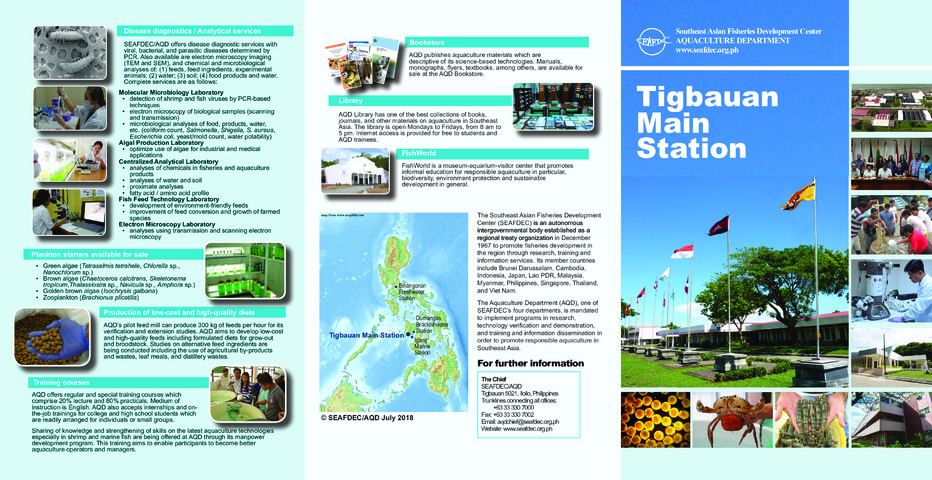
Tigbauan Main Station
(Aquaculture Department, Southeast Asian Fisheries Development Center, 2018)Established in 1973, the Tigbauan Main Station (TMS) is the SEAFDEC/ AQD headquarters located on the south coast of Panay Island. The 40-hectare complex includes various research laboratories, hatcheries, and broodstock ... -
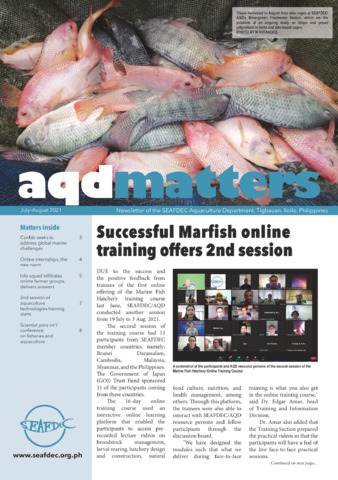
AQD Matters 2021 July - August
(Aquaculture Department, Southeast Asian Fisheries Development Center, 2021-10)In this issue: 1) Confab seeks to address global marine challenges; 2) Online internships, the new norm; 3) Info squad infiltrates online farmer groups, delivers answers; 4) 2nd session of aquaculture technologies training ... -
Life cycle of the blood fluke Sanguinicola armata Plehn, 1905 (Digenea: Sanguinicolidae), parasite of freshwater fishes in Malaysia
(Fish Health Section, Asian Fisheries Society, 2002)The blood fluke Sanguinocola armata is a parasite with a simple, two-host life cycle involving an aquatic mollusc, the intermediate host where cercariae develop, and a fish, which is the definitive host. In Malaysia, S. armata was first reported in bighead carp (Aristichthys nobilis) and grass carp (Ctenopharyngodon idella) fingerlings imported from Taiwan. In 1991, cercariae of S. armata have been observed in freshwater snail and the adult fluke in locally produced grass carp fingerlings. Preliminary investigation showed that the snail, Gyraulus sp., was infected with the furcocercous cercariae. Laboratory experiments were carried out to verify the role of this freshwater as the intermediate host of the blood fluke. Uninfected snails were exposed to infected grass carp fingerlings for 24 hours and were screened daily for presence of sporocyst or cercariae. For the laboratory infection of uninfected grass carp fingerlings, 102 uninfected grass carp fingerlings were exposed to cercariae for 24 hours. The post-exposed grass carp fingerlings were randomly chosen daily for the examination of S. armata infection. Results showed that the sporocyst and cercariae stages of S. armata were found in the digestive gland of the snail Gyraulus convexiusculus. Cercariae emerged from the infected snails throughout the evening of day-14 up to day-17. These furcocercous cercariae swam actively with alternating periods of passive flotation and infected the definitive host by penetration through the abdominal area. Immature and mature S. armata were found in the bulbous arteriosus of C. idella on the twelfth and eighteenth day respectively. Immature eggs were seen in gill, liver, kidney and heart on day-18 until day-77. Triangular eggs containing ciliated miracidia were observed only in the gill. Overall, 40 to 43 days were needed for S. armata to complete its life cycle at 27°C. -
Recent advances in fish parasitology in Japan
(Fish Health Section, Asian Fisheries Society, 2002)Recent advances in fish parasitological studies in Japan focus mainly on myxosporean, microsporean and monogenean infections. Myxosporeans: The two-host life cycle has been elucidated for several freshwater species in Japan. Actinosporean stages were studied, not only their morphology, but also their biology, viz. their viability in water, response to fish mucus, and portals of entry to fish. Myxobolus artus and Thelohanellus hovorkai, both parasites of carp Cyprinus carpio, cause severe damage when spores leave the host. Kudoa amamiensis infection of yellowtail, Seriola quinqueradiata, had a patchy geographical distribution in Okinawa, perhaps reflecting the distribution of its unknown alternate invertebrate host. With the development of PCR probes, the sensitivity of detection of infection in fish has dramatically increased. Microsporeans: Little is known about their mechanism of infection. Macrophages of ayu, Plecoglossus altivelis, recognized glycoproteins on the surface of Glugea plecoglossi spores, and produced much more H2O2 than O2 against phagocytized spores. It may be that G. plecoglossi utilizes this host defense mechanism to establish the infection in ayu. With no chemotherapeutants commercially available, Microsporidium seriolae infection of yellowtail was prevented by using filtered water to maintain fry in tanks, and Glugea-infected ayu was treated by raising the temperature of rearing water. Both PCR and a fluorescent dye, Uvitex 2B, were very sensitive tools to detect infection. Monogeneans: Egg entanglement on the culture net mesh was quantified in Heterobothrium okamotoi infection of tiger puffer, Takifugu rubripes. In vitro attachment of several species of oncomiracidia on cell wells coated with lyophilized extracts of skin epithelia of different fish species suggests a complex nature of their host specificity. Japanese flounder, Paralichthys olivaceus, and tiger puffer infected with Neobenedenia girellae and H. okamotoi, respectively, acquired immunity against reinfection. Tiger puffer develops antibodies against H. okamotoi, but the mechanism of immunity is not yet completely understood. Freshwater or H2O2 bath treatment of B. seriolae-infected yellowtail is effective, but laborious. Experiments showed that, as an alternative method, oral administration of praziquantel was easier and as effective as bath treatment. Most studies introduced here are related to parasite biology. This is because we aim to develop control measures against parasitic diseases with minimal reliance on chemotherapeutic agents. -
Detection and identification of aquatic Mycobacterium species in fish, fish farm workers and the environment
(Fish Health Section, Asian Fisheries Society, 2002)Mycobacteriosis, caused by Mycobacterium spp, is a common disease in snakehead (Channa striata) and Siamese fighting fish (Betta splendens). In Thailand, snakehead is an economically important food species, while Siamese fighting fish is one of the main ornamental species cultured for export. Mycobacteriosis is not confined to fish and can also be transmitted to humans. M. marinum has been reported to be the main species involved in mycobacteriosis in both fish and man. The results from this study showed that M. fortuitum as well as M. marinum, is involved in Mycobacterium infections observed on Siamese fighting fish and snakehead fish farms. Both M. fortuitum and M. marinum were detected in samples collected from the fish s environment, including water and fish food, although M. fortuitum appeared to be the more prevalent of the two species. However, a large number of the Mycobacterium spp. detected in the samples collected from the farms remains unspeciated. Workers on the Siamese fighting fish farms were affected by skin lesions, while those on snakehead fish farms were not unaffected. When biopsies of the lesions were analysed by polymerase chain reaction and reverse cross blot hybridisation, M. fortuitum together with unspeciated Mycobacterium sp. appeared to be the main aetiological agents associated with the lesions. -
Pathogenic Vibrio isolates from cultured seabass (Lates calcarifer), groupers (Epinephelus spp.) and red snappers (Lutjanus spp.)
(Fish Health Section, Asian Fisheries Society, 2002)Heavy mortality of cultured seabass (Lates calcarifer), groupers (Epinephelus spp.) and snappers (Lutjanus spp.) due to bacterial infection is a common problem in Malaysia. All the three species exhibited a wide range of clinical signs in the presence of suspected Vibrio spp. infection. Early stages of infection in the three cultured species ranged from abnormal body color change, poor swimming activity and feeding, and erythema and hemorrhage in and around the mouth and at the base of fins. Advance stages of infections showed petechiae and ulcerative haemorrhagic lesions. This study was carried out to isolate the various pathogenic Vibrio spp. affecting the cultured finfish and to differentiate their strains by morphological, physiological and biochemical characters. -
Birnaviruses of potential new serogroups isolated from tropical fish
(Fish Health Section, Asian Fisheries Society, 2002)Over the last 10 years, viruses have been isolated from fish imported into Singapore and also from indigenous fish in Singapore. In 1993, the marble goby Oxyeleotris marmorata** underwent viral diagnostic investigation as there were frequent reports of high losses in that species after importation into Singapore. Viruses, identified as birnaviruses based on their size and a double-stranded RNA genome, were isolated in BF-2 cells from marble gobies which were imported from four other Asian countries. The viruses underwent serotyping using antisera against all nine serotypes in birnavirus Serogroup A and the single serotype in Serogroup B. The viruses did not cross react at all with any of the antisera. However, they were neutralised with an antiserum against a birnavirus isolated in 1991 from a single giant snakehead, Channa (=Ophicephalus) micropeltes, held in a Singapore farm. That birnavirus was also not neutralised by any birnavirus Serogroup A or B antisera, and Serogroup A or B viruses were not neutralised by the antiserum against the virus isolated from C. micropeltes. On that basis the marble goby and snakehead birnaviruses should be classified as members of a new birnavirus Serogroup. -
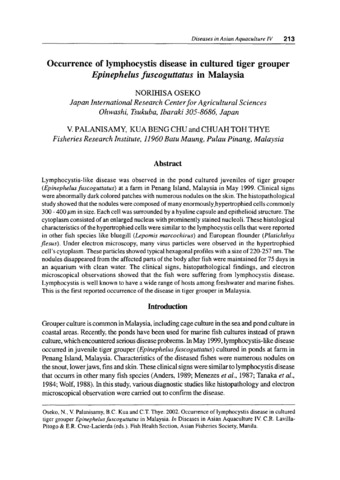
Occurrence of lymphocystis disease in cultured tiger grouper Epinephelus fuscoguttatus in Malaysia
(Fish Health Section, Asian Fisheries Society, 2002)Lymphocystis-like disease was observed in the pond cultured juveniles of tiger grouper (Epinephelus fuscoguttatus) at a farm in Penang Island, Malaysia in May 1999. Clinical signs were abnormally dark colored patches with numerous nodules on the skin. The histopathological study showed that the nodules were composed of many enormously hypertrophied cells commonly 300 - 400 µm in size. Each cell was surrounded by a hyaline capsule and epithelioid structure. The cytoplasm consisted of an enlarged nucleus with prominently stained nucleoli. These histological characteristics of the hypertrophied cells were similar to the lymphocystis cells that were reported in other fish species like bluegill (Lepomis marcochirus) and European flounder (Platichthys flesus). Under electron microscopy, many virus particles were observed in the hypertrophied cell s cytoplasm. These particles showed typical hexagonal profiles with a size of 220-257 nm. The nodules disappeared from the affected parts of the body after fish were maintained for 75 days in an aquarium with clean water. The clinical signs, histopathological findings, and electron microscopical observations showed that the fish were suffering from lymphocystis disease. Lymphocystis is well known to have a wide range of hosts among freshwater and marine fishes. This is the first reported occurrence of the disease in tiger grouper in Malaysia. -
Major viral and bacterial diseases of cultured seabass and groupers in Southeast Asia
(Fish Health Section, Asian Fisheries Society, 2002)Floating net-cage culture of fish was established in the early 1970s in Southeast Asia and has become very popular since. Although several species of marine and diadromous fishes have been successfully cultured, only a few species, particularly the seabass (Lates calcarifer) and grouper (Epinephelus spp.), are widely cultured. The expansion of commercial culture of marine and estuarine finfishes has been accompanied by the occurrence of diseases of infectious and noninfectious etiologies. Among the recognized causative agents of infectious diseases are protozoa, fungi, bacteria and viruses. Bacterial diseases, caused by Vibrio species (particularly V. parahemlyticus, V. anguillarum, and V. vunificus), and myxobacterial infection due to Flexibacter sp. and Flavobacterium sp. have continued to accompany the growth of marine fish cage-culture industry. Viral diseases include Lymphocystis, viral encephalitis and iridovirus infection. This paper reviews the major bacterial and viral pathogens of economically important finfishes, with emphasize on seabass and grouper. -
Diseases of maricultured gastropods and bivalves in Japan
(Fish Health Section, Asian Fisheries Society, 2002)Recently, some serious disease problems have occurred in cultured species of gastropods and bivalves in Japan. Among the current problems, amyotrophia of abalones (Nordotis species) and epizootic mortality of pearl oysters (Pinctada fucata martensii), are briefly described in this minireview. Amyotrophia occurs in juveniles of Japanese black abalone (Nordotis discus discus) and two other species of abalones (N. discus hannai, N. madaka) in hatcheries in the late spring, causing muscle atrophy in the mantle and epipodium and abnormal cell masses in the nerve tissues and gills. Although the disease was produced in susceptible juveniles of black abalone by inoculating filtered homogenate of affected abalones, the causative agent has not yet been determined. Epizootic mortalities of pearl oyster have been observed in western Japan since 1996. The adductor muscle of diseased animals often becames reddish and various histopathological changes, such as necrosis and atrophy, occur in both the adductor muscle and heart. Association of the toxic dinoflagellate Heterocapsa circularisquama, the protistan parasite Perkinsus sp. and birnavirus were first suspected, but now a virus or a filterable agent is thought to be the causative agent of the mortality.