SEAFDEC/AQD Institutional Repository: Recent submissions
4101-4120 / 4221
-
Utilization of seaweeds in Thailand
(Aquaculture Department, Southeast Asian Fisheries Development Center, 1990)Different seaweeds harvested from natural stocks are utilized in Thailand as human food and animal feed and for medicinal purpose and extraction of crude agar. Gracilaria and Porphyra are the most exploited commercially. Commercial cultivation through seaweed farming is recommended. -
Utilization and farming of seaweeds in Indonesia
(Aquaculture Department, Southeast Asian Fisheries Development Center, 1990)A great variety of seaweeds grow abundantly along the 81,000-km coastline of the 13,000 islands comprising the Indonesian archipelago. However, it is only recently that the economic importance of seaweeds has really been appreciated. At present, seaweeds collected in Indonesia are mainly used for food supplement, domestic agar manufacture, and for export. Because of the increasing demands for the carrageenan-containing seaweed, mass cultures have been undertaken in both experimental and production sites established in many parts of the country. These efforts are expected to increase the annual volume of exports from 2000 to 6000 mt. The paper reviews the state and problems of seaweed utilization, development, and farming efforts in Indonesia. -
Present status of seaweed culture in Korea
(Aquaculture Department, Southeast Asian Fisheries Development Center, 1990)Seaweeds from natural stocks as well as from aquaculture have been widely utilized in Korea for a long time. Porphyra was first cultivated 360 years ago. The culture of Undaria pinnatifida was introduced more than 10 years ago. Laminaria spp. were also introduced by employing an artificial culture method. L. religiosa was grown in natural beds along the middle part of the eastern coast after the initiation of farming of this species. At present, production of U. pinnatifida from farms is much greater than the natural harvest. The most widely cultured species of Porphyra is P. yezoensis , but P. tenera is also farmed in some areas. After Conchocelis was successfully grown, the artificial seedling method became very popular. The production of cultured Porphyra was 34,025 mt in 1980; U. pinnatifida , 153,333 mt in 1979; Laminaria , 5192 mt in 1979. -
Algal production and utilization relevant to aquaculture in the Philippines
(Aquaculture Department, Southeast Asian Fisheries Development Center, 1990)An outline is given of research conducted at the Aquaculture Department of SEAFDEC at Rizal, Philippines regarding algal culture and utilization. Culture methods for both brackishwater and freshwater algae are described and details given of applications of microalgae in the aquaculture industry, which include feed for fish and shrimp larvae. -
Philippine algal taxonomy: Past, present, and future
(Aquaculture Department, Southeast Asian Fisheries Development Center, 1990)This paper presents a historical account of the development of algal taxonomy in the Philippines, from its early beginnings in 1800 to the present, with emphasis on marine forms. Marine algal taxonomists in the country are urged to shift emphasis from the classical morphologic approach to the chemotaxonomic and cytologic method in attempts at resolving the classification and phylogeny of important marine groups such as the polymorphic and economically important Caulerpa, Ulva, Codium, Sargassum , and Gracilaria . Chemotaxonomy has close affinity with the morphological approach, hence is given priority over cytology with the use of the scanning electron microscope. -
Seaweed resources in the developing countries of Asia: Production and socio-economic implications
(Aquaculture Department, Southeast Asian Fisheries Development Center, 1990)The bulk of world seaweed production today comes from developed countries in the temperate region, including Japan, China, and Korea. The seaweed production potentials in the developing countries of Asia will have to be explored to meet the increasing world demand. Extensive shallow and farmable reef areas as well as cheap labor highly favor seaweed production. Harvesting from natural stocks is unreliable; efforts should thus be directed toward actual farming of seaweeds. In the Philippines, development of the farming technology on Eucheuma alvarezii and E. denticulatum significantly increased production by the middle of the 70 s. Harvests of Eucheuma from farms and other seaweeds from natural stocks now rank third among the fishery exports of the country. The socioeconomic implications of the development of the seaweed resources in the developing countries of Asia are discussed. The Philippine experience is cited specifically to show the benefits derived from seaweed farming technology. -
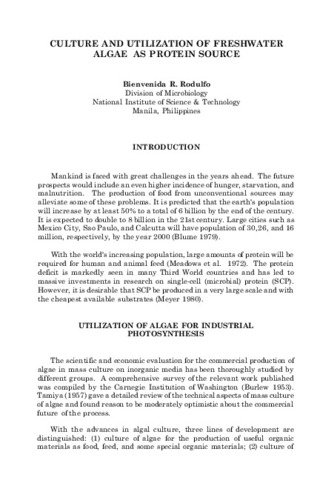
Culture and utilization of freshwater algae as protein source
(Aquaculture Department, Southeast Asian Fisheries Development Center, 1990)A discussion is presented on the commercial production of algae in mass culture conditions as a source of single-cell protein. Particular reference is made to the food situation in the Philippines, and research conducted by the Institute of Science and Technology regarding protein-rich algal strains suitable for commercial culture. -
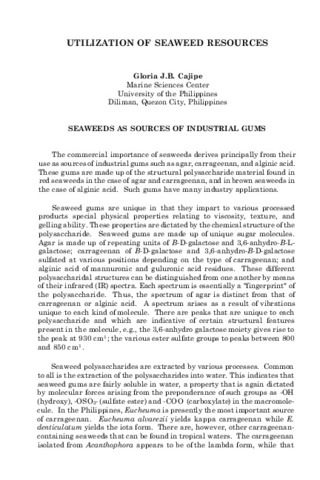
Utilization of seaweed resources
(Aquaculture Department, Southeast Asian Fisheries Development Center, 1990)A brief discussion is presented on the commercial importance of seaweeds in the Philippines, which is mainly concerned with their use as sources of industrial gums such as agar, carrageenan, and alginic acid. Carrageenan as a substitute for microbiological agar and the use of seaweeds as a binder of heavy metal pollutants are examined. -
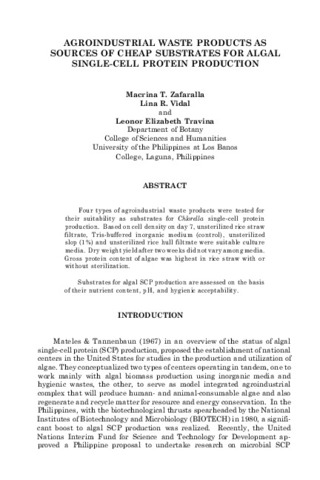
Agroindustrial waste products as sources of cheap substrates for algal single-cell protein production
(Aquaculture Department, Southeast Asian Fisheries Development Center, 1990)Four types of agroindustrial waste products were tested for their suitability as substrates for Chlorella single-cell protein production. Based on cell density on day 7, unsterilized rice straw filtrate, Tris-buffered inorganic medium (control), unsterilized slop (1%) and unsterilized rice hull filtrate were suitable culture media. Dry weight yield after two weeks did not vary among media. Gross protein content of algae was highest in rice straw with or without sterilization. Substrates for algal SCP production are assessed on the basis of their nutrient content, pH, and hygienic acceptability. -
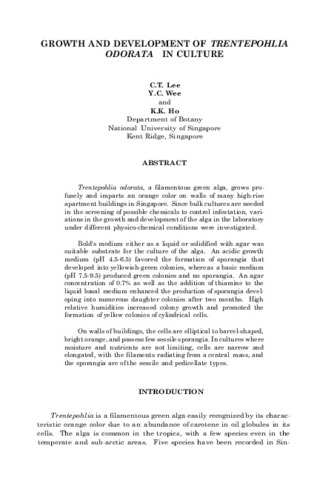
Growth and development of Trentepohlia odorata in culture
(Aquaculture Department, Southeast Asian Fisheries Development Center, 1990)Trentepohlia odorata, a filamentous green alga, grows profusely and imparts an orange color on walls of many high-rise apartment buildings in Singapore. Since bulk cultures are needed in the screening of possible chemicals to control infestation, variations in the growth and development of the alga in the laboratory under different physico-chemical conditions were investigated. Bold's medium either as a liquid or solidified with agar was suitable substrate for the culture of the alga. An acidic growth medium (pH 4.5-6.5) favored the formation of sporangia that developed into yellowish-green colonies, whereas a basic medium (pH 7.5-9.5) produced green colonies and no sporangia. An agar concentration of 0.7% as well as the addition of thiamine to the liquid basal medium enhanced the production of sporangia developing into numerous daughter colonies after two months. High relative humidities increased colony growth and promoted the formation of yellow colonies of cylindrical cells. On walls of buildings, the cells are elliptical to barrel-shaped, bright orange, and possess few sessile sporangia. In cultures where moisture and nutrients are not limiting, cells are narrow and elongated, with the filaments radiating from a central mass, and the sporangia are of the sessile and pedicellate types. -
Foreword
(Aquaculture Department, Southeast Asian Fisheries Development Center, 1990) -
Series: Aquaculture extension manual; No. 20
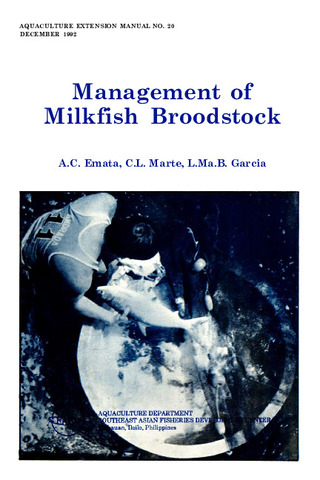
Management of milkfish broodstock
; ; Garcia, Luis Maria (Aquaculture Department, Southeast Asian Fisheries Development Center, 1992)
The manual on milkfish (Chanos chanos) broodstock management covers the following topics: reproductive biology; sources of broodstock; holding facilities for broodstock; feeding; determination of gonadal development; spawning and egg collection; transport of spawned eggs; determination of percent viable eggs; and determination of hatching rate.
(Aquaculture Department, Southeast Asian Fisheries Development Center, 1992)
The manual on milkfish (Chanos chanos) broodstock management covers the following topics: reproductive biology; sources of broodstock; holding facilities for broodstock; feeding; determination of gonadal development; spawning and egg collection; transport of spawned eggs; determination of percent viable eggs; and determination of hatching rate. -
Series: Aquaculture extension manual; No. 17
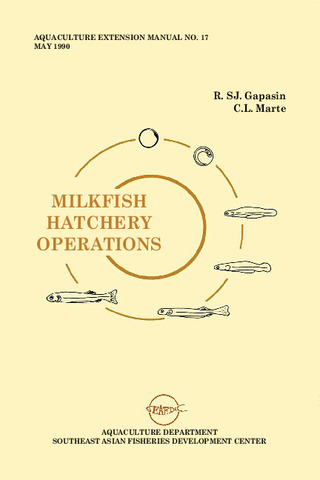
Milkfish hatchery operations
(Aquaculture Department, Southeast Asian Fisheries Development Center, 1990)The manual is intended primarily for practicing prawn hatchery operators who would like to diversify their operations to include larval rearing of milkfish (Chanos chanos). Only those procedures important in the daily operations of a milkfish hatchery are described in detail, under the following headings: Essential facilities - tanks and equipment; Production of natural food - Chlorella culture and Brachionus culture; Production of milkfish fry - preparation of hatching and larval rearing tanks, hatching of milkfish eggs, stocking of larvae, larval rearing, and harvesting. -
Series: Aquaculture extension manual; No. 18
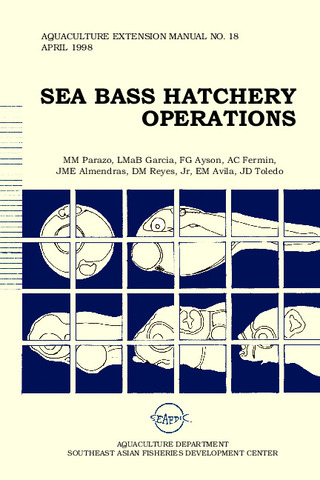
Sea bass hatchery operations
; Garcia, Luis Maria; ; ; ; ; ; (Aquaculture Department, Southeast Asian Fisheries Development Center, 1998)
The manual addresses sea bass (Lates calcarifer) fry production in the hatchery. It describes the principles and practical procedures for rearing sea bass - from eggs until metamorphosis - as practiced by the SEAFDEC Aquaculture Department in Tigbauan, Iloilo, Philippines. It is presented under the following main section headings: General principles; biology; Selecting a suitable site; Design - tank systems, seawater supply system, freshwater supply system, aeration system, other facilities; Broodstock - source of breeders, breeding techniques; Egg collection, transport and hatching; Larval rearing - stocking density, feed types and feeding management, water management size-grading of larvae; Harvest and transport of fry; and, Propagation of larval food - Chorella, Brachionus, Artemia, Moina. -
Acid sulfate soils and their management for brackishwater fishponds
(Aquaculture Department, Southeast Asian Fisheries Development Center; International Development Research Centre; Island Publishing House, Inc., 1984)The major problems of fishponds build on acid sulfate soils are low pH; ionic imbalance and toxic levels of aluminum, iron, and sulfate; deficiency of phosphorus and poor response to fertilizer application; slow and poor growth of fish food organisms and fish; erosion of dikes; and in some cases fish kills. For economic operations and to remedy the problems of poor algal growth, fish kills and low yields, the acid in the pond bottom and dikes has to be neutralized or removed. A repeated sequence of drying, tilling, and flushing with seawater is a cheap, fast, and effective reclamation method that can be done in one dry season. Following this method, the dry soil pH improved; exchangeable aluminum, pyritic iron, active iron, active manganese, and sulfate decreased; and available phorphorus improved. The values for alkalinity, phosphate, aluminum, iron, and sulfate in the pond water improved greatly. Fish production was about three-fold more in reclaimed ponds (375-510 kg/ha) compared with the control ponds (50-173 kg/ha). -
The sense organs and behaviors of milkfish fry in relation to collection techniques
(Aquaculture Department, Southeast Asian Fisheries Development Center; International Development Research Centre; Island Publishing House, Inc., 1984)This paper describes the sense organs and some of the behavioral characteristics of milkfish (Chanos chanos ) fry, based on studies conducted at the Aquaculture Department, SEAFDEC, Philippines and at Kagoshima University, Japan in 1982. Based on the experimental results obtained and the observations made in the Philippines, Indonesia, and Taiwan, existing fry collection techniques such as the employment of fish lamps and scare lines are considered effective and rational. Several recommendations are made for improvements of the collection gear and for research on fry behavior. -
The ecological aspects of milkfish fry occurrence, particularly in the Philippines
(Aquaculture Department, Southeast Asian Fisheries Development Center; International Development Research Centre; Island Publishing House, Inc., 1984)Aspects of the time, place, and mechanism of occurrence of milkfish (Chanos chanos ) fry, defined as the postlarvae 10-17 mm in total length and 3 weeks of age are considered. Fry occurrence shows seasonal patterns that differ by latitude. In the Philippines (15-21 degree N), fry appear earlier in the south (December-January) and later in the north (March-April); they disappear earlier in the north (July-August) than in the south (December-January). Greater numbers of fry occur in shore waters during the full moon and new moon periods, largely as a consequence of the greater spawning activity during the quarter moon periods. Fry catch by various active and passive filtering gear is greater at floods and high tide than at low and ebb tide. Milkfish fry occur in and are collected mostly from sandy beaches, particularly the surf zone and in and around river mouths. They appear to be distributed mostly near the surface, with greater numbers nearer shore. It appears that larvae smaller than 9-10 mm are distributed in midwaters, but once they reach this size they come up and are carried inshore by tidal and wind-driven currents. -
Milkfish culture techniques generated and developed by the Brackishwater Aquaculture Center
(Aquaculture Department, Southeast Asian Fisheries Development Center; International Development Research Centre; Island Publishing House, Inc., 1984)This paper reviews the work on milkfish (Chanos chanos ) culture techniques conducted from 1973 to 1983 by the Brackishwater Aquaculture Center, the aquaculture research arm of the College of Fisheries, University of the Philippines in the Visayas at Leganes, Iloilo, Philippines. Significant findings and innovative techniques dealing with milkfish fry collection and fingerling production such as those obtained from survival studies of fry during collection, sorting, handling acclimation storage, transport, and rearing in nursery ponds or land-based nurseries are reviewed. Fingerling production utilizing improved methods and techniques is discussed. Results of work on pond culture techniques are presented and discussed. -
Milkfish nursery pond and pen culture in the Indo-Pacific region
(Aquaculture Department, Southeast Asian Fisheries Development Center; International Development Research Centre; Island Publishing House, Inc., 1984)In culturing milkfish (Chanos chanos ) to marketable size, the fry (total length = 12-15 mm) are usually reared first in nursery ponds or pens (hapa nets) until they become fingerlings (total length = 2 cm or more). The fingerlings are then transferred to the grow-out ponds or pens where they are reared to marketable size. In some countries like the Philippines, fingerling production has become an industry by itself. This paper reviews the state of the art and constraints to and suggests future research directions for milkfish fingerling production in nursery ponds and pens. -
Collection, storage, transport, and acclimation of milkfish fry and fingerlings
(Aquaculture Department, Southeast Asian Fisheries Development Center; International Development Research Centre; Island Publishing House, Inc., 1984)The present methods of collecting fry and fingerlings involve filtration by mobile or stationary devices. The bottom topography of the fry ground, wind direction, and tidal fluctuations are the most important considerations in the design and construction of fry and fingerling catching gear. The behavior of young milkfish (Chanos chanos ) in the different environments where they are exploited determines the catching methods to be employed. Collection, handling, storage, and transport activities expose the fish to undue stress, which contributes to poor survival. The simple method of lowering the salinity of the water medium considerably reduces mortality. Prior acclimation history has significant effects on subsequent survival and adaptation. Although it appears that milkfish fry are more hardy than the fingerlings, both have the same capability for resisting subsequent environmental stress provided sufficient time is given for the fish to recover from previous stress.