SEAFDEC/AQD Institutional Repository: Recent submissions
Now showing items 1101-1120 of 4221
-
Fish catch and fisher incomes before and after installation of artificial reefs in Panguil Bay, northern Mindanao
(Bureau of Agricultural Research, Department of Agriculture, 2007)Two artificial reef complexes (10 modules) were deployed in Panguil Bay in 1990. The effect of the ARs on the fish catch and fisher incomes was studied from March 1993 to April 1994 in Purok 3, 4, 6, and 7 in San Antonio, Ozamis City and in Poblacion 1 and 4 in Clarin, Misamis Occidental. Clarin‘s 40 full-time fisher respondents had 50 outrigger boats, all without engines, and used 181 fishing gears, 93% of them simple or multiple hand lines. San Antonio‘s 80 full-time fisher respondents had 87 non-motor boats and 44 motor boats and used 489 fishing gears, 86% of them bottom-set gill nets. The fishers worked an average of 19 days a month and four hours a day. The fishing grounds were mostly between 3 and 3.5 km from shore, and the gears were operated in waters about 50 m deep. Of about 17,000 kg of fish harvested in Clarin and San Antonio over one year, 33% came from bottom-set gill nets, 32% from bottom-set long lines, and 28% from multiple hand lines. The catch included a great variety of fishes, plus shrimps and cuttlefish; threadfins made up 13% of the total volume by weight, slipmouths 10%, and sardines 7%. The catch ranged from 2,382 kg valued at P75,862 in Purok 3 to 3,212 kg worth P97,303 in Poblacion 1, but in Purok 7, the catch was 2,965 kg worth P123,195. The average annual revenues of fishers was P24,191 in San Antonio and P11,472 in Clarin, corresponding to monthly earnings of P2,016 and P956, respectively. The revenues and net incomes were low, but the returns on investment were high (78–300%). The fishing boat, with or without engine and gas, was the major expense incurred by the fishers. Between 1989 and 1993–94, the volume of fish catch increased two-fold in San Antonio and four-fold in Clarin. The average annual income of fishers in the six villages increased by 10–60% after the ARs, and the average annual expenses also increased by 5–30%. In 1993-94, the computed return on investment was 105% in San Antonio and 274% in Clarin, higher than in 1989. -
Giant squid Thysanoteuthis rhombus caught by jigs in Calauag Bay, southeastern Luzon
(Bureau of Agricultural Research, Department of Agriculture, 2007)Test fishing for the giant squid Thysanoteuthis rhombus using large jigs was conducted in selected areas around Alabat Island, Quezon Province from May 1991 to October 1992. A total of 92 fishing days and 425.3 fishing hours were successfully completed and 1,650 jigs were set. The total catch was 82 giant squids of total weight 412 kg. Catch per unit effort was on average 0.02 kg/jig-hour or 5 squids/100 jigs, but higher from July to September. Capture of the giant squid by jigs was very seasonal, only from June to October. During these months, fish aggregating shelters were installed to catch pelagic fishes, and these shelters may have attracted the giant squid to Calauag Bay. The sample of 82 giant squids adds considerable information to the biology of this species in Philippine waters. The smallest specimen, caught in August 1991, was 23 cm in mantle length and 750 g in weight. The largest specimen, caught in September 1992, was a male 69 cm in mantle length and 10.3 kg in weight. Of the 66 specimens examined, 31 were males and 35 were females. About 52% of the specimens were sexually mature, 30% were maturing, and the rest were immature. Of the 61 stomachs dissected, 20 were empty, six were full or 3/4 full, and the rest were in between. The giant squid was a fish eater, almost all stomachs containing fish bones, spines, scales, or digested fish meat. -
Effects of the dietary fermented tuna by-product meal on growth, blood parameters, nonspecific immune response, and disease resistance in juvenile olive flounder, Paralichthys olivaceus
; Aya, Frolan ; ; ; ; ; (World Aquaculture Society, 2019)
This study evaluated the effects of dietary fermented tuna by‐product meal (FTBM) in juvenile olive flounder, Paralichthys olivaceus. Five diets were formulated to replace fishmeal (FM) with FTBM at 0% (FTBM0), 12.5% (FTBM12.5), 25.0% (FTBM25), 37.5% (FTBM37.5), or 50% (FTBM50). After 8 wk, weight gain, specific growth rate, and feed efficiency of fish fed FTBM0 and FTBM12.5 diets were significantly higher than fish fed the other diets (P < 0.05). Also, mean cumulative survival rates (%) of fish fed the FTBM0 and FTBM12.5 diets were significantly higher than those fed FTBM50 diet at Day 9 postchallenge with Edwardsiella tarda (P < 0.05). Protein efficiency ratio of fish fed FTBM0 and FTBM12.5 diets was significantly higher (P < 0.05) than fish fed diets FTBM37.5 and FTBM50. Broken‐line regression analysis of weight gain showed an optimal FM replacement level of 10.65% with FTBM. Therefore, the optimal dietary inclusion of FTBM in juvenile olive flounder diets could be greater than 10.65% but less than 12.5% without any adverse physiological effects on fish health.
; ; ; ; ; (World Aquaculture Society, 2019)
This study evaluated the effects of dietary fermented tuna by‐product meal (FTBM) in juvenile olive flounder, Paralichthys olivaceus. Five diets were formulated to replace fishmeal (FM) with FTBM at 0% (FTBM0), 12.5% (FTBM12.5), 25.0% (FTBM25), 37.5% (FTBM37.5), or 50% (FTBM50). After 8 wk, weight gain, specific growth rate, and feed efficiency of fish fed FTBM0 and FTBM12.5 diets were significantly higher than fish fed the other diets (P < 0.05). Also, mean cumulative survival rates (%) of fish fed the FTBM0 and FTBM12.5 diets were significantly higher than those fed FTBM50 diet at Day 9 postchallenge with Edwardsiella tarda (P < 0.05). Protein efficiency ratio of fish fed FTBM0 and FTBM12.5 diets was significantly higher (P < 0.05) than fish fed diets FTBM37.5 and FTBM50. Broken‐line regression analysis of weight gain showed an optimal FM replacement level of 10.65% with FTBM. Therefore, the optimal dietary inclusion of FTBM in juvenile olive flounder diets could be greater than 10.65% but less than 12.5% without any adverse physiological effects on fish health. -
Development of various value-added products from 'aloy' or bullet tuna Auxis rochei
(Bureau of Agricultural Research, Department of Agriculture, 2007)The recommended steps in new product development were followed to utilize bullet tuna maximally. New products were generated, evaluated, and refined. Three product concepts were initially advanced to the product optimization stage; both product and positioning blueprints were created. The products were optimized in terms of the levels and combinations of additives and spices, and the organoleptic properties were evaluated. The new products—bullet tuna loaf, seasoned dried bullet tuna, canned spicy bullet tuna, and canned pet foods—were tested for shelf-life. Tuna loaf treated with potassium sorbate remained acceptable for 29 days at 0°C, whereas untreated samples remained acceptable for 26 d at 0°C, 16 d at 14°C, and 3 d at 35°C. Seasoned dried tuna was still acceptable until 15 d in storage at 0°C and until 6 d at 35°C. Canned spicy tuna remained acceptable after more than a year of storage at 35°C. Cost analysis based on the current retail prices of bullet tuna (P30/kg), additives, spices and other raw materials showed that the production costs were: P19 for 100 g of bullet tuna loaf; P2 for a piece of seasoned dried tuna; and P 12.5 for a can of spicy bullet tuna. Traditional processing methodologies were applied to bullet tuna as raw material. Smoking and dry-salting yield bullet tuna products that can be offered to the consumers at prices much lower than those of the newly developed value-added products. -
Growth and yield of the grouper Epinephelus coioides fed 'trash fish' at different rates and frequencies in floating net cages
(Bureau of Agricultural Research, Department of Agriculture, 2007)The effects of various feeding rates and frequencies on the growth and survival of orangespotted grouper Epinephelus coides were determined in floating net cages in Tiniguiban Cove, Puerto Princesa, Palawan. Juveniles (average weight 60 g) were stocked in 2 m x 2 m x 1.5 m cages at a density of 10/m3. The experiment tested six treatments: 10% of body weight (BW) daily; 5% BW daily; ad libitum daily; 10% BW every other day; 5% BW every other day; and ad libitum every other day. After five months, the fish fed at 10% daily had 100% survival and the highest weight gain (520 g), growth rate (3.5 g/d), net production (31.44 kg), and gross income (P5,463). However, returns were negative in all treatments because of either too high feed consumption and poor conversion or low net production. -
Demonstration of tilapia-carp polyculture in lowland and highland farms
(Bureau of Agricultural Research, Department of Agriculture, 2007)Technology demonstration was conducted in three selected lowland freshwater ponds in Lucban, Quezon and in three highland ponds in Ifugao. The ponds varied in location, size, water source, and operators. The polyculture system included 60% Nile tilapia, 30% common carp, and 10% bighead carp, seeded at a density of 5/m2. Two lowland ponds had total production of 4,737 and 4,416 kg/ha-yr (8.83 kg/m3 and 6.77 kg/m3). One highland pond yielded 2,786 kg/ha-yr (11.14 kg/m3). Survival rates were better in lowland areas, mostly because the farmer cooperators had better training and more experience. Costs-and-returns analysis showed high profitability of tilapia-carp polyculture. With proper management, polyculture can produce fish and increase farmers‘ incomes, even during the off-season for traditional crops. -
Improved production of mud crabs Scylla serrata in marine pens with used tires and bamboo tubes as shelters
(Bureau of Agricultural Research, Department of Agriculture, 2007)One serious problem in mud crab farming systems is cannibalism and low survival, but this can been offset by provision of shelters. Two types of shelters were tested on mud crabs grown in bamboo pens set in a mangrove area in Tiniguiban Cove in Puerto Princesa. Six pens, each 3 m x 3 m in area, were built side by side (the whole array 9 m x 6 m in area). Two pens were provided bamboo tubes, two had used tires, and two had both shelter types. The bamboo tubes were about 46 cm long and 13 cm in diameter, open on both ends, and each with a node retained as partition. The bamboo tubes were laid in one layer at the middle of the pens, 48 tubes in each of the two pens. The used tires were 50 cm in diameter, placed 20 cm apart in one layer in the middle of the pens, 12 tires in each of two pens. In the two pens that had both shelter types, half the number of bamboo tubes and used tires were laid out. All shelters were tied and did not move off the bottom. Juvenile crabs of 46 g body weight were stocked at 63/pen or 7/m2. The crabs were fed chopped trash fish at 5% of body weight daily at 0800 h and 1600 h. Mud crabs in the pens with bamboo tubes as shelters had the best survival (79%), weight gain (81 g), net production (4.5 kg/pen), and feed conversion ratio (4.9), as well as net income (P544,202/ha-yr) and return on investment (48%). The results clearly indicated that bamboo tubes were better shelter for juvenile mud crabs than used tires. Bamboo tubes were presumably more familiar to mud crabs reared in bamboo pens. Having node partitions in the middle, the bamboo tubes had smaller and safer hiding places. These shelters effectively reduced crowding, aggression, and cannibalism, and thus increased the survival and growth of mud crabs. The used tires evidently did not provide a good shelter configuration nor sufficient protection for mud crabs in bamboo pens. -
Evaluation of fertilizer use and milkfish yields in Palawan
(Bureau of Agricultural Research, Department of Agriculture, 2007)Milkfish yields in Palawan in 1993–94 were low, only 595 kg/ha-yr on average and ranged 100–700 kg/ha-yr in 35 of 50 farms surveyed. Only seven farms had yields between 1,000 and 1,800 kg/ha-yr. Yields were higher in deeper ponds, and shallowness of ponds was a major constraint to high yields. Farm -gate prices of milkfish ranged from P25 to P55 and averaged P42. The prices of milkfish were on average 43x greater than the price of organic fertilizers (chicken manure) and 6x more than the price of inorganic fertilizers. The income from milkfish made up 10-95% and averaged 53% of the total income of the farmers. One crop cycle a year was the practice in 28 of the 50 farms; 20 farms had two crops, and two farms went for 3–4 crops a year. A crop cycle was 3–4 months long in 14 farms, 5–6 months in 29 farms, and 7–9 months in 7 farms. Crop cycles started with draining and drying the ponds and applying fertilizers to grow natural food. Most of the farms were supplied by tidal water and water exchange in the ponds was done every spring tide in 33 farms. The other farms changed water once a month, once or twice in a crop cycle, or once a year. Application rates of organic fertilizers were mostly less than 1 ton/ha-yr and averaged 515 kg/hayr, but three farms used as much as 1,250 kg/ha-yr, and one farm used 3,000 kg/ha-yr. Half as much inorganic fertilizers were used; the average for the 50 farms was only 211 kg/ha-yr, but one farm used as much as 1,350 kg/ha-yr. The fertilizers encouraged natural food to grow in the ponds. Two of the farms grew mostly plankton, 15 grew the benthic mat lablab, and 33 grew the green filamentous algae lumut. None of the farms used commercial feeds. Stocking rates varied widely among the farms, ranged from 1,000 to 60,000 fry or fingerlings per hectare per year and averaged 8,000/ ha-yr. Two-thirds of the farms stocked less than 7,000/ha-yr, but eight farms stocked fry or fingerlings at much higher rates of 13,000–60,000/ ha-yr. An input use variation model showed that milkfish yield was a function of the ratios of prices of milkfish to prices of organic and inorganic fertilizers; pond water depth and salinity; milkfish income as percent of total income; family size; membership in aquaculture association; and contacts with government‘s extension services and information dissemination system. The surveyed farms ranged from 3 to 40 years old, with 92% under 20 years; they had been in operation 1–23 years, 76% of them for less than eight years. Of the 50 farms in the survey, only nine were private (titled) lands, 34 were covered by fishpond lease agreements (FLA issued by the Bureau of Fisheries and Aquatic Resources), and the others had only survey documents or no papers at all. Farm sizes ranged 0.8–50 ha (average 12.5 ha), and 52% of them were smaller than 6 ha. The private farms were small, only 1–7 ha except one that was 25 ha. The FLA farms were much larger, and 23 of them were 5–50 ha. Large parts of the large farms were not operational, and 90% of the farms used effective areas of less than 7 ha. The low lease fees for FLAs evidently did not encourage farm development to increase yields. The farms had mostly shallow ponds 25–100 cm deep (average 68 cm). -
Yield and agar quality of three red seaweed Gracilaria species grown in tanks at three salinities
(Bureau of Agricultural Research, Department of Agriculture, 2007)Gracilaria changii, G. firma and G. tenuistipitata were collected from the eastern coast of Sorsogon in southeastern Philippines and grown in concrete tanks at the SEAFDEC Aquaculture Department in Iloilo in May-June and in September-October 1994 at a stocking density of 1 kg/m2 and at three salinities (15, 25, and 35 ppt). In the first run, the highest specific growth rates per day were 2.5% at 25 ppt for G. changii, 3.6% at 35 ppt for G. firma, and 3.2% at 15 ppt for G. tenuistipitata. In the second run, the highest daily growth rates were 1.4% for G. changii, 1.2% for G. firma, and 3.3% for G. tenuistipitata, all at 15 ppt. Nutrient and light limitation in the second run led to lower and even negative growth rates. Gracilaria changii and G. firma were euryhaline but grew best at 25–35 ppt; G.tenuistipitata was not euryhaline and grew best at 15 ppt. The highest growth rates in tanks were at salinities close to those in the natural habitat: G. changii at 25 ppt, G. firma at 35 ppt, and G. tenuistipitata at 15 ppt. The estimated potential production (dry weight kg/m2-yr) in tanks was 1.65 kg G. changii at 25 ppt, 2.49 kg G. firma at 35 ppt, and 2.35 kg G. tenuistipitata at 15 ppt. Agar yields from three Gracilaria species varied from 5% to 23%, on average lowest in G. tenuistipitatata, and were generally higher at 25 ppt and 35 ppt than at 15 ppt. Agar gel strengths were also strongly affected by salinity and were highest at 35 ppt. Gracilaria tenuistipitata had very high gel strength (average 782 g/cm2 but as high as 1,082 g/cm2 comparable to agarose), well above the specified 750 g/cm2 for the international market. Gracilaria changii and G. firma had average gel strengths of 516 and 558 g/cm2, well within the range (400–600 g/cm2) for commercial agar used in the food industry. The sulfate contents were lower at 15 ppt and were even 0% in several instances, especially in G. tenuistipitata. The gelling temperature of 32°C and melting temperature of 97.3°C qualifies G. tenuistipitata for the international market. Gracilaria changii and G. firma had melting temperatures of 93–95°C but gelling temperatures of just 29°C. Farming techniques for these seaweeds should be developed to produce enough raw material for profitable commercial processing. -
Parasites from the green mussel (Perna viridis Linnaeus 1758) (Mollusca: Mytilidae) of Ivisan, Capiz, Philippines
(College of Agriculture and Food Science, University of the Philippines Los Baños, 2018)This study reports the parasites found in green mussel (Perna viridis L.) from Ivisan, Capiz, Philippines. Samples were collected monthly from January to December 2009. A total of 360 samples were collected, fixed in 10% formalin in seawater solution, and processed by standard histological techniques that included staining the sections with hematoxylin and eosin (H & E). The water temperature ranged from 24 to 30°C and salinity from 18 to 23 ppt. Microscopic analysis showed that the most prevalent parasites were Nematopsis sp. occurring mostly in connective tissues (46%), metacestodes of Tylocephalum sp. in the mantle (12%), and a turbellarian (4%) and metacercariae in the mantle (4%). Based on these findings, these parasites may not yet be a problem to mussel farming as they were low and caused no apparent damage to the host. -
Larval and early juvenile development of silver therapon, Leiopotherapon plumbeus (Actinopterygii: Perciformes: Terapontidae), reared in mesocosms
Aya, Frolan; ; ; Garcia, Luis Maria (Szczecińskie Towarzystwo Naukowe, 2017)
The silver therapon, Leiopotherapon plumbeus (Kner, 1864), is an endemic and economically important freshwater food fish in the Philippines. The natural populations of this species have been declining during the past years, mainly due to intense fishing pressure, habitat degradation, and introduction of invasive alien species. At present, it is considered a target species for domestication and conservation efforts. Despite several attempts of artificial reproduction and larval rearing, little is known on larval and early juvenile development of silver therapon. The presently reported study was therefore intended to fill this gap in the knowledge by determining the growth and describing body proportions, pigmentation, and fin formation of this fish. Newly hatched larvae were reared in mesocosm tanks at a mean temperature of 29.5°C. Larvae up to 30 days after hatching were sampled at irregular intervals and preserved in 5% buffered formalin. Early development stages for 245 preserved specimens were described in detail with reference to changes in morphology, growth and body proportions, pigmentation, and fin formation. Five developmental stages of silver therapon were identified: yolk sac larva (1.88 mm TL), preflexion (2.51 mm TL), notochord flexion (4.50-8.27 mm TL), postflexion larva (6.90-12.21 mm TL), and early juvenile (>13.40 mm TL). Growth was isometric for eye diameter and gape size whereas positive allometry was observed for body depth, head length, and preanal length. Some body proportions showed abrupt changes from preflexion to postflexion larvae before it stabilized during the early juvenile stage. Pigmentation in the form of stellate and punctate melanophores increased with developmental stage, with larvae becoming heavily pigmented from postflexion to early juvenile stage. These morphological changes, together with the full complement of fin rays and squamation observed in specimens larger than 13.4 mm TL, suggest the attainment of the juvenile stage of this species. These morphological changes may explain the food and feeding habits during the early life stages of silver therapon which is critical to their survival and recruitment in the wild and in a mesocosm hatchery environment. -
Series: ICLARM Technical Report; 58 | ICLARM Contribution; No. 1602
Bangus fry resource assessment in the Philippines
(ICLARM - The World Fish Center, 2001)Bangus or milkfish is the national fish of Philippine. Bangus culture is traditionally based on fry collected from the wild. Due to growing demand for fry the bangus industry. The Philippines Bureau of Fisheries and Aquatic Resources (BFAR), the Philippine Council of Aquatic and Marine Research and Development (PCAMRD), the Southeast Asian Fisheries Development Centre (SEFDEC) and ICLARM embarked of the conditions prevailing in the milkfish fry sector, project workshop was held in 1999. The present report is the outcome of workshop. Report highlights on the issues milkfish production, fry production in hatcheries, fry gathering activities, marketing issues, management of fry gathering grounds and its marketing and the related policy issues. -
Viability of a bottom-set tray ocean nursery system for Holothuria scabra Jaeger 1833
(Wiley, 2017)Scaling up the hatchery production of juvenile sandfish Holothuria scabra is constrained by limited hatchery space and the associated high operational costs. To shorten the hatchery rearing phase, ocean nursery systems like floating hapa nets have been used with good prospects but with limitations during rough sea conditions. In this study, the potential of bottom‐set trays (0.14 m2) as an alternative ocean nursery system for early sandfish juveniles (0.5 ± 0.1 cm) was evaluated. The effects of stocking density and presence of artificial substrates (AS) on the growth and survival were determined in a 60‐day field experiment. Average length and growth rates at lower stocking density treatment (100 individuals tray-1) were significantly higher (1.45 ± 0.22 cm; 0.03 ± 0.01 cm day-1) than at higher stocking density treatments (400 and 500 individuals tray-1) 0.95 ± 0.06 cm; 0.03 ± 0.004 cm day-1) with or without AS (p < .05) respectively. The coefficient of variation in length (CV) at high stocking densities were significantly higher than at low densities (p < .05) and growth rate was strongly negatively correlated with density. Survival was significantly higher (55% ± 9%) in trays with AS across all stocking density treatments than in trays without AS (34% ± 2%). Results suggest that AS may have reduced intra‐ and interspecific interactions, resulting to significantly lower growth variations and higher survival. The bottom‐set tray with AS can be a practical alternative ocean nursery unit for rearing early sandfish juveniles particularly when the sea surface condition is rough. With improved design and density management, survival and growth may be further enhanced. -
Series: Aquaculture extension manual; No. 64
Diseases of juvenile and adult mud crab Scylla spp. in the Philippines
Tendencia, Eleonor; ; (Aquaculture Department, Southeast Asian Fisheries Development Center, 2017)
This manual aims to provide updated information on the diseases of mud crabs initially authored by Lavilla-Pitogo and dela Peña (2004). It includes the name of the disease, causative agent, stages affected, effects on mud crab and methods of prevention and control. Except for the infectious diseases caused by viruses, which can be detected through molecular methods, most of the diseases can be visually diagnosed. Photographs of the external and internal anatomy of a normal mud crab, including the different sexes and species are included to help readers differentiate a normal from a diseased mud crab. -
Microalgal paste production of the diatom Chaetoceros calcitrans using electrolytic flocculation method at optimum culture conditions
(Springer Verlag, 2018)The optimum culture conditions of the local strain Chaetoceros calcitrans were determined to improve biomass and reduce cost of production. Under outdoor culture conditions, higher cell density was attained when the cultures were enriched with Tungkang Marine Research Laboratory (TMRL) medium composed of cheap technical grade reagents and cultured at 25 g L−1 salinity. The cultures were lighted with two 40 W cool-white GE fluorescent tubes (24–35 μmol photon m−2 s−1). Using semi-continuous culture system under established optimum culture conditions, C. calcitrans can be re-cultured thrice and concentrated at each culture cycle using electrolytic flocculation method to produce 4.6 kg m−3 of diatom paste. The viability of concentrated C. calcitrans after 3 months of storage was comparable to live diatom cells. Simple preservation technique by low-temperature storage is convenient for storing algal concentrates for use as starter cultures and for feeding invertebrates. The paste costs USD 8.24 kg−1 inclusive of the assets and flocculation materials for culturing and harvesting the diatom, respectively. This study established the suitable conditions for mass culture of C. calcitrans and produced concentrated diatoms in paste form that is readily available for aquaculture hatcheries at a lower cost. -
Basis for a blue revolution?
(International Development Research Centre, 1979)In 1977, scientists at the Southeast Asian Fisheries Development Centre (SEAFDEC) in the Philippines became the first anywhere to succeed in breeding milkfish (Chanos chanos) in captivity. The advance was made possible by an IDRC grant, approved in 1974, for a three-year project of research in the breeding and rearing of this important source of protein. The initial grant, for $826,000, was renewed for another three years in December 1978 in the amount of $421,100. -
Larval rearing of mud crab (Scylla): What lies ahead
; ; Quinitio, Emilia T.; ; ; ; ; ; ; (Elsevier, 2018)
The increasing global demand for mud crabs (genus Scylla) and threats to the wild populations highlight the urgency of fully rearing them in captivity. Despite considerable progress in mud crab production, most crab farms still rely heavily on wild-caught crablets and juveniles while the low and inconsistent success rates of larviculture remain as the main bottleneck impeding the development of mud crab aquaculture. Over the years, numerous studies have been conducted to determine the optimum larval rearing parameters, the ontogenic changes in digestive function and feeding behaviour, and the diets for different larval stages. These data, however, are dispersed and not summarised to inform culture practices. This review provides an update on the current progresses and to pinpoint the gaps in knowledge regarding mud crab larval rearing. We include all four mud crab species under the genus Scylla, i.e. Scylla serrata, Scylla olivacea, Scylla tranquebarica and Scylla paramamosain. Knowledge compiled in this review serves as an important guideline for prospective mud crab larviculture. Future research should gear towards filling in the gaps in our knowledge to advance mud crab larval rearing, thus fully incorporating mud crab into the aquaculture sector. -
Effects of elevated temperature on the different life stages of tropical mollusk, donkey's ear abalone (Haliotis asinina)
(Bioflux, 2017)The increase in sea surface temperature associated with climate change can cause tremendous impact on the different life stages of aquatic organisms, particularly on the tropical species. The present study investigates the effect of elevated temperature on hatching rate, growth and survival of larvae and breeders of tropical mollusk, donkey’s ear abalone (Haliotis asinina). Different life stages of abalone were exposed to the following temperature treatments: ambient (29°C), +2°C (31°C), and +4°C (33°C). Hatching rate was significantly reduced when the fertilized eggs were incubated at temperature 4°C above ambient. Increase in temperature at 2°C above ambient can significantly influence the survival of larvae. Significant decline in the survival was observed when the larvae were exposed at temperatures 31°C and 33°C, however bigger larvae were observed in groups reared at 31°C, while those larvae that were reared in 33°C were significantly smaller. Furthermore, reduced growth, feeding rate and survival were also observed in breeders reared at elevated temperature. The result of the study suggests that early developmental stages and reproducing adult abalone were vulnerable to the impact of climate change. -
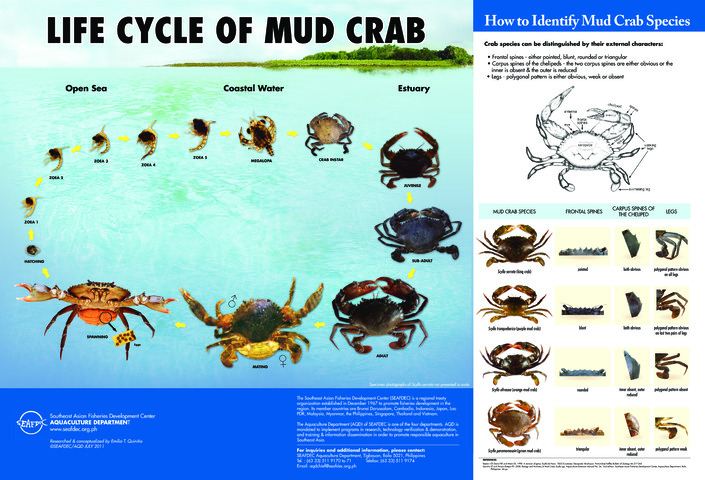
Life cycle of mud crab
Quinitio, Emilia T.Researched and conceptualized by Emilia T. Quinitio. (Aquaculture Department, Southeast Asian Fisheries Development Center, 2011)
-
Series: ACIAR Proceedings; No. 90
Review of recommendations from recent SEAFDEC workshops: SICCPPS and AQUACHEM
(Australian Centre for International Agricultural Research, 1999)The Second International Conference on the Culture of Penaeid Prawns and Shrimps (SICCPPS) was convened in Iloilo City by the Southeast Asian Fisheries Development Center (SEAFDEC) on May 14-17 1996 to bring together scientists, researchers and industry practitioners to discuss developments and constraints in shrimp culture. Two simultaneous workshops were held after the presentation of scientific papers: the Workshop on Seed Production and the Workshop on Pond Grow-out Culture of Shrimp.