SEAFDEC/AQD Institutional Repository: Recent submissions
Now showing items 4181-4200 of 4221
-
Economic and social considerations in seafarming and searanching
(Aquaculture Department, Southeast Asian Fisheries Development Center, 1994)Sustainable development of seafarming and searanching calls for careful planning. Investments in seafarming must take into account environmental, biotechnological, and socioeconomic considerations. Investment planning must be carefully examined as well as the physical design of production systems such that its negative impact is minimized and the positive impact is accentuated.Supply from the wild may not be expected to grow much higher than present levels. Many of the major commercially valuable fisheries are now overfished at or close to their respective minimum sustainable yield levels. Seafarming can attract some of the fishermen out of overcrowded fisheries.Production cost of seafarming produce is a major concern which has to be examined closely if these are to compete with and gradually supplant the supply of fish from the wild. Feed is one of the main inhibiting factors, hence, efficient consideration calls for constantly improving feed conversion and productivity per unit input.Existing government policies are not clear nor conducive to seafarming in terms of use rights of coastal waters. To attract potential investors into seafarming, governments are encouraged to review existing policies governing use rights to coastal waters, package the necessary technology consistent with the country's wage and price structure, and develop investment profile for seafarming opportunities using conservative criteria. -
Biotechnological researches at the Prefectural Fisheries Experimental Station in Japan
(Aquaculture Department, Southeast Asian Fisheries Development Center, 1994)Biotechnological studies have been conducted in 46 Prefectural Experimental Stations in Japan in 1991. In 41 of these, research focused on chromosome set manipulation including triploidy for sterilization and gynogenesis for sex control. Practical application of biotechnology for culture of each species is the main interest because each prefecture has its own project for promoting the local fisheries industry. Therefore, the commodities being studied are of commercial importance comprising of about 40 species.The culture production of Japan in 1988 totaled 1,426,000 tons, 95% of which consisted of 10 species. Biotechnology is not widely used since most seeds are not from hatcheries, but from the wild. Recently, however, promising results on the study of sex determination mechanism in the Japanese flounder have been adopted for actual seed production. This has attracted attention as an approach to mass production of all-female seedlings. -
Overview of aquaculture development in Southeast Asia
(Aquaculture Department, Southeast Asian Fisheries Development Center, 1994)The nine countries in Southeast Asia occupy a land area of 1.85% with a population of 7.4% in the world. In 1991, these countries had a total fisheries production of 10.2 million tons or 10.5% of the world total of 96.9 million tons. In aquaculture in 1990, world total production attained 15.3 million tons (15.7% of total world fisheries production) while the Southeast Asian countries produced 1.7 million tons (11 % of total world aquaculture production). The total fisheries production in Southeast Asia which is mainly capture fisheries has continued to increase gradually by about 3.3% from 1986 to 1990 while aquaculture production has been increasing at the rate of over 8.4% during this period.The major areas for aquaculture in Southeast Asia include inland freshwaters, brackishwaters, and marine waters. Various systems exist in the region including ponds, pens and cages, delimited or fenced open water areas, and culture integrated with other production activities. Highest potential is in Seafarming while ranching is a recent innovation. The species being cultured in the region consist of about 50 fishes, 10 crustaceans, 10 molluscs, 5 seaweeds, and 5 miscellaneous aquatic vertebrates.Aquaculture will increasingly supply food and industrial products considering the worldwide levelling off of capture fisheries production. Southeast Asia has the potential to contribute substantially to this need. Support for the industry inspite of this need is inadequate to meet its technical, economic, and management problems. A sound technological base through research and training and extension needs to be pursued vigorously. -
ADSEA '91-Foreword
(Aquaculture Department, Southeast Asian Fisheries Development Center, 1994) -
ADSEA '91-Preliminary pages
(Aquaculture Department, Southeast Asian Fisheries Development Center, 1994)Cover page, title page and table of contents -
Changes in mRNA expression of grouper (Epinephelus coioides) growth hormone and insulin-like growth factor I in response to nutritional status
(Elsevier, 2006)Growth hormone (GH) and insulin-like growth factor-I (IGF-I) are key links to nutritional condition and growth regulation in teleost. To understand the endocrine mechanism of growth regulation in grouper, we cloned the cDNAs for grouper GH and IGF-I and examined their mRNA expression during different nutritional status. Grouper GH cDNA is 936 base pairs (bp) long excluding the poly-A tail. It contained untranslated regions of 85 and 231bp in the 5'- and 3'-ends, respectively. It has an open reading frame of 612bp coding for a signal peptide of 17 amino acids (aa) and a mature hormone of 187aa residues. Based on the aa sequence of the mature hormone, grouper GH shows higher sequence identity (>76%) to GHs of perciforms than to GHs of cyprinids and salmonids (53-69%). Grouper preproIGF-I cDNA consisted of 558bp, which codes for 186aa. This is composed of 44aa for the signal peptide, 68aa for the mature peptide comprising B, C, A, and D domains, and 74aa for the E domain. Mature grouper IGF-I shows very high sequence identity to IGF-I of teleost fishes (84-97%) compared to advanced groups of vertebrates such as chicken, pig, and human (=<80%). Using DNA primers specific for grouper GH and IGF-I, the changes in mRNA levels of pituitary GH and hepatic IGF-I in response to starvation and refeeding were examined by a semi-quantitative RT-PCR. Significant elevation of GH mRNA level was observed after 2 weeks of food deprivation, and increased further after 3 and 4 weeks of starvation. GH mRNA level in fed-controls did not change significantly during the same period. Hepatic IGF-I mRNA level decreased significantly starting after 1 week of starvation until the 4th week. There was no significant change in IGF-I mRNA levels in fed-controls. One week of refeeding can restore the GH and IGF-I mRNA back to its normal levels. Deprivation of food for 1-4 weeks also resulted in cessation of growth and decrease in condition factor. -
A review of mangrove rehabilitation in the Philippines: successes, failures and future prospects
Primavera, Jurgenne ; (Springer, 2008)
From half a million hectares at the turn of the century, Philippine mangroves have declined to only 120,000 ha while fish/shrimp culture ponds have increased to 232,000 ha. Mangrove replanting programs have thus been popular, from community initiatives (1930s-1950s) to government-sponsored projects (1970s) to large-scale international development assistance programs (1980s to present). Planting costs escalated from less than US$100 to over $500/ha, with half of the latter amount allocated to administration, supervision and project management. Despite heavy funds for massive rehabilitation of mangrove forests over the last two decades, the long-term survival rates of mangroves are generally low at 10-20%. Poor survival can be mainly traced to two factors: inappropriate species and sites selection. The favored but unsuitable Rhizophora are planted in sandy substrates of exposed coastlines instead of the natural colonizers Avicennia and Sonneratia. More significantly, planting sites are generally in the lower intertidal to subtidal zones where mangroves do not thrive rather than the optimal middle to upper intertidal levels, for a simple reason. Such ideal sites have long been converted to brackishwater fishponds whereas the former are open access areas with no ownership problems. The issue of pond ownership may be complex and difficult, but such should not outweigh ecological requirements: mangroves should be planted where fishponds are, not on seagrass beds and tidal flats where they never existed. This paper reviews eight mangrove initiatives in the Philippines and evaluates the biophysical and institutional factors behind success or failure. The authors recommend specific protocols (among them pushing for a 4:1 mangrove to pond ratio recommended for a healthy ecosystem) and wider policy directions to make mangrove rehabilitation in the country more effective.
; (Springer, 2008)
From half a million hectares at the turn of the century, Philippine mangroves have declined to only 120,000 ha while fish/shrimp culture ponds have increased to 232,000 ha. Mangrove replanting programs have thus been popular, from community initiatives (1930s-1950s) to government-sponsored projects (1970s) to large-scale international development assistance programs (1980s to present). Planting costs escalated from less than US$100 to over $500/ha, with half of the latter amount allocated to administration, supervision and project management. Despite heavy funds for massive rehabilitation of mangrove forests over the last two decades, the long-term survival rates of mangroves are generally low at 10-20%. Poor survival can be mainly traced to two factors: inappropriate species and sites selection. The favored but unsuitable Rhizophora are planted in sandy substrates of exposed coastlines instead of the natural colonizers Avicennia and Sonneratia. More significantly, planting sites are generally in the lower intertidal to subtidal zones where mangroves do not thrive rather than the optimal middle to upper intertidal levels, for a simple reason. Such ideal sites have long been converted to brackishwater fishponds whereas the former are open access areas with no ownership problems. The issue of pond ownership may be complex and difficult, but such should not outweigh ecological requirements: mangroves should be planted where fishponds are, not on seagrass beds and tidal flats where they never existed. This paper reviews eight mangrove initiatives in the Philippines and evaluates the biophysical and institutional factors behind success or failure. The authors recommend specific protocols (among them pushing for a 4:1 mangrove to pond ratio recommended for a healthy ecosystem) and wider policy directions to make mangrove rehabilitation in the country more effective. -
Managing excess capacity in small-scale fisheries: Perspectives from stakeholders in three Southeast Asian countries
(Elsevier, 2008)The management of fishing capacity--in both inland and marine fisheries--is a major policy concern in most countries in Southeast Asia. Excess capacity leads to a number of negative impacts, such as resource use conflicts, overfishing, environmental degradation, economic wastage, and security threats. This paper presents the results of a regional study that examined various approaches to managing excess fishing capacity in small-scale fisheries in Southeast Asia. More specifically, the paper presents an analysis of perceptions of stakeholders in Cambodia, Philippines and Thailand regarding preferred solutions to addressing excess capacity. The paper concludes with a discussion of policy guidance for addressing excess fishing capacity based on the stakeholder-preferred solutions. -
Dehalogenase from Methylobacterium sp. HJ1 induced by the herbicide 2, 2-dichloropropionate (Dalapon)
; ; Pakingking, Rolando V., Jr.; ; (Academic Journals, 2008)
Heavy industrial activities and agricultural processes require consumption of many halogenated compounds, and release them continuously as pollutants into the environment. These xenobiotics show high toxicity and persistence and cause many problems to the society, soils and ground water. Microbial dehalogenases are involved in the biodegradation of many important chlorinated compounds. A bacterial strain identified as Methylobacterium sp. HJ1 is able to degrade the herbicide 2,2-dichloropropionic acid by removal of the halogen and subsequent metabolism of the product for energy. D,L-2-chloropropionate also supported good growth of the organism but 3-chloropropionate, monochloroacetate and dichloroacetate were not utilized. Cell-free extracts of the 2,2-dichloropropionate-grown bacteria converted 2,2-dichloropropionate into pyruvate with the release of two chloride ions for each molecule of pyruvate formed. This indicates the presence of dehalogenase activity in the cell-free extracts. Only 2,2-dichloropropionate and D,L-2-chloropropionate were inducers and substrates for the dehalogenase. Monochloroacetate and dichloroacetate did not serve as an inducer, whereas 3-chloropropionate was a non-substrate inducer. -
Coastal ecosystem-based management with nonlinear ecological functions and values
; ; ; ; ; Primavera, Jurgenne; ; ; ; ; ; ; ; ; ; (American Association for the Advancement of Science, 2008)
A common assumption is that ecosystem services respond linearly to changes in habitat size. This assumption leads frequently to an “all or none” choice of either preserving coastal habitats of converting them to human use. However, our survey of wave attenuation data from field studies of mangroves, salt marshes, seagrass beds, nearshore coral reefs, and sand dunes reveals that these relationships are rarely linear. By incorporating nonlinear wave attenuation is estimating coastal protection values of mangroves in Thailand, we show that the optimal land use option may instead be the integration of development and conservation consistent with ecosystem-based management goals. This result suggests that reconciling competing demands on coastal habitats should not always result in stark preservation-versus conversion choices. -
The loss of species: Mangrove extinction risk and geographic areas of global concern
; ; ; ; ; ; ; ; ; ; ; ; ; ; ; Primavera, Jurgenne; ; ; ; ; (PLoS ONE, 2010)
Mangrove species are uniquely adapted to tropical and subtropical coasts, and although relatively low in number of species, mangrove forests provide at least US $1.6 billion each year in ecosystem services and support coastal livelihoods worldwide. Globally, mangrove areas are declining rapidly as they are cleared for coastal development and aquaculture and logged for timber and fuel production. Little is known about the effects of mangrove area loss on individual mangrove species and local or regional populations. To address this gap, species-specific information on global distribution, population status, life history traits, and major threats were compiled for each of the 70 known species of mangroves. Each species' probability of extinction was assessed under the Categories and Criteria of the IUCN Red List of Threatened Species. Eleven of the 70 mangrove species (16%) are at elevated threat of extinction. Particular areas of geographical concern include the Atlantic and Pacific coasts of Central America, where as many as 40% of mangroves species present are threatened with extinction. Across the globe, mangrove species found primarily in the high intertidal and upstream estuarine zones, which often have specific freshwater requirements and patchy distributions, are the most threatened because they are often the first cleared for development of aquaculture and agriculture. The loss of mangrove species will have devastating economic and environmental consequences for coastal communities, especially in those areas with low mangrove diversity and high mangrove area or species loss. Several species at high risk of extinction may disappear well before the next decade if existing protective measures are not enforced. -
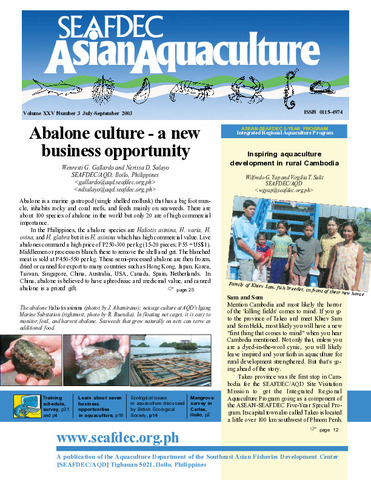
SEAFDEC Asian Aquaculture Volume 25(3) July - September 2003
(Aquaculture Department, Southeast Asian Fisheries Development Center, 2003) -
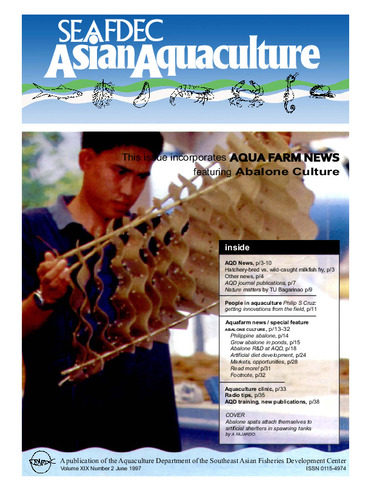
SEAFDEC Asian Aquaculture Volume 19(2) June 1997
(Aquaculture Department, Southeast Asian Fisheries Development Center, 1997)This issue incorporates Aqua Farm News featuring abalone culture. -
Aqua Farm News Volume 14(02-03) March - June 1996
(Aquaculture Department, Southeast Asian Fisheries Development Center, 1996)This issue takes a close look at one fishing village working hard to manage its resources by itself. There are interviews with the village head or Barangay Captain, women leaders, a schoolkid, and a primary grade teacher. ... -
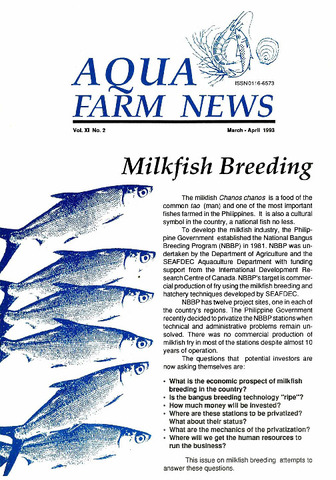
Aqua Farm News Volume 11(02) March - April 1993
(Aquaculture Department, Southeast Asian Fisheries Development Center, 1993)The milkfish Chanos chanos is a food of the common tao (man) and one of the most important fishes farmed in the Philippines. It is also a cultural symbol in the country, a national fish no less. To develop the milkfish industry, the Philippine Government established the National Bangus Breeding Program (NBBP) in 1981. NBBP was undertaken by the Department of Agriculture and the SEAFDEC Aquaculture Department with funding support from the International Development Research Centre of Canada. NBBP's target is commercial production of fry using the milkfish breeding and hatchery techniques developed by SEAFDEC. NBBP has twelve project sites, one in each of the country's regions. The Philippine Government recently decided to privatize the NBBP stations when technical and administrative problems remain unsolved. There was no commercial production of milkfish fry in most of the stations despite almost 10 years of operation. The questions that potential investors are now asking themselves are: • What is the economic prospect of milkfish breeding in the country? • Is the bangus breeding technology "ripe"? • How much money will be invested? • Where are these stations to be privatized? • What about their status? • What are the mechanics of the privatization? • Where will we get the human resources to run the business? This issue on milkfish breeding attempts to answer these questions. -
Aqua Farm News Volume 09(06) November - December 1991
(Aquaculture Department, Southeast Asian Fisheries Development Center, 1991) -
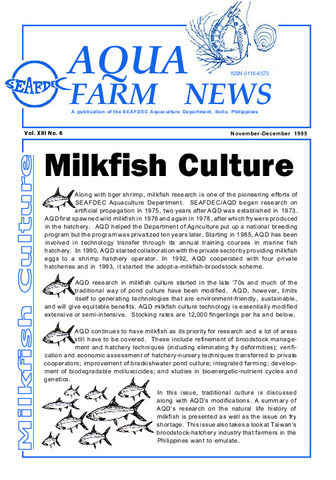
Aqua Farm News Volume 13(06) November - December 1995
(Aquaculture Department, Southeast Asian Fisheries Development Center, 1995)In this issue, traditional culture is discussed along with AQD's modifications. A summary of AQD's research on the natural life history of milkfish is presented as well as the issue on fry shortage. This issue also takes ... -
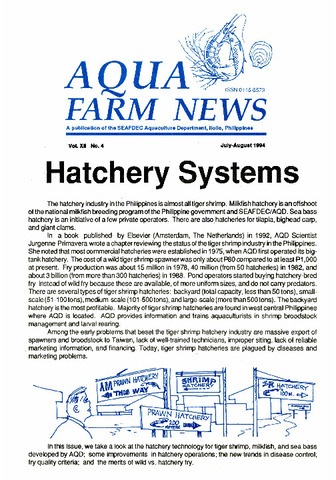
Aqua Farm News Volume 12(04) July - August 1994
(Aquaculture Department, Southeast Asian Fisheries Development Center, 1994)In this issue, we take a look at the hatchery technology for tiger shrimp, milkfish, and sea bass developed by AQD; some improvements in hatchery operations; the new trends in disease control; fry quality criteria; and the ... -
Aqua Farm News Volume 08(03) May - June 1990
(Aquaculture Department, Southeast Asian Fisheries Development Center, 1990) -
Aqua Farm News Volume 09(01) January - February 1991
(Aquaculture Department, Southeast Asian Fisheries Development Center, 1991)