SEAFDEC/AQD Institutional Repository: Recent submissions
Now showing items 1141-1160 of 4221
-
Studies on the use of copepods in the semi-intensive seed production of grouper Epinephelus coioides
(Blackwell Publishing, 2005)Previous studies by the authors have shown the feasibility of using copepods in the semi-intensive seed production of grouper Epinephelus coioides. Early-stage E. coioides larvae preferred to ingest copepod nauplii over rotifers, although their abundance is relatively low. Higher growth and survival were obtained in larvae provided with copepods than larvae fed with rotifers alone. In this study, the authors tested various fertilization techniques for the mass production of zooplankton in ponds. The zooplankton population increased from an initial density of 86–148 ind/L to 1,524–3,186 ind/L 9–12 days after flooding. Major zooplankton were identified as rotifers, copepods, including cyclopoid and harpacticoid spp., and cladocerans. The calanoid copepod Acartia tsuensis can be propagated in 1-ton tanks in mixed species of microalgae alone or in combination with baker’s yeast. Density of A. tsuensis increased from 60 ind/L at stocking to about 900 ind/L 3–5 days thereafter. A prototype collector for copepod eggs and nauplii was tested. The average daily numbers of eggs and nauplii collected varied (2,300–117,600), depending on the density of copepodids and adults in the holding container (1,000–8,000 ind/10-L container). Hatching rates of collected eggs ranged from 34 to 89%. Collected eggs may be stored at low temperature (4–10°C) for up to 7 days. Duration and viability of eggs stored at low temperature were highly affected by the presence of protozoans. A. tsuensis eggs survived freezing to –20°C (0.3–1.7%) only at the cleavage stage, suggesting the feasibility of cryopreservation. Use of pond grown zooplankton, particularly the calanoid copepods, for the seed production of grouper is discussed. -
Domestic effluents and pollution in Imbang River, Negros Occidental
(Bureau of Agricultural Research, Department of Agriculture, 2007)Domestic effluents, or waste waters from human settlements, were sampled from eight stations along Imbang River in Negros Occidental from July 1993 to February 1995. Three types of domestic waste waters were produced by communities along Imbang River. Waste waters from clothes washing, house cleaning, and bathing, including washings of domestic animals and holding pens and run-off from rains and storms were conveyed by open canals and ditches to the river. This type of domestic effluents were well aerated and had the least potential to degrade the rivers. Waste waters from kitchens and markets carried large volumes of food scraps and other solid wastes, were unsightly, and smelled bad from the decomposition of garbage. Overflows from septic tanks were the most objectionable domestic effluents with offensive visual and olfactory properties. Domestic effluents had pH 4–7.6, dissolved oxygen of 0.5–7.2 ppm, and biochemical oxygen demand ranging from 2 to 240 ppm. The overflows from septic tanks were of the worst quality, with BOD 20x greater than household washings, and 6x more than kitchen and market effluents. Fecal coliform bacteria made up 93% of the total coliforms in the septic tank overflows, 86% in kitchen and market waste waters, and 39% in household washings. The domestic effluents from the communities around Imbang River had higher than allowable levels of BOD and solids. The 11 barangays with 16,486 households and 85,535 people loaded about 3,4000 m3 of waste water into the river every day. Along with the waste water were 180 mt/yr of BOD, 590 mt/yr of total solids, plus large quantities of nutrients, surfactants, and fecal coliform bacteria. -
Sugar mill effluents and water quality in Imbang River and Malisbog River, Negros Occidental
(Bureau of Agricultural Research, Department of Agriculture, 2007)The effluents of two sugar mills and the effects on water quality in the receiving rivers were studied. Sugar mill A was located in Barangay Dos Hermanas in Talisay and discharged directly into Imbang River. Sugar Mill B was located in Barangay Hawaiian in Silay City and discharged into Malisbog River, a tributary of Imbang. Both sugar mills had sedimentation tanks and lagoons for partial wastewater treatment prior to discharge. Water sampling was done at 13 stations at effluent discharge sites and also upstream and downstream of these sites. The sugar mill effluents were particularly high in biochemical oxygen demand (BOD 109–419 mg/l), total suspended solids (168–384 mg/l), and total solids (1,185–1,234 mg/l), also high in ammonia (0.2–0.5 mg/l) and water temperature (31–38°C), but low in dissolved oxygen (2–5 mg/l). Measured stream flows varied at the different stations and were generally lowest at stations near sugar mill A and at stations near sugar mill B. At these sites, the depth of Imbang River varied from about 10 cm during low water flow in December–May to about 2 m during high water flow in June–November. During normal low flows, the sugar mill effluent comprised 75–85% of the total stream volume, causing highly polluted conditions immediately below the outlets. Sugar mill A discharged high annual loads of solids, BOD, nitrate, and phosphate into Imbang River, whereas sugar mill B loaded plenty of solids, BOD, ammonia, and phosphate into Malisbog River. The sugar cane milling season in Negros Occidental started in October and ended in May, coincident with the dry season. Significantly higher levels of BOD and nutrients, but lower DO, were observed in the river during the milling season (see figures in Gonzales et al., this volume), both because of greater discharge and lower dilution by lower stream flows. River water quality was better at the stations upstream than downstream of the sugar mills. Stations near the sugar mills had BOD, ammonia, and solids at concentrations exceeding the allowable limits set for river water by the Department of Environment and Natural Resources. -
Shrimp pond effluents and water quality in Imbang River, Negros Occidental
(Bureau of Agricultural Research, Department of Agriculture, 2007)The contribution of shrimp farm effluents to the pollution load in Imbang River, Negros Occidental was measured during the period May 1993 to February 1995. Shrimp pond effluents were characterized and the pollution load estimated. The pond effluents had low average nitrite (0.0025 ppm) and nitrate (0.06 ppm) and optimum (for shrimp culture) pH 7.9, phosphate 0.15 ppm, dissolved oxygen 5.20 ppm, and salinity 23.3 ppt. Ammonia was 0.13 ppm on average in most farms, above the safe level for shrimp, and total suspended solids was 23 ppm, about 2.5x the allowed limit for effluents. Biochemical oxygen demand (20 ppm) and settleable solids (0.15 ppm) were still with acceptable limits. Residues of organochlorine pesticides were present at very low concentrations, well below the safe levels for aquatic life. Most of the pollution load came from the regular water exchanges over the 4-month crop cycle, at least every two weeks in low-density farms and more frequently in the high-density farms. The total draining of pond water at harvest contributed a minor load. Total solids from shrimp farms contributed a huge load, about 181,325 mt/yr. Total suspended solids contributed 1,285 mt/yr and settleable solids <1 mt/yr. The total BOD load was 154,367 kg/yr. The phosphate load was about 1,080 kg/yr, and the total nitrogen load was 1,225 kg/yr. The effects of effluent release from farms were localized. Upstream water quality and other uses of the river were not affected. Since most of the shrimp farms were located 1.5–2 km from the sea, the release of effluents during water exchange and at harvest did not adversely affect water quality downstream of these farms. Where such draining increased the levels of ammonia, phosphate, and total suspended solids in the river, the effect was significant only within 250 m from the release point, and the pollutants were dissipated about 550–800 m downstream The other water quality variables were at low levels in the pond effluents and did not affect the river water during draining. Often the concentrations of pollutants in the river were higher before than during draining of pond effluents. Stations upstream of the release sites of pond effluents often had high pollutant concentrations from other upstream sources. -
Agricultural run-off and pollution in Imbang River, Negros Occidental
(Bureau of Agricultural Research, Department of Agriculture, 2007)This study determined the concentration of key pollutants carried by agricultural run-off from the drainage area of Imbang River, Negros Occidental over a two-year period. The quantities loaded into the river were estimated to assess the contribution of agriculture to the degradation of the river. Agricultural production in sugarcane and rice plantations in the area relied on chemicals to control pests and enhance production. Run-off from agricultural land contained an average 0.2 ppm phosphate, 0.2 ppm ammonia, 0.02 ppm nitrite, and 1.7 ppm nitrate from fertilizer inputs and other sources. The run-off also had 7.4 ppm biochemical oxygen demand, 465 ppm total solids, 296 ppm total suspended solids, 0.4 ppm settleable solids, plus traces of organochlorine pesticides. The concentrations of all these potential pollutants were not alarming or dangerous, although on occasion, some exceeded the tolerable limits. However, increasing reliance on fertilizers often leads to intensified use and related problems. Likewise, the continuing use of chemicals to control field pests is of serious concern given that residues are easily carried by run-off to the nearest waterway and passed on and magnified through the food chain. The health of farm workers who routinely handle these products is at risk. Apart from commercial fertilizers, farm lands received organic wastes from domestic and industrial sources. Most farmers maintained farm animals such as carabaos, goats, and sheep that were allowed to graze on the fields after crops had been harvested. Grazing animals frequently left surface deposits of manure. Some farmers on occasion used sugar mill wastes as fertilizers and road fillers in the haciendas. Moreover, household wastes including human excreta were commonly disposed on nearby fields. The contributions of animal and human wastes to the total load of nutrients could be substantial but difficult to quantify given the manner of production and the varying composition of the wastes. Indeed, agricultural run-off transports non-point pollutants from so many poorly defined sources. -
Water quality in Imbang river, Negros Occidental: effluents and pollutant loads from agriculture, sugar mills, households, and shrimp farms
(Bureau of Agricultural Research, Department of Agriculture, 2007)An ecological assessment of Imbang River in Negros Occidental was undertaken from December 1992 to February 1995. The effluents from sugar mills, households, shrimp farms, sugarcane plantations and rice fields were characterized and their pollutant loads estimated. Water quality and invertebrate assemblages were analyzed at several sites along the river to determine the environmental status. Results showed significant seasonal and site variations in water quality along Imbang River. The dry season, coinciding with the milling season, was the more critical time of the year as water quality tended to deteriorate. The segments of the river near the sugar mills and households had the poorest water quality. Sugar mill effluents had high water temperature (average 33oC but as high as 50oC), low dissolved oxygen, high total solids, the highest settleable solids (average 2.5 and as high as 17 m/l), and the highest biochemical oxygen demand (average 259 ppm but as high as 14,800 ppm BOD). Domestic effluents had low pH, high ammonia, very high BOD, plus detergents or surfactants and high levels of fecal coliform bacteria. Agricultural runoff had high nitrate, high total solids, and the highest total suspended solids (average 296 ppm but as high as 5,095 ppm TSS). Shrimp ponds used saline water of average 23 ppt, and had the highest total solids (average 23,456 ppm and as high as 57,400 ppm). By far the major contributor of pollutant loads into Imbang River was agriculture, due to its huge areal extent and huge volume of water use and run-off. Agricultural run-off carried the highest annual loads of 7,858 kg phosphate; 6,495 kg ammonia; 794 kg nitrite; 67,212 kg nitrate; 16,987 metric tons settleable solids; 16,800,000 mt total solids, and 11,890,000 mt total suspended solids; but only 297 mt BOD. Sugar mill effluents had the highest BOD load (1,583 mt/yr) and also had high nutrient loads. Household effluents contributed the second largest loads of solids next to agriculture, and also added surfactants (966 kg/yr) and fecal coliforms into the river. The six shrimp farms at the lower reaches of Imbang River were a minor contributor of pollutants into the river, annually adding about 891 kg ammonia; 1,077 kg phosphate; and 181,325 mt total solids. -
Socioeconomic profile of tuna fishers in northwestern Luzon
(Bureau of Agricultural Research, Department of Agriculture, 2007)A study of tuna fishers in northwestern Luzon (Region I) was done by means of a questionnaire. The 511 respondents included 178 from Ilocos Sur, 200 from La Union, and 133 from Pangasinan. Most of them were younger than 50 years, had basic education, married with large families of 3-9 children, owned the houses they lived in, and had low annual incomes of about P35,000. Fishing was their sole means of livelihood for almost all the respondents, except some for whom farming supplemented the income from fishing. Majority worked every night or day, 36% went fishing every other night or day, and 13% went fishing five times a week. Most fishers went out to sea at night. Fully 52% of the fishers worked within 50 km from shore; 38% fished within 51–100 km, and the others went out farther than 100 km and even 200 km. La Union fishers worked closest to shore (average 38 km) and Pangasinan fishers the farthest (average 92 km). More than 90% of all fishers used motorized bancas, which made it possible for them to fish farther out to sea. Only 36% of the fishers owned the boats and fishing gears they used, and most did not. In all three provinces, the capital for the fishing enterprise came mainly from savings. The average cost of motorized boats was P31,200; non-motorized boats, P1,200. Longlining was the most preferred fishing method in the region. Hand lining was the second most preferred in Ilocos Sur and Pangasinan. Gillnetting and other methods (rabuk, kawil, pana, and bira-bira) were ranked third and fourth, and trawling was the least preferred. Drift gill nets used for tunas cost on average P680; tuna long lines, about P600; tuna hand lines, P345; and troll lines, P750. The main species caught by the fishers were skipjack tuna, yellowfin tuna, frigate tuna, Spanish mackerel, rainbow runner, dolphinfish, sailfish, blue marlin, and threadfins. In Ilocos Sur, most fishers reported catches of 11-20 kg in one trip, and a few fishers caught 50 kg. Spanish mackerel and sailfish gave the fishers better incomes than the other species. Fish catches and prices and fisher incomes in La Union were lower than in Ilocos Sur. Threadfins were more abundant in La Union. Fishers in Pangasinan did not catch sailfin, marlin, or threadfins, but caught higher volumes (20–60 kg/trip) of the other species. -
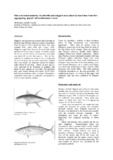
Diet and sexual maturity of yellowfin and skipjack tuna taken by hand lines from fish-aggregating 'payaw' off northwestern Luzon
(Bureau of Agricultural Research, Department of Agriculture, 2007)Skipjack tuna Katsuwonus pelamis and yellowfin or albacore tuna Thunnus albacares taken by hand lines from the 'payaw' off La Union and Ilocos Sur were sampled from April 1994 until August 1995. Skipjack ranged from 28 cm to 59 cm in fork length and from 0.35 to 4.2 kg in weight. Yellowfin ranged 24–67 cm and 0.25–6.4 kg. The common size landed was about 40 cm for both species. Size at first maturity of skipjack was about 41 cm in males and 42 cm in females. The yellowfin tuna taken by hand lines were almost all immature except two mature males about 60 cm long. About 18 prey species were identified in the stomachs of skipjack, and about 25 prey species in yellowfin. The preferred prey were mantis shrimps and squids. Small fishes and other invertebrates were also eaten. Mesopelagic lanternfish were eaten by yellowfin and epipelagic jellyfish were eaten by skipjack. -
The tuna fishery off northwestern Luzon: catch of purse seines and hand lines operating around fish-aggregating 'payaw'
(Bureau of Agricultural Research, Department of Agriculture, 2007)The tuna fishery along northwestern Luzon was studied from March 1994 to April 1995. About 120 units of fish aggregating ‘payaw’ were set 20–100 km offshore and fished by about 350 handline boats and 6 purse seines. The handline landing areas were in Apatot, San Esteban, Ilocos Sur and in Darigayos Cove, La Union. The resident purse seine was based at Poro Point in San Fernando, La Union; the others were occasional operators. Skipjack tuna Katsuwonus pelamis was the primary species landed by the purse seine and yellowfin tuna Thunnus albacares was mostly landed by the hand lines. These species occurred year-round with peaks during the dry season. The purse seine was operated about 9 sets per month, and landed an average of 51 mt fish monthly (catch rate 5.7 mt/set), highest in November, December and March. Handline fishing was carried out an average of 17 days a month (catch rate about 19 kg/boat-day). The tuna fishery was adversely affected by strong monsoon winds and typhoons. The rough seas inhibit fishing and give the tuna populations much needed respite from the intense fishing pressure. -
Seaweeds of Panay
(Aquaculture Department, Southeast Asian Fisheries Development Center, 2006)This practical book on the seaweeds of Panay, Philippines, acquaints and provides information to members of the academe and research institutions, policy makers, fishermen and businessmen regarding the taxonomy, distribution, ecology and economic importance of these resources. It consists of 4 major parts: (1) Introduction, which reviews the literature, habitat, distribution, morphological structure and reproduction; 2) Classification, which describes the classes to which the seaweeds generally belong; 3) Collection and preservation, which explains the procedure used in treatment of specimens; and, 4) Taxonomic list. A glossary is included, covering technical terms used. All species listed and described in this book are macrobenthic and were collected in Panay and Guimaras Islands. -
Changes in the fish diversity and abundance on a heavily fished fringing reef on Santiago Island, Pangasinan, Philippines
(Bureau of Agricultural Research, Department of Agriculture, 2007)Fish assemblages on the reef slope, reef flat, and seagrass beds on Santiago Island were sampled over 18 months in 1992-1993 as part of a 6-year reef monitoring project started in 1986. Abundance and species diversity were analyzed by a variety of indices, and by multi-dimensional scaling and correlated ordered similarity matrix. The monitoring showed a distinct shift in the reef slope fish composition during the first half of 1988. Of the 100 most abundant species, 21 species showed significant reductions in abundance, and 20 species showed significant increases. Differences were not due to depth preference or feeding habits. Fishing pressure was apparently responsible for declines in Cheilinus trilobatus, Acanthurus nigricauda, and Naso literatus, as well as a general decline in the family Acanthuridae (surgeonfishes). However, analysis of site preferences of the decreasing species and the increasing species indicated a shift in community composition from those species preferring more coral cover to those preferring more sand, rock, and possibly Sargassum seaweed. Site preferences were determined from benthic life form transects done in 1992. Of 35 significantly changing species for which habitat data was obtained, 24 fit the hypothesis of habitat change. This supports the proposition from previous studies that the major cause of change in the reef slope fish community was the destructive fishing activity associated with Malthusian overfishing. Similar analyses of the fish assemblages on the reef flat and on the seagrass beds showed seasonal effects, particularly in the latter, but no strong shift comparable to that of the reef slope. These latter areas had been subjected to greater fishing pressure for a longer period. Reef fish populations such as those in Bolinao tend to be highly resilient provided the larval supply is not adversely affected. However, subtle changes in the cover of coral on a reef can lead to major changes in the composition of the fish community. Coral cover is being widely diminished on Philippine reefs, and substantial changes in the fish communities may be anticipated, even on reefs with initially low coral cover. These changes may affect the utility and immediate value of the fish to local fishers and the market systems they supply. It is of great urgency to stop destructive fishing practices such as blasting and use of cyanide, and to develop anchoring methods that are minimally destructive. There is a strong predictive relation between the numbers of fish (abundance) in an area and the numbers of species (biodiversity) they include. As fish populations decline due to destructive fishing, or highly concentrated non-destructive fishing, the local species richness may be expected to decline. This decline may have serious short-term social and economic consequences, as well as far-reaching long-term environmental effects. Efforts to reduce overfishing must be intensified—though reduction of birth rate, provision of alternative livelihoods, and curbing of destructive fishing — in order to prevent a very distressing future for the Philippine marine environment and the people it supports. -
Limit of colour vision in dim light in larvae of the giant freshwater prawn Macrobrachium rosenbergii
; Bagarinao, Teodora ; ; ; (Springer Verlag, 2018)
Colour vision depends on sufficient ambient light and becomes ineffective at a particular low light intensity. It is not known how decapod crustaceans see colour in dim light. In the present study we investigated the colour vision threshold in larvae of the giant freshwater prawn Macrobrachium rosenbergii in a tank under natural illumination. Plastic beads of different colours (blue, red, yellow and white) in various combinations were suspended in the tank. The larvae swam straight toward the beads and gathered around them. The number of larvae was highest on the blue and white beads. The luminance in the tank was then gradually decreased by covering it with different numbers of layers of black cloth, and the response of the larvae to the beads was video-recorded under infrared illumination. The preference for blue and white beads remained manifest as the luminance was reduced from 418 to 0.07 cd/m2, but not at 0.02 cd/m2, indicating a colour vision threshold between 0.07 and 0.02 cd/m2. The larvae have apposition compound eyes with large optical parameters, comparable to those of apposition eyes of nocturnal insects, which presumably capture more light and show enhanced sensitivity, enabling the larvae to see colour in dim light.
; ; ; (Springer Verlag, 2018)
Colour vision depends on sufficient ambient light and becomes ineffective at a particular low light intensity. It is not known how decapod crustaceans see colour in dim light. In the present study we investigated the colour vision threshold in larvae of the giant freshwater prawn Macrobrachium rosenbergii in a tank under natural illumination. Plastic beads of different colours (blue, red, yellow and white) in various combinations were suspended in the tank. The larvae swam straight toward the beads and gathered around them. The number of larvae was highest on the blue and white beads. The luminance in the tank was then gradually decreased by covering it with different numbers of layers of black cloth, and the response of the larvae to the beads was video-recorded under infrared illumination. The preference for blue and white beads remained manifest as the luminance was reduced from 418 to 0.07 cd/m2, but not at 0.02 cd/m2, indicating a colour vision threshold between 0.07 and 0.02 cd/m2. The larvae have apposition compound eyes with large optical parameters, comparable to those of apposition eyes of nocturnal insects, which presumably capture more light and show enhanced sensitivity, enabling the larvae to see colour in dim light. -
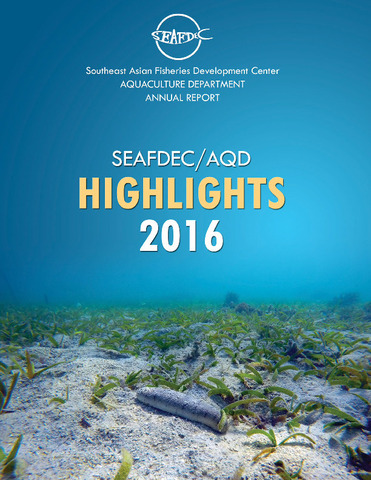
SEAFDEC/AQD highlights 2016
(Aquaculture Department, Southeast Asian Fisheries Development Center, 2017)SEAFDEC/AQD highlights 2016 is SEAFDEC/AQD’s annual report updating on its accomplishments and progress for the year 2016. -
Characterisation of Vibrio isolates recovered from the eyes of cage-cultured pompano (Trachinotus blochii) infested with caligid parasites (Lepeophtheirus spinifer)
Pakingking, Rolando V., Jr.; ; ; (European Association of Fish Pathologists, 2018)
Exophthalmia was documented among sea cage-cultured pompano (Trachinotus blochii) broodstocks with caligid parasite (Lepeophtheirus spinifer) infestation in the Philippines. Following sequencing, and based on the results of both diagnostic investigations and infection experiments, V. harveyi likely had a role in the reported exophthalmia cases, and this was initiated by L. spinifer infection. -
Genetic assessment of milkfish (Chanos chanos Forsskal) stocks based on novel short tandem repeats for marker-aided broodstock management
Romana-Eguia, Maria Rowena R.; ; ; ; (John Wiley and Sons, 2018)
Milkfish hatchery broodstock are either from on-grown wild-caught or hatchery-produced fry/juveniles. To determine if a marker-assisted management scheme can be formulated for improved milkfish hatchery production, milkfish stocks were genetically characterized using nine novel short tandem repeats or microsatellites. Eight wild-bred Philippine stocks (CLA, CUR, CAM, SIH, SBH-I1, HH, PAL and ZH-P0), four hatchery-bred stocks (SBH-I2, SBH-D, BoH and ZH-F1), two farm stocks of known mixed lineages (SPH and BDH) and one Indonesian hatchery-bred stock (WJH) were assessed. WJH was included since milkfish fingerlings from Indonesia reared in Philippine farms could be developed into future broodstock. Mean allelic richness (Ar) was highest in wild-bred stocks (9.5) and lowest in hatchery-bred spawners (9.1). Mean expected heterozygosities (He) were relatively similar in all stocks with wild-bred stocks slightly higher (0.67) than the others. An analysis of molecular variance indicated significant yet low genetic differentiation among stocks (FST = 0.013; p = .000) where variation (98.6%) was explained by intra-stock differences. In some of the domesticated stocks, reductions in mean allelic richness were observed in first generation hatchery broodstock (e.g. ZH-F1; Ar = 8.3), compared with their founder stock (e.g. ZH-P0; Ar = 9.4). The Indonesian stock was similar to local wild-bred stocks based on genetic variability indices; thus, it might be likely that the local stocks’ fitness traits could be comparable with the imported milkfish stock which has been perceived to be better. The quality of locally available farmed milkfish and prospects of formulating a broodstock management scheme for the production of good quality milkfish seedstock are herewith discussed. -
An overview of agricultural pollution in the Philippines: Summary report
; Briones, Roehlano; ; ; Cuvin-Aralar, Maria Lourdes ; Salvacion, Arnold ; ; ; ; ; ; (World Bank, 2016)
The 'study' constitutes the totality of the work and includes multiple components, including national overviews of agricultural pollution for the three focus countries, thematic working papers, and an overall synthesis report. The present report corresponds to the national overview of agricultural pollution in the Philippines, and specifically, to the summary of three background papers on crops, livestock, and fishery systems respectively. The overview covers water, soil, and air pollution directly associated with activities and decisions made at the farm level or its equivalent (that is, vessel level or pond level in the case of fisheries). It especially looks at: (a) the use of fertilizers; (b) the use of pesticides; (c) another cropland management practices (including the use of plastics, the introduction of invasive species, irrigation and land preparation practices); (d) the burning of agricultural residues; (e) animal waste management (land and aquatic species); and (f) the use of feed supplements, including antibiotics, hormones, and heavy metals in animal agriculture (land and aquatic). Environmental impacts relating to land-use change are beyond the scope of the review. -
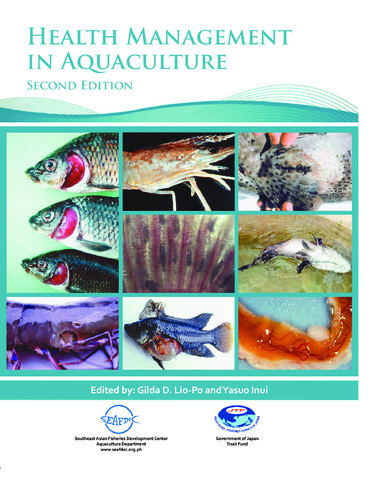
Health management in aquaculture
(Aquaculture Department, Southeast Asian Fisheries Development Center, 2010-07)A textbook on diseases of cultured warmwater fish and shrimps in the Philippines. Eleven chapters cover essential information on the basic principles of disease causation, major diseases of cultured fish and crustaceans, particularly shrimps, and methods of prevention and control. Emphasis is made on major diseases that occur in the Philippines and other countries in the Asian region. Included also are topics on harmful algae, immunology and molecular biological diagnostic techniques. -
Basic epidemiological concepts for surveillance in aquaculture
(Aquaculture Department, Southeast Asian Fisheries Development Center, 2010) -
Probiotics in aquaculture
(Aquaculture Department, Southeast Asian Fisheries Development Center, 2010) -
Immunity and biological methods of disease prevention and control
Amar, Edgar C.; (Aquaculture Department, Southeast Asian Fisheries Development Center, 2010)
The chapter deals with the barriers that prevent microbial entry and the various internal defense mechanisms that are part of the host's arsenal in combating in combating invading microbes. It also discusses some of the biological methods of disease prevention and control.