SEAFDEC/AQD Institutional Repository: Recent submissions
Now showing items 3121-3140 of 4221
-
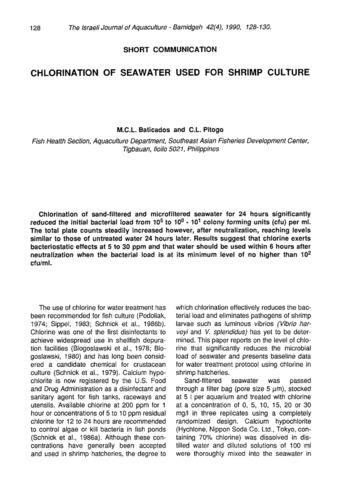
Chlorination of seawater used for shrimp culture
(SIAMB, 1990)Chlorination of sand-filtered and microfiltered seawater for 24 hours significantly reduced the initial bacterial load from 105 to 100 - 101 colony forming units (cfu) per ml. The total plate counts steadily increased however, after neutralization, reaching levels similar to those of untreated water 24 hours later. Results suggest that chlorine exerts bacteriostatic effects at 5 to 30 ppm and that water should be used within 6 hours after neutralization when the bacterial load is at its minimum level of no higher than 102 cfu/ml. -
The effect of stunting on growth, survival, and net production of milkfish (Chanos chanos Forsskal)
(Elsevier, 1988)The seasonal abundance of milkfish fry in the Philippines has led to the practice of buying a sufficient supply during the peak season to compensate for the shortage during slack periods. Fry that are not immediately grown out are crowded and stunted in transition ponds until they are transferred to rearing ponds. Milkfish farmers believe that stunted fingerlings grow faster than newly grown ones and therefore yield extra croppings. To assess the efficiency of production schemes, stunted and non-stunted milkfish fingerlings were cultured in twelve 144-m2 ponds for a 3-month period. The treatments employed were: Treatment I, 2-month-old fingerlings; Treatment II, 3-month-old fingerlings; and Treatment III, 6-month-old fingerlings, with the initial weights of 3.3 g, 7.8 g, and 43.1 g, respectively. Survival, netproduction, cumulative and monthly weight gains did not differ significantly (P > 0.05) among the three treatments. The results indicate that stunting did not illicit a significant increase, nor did it adversely affect the growth, survival, and netproduction of milkfish in a straight culture system. Stunting can therefore be practised by farmers to provide an adequate supply of fingerlings for year-round operation. -
Growth and mid-gut cells profile of Penaeus monodon juveniles fed water-soluble-vitamin deficient diets
(Elsevier, 1989)Growth and changes in the mid-gut cell morphology of Penaeus monodon juveniles were evaluated after feeding for 35 days with semi-purified diets deficient in water-soluble vitamins. Diets were prepared by deleting one vitamin at a time from the vitamin supplement consisting of cyanocobalamine, folic acid, thiamine, riboflavin, pyridoxine, niacin, choline, inositol and ascorbic acid. Controls were the complete vitamin diet (control diet 1) and the no vitamin diet (control diet 2). Growth rate was poorest for treatment without vitamin supplement and the inositol and choline-deficient diets. Enhanced growth was observed in prawns fed with the riboflavin-deficient diet. All treatments except control diet 1 showed histopathological changes in the mid-gut cells. Detachment or destruction of the epithelial cells were observed in most cases but more severely in treatments without vitamin supplement followed by inositol, choline and vitamin C. -
Linoleic (ω6) and linolenic (ω3) acids in the diet of fingerling milkfish (Chanos chanos Forsskal)
(Elsevier, 1988)Feeding trials were conducted to determine the effects of linoleic acids on growth, survival, fatty acid composition and liver histology of milkfish. Five isocaloric semi-purified diets were formulated, either lipid-free or containing the following lipids: 7% lauric acid (LA), 6% LA + 1% linoleic, 6% LA + 1% linolenic acid, and 6% LA + 0.5% linoleic + 0.05% linolenic acids, and fed to milkfish with an average weight of 1.55 ± 0.25 g. there were no significant differences in growth or survival between fish fed the lipid-free and the LA diets in the five treatments tested. However, growth of fish fed with linoleic and linolenic acids was significantly higher (P<0.05) than that obtained in fish fed lipid-free and LA diets. The best growth response (233%) was attained with fish fed linolenic acid alone. Fatty acid analyses of the total lipid showed that lipid-free and LA diets increased the levels of monoenoic acids in the fish. The addition of linoleic and linolenic acids, alone or in combination, suppressed the levels of these monoenes and increased the levels of polyunsaturated fatty acids (PUFA). Histological analyses using light microscopy revealed slight abnormalities in the hepatocytes of fish fed lipid-free and LA diets. Both linoleic and linolenic acids are effective for good growth and survival of fingerling milkfish; however, the effect of linolenic acid on the growth of this species is better than that of linoleic acid. -
Hatchery production of Oreochromis niloticus L. at different sex ratios and stocking densities
(Elsevier, 1988)The influence of various sex ratios and stocking densities on hatchery production of Nile tilapia, Oreochromis niloticus L., was studied in land-based (concrete tanks) and lake-based (hapa nets) systems. In both hatchery systems, egg and fry production was maximum at a sex ratio of 4:1 females to males and a density of 4 females per m2. Seed production varied significantly among treatments at different periods of the year. In concrete tanks, significantly high seed production of 12.98 and 11.77 eggs and fry per spawner per day was obtained in March and August, respectively. In hapa nets, irrespective of sex ratios, 10.18 seeds per spawner were collected daily in March. In relation to the broodstock density in concrete tanks, significantly bigger daily harvests of 13.41 and 13.00 eggs and fry per spawner were produced in late February and March, respectively. In hapa nets, daily harvests of 8.95 and 7.74 eggs and fry per spawner were the highest seed production levels which occurred in April and March, respectively. Seed production was significantly higher in concrete tanks than in hapa nets while insignificant differences (P>0.05) were found among sex ratio and broodstock density treatments. -
Evaluation of organic and inorganic fertilizers in brackishwater milkfish ponds
(Elsevier, 1989)The study was conducted in twelve 144-m2 ponds to evaluate the effect of different organic and inorganic fertilizers on the growth, survival, gross production, and profitability of marketable milkfish. The following treatments were used: Treatment I, SEAFDEC traditional fertilization practice (16-20-0 at 50 kg/ha and 45-0-0 at 15 kg/ha); Treatment II, half-dosage of Treatment I; Treatment III, chicken manure at 0.5 ton/ha; and Treatment IV, MASA (processed from agricultural and industrial wastes) fertilizer at 0.5 ton/ha. All treatments were applied once in every 2 weeks. No significant difference (P > 0.05) existed in the harvest and production of milkfish among the treatments. However, economic indicators such as return-on-investment (ROI), payback period, and marginal analysis ranked the performance of the fertilizer treatments in the order of I, II, III and IV. Fish kills occurred in three ponds applied with chicken manure and MASA fertilizer. This could have been due to a heavy build-up of organic matter in the pond bottom which led to the collapse of the benthic algal community, depletion of dissolved oxygen and the presence of hydrogen sulfide. It is therefore suggested that a lower dosage of organic fertilizer should be applied in ponds especially during the rainy season. -
Studies on the chemical control of luminous bacteria Vibrio harveyi and V. splendidus isolated from diseased Penaeus monodon larvae and rearing water
(Inter Research, 1990)The minimum inhibitory concentrations (MICs) and minimum bactericidal concentrations (MBCs) of 24 drugs for luminous bacteria Vibrio harveyi and V. splendidus were determined. Only chloramphenicol, sodium nifurstyrenate and the nitrofurans (furazolidone, nitrofurazone, nitrofurantoin and Prefuran) showed relatively low MICs and MBCs (<25 µg/ml-1). The bacteria showed varied responses to chloramphenicol and Prefuran and low sensitivity to oxytetracycline. Chloramphenicol, oxytetracycline and Prefuran are commonly used in shrimp hatcheries. Shrimp larvae showed high survival rates and active swimming movement after 24 h exposure to in vivo bactericidal doses of chloramphenicol, Furacin, nitrofurantoin (protozoa only), oxytetracycline (nauplius only), Prefuran (mysis only) and sodium nifurstyrenate, but the drugs caused deformities in the carapace, rostrum, and setae. Chemical control of luminous vibriosis among shrimp larvae appears limited, based on the efficacy of existing and readily available drugs, because of the possible development of resistant strains of bacteria and the limited tolerance of the shrimp larvae to the drugs. -
Comparison of various water replenishment and fertilization schemes in brackishwater milkfish ponds
(Blackwell Publishing, 1989)The study was undertaken to determine the optimum combination of the frequency of water replenishment and fertilization that can yield the highest growth, survival, and gross production of milkfish. Results indicated that mean body weight and survival were not significantly different (P > 0.05) among the treatments. Gross fish production was higher in biweekly fertilization if considered as a single factor. However, when this was in combination with the weekly or biweekly water replenishment, similar gross fish production was attained. In any case, because biweekly fertilization has a better effect than a weekly schedule, the former should be used in combination with any other level of replenishment. A weekly water replenishment, however, is impractical in big pond areas of 5–10 ha compartments which are still common in some milkfish ponds in the Philippines. Therefore, biweekly water replenishment and fertilization with 16–20–0 at 50 kg ha-1 would be reasonable. -
An economic analysis of the modular pond system of milkfish production in the Philippines
(Elsevier, 1989)In 1980, the annual yield of milkfish ponds in the Philippines was 800 kg/ha while the potential yield is estimated to be 2000 kg/ha. The modular pond system analyzed in this study can largely close the gap between actual and potential yield through more efficient use of pond capacity to increase the number of croppings up to 7 times in 1 year. Pilot-scale production using the modular pond system was done at the Leganes Research Station (LRS) SEAFDEC, Iloilo, and at three cooperating commercial farms. Scale of operation ranged from 2.7 ha to 7.9 ha. From 2 to 7 production runs were recorded with per hectare outputs ranging from 278 kg to 341 kg per run. Input costs were based on actual figures and the ex-farm milkfish price as P21.00 (4 to 6 fish/kg). The average return on investment and payback period for all sites was 68.81% and 1.25 years, respectively. -
Use of kappa-carrageenan microbound diet (C-MBD) as feed for Penaeus monodon larvae
(Springer Verlag, 1989)The performance of an artificial practical diet, kappa-carrageenan microbound diet (C-MBD) was assessed on Penaeus monodon larvae at the SEAFDEC Broodstock and Maturation Experimental Laboratory in March 1986. Shrimps were reared from zoea to post-larvae using five dietary treatments: (a) natural food - Chaetoceros calicitrans and Artemia salina ; (b) C-MBD; (c) combination of natural food and C-MBD; (d) commercial diet (microencapsulated, MED); (e) combination of natural food and commercial diet. Results showed slow development with larvae fed the commercial diet. Feeding with C-MBD in combination with natural food resulted in the highest % survival among treatments (69.6), but this was not significantly different (p > 0.05) from those obtained with larvae fed natural food alone, C-MBD alone or their combination. -
The effect of stress on spawning of brood fish and survival of larvae of the rabbitfish, Siganus guttatus (Bloch)
(Elsevier, 1989)The effects of stress due to handling, and repeated sham and human chorionic gonadotropin (HCG) injections on spawning and survival of the rabbitfish, Siganus guttatus were studied. Results showed that stress significantly enhanced spawning in captive females, but apparently has no significant effect on the survival of larvae. The results indicate that factors other than stress are responsible for the high variability in larval survival in the hatchery. In addition, the results clearly demonstrate the necessity of exogenous gonadotropin to ensure 100% monthly spawning of captive S. guttatus females. -
Effects of initial stocking size on the growth of Nile tilapia fingerlings in cages without supplemental feed in Laguna Lake, Philippines
(University of the Philippines, 1988)Oreochromis niloticus fingerlings were stocked at three different initial size ranges of 1-3, 7-12 and 20-30 g in fixed net cages in Laguna Lake, Philippines. These were reared without supplemental feed for 120 days. Fingerlings with the biggest initial size at stocking were the most efficient in terms of average weight gain, average final fish weight and total fish production. -
Interaction between test and reference populations when tilapia strains are compared by the “internal control” technique
(Elsevier, 1990)Several strains of Oreochromis niloticus, O. mossambicus and their hybrids occur in the Philippines, and others are likely to be introduced or developed locally in the near future. Our objective was to study biological interaction. The paper reports on an experimental design in which "reference" fish are included in each replicate to provide internal statistical control. Growth of 10 full-sib families from each of two domestic strains was compared. A third strain of red tilapia was mass spawned to provide reference fish. Thirty equal-sized fry from each family were matched with 30 red tilapia fry and reared for 8 weeks in laboratory aquaria. The fish were deliberately crowded to provide a "worst-case scenario" for the application of the reference-strain technique. The objective was to see whether behavioural interaction causes statistical or genotype × environment interactions that create problems in the analysis. The test strains interacted biologically with the reference strain in different ways: the growth (change in length) of strain 1 only was negatively correlated with reference growth. Statistical interaction did occur in this extreme situation. We speculate that the reference-fish technique will be more useful in experiments in ponds or cages, where variable environmental factors induce positive, rather than negative, correlations between reference and test strains. -
Survival of young rabbitfish (Siganus guttatus Bloch) under simulated transport conditions
(Blackwell Publishing, 1990)The effect of loading density, transport duration, water temperature, and salinity on survival of young rabbitfish (Siganus guttatus Bloch) under simulated transport conditions was investigated. The rocking motion of transport was simulated by an electric shaker. At ambient temperature and salinity (28°C/32‰S) increasing loadin density and transport duration resulted in decreasin fish survival rates. When both temperature ant salinity (20°C/20‰S) were lowered survival improved sinificantly. Dissolved oxygen, water temperature, and salinity were critical factors affecting survivaf of young rabbitfish during simulated transport. Based on the results, a density of 100 fish/L can be packed for 8 hours of transport and 300 fish/L for 2 hours at 28°C and 32‰, and about 200 fish/L for 4 hours at 20°C and 20‰S. -
Sustained hormone release. III. Use of gonadotropin releasing hormone analogues to induce multiple spawnings in sea bass, Lates calcarifer
(Elsevier, 1988)Two gonadotropin releasing hormone analogues (GnRHa), [D-Ala6, Pro9-ethylamide] mammalian GnRH and [D-Arg6, Pro9-ethylamide] salmon GnRH, were shown to induce spawning in see bass. A single injection of GnRHa induced one spawning, but multiple (two to four) injections spaced 24 h apart produced one to four spawnings in individual females. More striking were the sea bass that spawned up to five times after an osmotic pump, which releases GnRHa for 14 days, was implanted. A less expensive, but equally effective method was implantation of GnRHa in pellets with a cholesterol-cellulose matrix. Multiple spawnings in a single female were produced by only two pellets implanted at one time; individual fish released up to 7 million eggs with good fertility and hatching rates. Individual sea bass were shown to remature in the same season and produce multiple spawnings in both June and September if stimulated with GnRHa in pellets. Stimulation of multiple spawnings was not clearly different if the mammalian or salmon GnRH analogues were used or if the stimulation occurred at the new or first quarter moon. Finally, an individual male was shown to be capable of fertilizing the eggs of one female for at least four sequential spawnings, although the fertility and hatching rates were higher if two males were placed with a female. In conclusion, pellets, pumps and repeated injections produced multiple spawnings in sea bass, but the pellets were more reliable, cheaper, and less stressful to the fish. -
Economic feasibility analysis of the monoculture of mudcrab (Scylla serrata) Forsskal
(Elsevier, 1990)Mudcrabs, Scylla serrata Forsskal, were monocultured at different stocking densities: 5000, 10 000, 15 000 and 20 000/ha for 90 days. Highest mean weight, survival and relative growth increment (P>0.05) were obtained from a stocking density of 5000/ha. Best feed conversion ratio of 1.72 and corresponding gross production of 1019 kg/ha per crop were attained at the same stocking density. The economic indicators, i.e., return on investment and return on equity, were also highest at 5000/ha stocking density and the payback period was shortest. Partial budgeting showed that no incremental benefit accrued from stocking beyond 5000/ha. Sensitivity analysis showed that even if the value of mudcrab were to decrease by 28%, mudcrab monoculture would still be economically viable. -
Artificial diets for milkfish, Chanos chanos (Forsskal), fry reared in seawater
(Elsevier, 1988)Milkfish fry obtained from the wild (0.009 g body weight, 10 mm total length) were stocked at 200 individuals in each of 18 fiberglass tanks containing 30 l of filtered aerated seawater. Mean salinity and temperature were 33 ppt and 28.3°C, respectively. The fry were fed with six artificial dry diets containing a mean crude protein of 40.8%. The diets were fed at the rate of 20% of the biomass/day for the first 14 days and 15% of the biomass/day for the last 14 days. Results indicated that there were no significant differences among the treatment means (P>0.05). Milkfish fry had mean body weights of 0.173–0.202 g, mean total lengths of 29–31 mm, mean feed efficiency values of 0.94–1.16, and mean survival rates of 92–98%. The remarkably similar response of milkfish fry to the six diets demonstrated that the diets contain the essential nutrients necessary for a fast-growing fish. Soybean meal can replace corn gluten meal and meat and bone meal can substitute shrimp head meal for up to 8% of the crude protein. -
Carbohydrate requirements of Penaeus monodon (Fabricius) juveniles
(Elsevier, 1987)P. monodon juveniles with an initial mean weight of 0.62 g were fed isonitrogenous (45%) and isolipidic (10%) semi-purified diets containing 10, 20 and 30% trehalose, sucrose and glucose for 56 days. Shrimp fed the diet with 20% trehalose had the highest weight gain. Of the three types of sugar tested, shrimp fed diets containing trehalose and sucrose exhibited better weight gains than those fed glucose diets. A dietary sugar level of 20% resulted in the best weight gain whereas the 30% level gave the lowest weight gain. The survival of shrimp was also affected by the type of carbohydrate fed. Trehalose and sucrose diets promoted higher survival rates than glucose diets. The different types and levels of carbohydrates showed combined effects on the dry matter percentages of crude protein and total lipid. Trehalose and sucrose diets generally promoted increased protein deposition. Trehalose at 30% and sucrose at 20% depressed lipid content. -
Dietary requirements of rainbow trout for tryptophan, lysine and arginine determined by growth and biochemical measurements
(Springer Verlag, 1986)Three separate studies were performed to determine the dietary requirements of rainbow troutSalmo gairdneri for tryptophan (Trp), lysine (Lys) and arginine (Arg) from both growth and biochemical data. The growth studies were carried out over a 12 week period. From graphical plots of % mean weight gain against % amino acid in diet the following requirement values were obtained, Trp 0.25% diet (0.4% dietary crude protein); Lys 1.9% diet (4.3% dietary protein); and Arg 1.6–1.8% diet (3.6–4% dietary protein). Plasma and liver amino acid concentrations measured 20h after feeding did not prove useful for determination of requirement values. Hepatic activities of Trp pyrrolase (TP), Lys α ketoglutarate reductase (LKGR) and arginase were not significantly affected by varying levels of Trp, Lys and Arg respectively in the diet. TP has a cytosolic location and a Km of 0.2 mM for Trp; LKGR is mitochondrial and the Km for Lys is 7.3 mM; arginase is also mitochondrial and has a Km of 4.9 mM for arginine. Measurements of expired14CO2, after injection of a tracer dose of14C amino acid, did allow estimates of requirement levels to be made. The values obtained from the oxidation studies reinforced the values obtained from the growth data but were not precise enough to justify using this method on its own. -
Leucaena leucocephala leaves in formulated feed for Penaeus monodon: a concrete example of the application of histology in nutrition research
; Quinitio, Emilia T. ; (Elsevier, 1986)
Penaeus monodon postlarvae were fed with formulated diets containing either soaked or unsoaked Leucaena leaves. A similarly prepared feed with soybean in place of Leucaena was used for comparison. Results were analysed by statistical and histological methods. Results of the 4-week feeding experiment showed that mean weight gains and percentage survival of the prawns fed with the two Leucaena-containing diets were higher, but not significantly different from soybean-containing diet. The content of the poisonous amino acid mimosine in the Leucaena leaves could be reduced about 70% by soaking the leaves in freshwater for 24 h. Highest weight gain was obtained with the feed containing these soaked leaves. In addition to growth and survival, the R-cells of the midgut glands of the postlarvae were investigated by light and electron microscopy. Although the statistical growth values and the proximate analyses of the test diets were similar, a food-specific ultrastructure was established after only 4 days of feeding. All diets resulted in subcellular characteristics typical for well fed prawns and, at that time, the Leucaena diets were already slightly superior to the soybean control. This indicates that different sources of macronutrients lead to different ultrastructures even if the proximate analyses of protein, carbohydrate and lipid are similar. Only slight changes in the R-cells were observed after 11, 20 and 28 days in the prawns fed with the soybean diet compared to 4 days of feeding. In the diet containing unsoaked Leucaena leaves, however, many R-cells became heavily damaged after 20 and 28 days, whereas the prawns fed with the diet containing soaked leaves exhibited less pronounced distortion. Statistical analyses of growth and survival rate did not show these adverse effects at that time. Although it is highly probable that the mimosine is responsible for those pathological symptoms, complementary experiments could not clearly prove that. The effects of feed components are visible on the cellular or organ level after only a few days, whereas the individuals (organism level) reflect them about 10 days later. Another 10 days later the changes are manifested in the population. Therefore it is suggested to use histology in nutrition studies as a supplementary source of information to statistical and biochemical parameters. The midgut glands can further be used to monitor the nutritional condition of prawns in aquaculture, sea ranching, and in ecological investigations. The study confirms that Leucaena leaves are a promising protein source for prawn diets if mimosine could be reduced to a very low level. A mimosine level of 0.25% in the feed is still too high, if the diet is used uninterruptedly for several weeks.
; (Elsevier, 1986)
Penaeus monodon postlarvae were fed with formulated diets containing either soaked or unsoaked Leucaena leaves. A similarly prepared feed with soybean in place of Leucaena was used for comparison. Results were analysed by statistical and histological methods. Results of the 4-week feeding experiment showed that mean weight gains and percentage survival of the prawns fed with the two Leucaena-containing diets were higher, but not significantly different from soybean-containing diet. The content of the poisonous amino acid mimosine in the Leucaena leaves could be reduced about 70% by soaking the leaves in freshwater for 24 h. Highest weight gain was obtained with the feed containing these soaked leaves. In addition to growth and survival, the R-cells of the midgut glands of the postlarvae were investigated by light and electron microscopy. Although the statistical growth values and the proximate analyses of the test diets were similar, a food-specific ultrastructure was established after only 4 days of feeding. All diets resulted in subcellular characteristics typical for well fed prawns and, at that time, the Leucaena diets were already slightly superior to the soybean control. This indicates that different sources of macronutrients lead to different ultrastructures even if the proximate analyses of protein, carbohydrate and lipid are similar. Only slight changes in the R-cells were observed after 11, 20 and 28 days in the prawns fed with the soybean diet compared to 4 days of feeding. In the diet containing unsoaked Leucaena leaves, however, many R-cells became heavily damaged after 20 and 28 days, whereas the prawns fed with the diet containing soaked leaves exhibited less pronounced distortion. Statistical analyses of growth and survival rate did not show these adverse effects at that time. Although it is highly probable that the mimosine is responsible for those pathological symptoms, complementary experiments could not clearly prove that. The effects of feed components are visible on the cellular or organ level after only a few days, whereas the individuals (organism level) reflect them about 10 days later. Another 10 days later the changes are manifested in the population. Therefore it is suggested to use histology in nutrition studies as a supplementary source of information to statistical and biochemical parameters. The midgut glands can further be used to monitor the nutritional condition of prawns in aquaculture, sea ranching, and in ecological investigations. The study confirms that Leucaena leaves are a promising protein source for prawn diets if mimosine could be reduced to a very low level. A mimosine level of 0.25% in the feed is still too high, if the diet is used uninterruptedly for several weeks.