SEAFDEC/AQD Institutional Repository: Recent submissions
Now showing items 3361-3380 of 4221
-
Socio-cultural context of fishers’ participation in coastal resources management in Anini-y, Antique in west central Philippines
(Elsevier, 2011)The vicious cycle of poverty, overfishing and resource degradation in coastal communities in the Philippines calls for action that will address the problem of declining fish catch and degraded fish habitats. The literature has shown that an efficient and effective coastal management program can be instrumental in approaching this problem. In order to secure food and livelihood of fishers, the Southeast Asian Fisheries Development Center/Aquaculture Department collaborated with the local government of Anini-y, Antique to develop a sustainable utilization of natural marine resources through sea ranching of abalone within the Nogas Island marine protected area. Establishing a marine protected area is a means of conserving natural stocks while sea ranching is considered an effective strategy that can increase fishery resources. The two management schemes are considered as effective coastal resources management strategies. The success of a sea-ranching project is dependent not only on biophysical but also on socioeconomic factors as determinants of community participation and cooperation. A social assessment was conducted to determine the fishers’ socio-cultural characteristics, their perceptions of their coastal resources and knowledge on how to effectively manage these coastal resources. The fishers’ awareness on fishing regulations and the extent of their participation in community's coastal resources management activities were also determined. Data were collected from a household survey using a semi-structured questionnaire, focus group discussions and in-depth interviews with key informants. The fishers generally scored low in almost all aspects of their socioeconomic wellbeing. Most fishers perceived that their coastal resources were in a bad condition which they attributed to illegal and commercial fishing, increasing number of fishers and the poor enforcement of fishery regulations. However, the weighted mean scores of their knowledge on coastal resources management, awareness to fishery regulations and participation in community coastal resource management activities were average. This implied that fishers when trained and developed can become potential partners for effective coastal resources management programs. -
Mycoflora of the 'green water' culture system of tiger shrimp Penaeus monodon Fabricius
(Blackwell Publishing Ltd, 2005)This study was conducted to quantify and characterize the mycoflora associated with the ‘green water’ culture system of Penaeus monodon. Samples of water, tilapia gut and mucus, and shrimp hepatopancreas from three shrimp farms were collected during 15, 30, 45 and 60 days of culture (DOC). Results showed that high fungal loads were observed in tilapia gut (total: 117–1352 colony forming unit (CFU) 5 cm hind gut−1; yeasts: 0–136 CFU 5 cm hind gut−1) and mucus (total: 12–311 CFU (5 cm2)−1; yeasts: 0–88 CFU (5 cm2)−1), while minimal fungal populations were observed in water samples (total: 0–110CFU mL−1; yeasts: 0–5 CFU ml−1). Shrimp hepatopancreas harboured a very low number of filamentous fungi (0–27 CFU 0.1 g−1) and yeasts (0–7CFU 0.1 g−1) especially at 60 DOC. The filamentous fungal isolates were dominated by Penicillium and Aspergillus species, while the yeast populations were dominated by Rhodotorula and Saccharomyces species. The dominance of these fungi on tilapia mucus and gut and their presence in the rearing water might play an important role in the overall mechanisms involved in the control of luminous Vibrio in the ‘green water’ grow-out culture of P. monodon. -
Sulfide-hemoglobin interactions in the sulfide-tolerant salt marsh resident, the California killifish Fundulus parvipinnis
Bagarinao, Teodora ; (Springer-Verlag, 1992)
Sulfide can potentially damage hemoglobin or be detoxified by hemoglobin. In the sulfide-tolerant California killifish neither seems to be the case at environmentally realistic (micromolar) and physiologically relevant (millimolar) sulfide concentrations. An 8-h exposure of killifish to 5 and 8 mmol sulfide · 1 -1 results in 50–100% mortality, but not due to sulfhemoglobin (where sulfide covalently binds to the porphyrin) nor ferric hemoglobin (Hb + ), both dysfunctional hemoglobin derivatives. Killifish hemoglobin converts to sulfhemoglobin in vitro only in the presence of 1–5 mmol sulfide · 1 -1 . The amount of sulfhemoglobin formed increases with time and heme concentration but decreases with pH. Hb + binds sulfide as ferric hemoglobin sulfide (Hb + S, an unstable complex where sulfide ligates to the iron), and also as sulfhemoglobin. Killifish blood does not catalyze the oxidation of 10–500 µmol sulfide · 1 -1 to any appreciable extent. Radiolabeled sulfide incubated with oxyhemoglobin or whole blood disappears at rates greater than in buffers, but only minimal amounts of thiosulfate and no sulfate nor sulfite are formed (elemental sulfur and bound sulfide not quantified). Sulfide disappearance rates increase linearly with initial sulfide concentration. Hb + does catalyze the oxidation of sulfide to thiosulfate in vitro. Similar experiments on another sulfide-tolerant species, the long-jawed mudsucker Gillichthys mirabilis , produced similar results.
; (Springer-Verlag, 1992)
Sulfide can potentially damage hemoglobin or be detoxified by hemoglobin. In the sulfide-tolerant California killifish neither seems to be the case at environmentally realistic (micromolar) and physiologically relevant (millimolar) sulfide concentrations. An 8-h exposure of killifish to 5 and 8 mmol sulfide · 1 -1 results in 50–100% mortality, but not due to sulfhemoglobin (where sulfide covalently binds to the porphyrin) nor ferric hemoglobin (Hb + ), both dysfunctional hemoglobin derivatives. Killifish hemoglobin converts to sulfhemoglobin in vitro only in the presence of 1–5 mmol sulfide · 1 -1 . The amount of sulfhemoglobin formed increases with time and heme concentration but decreases with pH. Hb + binds sulfide as ferric hemoglobin sulfide (Hb + S, an unstable complex where sulfide ligates to the iron), and also as sulfhemoglobin. Killifish blood does not catalyze the oxidation of 10–500 µmol sulfide · 1 -1 to any appreciable extent. Radiolabeled sulfide incubated with oxyhemoglobin or whole blood disappears at rates greater than in buffers, but only minimal amounts of thiosulfate and no sulfate nor sulfite are formed (elemental sulfur and bound sulfide not quantified). Sulfide disappearance rates increase linearly with initial sulfide concentration. Hb + does catalyze the oxidation of sulfide to thiosulfate in vitro. Similar experiments on another sulfide-tolerant species, the long-jawed mudsucker Gillichthys mirabilis , produced similar results. -
Sulfide as an environmental factor and toxicant: Tolerance and adaptations in aquatic organisms
Bagarinao, Teodora (Elsevier, 1992)
This review brings together a large number of independent and seemingly unrelated studies in various disciplines under four major topics: (1) sulfide as an environmental factor in aquatic habitats; (2) sulfide as a toxicant; (3) sulfide tolerance of aquatic organisms; and (4) adaptations limiting sulfide toxicity. Sulfide is widely distributed in the aquatic environment, but has been largely overlooked as an environmental factor for aquatic organisms. Sulfide at nanomoiar to millimolar concentrations adversely affects cytochrome c oxidase, various other enzymes, oxygen transport proteins, cellular structures, and consequently the physiological functions of organisms. These toxic effects are well documented in the biomedical literature, and also occur in the aquatic organisms that have been studied. Sulfide tolerance varies widely among protozoans, sediment meiofauna, polychaetes, bivalves, crustaceans, marine and freshwater fishes, and aquatic plants, often in correlation with the relative sulfide levels in the respective habitats. Aquatic organisms have evolved various adaptations against sulfide toxicity, possibly several acting in concert. Most animals are able to avoid and escape from sulfide, but cannot exclude sulfide from the body. No sulfide-resistant cytochrome c oxidase has been demonstrated, and most animals are capable of some degree of anaerobic meabolism. Various invertebrates have entered into symbiotic associations with sulfide-oxidizing bacteria. Some of these invertebrates immobilize and transport sulfide by means of sulfide-binding proteins or persulfides in the blood. Detoxication of sulfide occurs by methylation, non-specific oxidation, and enzymatic oxidation by mitochondria. Oxidative detoxication of sulfide to thiosulfate by mitochondria is common to several major taxa (protozoan, mollusk, teleosts, mammal), and is effective at low micromolar sulfide concentrations. Among organisms lacking sulfide-oxidizing bacterial symbionts, the mitochondria may thus provide the chief defense against environmental sulfide, and may allow the whole organism to tolerate sulfide concentrations 2–3 orders of magnitude greater than would inhibit cytochrome c oxidase. -
The way forward with ecosystem-based management in tropical contexts: Reconciling with existing management systems
; ; ; ; Primavera, Jurgenne; ; ; ; ; ; (Elsevier, 2012)
This paper discusses some of the challenges and opportunities that can arise when implementing ecosystem-basedmanagement (EBM) in tropical nations. EBM creates a new series of challenges, problems, and opportunities that must be considered in light of existing governance and management frameworks in a local context. The paper presents five case studies from different parts of the tropical world, including Oceania, insular and continental Southeast Asia, East Africa, and the Caribbean, which illustrate that the implementation of EBM in watershed and marine ecosystems offers a new series of challenges and opportunities for its inclusion with existing forms of environmental governance and management. The paper suggests that EBM is best thought of as an expansion of customary management (CM) and integrated coastal management (ICM), rather than a paradigm shift, and that it has certain benefits that are worth integrating into existing systems when possible. The paper concludes that the cultural and institutional context of CM as well as the experience, technical skills, and legal basis that serve ICM programs are logical platforms from which to build EBM programs. Some guidelines for creating hybrid management regimes are suggested. In sum, declining marine species and ecosystems require urgent action, necessitating utilization of existing paradigms such as ICM and CM as a foundation for building EBM. -
Growth and survival of grouper Epinephelus coioides (Hamilton) larvae fed free-living nematode Panagrellus redivivus at first feeding
(European Aquaculture Society, 2011)The free-living nematode, Panagrellus redivivus, was tested as live food for grouper Epinephelus coioides larvae during the first feeding stage. A series of experiments were conducted to determine the acceptability of the free-living nematodes in grouper larvae at first feeding, the optimum nematode density and the response of the larvae to nutritionally enriched nematode. All experiments were conducted in 200-L conical tanks filled with 150-L filtered seawater and stocked at 15 larvae L−1. Duration of feeding experiments was up to day 21 (experiment 1) and 14 days (experiment 2 and 3). Brachionus plicatilis and Artemia (experiment 1) and Brachionus plicatilis alone (experiment 2 & 3) was used as the control treatment. Observations indicated that the grouper larvae readily fed on free-living nematodes as early as 3 days posthatching, the start of exogenous feeding. Optimum feeding density for the larvae was 75 nematodes ml−1. The enrichment of cod liver oil or sunflower oil influenced the total lipids and n-3 highly unsaturated fatty acids of P. redivivus, which in turn influenced those of the grouper larvae, however, growth and survival of the larvae were not affected (P > 0.05). The results from this investigation showed that the nematode, P. redivivus, can be used as first live food for grouper larvae from the onset of exogenous feeding until they could feed on Artemia nauplii. -
Series: Technical report / SEAFDEC Aquaculture Department; No. 10
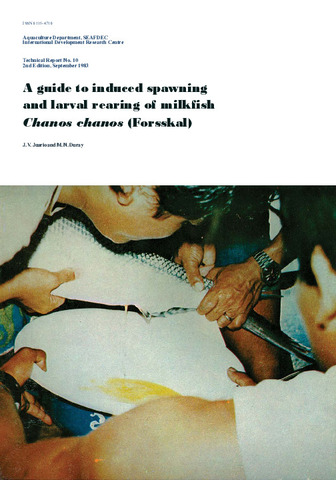
A guide to induced spawning and larval rearing of milkfish Chanos chanos (Forsskal)
(Aquaculture Department, Southeast Asian Fisheries Development Center; International Development Research Centre, 1983)The techniques for the artificial propagation of milkfish (Chanos chanos ) developed at SEAFDEC are presented. These include: 1) capture and transport of spawners; 2) determination of sex and weight and maturity of fish; 3) induced spawning (preparation of injection, males, females); 4) fertilization and incubation; 5) larval rearing; and 6) mass production of larval food. -
Use of mangroves for aquaculture: Vietnam.
(Aquaculture Department, Southeast Asian Fisheries Development Center, 2004)Vietnam has a coastal line of 3600 km with a large wetland (tidal area) area of 600,000 ha (according to the survey statistics of the Institute of Planning and Economics under the Ministry of Fisheries), in which mangrove areas occupy a big part. Before the war, there were about 400,000 ha of mangroves in Vietnam; the largest area located in the South of Vietnam (Mekong River Delta) mainly in Tra Vinh, Soc Trang and Minh Hai. Mangrove forest serves as buffer zone or as biological filter layer. Mangrove is not only a very important ecosystem for forestry and agriculture but plays a decisive role in exploitation, aquaculture and biodiversity yield. Mangrove forests of Vietnam, especially in the South of Vietnam has been the main source of livelihood for farmers and fishermen, for a long time, which until now still occupy a large proportion of the whole country. -
Mitigation plan on the use of mangroves for aquaculture: Thailand.
(Aquaculture Department, Southeast Asian Fisheries Development Center, 2004)Mangrove forest is one of the important coastal natural resources of Thailand, however, mangrove forests have deteriorated very rapidly at a rate of more than 50% of the mangrove loss during 1961–1996. The utilization and destruction of mangrove forest has been seriously discussed in many fora. Shrimp farming is one activity, which has disturbed the mangrove forests. According to the inventory and analysis of LANDSAT5 TM satellite imagery data of 1993, only 17.49% of shrimp farms are located in mangrove forests and only 7.36% in the productive area. In addition 10.10% of shrimp farms are in unproductive or upland area, which have been leased legally by the farmers. Therefore, the Royal Thai Government has been working closely with the local communities and NGOs to implement a mangrove reforestation program targeting a replanting of 24,394.64 ha. As a result, the mangrove area has increased to 252,750.88 ha in 2001. -
The use of mangroves for aquaculture: Philippines
(Aquaculture Department, Southeast Asian Fisheries Development Center, 2004)According to the National Forest Resource Inventory (NFRI), the estimated remaining area of mangrove forests in the Philippines in 1988 is 139,100 ha (DENR 1994). Of the total 139,100 ha mangrove forests, 78,593 ha are found within the mangrove forest reservations. Presidential Proclamation (PP) 2151 declares approximately 4326 ha as mangrove wilderness areas, while PP 2152 declares an aggregate 74,268 ha as mangrove swamp forest reserves. Approximately 95% of these mangroves are secondary growth and only 5% are old growth mangroves. These old growth mangrove forests are mostly located in Palawan Island. Results of a survey revealed that Palawan covers 35% of the conservation area followed by Surigao del Norte, which covers 22% of the total mangrove forest reserve. Surigao del Norte covers more than 50% of mangrove wilderness areas followed by Bohol with 29%. However, recent survey showed that there are mangrove reservation areas converted and developed for aquaculture purposes. Portions of the mangrove swamp forest reserves are found in Palawan, Quezon, Camarines Norte, Leyte, Cebu, Bohol, Lanao del Norte, Misamis Occidental, Davao, Surigao del Norte, Surigao del Sur and Zamboanga del Sur. -
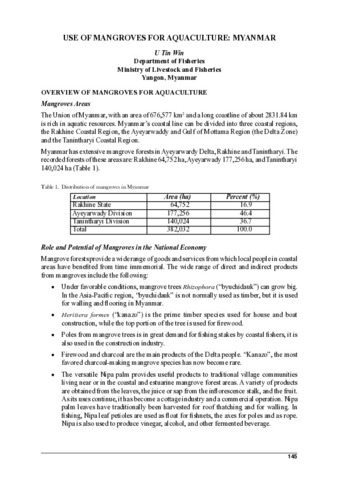
Use of mangroves for aquaculture: Myanmar.
(Aquaculture Department, Southeast Asian Fisheries Development Center, 2004)Aquaculture has only started to develop rapidly in the past few decades, due to better knowledge of culture species, improved methodologies and techniques in breeding, nutrition and increasing demand for food fish of high-value species such as shrimps, sea bass and groupers. Mangrove deforestation has an impact on shrimp culture itself, the success of the latter (when traditional culture method is used) depends on stocking of wild fry. For semi-intensive and intensive shrimp culture, the number of wild caught spawners may decrease because wild shrimp populations also use mangrove swamps as its feeding ground. Other negative effects of mangrove destruction to make way to shrimp ponds, include water pollution from pond effluents, sedimentation from the release of solid materials from pond, interruption of the tidal water flow, dwindling natural shrimp and fish stock due to increased pollution or product contamination due to indiscriminate use of chemicals. Chemicals and drugs (antibiotic) should not be used in fish and shrimp culture for prevention and control of bacteria and viral diseases. In order to ensure the sustainable development of aquaculture, it is important to bear in mind the interdependence of technology and natural resource under various socioeconomic setting. -
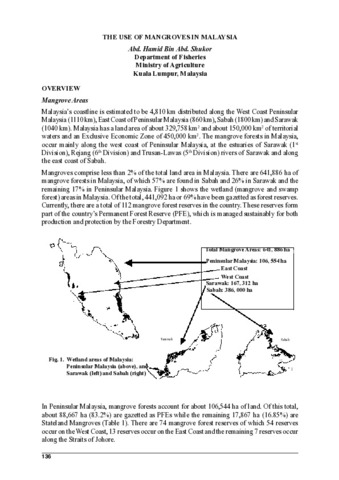
The use of mangroves in Malaysia
(Aquaculture Department, Southeast Asian Fisheries Development Center, 2004) -
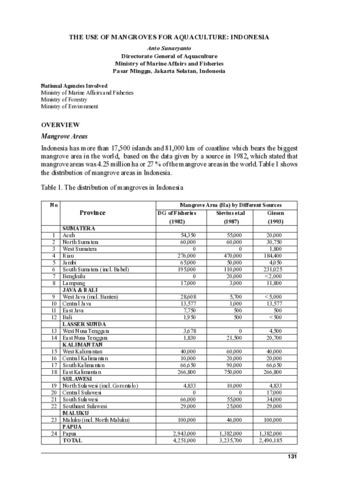
The use of mangroves for aquaculture: Indonesia.
(Aquaculture Department, Southeast Asian Fisheries Development Center, 2004)Indonesia has more than 17,500 islands and 81,000 km of coastline which bears the biggest mangrove area in the world, based on the data given by a source in 1982, which stated that mangrove areas was 4.25 million ha or 27 % of the mangrove areas in the world. Later data in 1987 and 1993 the total mangrove areas were only 3.23 and 2.49 million ha, respectively, and theses have been reportedly reduced by about 1.0 and 0.8 million ha, respectively, allegedly due to aquaculture. Various sources also supply different data, but generally, the tendency of deforestation in mangrove areas is also shown. Brackishwater pond culture was always suspected to be the main cause of the deforestation. Nevertheless, the development of brackishwater pond area does not support the allegations. From the data given by the Directorate General of Fisheries, brackishwater pond area in 1982, 1987 and 1993 are 220,400 ha, 263,200 and 331,800 ha, respectively, which means only about 22% ha (of the 1.0 million ha reduction) and 41% ha (of the 0.8 million ha reduction) may have caused the mangrove area reduction. In reality, not all of the brackishwater ponds are developed in mangrove areas as some of them are in coastal sand areas. -
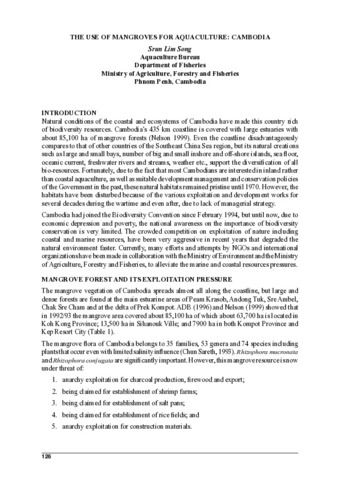
The use of mangroves for aquaculture: Cambodia.
(Aquaculture Department, Southeast Asian Fisheries Development Center, 2004)Natural conditions of the coastal and ecosystems of Cambodia have made this country rich of biodiversity resources. Cambodia’s 435 km coastline is covered with large estuaries with about 85,100 ha of mangrove forests (Nelson 1999). Even the coastline disadvantageously compares to that of other countries of the Southeast China Sea region, but its natural creations such as large and small bays, number of big and small inshore and off-shore islands, sea floor, oceanic current, freshwater rivers and streams, weather etc., support the diversification of all bio-resources. Fortunately, due to the fact that most Cambodians are interested in inland rather than coastal aquaculture, as well as suitable development management and conservation policies of the Government in the past, these natural habitats remained pristine until 1970. However, the habitats have been disturbed because of the various exploitation and development works for several decades during the wartime and even after, due to lack of managerial strategy. Cambodia had joined the Biodiversity Convention since February 1994, but until now, due to economic depression and poverty, the national awareness on the importance of biodiversity conservation is very limited. The crowded competition on exploitation of nature including coastal and marine resources, have been very aggressive in recent years that degraded the natural environment faster. Currently, many efforts and attempts by NGOs and international organizations have been made in collaboration with the Ministry of Environment and the Ministry of Agriculture, Forestry and Fisheries, to alleviate the marine and coastal resources pressures. -
Shrimp culture and mangroves: Brunei Darussalam.
(Aquaculture Department, Southeast Asian Fisheries Development Center, 2004)Brunei Darussalam is a coastal state located in the north-western portion of Borneo island within latitudes 5o 05’ N and 4o 00’ N and longitudes 114o 04’ E and 115o 22’ E. The country has a land area of 5765 km2 (576,400 ha.) divided administratively into four districts, i.e. Brunei-Muara, Tutong, Belait and Temburong. The coastline of the country is roughly 130 km long, fronting the South China Sea and shares a common border with the east Malaysian State of Sarawak. The main population centers are in the coastal zone, accounting for over 85% of the population (305,100 in 1996). It is a Malay Islamic Monarchy and has a stable economy largely dependent on the exploitation of petroleum hydrocarbons. -
Studies on sustainable production systems of aquatic animals in brackish mangrove areas.
(Aquaculture Department, Southeast Asian Fisheries Development Center, 2004)The Southeast Asian Fisheries Development Center (SEAFDEC) and the Japan International Research Center for Agricultural Sciences (JIRCAS) signed a Memorandum of Understanding (MOU) in 2001 for the promotion of fisheries and aquaculture research and development in Southeast Asia. Under the said MOU, five collaborative research studies have been implemented at AQD in Iloilo, Philippines. In addition, JIRCAS also implements projects relevant to sustainable production systems of aquatic animals in brackish mangrove areas. -
Development of freshwater prawn (Macrobrachium rosenbergii) seed production and culture technology in the Mekong Delta Region of Vietnam: A review of the JIRCAS Project at Cantho University.
(Aquaculture Department, Southeast Asian Fisheries Development Center, 2004)The Mekong Delta of Vietnam is a region rich in aquatic resources having high potential for aquaculture development. Inland aquaculture in the Mekong Delta has greatly increased since the last decade. Fish culture carried out in combination with other agricultural activities such as animal husbandry and rice cultivation, and intensive aquaculture in ponds and cages have been the dominant forms of fish production. However, the giant freshwater prawn, Macrobrachium rosenbergii, has recently become a species of economic significance and the target of aquaculture activity in the Mekong Delta. M. rosenbergii is cultured throughout the region in the rice fields, ponds, orchard gardens and in pens along river banks. The major constraints in this industry are seed supply and culture techniques, becoming the major obstacles for the further development of the culture of this species. In a collaborative research project implemented between the Japan International Research Center for Agricultural Sciences (JIRCAS) and Cantho University (CTU) since 1994, studies have been carried out on various aspects relating to the establishment of M. rosenbergii seed production and culture technology. The project is now in the middle of its second phase and has generated a great deal of scientific and practical information. This paper presents an overview of the achievements of this project. -
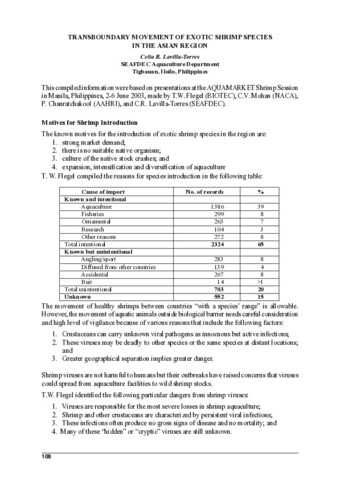
Transboundary movement of exotic shrimp species in the Asian region.
(Aquaculture Department, Southeast Asian Fisheries Development Center, 2004)This compiled information were based on presentations at the AQUAMARKET Shrimp Session in Manila, Philippines, 2-6 June 2003, made by T.W. Flegel (BIOTEC), C.V. Mohan (NACA), P. Chanratchakool (AAHRI), and C.R. Lavilla-Torres (SEAFDEC). -
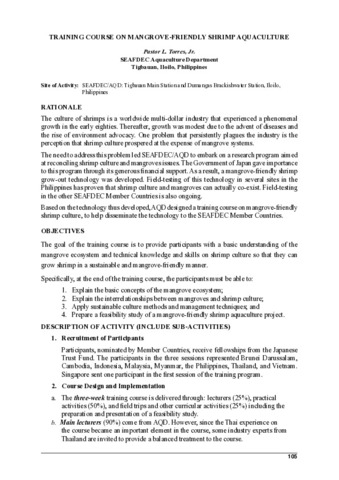
Training course on mangrove-friendly shrimp aquaculture.
(Aquaculture Department, Southeast Asian Fisheries Development Center, 2004)The culture of shrimps is a worldwide multi-dollar industry that experienced a phenomenal growth in the early eighties. Thereafter, growth was modest due to the advent of diseases and the rise of environment advocacy. One problem that persistently plagues the industry is the perception that shrimp culture prospered at the expense of mangrove systems. The need to address this problem led SEAFDEC/AQD to embark on a research program aimed at reconciling shrimp culture and mangroves issues. The Government of Japan gave importance to this program through its generous financial support. As a result, a mangrove-friendly shrimp grow-out technology was developed. Field-testing of this technology in several sites in the Philippines has proven that shrimp culture and mangroves can actually co-exist. Field-testing in the other SEAFDEC Member Countries is also ongoing. Based on the technology thus developed, AQD designed a training course on mangrove-friendly shrimp culture, to help disseminate the technology to the SEAFDEC Member Countries. -
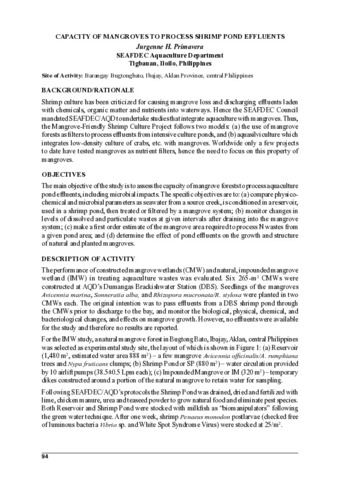
Capacity of mangroves to process shrimp pond effluents.
Primavera, Jurgenne (Aquaculture Department, Southeast Asian Fisheries Development Center, 2004)
Shrimp culture has been criticized for causing mangrove loss and discharging effluents laden with chemicals, organic matter and nutrients into waterways. Hence the SEAFDEC Council mandated SEAFDEC/AQD to undertake studies that integrate aquaculture with mangroves. Thus, the Mangrove-Friendly Shrimp Culture Project follows two models: (a) the use of mangrove forests as filters to process effluents from intensive culture ponds, and (b) aquasilviculture which integrates low-density culture of crabs, etc. with mangroves. Worldwide only a few projects to date have tested mangroves as nutrient filters, hence the need to focus on this property of mangroves.