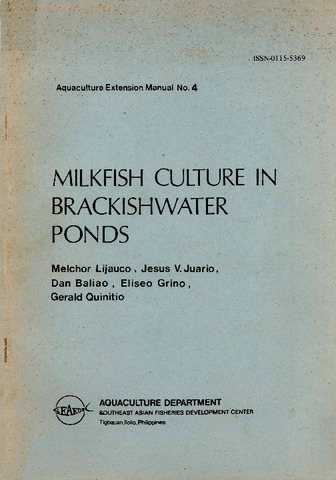
Milkfish culture in brackishwater ponds


Share
抄録
The manual is intended as a guide for operation in milkfish farming. It is presented under the following major sections: 1) Handling of fry - counting, storage and transport; 2) Pond layout and construction - selection of farm site, layout, construction, plan and specification; 3) Pond operation, culture and management - nursery pond management and rearing pond operation; 4) Harvest and post-harvest - harvest, post harvest, and processing; and 5) Economics and costing - cost of construction, cost of operation, and production/yield.
Suggested Citation
Lijauco, M., Juario, J. V., Baliao, D., Grino, E., & Quinitio, G. (1979). Milkfish culture in brackishwater ponds. Tigbauan, Iloilo, Philippines: Aquaculture Department, Southeast Asian Fisheries Development Center.
Type
BookISSN
0115-5369シリーズ
Aquaculture extension manual; No. 4Format
30p. ; 24cm.
Collections
Related items
Showing items related by title, author, creator and subject.
-
Aquaculture in the Philippines
(Aquaculture Department, Southeast Asian Fisheries Development Center, 1995)Aquaculture is regarded as the most promising source of protein food in the years ahead. Milkfish and Nile tilapia are the major fishes now produced but groupers, sea bass, rabbitfish, red snappers, carps, and catfishes are grown by some farmers. The tiger shrimp is still the most important cultured crustacean, but white shrimps and mudcrabs also have great potential. Oysters and mussels are produced in considerable amounts. Mariculture of the seaweed Eucheuma is now a well established industry, and the pond culture of Gracilaria for agar extraction is beginning to take off. -
Management of feeding aquaculture species
(Aquaculture Department, Southeast Asian Fisheries Development Center, 2002)This chapter teaches the reader to: differentiate the different feeding strategies in pond culture; learn feeding management methods such as stock sampling and record keeping, calculating daily feed ration, choosing appropriate feed size, and methods of applying feeds; understand the impact of feeding management on water quality and environment and on the cultured animal’s growth, survival, and feed conversion ratio; and describe the different feeding schemes used to culture fishes (milkfish, tilapia, rabbitfish, bighead carp, native catfish, sea bass, orange-spotted grouper, and mangrove red snapper; and crustaceans (tiger shrimp and mud crab). Other species for aquaculture stock enhancement (donkey’s ear abalone, seahorses, window-pane oyster) are also discussed. -
Brackishwater integrated farming systems in Southeast Asia
(Aquaculture Department, Southeast Asian Fisheries Development Center, 1995)Integrated aquaculture-agriculture systems are more common in fresh water than in brackish water. Nevertheless, southeast Asian countries already have considerable research and experience in brackishwater integrated farming systems. In the Philippines, the effects of animal wastes on water quality and production of fish have been studied: chicken wastes on the mixed culture of milkfish Chanos chanos, tilapia Oreochromis niloticus, and shrimp Penaeus indicus; chicken and cattle manures on P. monodon and Artemia; and swine wastes on tilapia O. mossambicus. In Indonesia, about 60 hectares of fish farms have crops (pumpkin, spinach, cassava, maize, and chili) or livestock (cattle, goat, sheep, chicken, and duck) grown on the dikes of milkfish ponds. In Vietnam, culture of the giant prawn Macrobrachium rosenbergii, Scylla serrata and marine shrimps has been integrated with coastal rice farming. Aquaculture-silviculture is a flourishing venture in Vietnam and Indonesia and gaining ground with experimental sites in Thailand and the Philippines. The seaweed Gracilaria has been cultured with fishes and shrimps in Taiwan, Vietnam, Thailand, and the Philippines. The production of Artemia cysts and biomass has been integrated with salt-making and fish or shrimp farming in the Philippines and Thailand. Production inputs and outputs from these integrated farming systems vary widely and socioeconomic information is nil. It is imperative to conduct follow-up research and evaluation of each system in terms of production and socioeconomics.