02 SEAFDEC/AQD Collaborative Publications: Recent submissions
146-150 / 453
-
Series: Summary of Proceedings No. 1/2013;
GIS-assisted trans-boundary risk mapping for water related food, health assessment and disaster risk reduction: Pilot, Sta. Rosa-Silang sub-watershed
(PCAARRD-DOST, 2013)The academic institutions from Japan, the Research Institute for Nature and Humanities (RIHN) and the Yokohama National University (YNU) provided a four-year (2010-2013) research fund and engaged the College of Agriculture-UPLB, the College of Medicine, University of the Philippines Manila (UPM), and LLDA, to conduct the first ever comprehensive integrated and multi-disciplinary researches on ecology-related food and human health risks for the establishment of science-based decision making and policies to protect the environment for sustainable urbanization and land use development in and around the Laguna Lake Region. The pilot study is a GIS-based risk mapping and assessment of the Sta. Rosa-Silang sub-watershed to provide basis for trans-boundary risk management of sub-watershed resources. This hopes to reduce the threats and impacts of climate change related flooding on urban investment, food security, health security, and, on the overall quality of life and environment in Sta. Rosa City, located downstream of the Sta. Rosa-Silang sub-watershed. The study likewise provided the graphic illustration of trans-boundary roles and ecological interconnectivity, as well as positive complementation between sustainable farming systems in the headwaters and modern urbanization in the lower portions managed by two politically separate LGUs belonging to different towns and provinces. The GIS-based risk based technical evaluation maps clearly identify the phenomenon called landscape inversion which manifested itself as alluvial fan formation with special recognizable footprints for high flood risk areas. Ultimately, the overlaying of GIS maps contributed to the (a) scientific explanation about the anomalies of river system, (b) possible maximum coverage of old Laguna Lake and location of its original boundaries, (c) areas whose groundwater are most likely vulnerable to groundwater contamination; and (d) explanation to massive flood and spatially redefine the old Laguna Lake water lines as the aftermath of super typhoon Ondoy. -
Series: Summary of Proceedings No. 1/2013;
Primary productivity, chlorophyll, phytoplankton and the development to eutrophic state of Taal Lake, southern Luzon, Philippines
(PCAARRD-DOST, 2013)Physico-chemical properties and biological components such as primary productivity, chlorophyll-a and phytoplankton were measured from January to October of 2008. This study aimed to determine the present trophic state and to provide information needed by policy makers for the management, conservation and sustainable use of Taal Lake. Primary productivity was measured using the Light and Dark Bottle Method, chlorophyll-a by fluorescence using SD204 Instrument, phytoplankton using Haemacytometer Method, and identification keys. All the parameters except pH have no significant differences on the type (cage or open water areas). However, all the parameters except net primary productivity and chlorophyll had significant differences between cages and open water areas. There are significant differences with respect to water temperature, water transparency, and dissolved oxygen among stations and months. Dissolved oxygen, nitrate and net primary productivity in the cages and open water areas displayed interaction effects on the months. Moreover, all parameters except Gross Primary Productivity (GPP) and chlorophyll-a in the stations had significant interaction effects also on the months. Nitrate is positively correlated with primary productivity, dissolved oxygen and pH, while total phosphorus has direct association with chlorophyll. Based on transparency readings, Taal Lake is mesotrophic. Both nitrates and total phosphorus exceeded the prescription of USEPA 1976a and UNEP-IETC-ILEC 2001 of 0.30 mg/L and 84.4 mg/L, respectively. On the other hand, chlorophyll-a peak concentration obtained in the study was fivefolds higher than the standard set by USEPA (1974) as cited by Novotny and Olem (1994) and UNEP-IETC-ILEC (2001). The cyanobacterial dominance and high chlorophyll, reduced transparency, off-flavor, and odor problems are symptoms of eutrophication, indicating that Taal Lake has developed into eutrophic status. It is recommended that continuous monitoring of water quality be carried out to determine if there is improvement or conditions remain the same or further deterioration occurs. Likewise, the carrying capacity of the lake and the causes of off-flavor must also be determined. -
Series: Summary of Proceedings No. 1/2013;
Time- and space-related water quality fluctuations and phytoplankton community dynamics in Lake Sampaloc of San Pablo City and Lake Crocodile of Los Baños, Laguna, Philippines
(PCAARRD-DOST, 2013)A study was done from June 2008 to June 2010 to compare the limnological features of two lakes in Laguna Province, namely, Sampaloc, a maar lake of San Pablo City, and Crocodile of Los Baños. Temporal variations were analyzed with emphasis on trophic state parameters monitored at three and two stations, respectively; and with three replicate areas/station. Statistical analysis used was the Kruskall-Wallis ANOVA and Pearson correlation analysis. Both lakes had significant to very highly significant seasonal differences in terms of water temperature (WT), total hardness (TH), nitrite-N, total inorganic nitrogen (TIN), soluble reactive phosphorus (SRP), total P (TP), and chemical oxygen demand (COD). Wet season (WS) lake warming in Lake Sampaloc possibly resulted from advective and convective heat transfers. In Lake Crocodile, solar heating is suspected because of cooling in January and warming in summer. In the dry season (DS), all ionic N forms and TIN spiked, implying improved N storage while oxidative N conversion improved and accompanied by enhanced algal growth. In Lake Crocodile, the WS saw increasing TH and NO2-N. In both lakes, elevated SRP and TP in DS was possibly caused by increased evaporation rates as P-augmenting human activities continued translating in increased pollution as evidenced by rising COD and Chl a. Chl a correlated with SDT, TA, EC, NO3-N, TIN, SRP and TP. The data is summarized in Table 1. Chl a ranges and overall means put Lake Sampaloc under eutrophic category, while Lake Crocodile is under mesotrophic to low-eutrophic. Species richness was higher in Lake Sampaloc with a cool month spike, the Cyanophyceae and Chlorophyceae exhibiting balanced representation. The Shanon-Wiener index of diversity, H range was 0.16-1.87. and the top three dominant species were Microcystis, Aulacoseira and Aphanocapsa. Lake Crocodile was mesotrophic to low-eutrophic with species richness spike in June and February, respectively. There were four to nine species found per station per sampling; the Shannon-Wiener H range is 0.07-0.96; and Microcystis, Coelastrum and Chroococcus disperses as dominants. Figure 1 shows the diversity indices for phytoplankton in the two lakes. -
Series: Summary of Proceedings No. 1/2013;
A fisheries in crisis: Threatened biodiversity and fish production of Lake Mainit, northeastern Mindanao
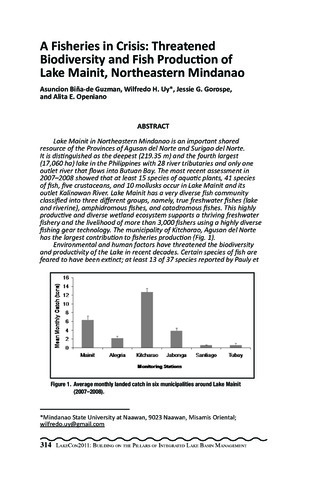
(PCAARRD-DOST, 2013)Lake Mainit in Northeastern Mindanao is an important shared resource of the Provinces of Agusan del Norte and Surigao del Norte. It is distinguished as the deepest (219.35 m) and the fourth largest (17,060 ha) lake in the Philippines with 28 river tributaries and only one outlet river that flows into Butuan Bay. The most recent assessment in 2007-2008 showed that at least 15 species of aquatic plants, 41 species of fish, five crustaceans, and 10 mollusks occur in Lake Mainit and its outlet Kalinawan River. Lake Mainit has a very diverse fish community classified into three different groups, namely, true freshwater fishes (lake and riverine), amphidromous fishes, and catadromous fishes. This highly productive and diverse wetland ecosystem supports a thriving freshwater fishery and the livelihood of more than 3,000 fishers using a highly diverse fishing gear technology. The municipality of Kitcharao, Agusan del Norte has the largest contribution to fisheries production (Fig. 1). Environmental and human factors have threatened the biodiversity and productivity of the Lake in recent decades. Certain species of fish are feared to have been extinct; at least 13 of 37 species reported by Pauly et al. (1990) were no longer encountered in the present study. More than 65% of the fish are migratory between the lake and Butuan Bay through the Kalinawan River. The population of the once abundant giant mottled eel (Anguilla marmorata) has drastically declined, resulting from massive fishing on adult eels during their seasonal spawning along Kalinawan River. The native white goby (Glossogobius giuris), locally known as pijanga, remains the most important fishery resource in Lake Mainit (Fig. 2), but the current fish catch is about 63% of the 1997-98 production as reported by Galicia and Lopez (2000). Many species are caught in progressively smaller sizes, resulting in lower economic value and hence, marginal fisher incomes. Pollution, unsustainable fishing practices, high fishing pressure, and lack of enforcement of fisheries policies have drastically reduced the annual fish catch from 15,108 t in 1980-81 to only about 831.50 t in 2007-08, which is only about 5.5% of the production level 26 years ago. Lake Mainit experiences the typical syndrome of a threatened fisheries resources: biodiversity loss, high fishing pressure, use of unsustainable fishing gears and methods, declining fish catch and catch-per-unit-effort, decreasing size of fish caught, and marginal or meager fisher incomes barely enough to provide for the basic daily needs like food, health, and children s education. The Lake Mainit Development Alliance (LMDA), an inter-LGU alliance among the eight municipalities around the lake, provides a ray of hope for this threatened resource. A fisheries management program is being integrated into the Lake Mainit Development Agenda to help restore Lake Mainit fisheries resources to sustainable levels. -
Series: Summary of Proceedings No. 1/2013;
Dead zones in Philippine protected areas law: Institutional tolerance of lawbreaking and the complicity of the stakeholders
(PCAARRD-DOST, 2013)As many problems associated with the conservation and protection of lakes are perceived to be caused by the simple failure to enforce laws, this paper is an analysis of the myriad reasons behind the lack of law enforcement. These include high enforcement and transaction costs, overly broad scope of policies, conflicting laws or varying interpretations of laws, and lack of information or understanding of existing laws, among other reasons. It suggests that at least for some laws, these are not the main reasons for lack of implementation. Instead, both political leaders and stakeholders are complicit in such failure to enforce and therefore make what Tim Wu of the University of Columbia calls dead zones. The complicity can be due to economic and social benefits that lack of enforcement allows, the sources of which are perceived not to be morally reprehensible. Furthermore, using the policy-making and decision-making experience in the Taal Volcano Protected Landscape (Fig. 1), such complicity has boundaries and enforcement is agreed upon and even pushed when the economic benefits arising from the political failure are threatened. In the space where there is complicity in the failure to enforce, or where the resulting policy is overly broad and allows for selective enforcement, such complicity also leads to politicized decision-making, itself variably tolerated by stakeholders or opposed based on the risk versus economic benefits balance. Finally, the study suggests that despite the dead zones, there is an inherent aversion to withdrawing these unenforced laws from the books. Utpal Bhattacharya and Hazem Daouk of Cornell University, in their study of insider trading, suggests that unenforced law may be more harmful than no law at all. As such, the study was in the context of law-breaking for economic benefit, it is contrasted with law-breaking in a protected area for economic gain. Bhattacharya and Daouk suggests that a less transparent, unequal marketplace tends to disadvantage outsiders, and disadvantaged outsiders demand a higher return on their investments. The paper explores whether those disadvantaged by politicized decision-making on the issuance of licenses for fishcages in Taal Lake will tend to circumvent other protected area policies in order to get a higher return on investment, thereby creating a larger dead zone in a different area of regulation. Hence, the enforcement cost would be higher in terms of monitoring compliance with aquaculture regulations that are harder to monitor such as stocking density standards and feeding regulations.