02 SEAFDEC/AQD Collaborative Publications: Recent submissions
66-70 / 453
-
Preliminary trials on the optimization of hormone dosages for induced breeding of Philippine silver perch, Leiopotherapon plumbeus
; Aya, Frolan ; Romana-Eguia, Maria Rowena R. (Aquaculture Department, Southeast Asian Fisheries Development Center, 2015)
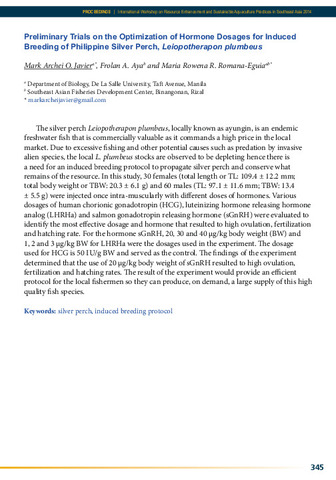
The silver perch Leiopotherapon plumbeus, locally known as ayungin, is an endemic freshwater fish that is commercially valuable as it commands a high price in the local market. Due to excessive fishing and other potential causes such as predation by invasive alien species, the local L. plumbeus stocks are observed to be depleting hence there is a need for an induced breeding protocol to propagate silver perch and conserve what remains of the resource. In this study, 30 females (total length or TL: 109.4 ± 12.2 mm; total body weight or TBW: 20.3 ± 6.1 g) and 60 males (TL: 97.1 ± 11.6 mm; TBW: 13.4 ± 5.5 g) were injected once intra-muscularly with different doses of hormones. Various dosages of human chorionic gonadotropin (HCG), luteinizing hormone releasing hormone analog (LHRHa) and salmon gonadotropin releasing hormone (sGnRH) were evaluated to identify the most effective dosage and hormone that resulted to high ovulation, fertilization and hatching rate. For the hormone sGnRH, 20, 30 and 40 µg/kg body weight (BW) and 1, 2 and 3 µg/kg BW for LHRHa were the dosages used in the experiment. The dosage used for HCG is 50 IU/g BW and served as the control. The findings of the experiment determined that the use of 20 µg/kg body weight of sGnRH resulted to high ovulation, fertilization and hatching rates. The result of the experiment would provide an efficient protocol for the local fishermen so they can produce, on demand, a large supply of this high quality fish species.
; Romana-Eguia, Maria Rowena R. (Aquaculture Department, Southeast Asian Fisheries Development Center, 2015)
The silver perch Leiopotherapon plumbeus, locally known as ayungin, is an endemic freshwater fish that is commercially valuable as it commands a high price in the local market. Due to excessive fishing and other potential causes such as predation by invasive alien species, the local L. plumbeus stocks are observed to be depleting hence there is a need for an induced breeding protocol to propagate silver perch and conserve what remains of the resource. In this study, 30 females (total length or TL: 109.4 ± 12.2 mm; total body weight or TBW: 20.3 ± 6.1 g) and 60 males (TL: 97.1 ± 11.6 mm; TBW: 13.4 ± 5.5 g) were injected once intra-muscularly with different doses of hormones. Various dosages of human chorionic gonadotropin (HCG), luteinizing hormone releasing hormone analog (LHRHa) and salmon gonadotropin releasing hormone (sGnRH) were evaluated to identify the most effective dosage and hormone that resulted to high ovulation, fertilization and hatching rate. For the hormone sGnRH, 20, 30 and 40 µg/kg body weight (BW) and 1, 2 and 3 µg/kg BW for LHRHa were the dosages used in the experiment. The dosage used for HCG is 50 IU/g BW and served as the control. The findings of the experiment determined that the use of 20 µg/kg body weight of sGnRH resulted to high ovulation, fertilization and hatching rates. The result of the experiment would provide an efficient protocol for the local fishermen so they can produce, on demand, a large supply of this high quality fish species. -
A preliminary study on the diagnosis of coral reef healthiness and establishment of coral replenishment technology
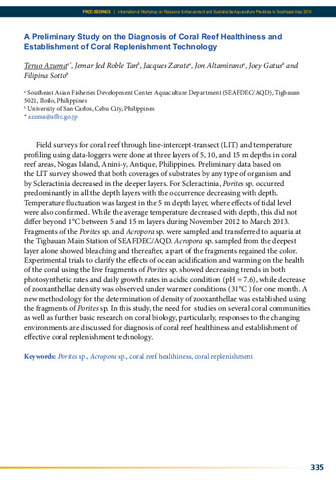
(Aquaculture Department, Southeast Asian Fisheries Development Center, 2015)Field surveys for coral reef through line-intercept-transect (LIT) and temperature profiling using data-loggers were done at three layers of 5, 10, and 15 m depths in coral reef areas, Nogas Island, Anini-y, Antique, Philippines. Preliminary data based on the LIT survey showed that both coverages of substrates by any type of organism and by Scleractinia decreased in the deeper layers. For Scleractinia, Porites sp. occurred predominantly in all the depth layers with the occurrence decreasing with depth. Temperature fluctuation was largest in the 5 m depth layer, where effects of tidal level were also confirmed. While the average temperature decreased with depth, this did not differ beyond 1°C between 5 and 15 m layers during November 2012 to March 2013. Fragments of the Porites sp. and Acropora sp. were sampled and transferred to aquaria at the Tigbauan Main Station of SEAFDEC/AQD. Acropora sp. sampled from the deepest layer alone showed bleaching and thereafter, a part of the fragments regained the color. Experimental trials to clarify the effects of ocean acidification and warming on the health of the coral using the live fragments of Porites sp. showed decreasing trends in both photosynthetic rates and daily growth rates in acidic condition (pH = 7.6), while decrease of zooxanthellae density was observed under warmer conditions (31°C ) for one month. A new methodology for the determination of density of zooxanthellae was established using the fragments of Porites sp. In this study, the need for studies on several coral communities as well as further basic research on coral biology, particularly, responses to the changing environments are discussed for diagnosis of coral reef healthiness and establishment of effective coral replenishment technology. -
The importance of mangroves to capture and culture fisheries
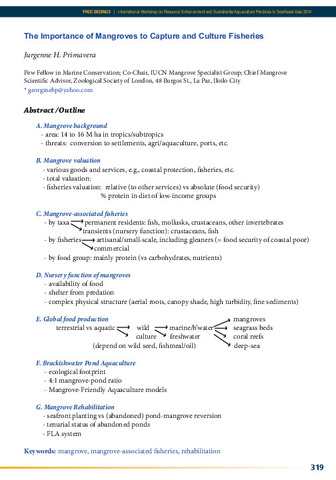
Primavera, JurgenneAbstract only. (Aquaculture Department, Southeast Asian Fisheries Development Center, 2015)
-
Good aquaculture practices (GAqP): setting directions for harmonized regional standards - the Philippine experience
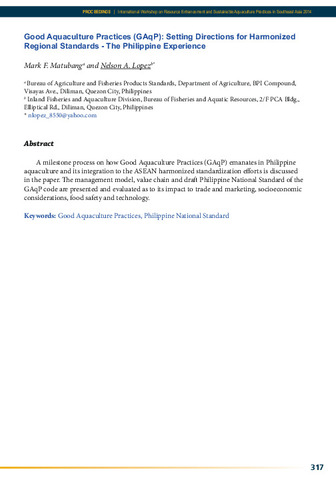
(Aquaculture Department, Southeast Asian Fisheries Development Center, 2015)A milestone process on how Good Aquaculture Practices (GAqP) emanates in Philippine aquaculture and its integration to the ASEAN harmonized standardization efforts is discussed in the paper. The management model, value chain and draft Philippine National Standard of the GAqP code are presented and evaluated as to its impact to trade and marketing, socioeconomic considerations, food safety and technology. -
Assessment of humphead wrasse (Cheilinus undulatus), spawning aggregations and declaration of marine protected area as strategy for enhancement of wild stocks
(Aquaculture Department, Southeast Asian Fisheries Development Center, 2015)Humphead wrasse, known as the Napoleon fish (Cheilinus undulatus), is the largest living member of the family Labridae. It is slow growing but can grow to a maximum size exceeding 2 m and 190 kg. This species was the first commercially important coral reef food fish to be listed in the Convention on International Trade in Endangered Species of Wild Fauna and Flora (CITES) Appendix II in 2004 because of its vulnerable status and the ongoing threat to its conservation from international trade. Like many coral reef fishes, the humphead wrasse, Cheilinus undulatus, aggregate in reef areas when they spawn and this spawning behaviour makes them highly vulnerable to overfishing. Assessment of the spawning aggregations of this species was conducted in the municipalities of Sibutu and Sitangkai in the province of Tawi-Tawi, Philippines. Key informant interviews (KII) with fishermen, mariculturists, and other stakeholders and focus group discussions (FGD) with local government leaders, Fisheries and Aquatic Resources Management (FARMC) members, mariculturists, and exporters were conducted. Guided by the results of these KII and FGDs, underwater visual census of mameng (local common name for Napoleon wrasse) populations (juvenile and mature) were conducted to document spawning aggregation sites. Since there was no photo-documentation of actual spawning aggregations of mameng in the reef areas, indirect measures were used. Result of the KII and FGD indicated that the Baligtang Reef in Sipangkot and Tando Owak are major sources of spawners. Anecdotal accounts of Bajau fishermen showed that Dungun Dungon, Baligtang reef, Tando Owak and Tugalan are traditional fishing grounds for mameng spawning aggregations. From the length-frequency analysis of mameng caught by hook and line and fish pot in the Baligtang Reef in Sipangkot, the estimated length at maturity of this species was found to be 25-35 cm. There were 134 individuals caught within this size range so they are considered potential spawners. Another indirect proof used was the underwater documentation of juvenile humphead wrasse which were regularly observed and photographed in association with seagrass beds and branching coral reefs in Baligtang Reef in Sipangkot, Sitangkai. Gonadal study also indicated that the mameng caught in this area had mature and ripe gonads but the number of mature fish depends on the season. These were the basis of declaring Spawning Aggregation Sites in Tando Owak and Dungun Dungun in Sibutu and Baligtang Reef, Sipangkot and Tugalan in Sitangkai. These were declared as marine protected areas by ordinance of the municipal Sangguniang Bayan of the two municipalities. Management and enforcement plans have been developed and Bantay Dagat have been trained to protect the spawning aggregations and this strategy aims to protect the wild stocks of humphead wrasse. Protecting the spawners would ensure that there would be enough recruits, prevent recruitment overfishing and enhance the wild stocks.