02 SEAFDEC/AQD Collaborative Publications: Recent submissions
Now showing items 151-155 of 453
-
Series: Milkfish Podcasts
Milkfish aquaculture: Alternate-day feeding strategy for reducing cost of milkfish culture in brackishwater ponds and marine cages in the Philippines
(AquaFish Collaborative Research Support Program (AquaFish CRSP), 2012-02-02)This podcast provides information on how an alternate-day feeding strategy can be used to reduce costs for culturing milkfish in ponds or marine cages. -
Philippine National Standard: Live, chilled/frozen grouper
(Bureau of Agriculture and Fisheries Standards, 2009)This Philippine National Standard for live, chilled/frozen grouper identifies the Philippine species of grouper, specifies their essential composition and quality factors (including size classification and quality characteristics), provides the presentation, packaging and labeling requirements, indicates the methods sampling, examination and analyses, and defines the types of defectives. It is hoped that this standard accomplishes our two pronged goal of protecting consumer health and making the Philippine fish and fishery products globally competitive. -
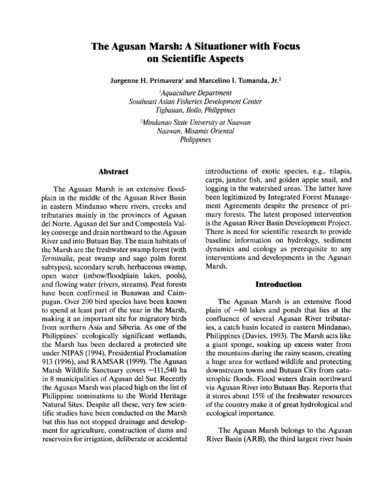
The Agusan marsh: A situationer with focus on scientific aspects
Primavera, Jurgenne ; (UNESCO Jakarta Office, Philippine Council for Aquatic and Marine Research and Development, 2008)
The Agusan Marsh is an extensive floodplain in the middle of the Agusan River Basin in eastern Mindanao where rivers, creeks and tributaries mainly in the provinces of Agusan del Norte, Agusan del Sur and Compostela Valley converge and drain northward to the Agusan River and into Butuan Bay. The main habitats of the Marsh are the freshwater swamp forest (with Terminalia, peat swamp and sago palm forest subtypes), secondary scrub, herbaceous swamp, open water (oxbow/floodplain lakes, pools), and flowing water (rivers, streams). Peat forests have been confirmed in Bunawan and Caimpugan. Over 200 bird species have been known to spend at least part of the year in the Marsh, making it an important site for migratory birds from northern Asia and Siberia. As one of the Philippines' ecologically significant wetlands, the Marsh has been declared a protected site under NIP AS (1994), Presidential Proclamation 913 (1996), and RAMSAR (1999). The Agusan Marsh Wildlife Sanctuary covers -111,540 ha in 8 municipalities of Agusan del Sur. Recently the Agusan Marsh was placed high on the list of Philippine nominations to the World Heritage Natural Sites. Despite all these, very few scientific studies have been conducted on the Marsh but this has not stopped drainage and development for agriculture, construction of dams and reservoirs for irrigation, deliberate or accidental introductions of exotic species, e.g., tilapia, carps, janitor fish, and golden apple snail, and logging in the watershed areas. The latter have been legitimized by Integrated Forest Management Agreements despite the presence of primary forests. The latest proposed intervention is the Agusan River Basin Development Project. There is need for scientific research to provide baseline information on hydrology, sediment dynamics and ecology as prerequisite to any interventions and developments in the Agusan Marsh.
; (UNESCO Jakarta Office, Philippine Council for Aquatic and Marine Research and Development, 2008)
The Agusan Marsh is an extensive floodplain in the middle of the Agusan River Basin in eastern Mindanao where rivers, creeks and tributaries mainly in the provinces of Agusan del Norte, Agusan del Sur and Compostela Valley converge and drain northward to the Agusan River and into Butuan Bay. The main habitats of the Marsh are the freshwater swamp forest (with Terminalia, peat swamp and sago palm forest subtypes), secondary scrub, herbaceous swamp, open water (oxbow/floodplain lakes, pools), and flowing water (rivers, streams). Peat forests have been confirmed in Bunawan and Caimpugan. Over 200 bird species have been known to spend at least part of the year in the Marsh, making it an important site for migratory birds from northern Asia and Siberia. As one of the Philippines' ecologically significant wetlands, the Marsh has been declared a protected site under NIP AS (1994), Presidential Proclamation 913 (1996), and RAMSAR (1999). The Agusan Marsh Wildlife Sanctuary covers -111,540 ha in 8 municipalities of Agusan del Sur. Recently the Agusan Marsh was placed high on the list of Philippine nominations to the World Heritage Natural Sites. Despite all these, very few scientific studies have been conducted on the Marsh but this has not stopped drainage and development for agriculture, construction of dams and reservoirs for irrigation, deliberate or accidental introductions of exotic species, e.g., tilapia, carps, janitor fish, and golden apple snail, and logging in the watershed areas. The latter have been legitimized by Integrated Forest Management Agreements despite the presence of primary forests. The latest proposed intervention is the Agusan River Basin Development Project. There is need for scientific research to provide baseline information on hydrology, sediment dynamics and ecology as prerequisite to any interventions and developments in the Agusan Marsh. -
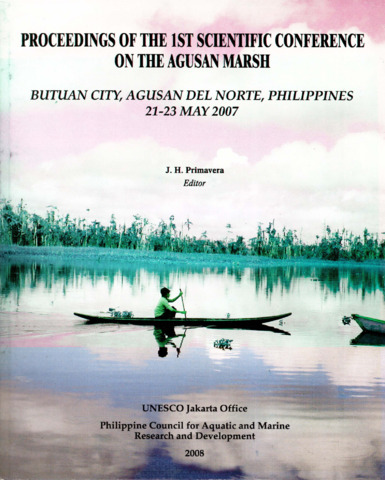
Proceedings of the 1st Scientific Conference on the Agusan Marsh: Butuan City, Agusan del Norte, Philippines, 21-23 May 2007
(UNESCO Jakarta Office, Philippine Council for Aquatic and Marine Research and Development, 2008) -
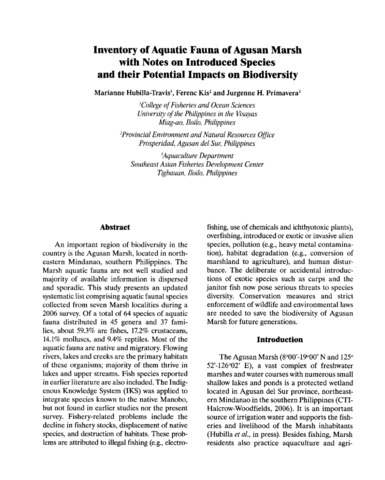
Inventory of aquatic fauna of Agusan marsh with notes on introduced species and their potential impacts on biodiversity
; ; Primavera, Jurgenne (UNESCO Jakarta Office, Philippine Council for Aquatic and Marine Research and Development, 2008)
An important region of biodiversity in the country is the Agusan Marsh, located in northeastern Mindanao, southern Philippines. The Marsh aquatic fauna are not well studied and majority of available information is dispersed and sporadic. This study presents an updated systematic list comprising aquatic faunal species collected from seven Marsh localities during a 2006 survey. Of a total of 64 species of aquatic fauna distributed in 45 genera and 37 families, about 59.3% are fishes, 17.2% crustaceans, 14.1% molluscs, and 9.4% reptiles. Most of the aquatic fauna are native and migratory. Flowing rivers, lakes and creeks are the primary habitats of these organisms; majority of them thrive in lakes and upper streams. Fish species reported in earlier literature are also included. The Indigenous Knowledge System (IKS) was applied to integrate species known to the native Manobo, but not found in earlier studies nor the present survey. Fishery-related problems include the decline in fishery stocks, displacement of native species, and destruction of habitats. These problems are attributed to illegal fishing (e.g., electrofishing, use of chemicals and ichthyotoxic plants), overfishing, introduced or exotic or invasive alien species, pollution (e.g., heavy metal contamination), habitat degradation (e.g., conversion of marshland to agriculture), and human disturbance. The deliberate or accidental introductions of exotic species such as carps and the janitor fish now pose serious threats to species diversity. Conservation measures and strict enforcement of wildlife and environmental laws are needed to save the biodiversity of Agusan Marsh for future generations.