SEAFDEC/AQD Publications in Print and for Sale: Recent submissions
Now showing items 21-30 of 30
-
Series: Aquaculture extension manual; No. 54
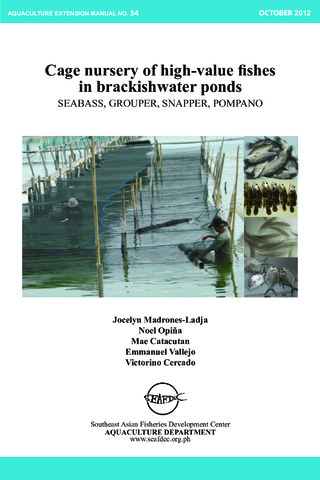
Cage nursery of high-value fishes in brackishwater ponds: Seabass, grouper, snapper, pompano
(Aquaculture Department, Southeast Asian Fisheries Development Center, 2012)This extension manual describes nursery pond requirements, nursery rearing procedures, common diseases of young marine fish, and economic analysis of cage nursery as an enterprise separate from hatchery and grow-out culture. -
Series: Aquaculture extension manual; No. 51
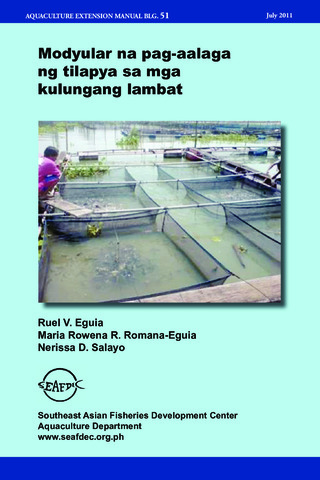
Modyular na pag-aalaga ng tilapya sa mga kulungang lambat
; Romana-Eguia, Maria Rowena R.An extension manual detailing traditional cage culture method, concept of modular cage culture, economic feasibility of modular cage culture, and post harvest processing. ; (Aquaculture Department, Southeast Asian Fisheries Development Center, 2011)
-
Series: Aquaculture extension manual No. 45
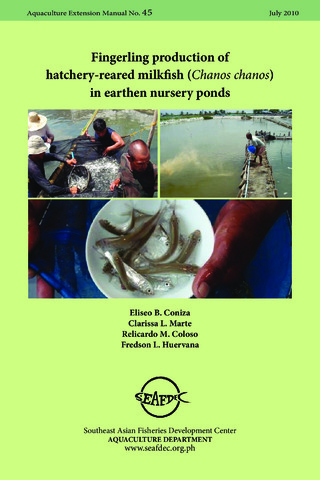
Fingerling production of hatchery-reared milkfish (Chanos chanos) in earthen nursery ponds
(Aquaculture Department, Southeast Asian Fisheries Development Center, 2010)Fingerling production of milkfish in ponds maybe operated as a commercial enterprise or a component of milkfish farming that comprises nursery, transition and rearing or grow-out phases. The fishpond nursery is used to grow milkfish fry to fingerlings 1-3 g in weight or 1-2 inches in length. The nursery pond is the smallest of the major fishpond compartment ranging from 500 to 5,000 m2, and is about 10% of the total farming area. The pond is prepared with utmost care to eliminate predators and competitors. The area should have good topography, is free from flooding and should have soil with good water retention properties for good dike construction and efficient culture management. Water supply should be adequate year-round and free from pollutants. Good pond water quality is maintained and natural food should be adequate to enhance growth and survival. With high stocking densities, supplemental feed is also provided. The three types of nurseries are based on feed sources: lablab, plankton with supplemental feeding and direct feeding. Select hatchery-reared fry (21 day old) that swim actively in schools, are uniform in size, have robust body, and are resistant to handling and transport stress. The ideal fry stocking density is 5-40 pieces/m2. Survival ranging from 50-90% can be expected after 25-45 days of rearing. Harvest, packing, transport, acclimation and stocking of the fry or fingerlings are carefully done during the cooler part of the day. Economic indicators show that fingerlings production is a profitable business. The improvement of milkfish grow-out technology from extensive or traditional to modified-extensive, semi-intensive and intensive culture in ponds, pens or in sea cages has increased demand for good quality fingerlings. Mass production of hatchery-reared fingerlings in earthen nursery ponds during peak season of fry availability can help bridge the supply gap. A steady supply of fingerlings for a whole year s operation will further increase production and ensure a sustainable supply of affordable market-sized fish. -
Series: Aquaculture extension manual; No. 53
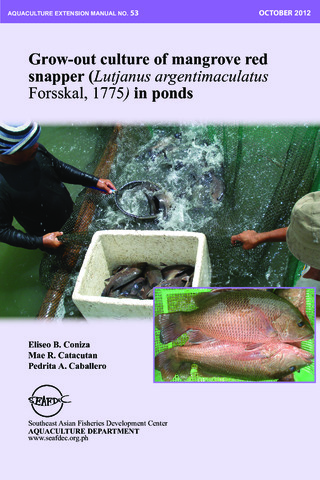
Grow-out culture of mangrove red snapper (Lutjanus argentimaculatus Forsskal, 1775) in ponds
(Aquaculture Department, Southeast Asian Fisheries Development Center, 2012)The mangrove red snapper is among the high-value marine fishes with great potential for export. Snapper is important to coastal fishery and ideal for aquaculture particularly in Southeast Asia. Grow-out culture of snapper are described - pond culture and culture in cages inside the ponds. In the pond culture, the whole area can be maximized and the available natural food can be utilized by snapper. In rearing snapper in cages inside the pond, fish sampling and harvesting are easily done and also in preventing of disease infection and securing of fish stocks during flooding. In both culture methods a good site would have a mangrove buffer space about 20-100 m that lies between the ponds and the source of water like river or sea. Pond soil with a good water retention property is desirable for dike construction. Water supply should be adequate year-round, free from pollutants and run-off flooding. Pond supplies, labor and technology should be available on the selected site which is also accessible to markets with peaceful locale. The pond for growing snapper should be prepared well in order to promote good growth of fish, to minimize pollution, and prevents the proliferation of pathogens. Stocking of healthy and larger uniform size juveniles will mean higher survival, faster growth and shorter culture period. Proper handling of juveniles during harvest, size-grading, counting, packing, transport, acclimation and stocking should be observed and should be done during the cooler part of the day. Recommended juveniles for grow-out is about 20-100 g average body weight (ABW) and stocking densities of 5,000/ha in ponds, and at 5 pcs/m3 or 5,000 pcs/ha when stocked in cages inside the pond. During culture, good water quality is maintained and when necessary the cleaning of net cages, repair of dike leaks and seepages, and aeration are to be considered. Snapper dietary protein is about 48-50%. The following are the factors to consider in the feeding management of snapper: total stock (pcs), survival (%), ABW (g), feed rate (% biomass), feed type, feed size, feeding frequency and time. Economic analysis based on 0.422 ha pond shows that feeds accounted for 60-67% and juveniles contribute 23-25% of the variable cost. The feed conversion ratios, return on investments, payback period and discounted benefit-cost ratios are 2.5 and 2.6; 203 and 43%; 0.46 and 1.76 yr; 1.4 and 1.2 for culture of snapper in pond and culture in cages inside the pond, respectively, are likewise acceptable. -
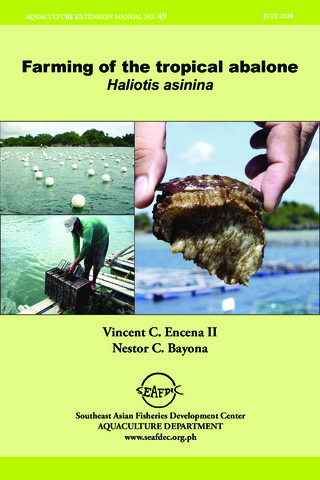
Series: Aquaculture extension manual; No. 49
Farming of the tropical abalone Haliotis asinina
(Aquaculture Department, Southeast Asian Fisheries Development Center, 2010)This manual was written to provide abalone growers a practical guide on how to culture abalone based on the studies and trials conducted by SEAFDEC Aquaculture Department. -
Series: Aquaculture extension manual; No. 48
Seed production of sandfish (Holothuria scabra) in Vietnam
(Aquaculture Department, Southeast Asian Fisheries Development Center, 2010)An extension manual describing broodstock management, larval rearing, and management of nursery systems. -
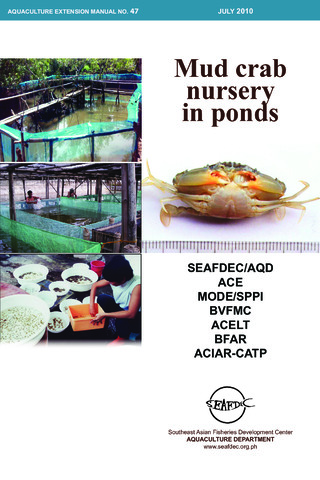
Series: Aquaculture extension manual; No. 47
Mud crab nursery in ponds
Quinitio, Emilia T.An extension manual that is highly illustrated, detailing the biology, nursery, harvest, marketing, costs-and-returns of mudcrab nursery in ponds.; ; ; ; ; ; (Aquaculture Department, Southeast Asian Fisheries Development Center, 2010)
-
Series: Aquaculture extension manual; No. 46
Intensive culture of sea bass, Lates calcarifer Bloch, in brackishwater earthen ponds
(Aquaculture Department, Southeast Asian Fisheries Development Center, 2010)An extension manual describing criteria for site selection, monoculture and polyculture operations including feeds and feeding, harvest, common diseases, economic analysis. -
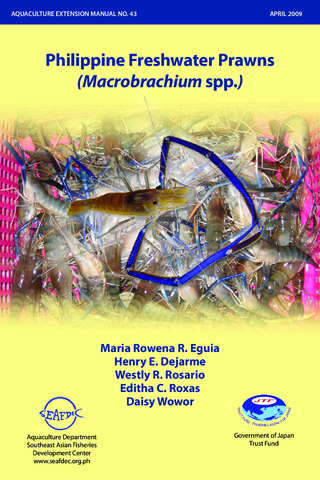
Series: Aquaculture extension manual; No. 43
Philippine freshwater prawns (Macrobrachium spp.)
Eguia, Maria Rowena R.; ; ; ; (Aquaculture Department, Southeast Asian Fisheries Development Center, 2009)
This manual provides information on the biology, morphology, natural distribution, habitat, and economic importance of 22 notable species of Macrobrachium in the Philippines. -
Series: Aquaculture extension manual; No. 39
Abalone hatchery
(Aquaculture Department, Southeast Asian Fisheries Development Center, 2008)This manual contains information on abalone hatchery operation, including site selection, design, culture of natural food, broodstock management, spawning, nursery, packing and transport, and profitability analyses.