Yeasts as food organisms in aquaculture
Download URL
www.fao.orgDate
1982Page views
3,423
AGROVOC keyword
Taxonomic term

Metadata
Show full item recordShare
Abstract
The use of yeast as feed in aquaculture is discussed. It has been successfully used as feed for Penaeus japonicus larvae, for Brachionus plicatilis mass culture, and for the improvement of nutritional quality of Tigriopus japonicus. It has been found most effective as supplemental food when enough phytoplankton cannot be supplied.
Suggested Citation
Villegas, C. T. (1982). Yeasts as food organisms in aquaculture. In Report of the Training Course on Growing Food Organisms for Fish Hatcheries: Tigbauan, Iloilo, Philippines, 3-22 August 1981 (pp. 77–80). Manila, Philippines: South China Sea Fisheries Development and Coordinating Programme.
Type
Conference paperCollections
- Conference Proceedings [300]
Related items
Showing items related by title, author, creator and subject.
-
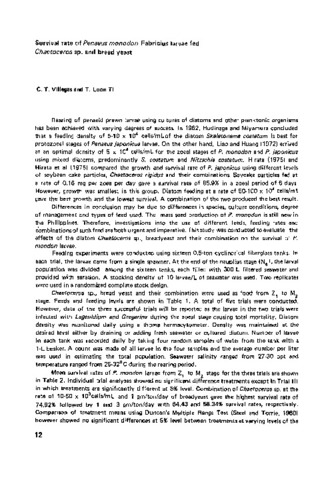
Survival rate of Penaeus monodon Fabricius larvae fed Chaetoceros sp. and bread yeast
(Aquaculture Department, Southeast Asian Fisheries Development Center, 1978)An evaluation was made of the effects of Chaetoceros species, bread yeast and their combination on the survival of Penaeus monodon larvae. In general it was found that feeding with a combination of the 2 resulted in higher larval survival rates. -
Nutritional value of marine yeast fed to larvae of Penaeus monodon in combination with algae
(Aquaculture Department, Southeast Asian Fisheries Development Center, 1985)Saccharomyces cerevasiae and Rhodotorula aurantica, two marine yeast species, were fed to Penaeus monodon larvae (N6 to M1) singly and in combination with Tetraselmis sp. and Chaetoceros calcitrans in varying proportions. Larvae fed combination diets gave survival rates comparable to or higher than those fed algae or yeast alone. Chemical analyses show that the yeasts have low fat, moderate protein and high carbohydrate content. They also contain essential amino acids but are different in the fatty acids found to be essential for prawns. When used in combination with algae, the nutritional value of the yeasts seemed to have been improved. The use of marine yeasts in larval rearing could reduce economic and technological inputs in the production of natural foods for larval rearing. They are cheaper and easier to mass produce. They can be grown to very high densities using cheap carbon sources like molasses, brown sugar and coconut water with added nutrients in relatively shorter periods of time. -
Anti-luminous Vibrio factors associated with the ‘green water’ grow-out culture of the tiger shrimp Penaeus monodon
(Elsevier, 2005)The ability of the “green water” grow-out culture of the tiger shrimp Penaeus monodon to prevent outbreaks of Luminous Vibriosis was investigated by screening associated isolates of bacteria, fungi, phytoplankton and fish skin mucus for anti-luminous Vibrio metabolites. Among the 85 bacterial isolates tested, 63 (74%) caused +∼+++ inhibition of the Vibrio harveyi pathogen after 24–48 h co-cultivation. The variation in growth inhibition rates of +, ++, and +++ were demonstrated by 15 (18%), 13 (15%), and 28 (33%) isolates, respectively, 24 h after treatment. Eight bacterial isolates showed consistently sustained maximum inhibition of luminous Vibrio after 24 to 48 h exposure. The majority of these luminous Vibrio inhibiting bacterial isolates were obtained from tilapia mucus and gut. In tests with fungi, 4 of 20 (20%) yeast isolates showed intracellular metabolites inhibitory to luminous Vibrio. Among filamentous fungi, 5 of 45 (11%) isolates yielded intracellular metabolites while 3 of 41 (7%) isolates had extracellular metabolites inhibitory to luminous Vibrio. These fungal isolates were identified as Rhodotorula sp., Saccharomyces sp., Candida sp., Penicillium sp., mycelia sterilia, and two unidentified species. The microalgae, Chaetoceros calcitrans and Nitzchia sp., consistently demonstrated complete inhibition of luminous Vibrio from 24 h and 48 h post exposure, respectively, and during the 7-day experiment. Leptolyngbia sp. caused a 94–100% reduction of the luminous Vibrio population from 104 to 101 cfu/ml 24 h post exposure which was sustained throughout the 10-day observation period. In contrast, the inhibitory effects of Skeletonema costatum on luminous Vibrio was bacteriostatic throughout the 7-day exposure while Nannochlorum sp. did not significantly inhibit luminous Vibrio. The skin mucus of jewel tilapia, Tilapia hornorum, had no resident luminous bacteria and inhibited this bacterial pathogen in 6–48 h, which was proportionate to the 103 and 105 cfu/ml test concentrations of luminous Vibrio. This study provides a scientific explanation that the effectiveness of the “green water” culture of tiger shrimp (P. monodon) in preventing outbreaks of luminous Vibriosis among P. monodon juveniles in grow-out ponds can be attributed to the presence of anti-luminous Vibrio factors in the bacterial, fungal, phytoplankton microbiota and the skin mucus of tilapia associated with this novel technique of shrimp culture.