Amino and fatty acid profiles of wild-sourced grouper (Epinephelus coioides) broodstock and larvae

Share
Abstract
This study was undertaken to provide information on the levels of amino acids in the muscle, liver and gonad of wild-sourced broodstock and larvae, as well as in neurula eggs and day 35 larvae from a hatchery. The fatty acid composition of grouper broodstock tissues was also determined. Samples were analysed for crude protein, amino acids, total lipids and fatty acid contents. Muscle contained higher levels of crude protein and amino acids than the ovary and liver. At the early maturing stage, the grouper ovarian protein was 73.3% and lipid was 19.3%, indicating the high dietary requirements of these nutrients for ovarian development. The crude protein and amino acid contents in wild-sourced larvae were higher than that in eggs and larvae from the hatchery.
Suggested Citation
Alava, V. R., Priolo, F. M. P., Arnaiz, M., & Toledo, J. D. (2004). Amino and fatty acid profiles of wild-sourced grouper (Epinephelus coioides) broodstock and larvae. In S. McBride & K. C. Williams (Eds.), Advances in grouper aquaculture (pp. 53–54). Canberra: Australian Centre for International Agricultural Research.
Type
Book chapterISBN
9781863204385Series
ACIAR Monograph 110Collections
- Books and Book Chapters [123]
Related items
Showing items related by title, author, creator and subject.
-
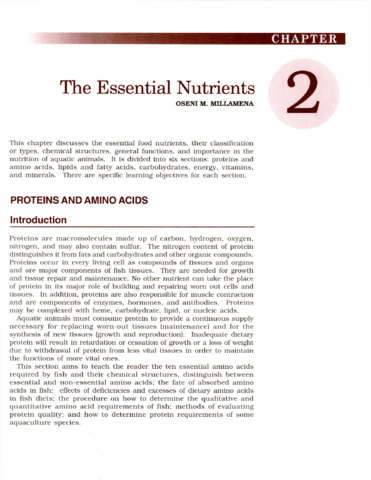
The essential nutrients: Proteins and amino acids
(Aquaculture Department, Southeast Asian Fisheries Development Center, 2002)This section aims to teach the reader the ten essential amino acids required by fish and their chemical structures, distinguish between essential and non-essential amino acids; the fate of absorbed amino acids in fish; effects of deficiencies and excesses of dietary amino acids in fish diets; the procedure on how to determine the qualitative and quantitative amino acid requirements of fish; methods of evaluating protein quality; and how to determine protein requirements of some aquaculture species. -
Philippine thraustochytrids from mangroves: A rich new source of essential fatty acids for human nutrition
(Marine Science Institute, University of the Philippines, 2007) -
Evaluation of dietary freeze-dried Chaetoceros calcitrans supplementation to control Vibrio harveyi infection on Penaeus monodon juvenile
; ; ; ; Amar, Edgar (Elsevier, 2014)
Effects of supplementation of diets with freeze-dried Chaetoceros calcitrans to control Vibrio harveyi infection are evaluated through immune responses, and disease resistance of juvenile Penaeus monodon. Total lipid and fatty acid profile of Chaetoceros calcitrans is also analyzed. A challenge infection with 107 cfu/mL concentration of Vibrio harveyi is intramuscularly injected to juvenile Penaeus monodon after 45 days of feeding of diets supplemented with 15 g/kg and 30 g/kg dried Chaetoceros calcitrans. The use of dried Chaetoceros calcitrans is compared with that of ß-1,3 glucan Curdlan, a commercial immune enhancer. Incorporation of 30 g/kg Chaetoceros calcitrans in the diet enhances the immune system of shrimp as effected by high prophenoloxidase activity and plasma protein concentration and is better compared to the commercially available Curdlan. Chaetoceros calcitrans also contains polyunsaturated fatty acids (PUFAs) such as linolenic acid and eicosapentanoic acid (EPA) which are responsible for its antibacterial action against Vibrio harveyi. All these biological activities of Chaetoceros calcitrans add up to increase resistance of the juvenile Penaeus monodon to vibriosis as shown by its high survival rate from the challenge infection with Vibrio harveyi. Therefore, it is worthwhile to use Chaetoceros calcitrans as supplementary feed. Its effect in increasing the immune competence coupled with its antibacterial action, make the shrimp resistant to luminous vibriosis that continues to affect the industry, thereby augmenting aquaculture production.
(Elsevier, 2014)
Effects of supplementation of diets with freeze-dried Chaetoceros calcitrans to control Vibrio harveyi infection are evaluated through immune responses, and disease resistance of juvenile Penaeus monodon. Total lipid and fatty acid profile of Chaetoceros calcitrans is also analyzed. A challenge infection with 107 cfu/mL concentration of Vibrio harveyi is intramuscularly injected to juvenile Penaeus monodon after 45 days of feeding of diets supplemented with 15 g/kg and 30 g/kg dried Chaetoceros calcitrans. The use of dried Chaetoceros calcitrans is compared with that of ß-1,3 glucan Curdlan, a commercial immune enhancer. Incorporation of 30 g/kg Chaetoceros calcitrans in the diet enhances the immune system of shrimp as effected by high prophenoloxidase activity and plasma protein concentration and is better compared to the commercially available Curdlan. Chaetoceros calcitrans also contains polyunsaturated fatty acids (PUFAs) such as linolenic acid and eicosapentanoic acid (EPA) which are responsible for its antibacterial action against Vibrio harveyi. All these biological activities of Chaetoceros calcitrans add up to increase resistance of the juvenile Penaeus monodon to vibriosis as shown by its high survival rate from the challenge infection with Vibrio harveyi. Therefore, it is worthwhile to use Chaetoceros calcitrans as supplementary feed. Its effect in increasing the immune competence coupled with its antibacterial action, make the shrimp resistant to luminous vibriosis that continues to affect the industry, thereby augmenting aquaculture production.