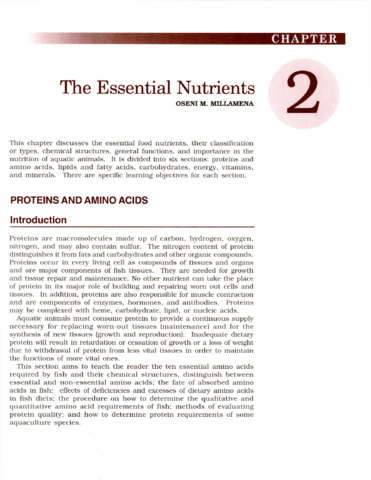
The essential nutrients: Proteins and amino acids


Share
Abstract
This section aims to teach the reader the ten essential amino acids required by fish and their chemical structures, distinguish between essential and non-essential amino acids; the fate of absorbed amino acids in fish; effects of deficiencies and excesses of dietary amino acids in fish diets; the procedure on how to determine the qualitative and quantitative amino acid requirements of fish; methods of evaluating protein quality; and how to determine protein requirements of some aquaculture species.
Suggested Citation
Millamena, O. M. (2002). The essential nutrients: Proteins and amino acids. In O. M. Millamena, R. M. Coloso, & F. P. Pascual (Eds.), Nutrition in Tropical Aquaculture: Essentials of fish nutrition, feeds, and feeding of tropical aquatic species (pp. 7–20). Tigbauan, Iloilo, Philippines: Aquaculture Department, Southeast Asian Fisheries Development Center.
Contents
- Introduction
- Amino acids
- Classification of amino acids
- Essential amino acids
- Non-essential amino acids
- Classification of proteins
- Protein structure
- Fate of absorbed amino acids
- Importance of amino acid profiles in fish nutrition
- Qualitative amino acid requirements
- Quantitative amino acid requirements
- Deficiencies and excesses of dietary amino acids
- Evaluation of protein quality
- Protein requirement
- Guide questions
Type
Book chapterISBN
971851158XRelated items
Showing items related by title, author, creator and subject.
-
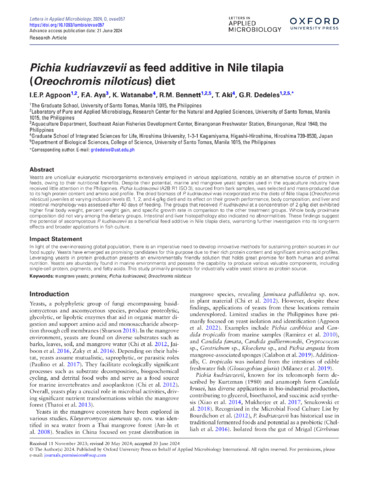
Pichia kudriavzevii as feed additive in Nile tilapia (Oreochromis niloticus) diet
; Aya, Frolan ; Watanabe, Kenshi ; ; Aki, Tsunehiro ; Dedeles, Gina (Oxford University Press; Applied Microbiology International, 2024-06)
Yeasts are unicellular eukaryotic microorganisms extensively employed in various applications, notably as an alternative source of protein in feeds, owing to their nutritional benefits. Despite their potential, marine and mangrove yeast species used in the aquaculture industry have received little attention in the Philippines. Pichia kudriavzevii (A2B R1 ISO 3), sourced from bark samples, was selected and mass-produced due to its high protein content and amino acid profile. The dried biomass of P. kudriavzevii was incorporated into the diets of Nile tilapia (Oreochromis niloticus) juveniles at varying inclusion levels (0, 1, 2, and 4 g/kg diet) and its effect on their growth performance, body composition, and liver and intestinal morphology was assessed after 40 days of feeding. The groups that received P. kudriavzevii at a concentration of 2 g/kg diet exhibited higher final body weight, percent weight gain, and specific growth rate in comparison to the other treatment groups. Whole body proximate composition did not vary among the dietary groups. Intestinal and liver histopathology also indicated no abnormalities. These findings suggest the potential of ascomycetous P. kudriavzevii as a beneficial feed additive in Nile tilapia diets, warranting further investigation into its long-term effects and broader applications in fish culture.
; Watanabe, Kenshi ; ; Aki, Tsunehiro ; Dedeles, Gina (Oxford University Press; Applied Microbiology International, 2024-06)
Yeasts are unicellular eukaryotic microorganisms extensively employed in various applications, notably as an alternative source of protein in feeds, owing to their nutritional benefits. Despite their potential, marine and mangrove yeast species used in the aquaculture industry have received little attention in the Philippines. Pichia kudriavzevii (A2B R1 ISO 3), sourced from bark samples, was selected and mass-produced due to its high protein content and amino acid profile. The dried biomass of P. kudriavzevii was incorporated into the diets of Nile tilapia (Oreochromis niloticus) juveniles at varying inclusion levels (0, 1, 2, and 4 g/kg diet) and its effect on their growth performance, body composition, and liver and intestinal morphology was assessed after 40 days of feeding. The groups that received P. kudriavzevii at a concentration of 2 g/kg diet exhibited higher final body weight, percent weight gain, and specific growth rate in comparison to the other treatment groups. Whole body proximate composition did not vary among the dietary groups. Intestinal and liver histopathology also indicated no abnormalities. These findings suggest the potential of ascomycetous P. kudriavzevii as a beneficial feed additive in Nile tilapia diets, warranting further investigation into its long-term effects and broader applications in fish culture. -
Series: ACIAR Monograph 110
Amino and fatty acid profiles of wild-sourced grouper (Epinephelus coioides) broodstock and larvae
(Australian Centre for International Agricultural Research, 2004)This study was undertaken to provide information on the levels of amino acids in the muscle, liver and gonad of wild-sourced broodstock and larvae, as well as in neurula eggs and day 35 larvae from a hatchery. The fatty acid composition of grouper broodstock tissues was also determined. Samples were analysed for crude protein, amino acids, total lipids and fatty acid contents. Muscle contained higher levels of crude protein and amino acids than the ovary and liver. At the early maturing stage, the grouper ovarian protein was 73.3% and lipid was 19.3%, indicating the high dietary requirements of these nutrients for ovarian development. The crude protein and amino acid contents in wild-sourced larvae were higher than that in eggs and larvae from the hatchery. -
Molecular cloning and localization of GABAA receptor-associated protein in the rotifer Brachionus plicatilis
(Wiley-VCH Verlag, 2014)γ-Aminobutyric acid receptor type A-associated protein (GABARAP) and its homologs constitute a protein family found in many eukaryotes from yeast to human, and are known to be involved in intracellular membrane trafficking of GABAA receptors and autophagy. In this study, we cloned cDNA-encoding GABARAP from the monogonont rotifer Brachionus plicatilis and examined for its tissue distribution at the protein level in neonates, males and females. Using reverse transcription (RT)-PCR and rapid amplification of cDNA ends (RACE) techniques, we showed that like other GABARAPs, rotifer GABARAP was also composed of 117 amino acids and highly homologous to vertebrate GABARAP2 ortholog (74–76% identity). GABARAP was demonstrated with its specific antibody to be ubiquitously distributed, irrespective of neonates, males, and females, in the coronal area that covers brain and contains most mechano- and chemoreceptors. Rotifer GABARAP was also expressed in the mature eggs but not in immature eggs. Double immunostaining with mammalian anti-GABA γ receptor antibody showed that rotifer GABARAP co-localized with GABA receptor, suggesting the association of the two proteins. The presence of GABARAP in rotifer implies that it is highly conserved during evolution, and plays important roles in various biological processes.