Diet and sexual maturity of yellowfin and skipjack tuna taken by hand lines from fish-aggregating 'payaw' off northwestern Luzon

Share
抄録
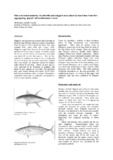
Skipjack tuna Katsuwonus pelamis and yellowfin or albacore tuna Thunnus albacares taken by hand lines from the 'payaw' off La Union and Ilocos Sur were sampled from April 1994 until August 1995. Skipjack ranged from 28 cm to 59 cm in fork length and from 0.35 to 4.2 kg in weight. Yellowfin ranged 24–67 cm and 0.25–6.4 kg. The common size landed was about 40 cm for both species. Size at first maturity of skipjack was about 41 cm in males and 42 cm in females. The yellowfin tuna taken by hand lines were almost all immature except two mature males about 60 cm long. About 18 prey species were identified in the stomachs of skipjack, and about 25 prey species in yellowfin. The preferred prey were mantis shrimps and squids. Small fishes and other invertebrates were also eaten. Mesopelagic lanternfish were eaten by yellowfin and epipelagic jellyfish were eaten by skipjack.
Suggested Citation
Mamhot, J. R., & Verceles, E. R. (2007). Diet and sexual maturity of yellowfin and skipjack tuna taken by hand lines from fish-aggregating 'payaw' off northwestern Luzon. In T. U. Bagarinao (Ed.), Research Output of the Fisheries Sector Program (Vol. 2. Reports on Fisheries and Aquaculture, pp. 25-27). Quezon City, Philippines: Bureau of Agricultural Research, Department of Agriculture.
Type
Book chapterISBN
9718511776Related items
Showing items related by title, author, creator and subject.
-
Evaluation of dietary fermented tuna by-product meal as partial replacement for unprocessed tuna by-product meal in fishmeal-based diets for juvenile olive flounder Paralichthys olivaceus
Aya, Frolan ; Moniruzzaman, Mohammad ; ; Won, Seonghun ; Hamidoghli, Ali ; ; (Springer, 2022-12-06)
This study examined the effects of feeding fermented tuna by-product (FTBP) on the growth, non-specific immune response, liver and intestinal morphology, and disease resistance of olive flounder Paralichthys olivaceus. Olive flounders (n = 20; 2 g) were randomly assigned into four dietary groups in triplicates. Fish were fed four test diets (50% crude protein; 10% crude lipid) for 10 weeks in which unprocessed tuna by-product (TBP) meal was replaced (on a protein basis) with 0% (FTBP0 as the control diet), 15% (FTBP15), 30% (FTBP30), and 60% (FTBP60) of FTBP protein. Results showed that growth performance, blood parameters, and proximate composition were not influenced by FTBP inclusion. Non-specific immune parameters such as superoxide dismutase activity in the FTBP30 and FTBP60 groups were significantly higher than in the FTBP15 and the control groups, whereas lysozyme and myeloperoxidase activities were not different. Liver histopathology revealed normal architecture in groups fed FTBP0 and FTBP15 diets although mild alterations were noted in the FTBP30- and FTBP60-fed groups. Intestinal villi height and muscular thickness were not significantly altered with FTBP inclusion. Moreover, higher cumulative survival rate was observed in the FTBP60-fed group than fish fed with the other diets following the 13-day challenge with E. tarda. Together, these results demonstrate that fermented tuna by-product meal could be included at 60% in olive flounder diets.
; Moniruzzaman, Mohammad ; ; Won, Seonghun ; Hamidoghli, Ali ; ; (Springer, 2022-12-06)
This study examined the effects of feeding fermented tuna by-product (FTBP) on the growth, non-specific immune response, liver and intestinal morphology, and disease resistance of olive flounder Paralichthys olivaceus. Olive flounders (n = 20; 2 g) were randomly assigned into four dietary groups in triplicates. Fish were fed four test diets (50% crude protein; 10% crude lipid) for 10 weeks in which unprocessed tuna by-product (TBP) meal was replaced (on a protein basis) with 0% (FTBP0 as the control diet), 15% (FTBP15), 30% (FTBP30), and 60% (FTBP60) of FTBP protein. Results showed that growth performance, blood parameters, and proximate composition were not influenced by FTBP inclusion. Non-specific immune parameters such as superoxide dismutase activity in the FTBP30 and FTBP60 groups were significantly higher than in the FTBP15 and the control groups, whereas lysozyme and myeloperoxidase activities were not different. Liver histopathology revealed normal architecture in groups fed FTBP0 and FTBP15 diets although mild alterations were noted in the FTBP30- and FTBP60-fed groups. Intestinal villi height and muscular thickness were not significantly altered with FTBP inclusion. Moreover, higher cumulative survival rate was observed in the FTBP60-fed group than fish fed with the other diets following the 13-day challenge with E. tarda. Together, these results demonstrate that fermented tuna by-product meal could be included at 60% in olive flounder diets. -
Development of various value-added products from 'aloy' or bullet tuna Auxis rochei
(Bureau of Agricultural Research, Department of Agriculture, 2007)The recommended steps in new product development were followed to utilize bullet tuna maximally. New products were generated, evaluated, and refined. Three product concepts were initially advanced to the product optimization stage; both product and positioning blueprints were created. The products were optimized in terms of the levels and combinations of additives and spices, and the organoleptic properties were evaluated. The new products—bullet tuna loaf, seasoned dried bullet tuna, canned spicy bullet tuna, and canned pet foods—were tested for shelf-life. Tuna loaf treated with potassium sorbate remained acceptable for 29 days at 0°C, whereas untreated samples remained acceptable for 26 d at 0°C, 16 d at 14°C, and 3 d at 35°C. Seasoned dried tuna was still acceptable until 15 d in storage at 0°C and until 6 d at 35°C. Canned spicy tuna remained acceptable after more than a year of storage at 35°C. Cost analysis based on the current retail prices of bullet tuna (P30/kg), additives, spices and other raw materials showed that the production costs were: P19 for 100 g of bullet tuna loaf; P2 for a piece of seasoned dried tuna; and P 12.5 for a can of spicy bullet tuna. Traditional processing methodologies were applied to bullet tuna as raw material. Smoking and dry-salting yield bullet tuna products that can be offered to the consumers at prices much lower than those of the newly developed value-added products. -
Insights on the seasonal variations of reproductive features in the eastern Atlantic bluefin tuna
; ; ; ; ; ; ; ; Palma, Peter; ; (Elsevier, 2019)
The Atlantic Bluefin Tuna (ABFT, Thunnus thynnus) is one of the most intensely exploited fisheries resources in the world. In spite of the years of studies on ABFT, basic aspects of its reproductive biology remain uncertain. To gain insight regarding the seasonal changes of the reproductive characteristics of the eastern stock of ABFT, blood and tissue samples were collected from mature specimens caught in the Mediterranean basin during the reproductive (May-June) and non-reproductive season (Oct-Nov). Histological analysis of the gonads of May-June samples indicated that there were females which were actively spawning (contained post-ovulatory follicles) and females that were not actively spawning that had previtellogenic and fully vitellogenic oocytes. In males, testis were at early or late stage of spermatogenesis during the reproductive season. In Oct-Nov, ovaries contained mostly previtellogenic oocytes as well as β and α atretic follicles while the testis predominantly contained spermatogonia and few cysts with spermatocytes and spermatozoa. Gonadosomatic index (GSI) in females was highest among the actively spawning individuals while in males GSI was higher in early and late spermatogenic individuals compared to those that were spent. Plasma sex steroids levels varied with the reproductive season. In females, estradiol (E2), was higher in May-June while testosterone (T) and progesterone (P) did not vary. In males, E2 and T were higher in May-June while P levels were similar at the two sampling points. Circulating follicle stimulating hormone (FSH) was higher in Oct-Nov than in May-June both in males and females. Vitellogenin (VTG) was detected in plasma from both males and females during the reproductive season with levels in females significantly higher than in males. VTG was undetected in Oct-Nov samples. Since choriogenesis is an important event during follicle growth, the expression of three genes involved in vitelline envelope formation and hardening was measured and results showed significantly higher levels in ovaries in fish caught in May-June with respect to those sampled in Oct-Nov. In addition, a set of genes encoding for ion channels that are responsible for oocyte hydration and buoyancy, as well as sperm viability, were characterized at the two time points, and these were found to be more highly expressed in females during the reproductive season. Finally, the expression level of three mRNAs encoding for different lipid-binding proteins was analyzed with significantly higher levels detected in males, suggesting sex-specific expression. Our findings provide additional information on the reproductive biology of ABFT, particularly on biomarkers for the assessment of the state of maturation of the gonad, highlighting gender-specific signals and seasonal differences.