Books and Book Chapters: Recent submissions
Now showing items 1-20 of 123
-
Practices and economics of successful shrimp farms in the Philippines
(Wiley, 2006)After reaching a production of 90,426 mt in 1994, production of black tiger shrimp (Penaeus monodon) in the Philippines has slowly declined and has dropped to only 35,493 mt, the lowest since 1987. Amidst the production failures besetting most of the farms in the country, a few farms man- aged to turn around once again and operate profitably with some even expanding their operations and are the subject of this study covering 40 farms. The common characteristics of the successful farms were found to be as follows: (a) easy access to clean seawater due to relatively deep nature of the shoreline, availability of saltwater from well, or adequate reservoir area to treat new water; (b) clean and compact pond bottom either because these are located above the tidal level or have been backfilled heavily with crushed limestone; (c) use of healthy fry by ascertaining fry condition through proper diagnostics; (d) adequate aeration; (e) good feed management; (f) use of bioreme- diators such as microbial inoculants (often referred to as probiotics), fish or both; (g) long dry-out period or alternating shrimp with tilapia or milkfish effectively limiting shrimp production to only one crop per year; and (h) adequate production-based incentives to technicians and workers. When standardized into 5 ha farms under three stocking density conditions, the economic performances are as follows at density levels of 5/m2, 15/m2, and 40/m2, respectively. The returns on investment (ROI) are 106.7%, 66.0%, and 78.5%; the internal rates of return (IRR) 250%, 111%, and 142%; and finally a return on equity (at a loan/equity of 70:30) 355.8%, 220.1%, and 261.8%. -
A practical guide to feeds and feed management for cultured groupers
(Network of Aquaculture Centres in Asia-Pacific, 2005)Farming of groupers (members of the Serranidae, subfamily Epinephelinae) is widely practiced in Asia. Groupers are carnivorous and consequently prefer feeds high in fish protein. Most farms in Asia still rely on what is commonly termed "trash fish". Despite the apparent abundance and availability of "trash" fish in many areas, there are some issues and problems related to its use in fish farming. To provide farmers with a viable alternative to feeding trash fish to grouper, the Australian Centre for International Agricultural Research (ACIAR) supported project FIS/97/73 Improved hatchery and grow-out technology for grouper aquaculture in the Asia-Pacific region from 1999 to 2002, with one component to develop formulated feed for grouper aquaculture. The experiences of the project have been synthesized into this Practical Guide to Feeds and Feed Management for Cultured Groupers to promote the use of formulated feeds; promote reduction in the use of trash fish in grouper aquaculture; and to assist farmers in making more efficient use of feeds and feed resources. This guide explores new and better farming practices making use of formulated feeds, as well as technical aspects of feed storage and quality control, management of feeding including weaning of groupers onto formulated feeds and economic considerations. -
Seaweed health problems: Major limiting factors affecting the sustainability of the seaweed aquaculture industry in the Philippines
Faisan, Jr., Joseph ; (Springer International Publishing, 2024)
The Philippines remains one of the top eucheumatoid seaweed producers worldwide. However, the reported seaweed health problems affecting farms have been one of the reasons for the decline in seaweed production in the country. Outbreaks of “ice-ice” disease (IID), epiphytic pests, and grazing problems have significantly reduced biomass yields and compromised carrageenan quality, directly affecting the livelihood of tens of thousands of families dependent on seaweed farming. In this chapter, we listed seaweed health problems based on type-association with the host seaweed plant and highlighted factors contributing to farm problems. Additionally, recommendations are presented that are relevant to the protection of the long-term sustainability of the eucheumatoid seaweed farming industry in the Philippines.
; (Springer International Publishing, 2024)
The Philippines remains one of the top eucheumatoid seaweed producers worldwide. However, the reported seaweed health problems affecting farms have been one of the reasons for the decline in seaweed production in the country. Outbreaks of “ice-ice” disease (IID), epiphytic pests, and grazing problems have significantly reduced biomass yields and compromised carrageenan quality, directly affecting the livelihood of tens of thousands of families dependent on seaweed farming. In this chapter, we listed seaweed health problems based on type-association with the host seaweed plant and highlighted factors contributing to farm problems. Additionally, recommendations are presented that are relevant to the protection of the long-term sustainability of the eucheumatoid seaweed farming industry in the Philippines. -
Series: JIRCAS Working Report; No. 56
Comparative analysis of small-scale aquaculture industry in three Southeast Asian countries
(Japan International Research Center for Agricultural Sciences, 2007)In many Southeast Asian countries, coastal fishing villages are increasingly encouraging their inhabitants to start small-scale aquaculture as a way of reducing the labor involved in fishing and diversifying their sources of income. This study aims to conduct a comparative analysis of small-scale aquaculture in the Philippines, Thailand and Malaysia (hereinafter referred to as the ‘three countries’). Aquaculture plays a leading role as a secondary source of income in the Philippines, and is both a primary and secondary source of income in Thailand and Malaysia. Even if a highly productive method of aquaculture were introduced in the Philippines, however, it would not see much uptake because it would be prone to damage by typhoons. Thailand and Malaysia, however, which are unaffected by typhoons, have rapidly increased their mussel production thanks to the active introduction of highly productive aquaculture methods. Our search of the points that developing areas in the three countries have in common revealed that many people started small-scale aquaculture after the mid-1990s in advanced areas, and that most small-scale aquaculture operators say that shellfish are easy to culture and want to continue in the business. -
Series: JIRCAS Working Report; No. 56
Comparative analysis of pattern of fishcage culture using marine/brackish water in three Southeast Asian countries
(Japan International Research Center for Agricultural Sciences, 2007)Production by fishcage culture using marine/brackish water has increased drastically since the mid-1980s, when the technology for developing sea bass hatchery fry was established. In the 1990s, it grew further, due to the start of production of grouper and snapper hatchery fry. We conducted a comparative analysis of production by fishcage culture and patterns of fishcage culture in the Philippines, Thailand, and Malaysia, all of which are major producer of fish by fishcage culture using marine/brackish water in the Southeast Asian countries. We compared of fishcage culture management between the reference and current year and analyzes the average of the reference year (the year when fishcage culture started; the same hereinafter) and current year (2004). In terms of production of cultured fish by kind, sea bass showed a more than 50% decrease - from 67% to 32%, whereas grouper saw a nearly doubled ratio from 20% to 39%. Snapper remained almost the same, at 29% to 28%. Other fish (mainly rabbitfish, threadfin bream and grunter) saw an increased ratio from 5% to 16%. We compared the management of fishcage culture between the reference year and 2004. We looked into the ratio of production by type of fish and found that sea bass showed a decreased ratio to less than half from 67% to 32%; while grouper showed a near doubling of its ratio from 20% to 39%. Snapper remained almost unchanged, at 28% to 29%; and other kinds of fish increased their ratios from 5% to 16%. In terms of operating cost per kilogram for farming groupers, fishcage culture costs more than fishpond culture. Fishcage culture, however, is more convenient and productive than fishpond culture, and requires lower initial cost than fishpond culture, since the former does not require an initial outlay for constructing a pond or management of water quality. Accordingly, fishcage culture shows overwhelmingly higher production than fishpond culture. -
Series: JIRCAS Working Report; No. 44
Detection of betanodaviruses from different organs of broodstocks and wild juveniles of orange-spotted grouper, Epinephelus coioides
(Japan International Research Center for Agricultural Sciences, 2006)Aquaculture of grouper including orange-spotted grouper suffers losses from viral nervous necrosis (VNN). This disease usually occurs in larval stage resulting in a high rate of mortality. It is conceivable that vertical transmission from subclinically infected broodstock fish to the brood is the major route of infection. However, there are only a few studies regarding the fish subclinically infected with VNN and the evidence for a causal relationship between subclinically infected adult fish and vertical transmission remains tenuous. The purpose of this study is to reveal the distribution of the virus in asymptomatically infected fish. Six healthy broodstocks of orange-spotted groupers with body weights ranging from 5 to 12 kg were used and 14 different organs were collected. Cell culture and PCR methods were used to detect the virus. Additionally, 8 wild juveniles with body weights ranging from 2 to 4 g were also analyzed. In our results, the virus was detected by means of PCR but not by the cell culture method. All the broodstocks and wild juveniles were positive in the PCR test except for one juvenile. The highest detection rate of the virus among organs was the brain. However, the virus gene was also amplified from organs other than the central nervous system (CNS). We hypothesize that the virus was latently retained in the CNS of subclinically infected fish and when the fish immune system was weakened such latent virus was released from CNS to the peripheral organs including the gonad. This mechanism might provoke the vertical transmission infection. -
Series: JIRCAS Working Report; No. 44
Arachidonic acid enrichment of rotifers and effects of dietary arachidonic acid on broodstock performance of rabbitfish Siganus guttatus
(Japan International Research Center for Agricultural Sciences, 2006)Rotifers (Brachionus sp.) were cultured with various combinations of baker’s yeast, Nannochloropsis sp., Culture selco, and DHAPS with or without supplementation of arachidonic acid (triacylglycerol form). Rotifers were able to be enriched with emulsified- arachidonic acid supplemented to culture media. Considered the reciprocal ratios of arachidonic acid, EPA and DHA in rotifers, rotifers pre-cultured in Culture selco and then cultured in DHAPS had the best balance of essential fatty acids, and the optimum level of arachidonic acid supplementation to DHAPS appeared between 0% and 5%. A feeding test was conducted to investigate the effects of arachidonic acid on the broodstock performance of rabbitfish (Siganus guttatus), one of the commercially valuable species in mangrove areas. A diet with 1.5% of arachidonic acid supplementation appeared to affect negatively the reproductive performance of S. guttatus broodstock, perhaps due to the excessive supplementation. Considered together with results of mangrove red snapper in 2003, the optimum supplementation of arachidonic acid in broodstock diets might be around 0.5%. -
Series: JIRCAS Working Report; No. 44
Arachidonic acid distribution in mangrove organisms in the Philippines, Malaysia and Japan
(Japan International Research Center for Agricultural Sciences, 2006)There has been little information on the importance of arachidonic acid (20:4n-6, ArA) in fish and other aquatic animals, although the importance of eicosapentaenoic acid (20:5n-3, EPA) and docosahexaenoic acid (22:6n-3, DHA) has been highlighted. The present study was conducted to investigate essential fatty acid composition, especially ArA distribution in mangrove organisms in the Philippines, Malaysia and Japan. The overall results revealed that ArA was not a minor component in mangrove organisms, and that the existence of ArA in mangrove organisms is widespread, irrespective of the differences in species, geography and environment. Both mangrove green and dead leaves were rich in linoleic acid (18:2n-6 LA) and linolenic acid (18:3n-3 LNA), which are respectively precursors of ArA and EPA & DHA, although ArA, EPA and DHA were not detected in these leaves. Mangrove invertebrates contained intermediate to high ArA. Especially, mangrove snails had very high ArA levels with low DHA levels, and thus the snails appeared promising as a new dietary source rich in ArA. Most of fishes in mangrove areas showed entirely higher ArA levels than EPA levels. As overall traits, ArA/EPA ratios of mangrove animals were higher than those of cold and temperate water species .The present results suggest that ArA may be nutritionally more important for egg and larval development, and that its supplementation in diets can enhance the development of broodstock management and fry production technologies in mangrove areas. The information of the present report can be used as a guideline for development of appropriate broodstock and/or larval diets in mangrove areas. -
Series: JIRCAS Working Report; No. 44
Analysis of the sustainability of extensive and intensive methods in brackish water fishpond culture primarily producing shrimp in three Southeast Asian countries
(Japan International Research Center for Agricultural Sciences, 2006)This study is an investigation of the aquaculture methods used in brackish water fishpond culture mainly producing shrimp in the Philippines, Thailand and Malaysia. Extensive methods are practiced in the Philippines and Thailand (2 tons/ha and below for annual production of shrimp with no or few feeding method), while the intensive method is used in all the 3 countries (2 tons/ha and over for the annual production of shrimp with more feeding method). Most of the production of cultured shrimp relies on the intensive method. The yield of shrimp using the extensive method is relatively high in the Philippines, but small in Thailand due to declining water quality. With regard to the intensive method, the Philippines has a low death rate for monodon (Penaeus monodon) because it has adopted the Green water system as a measure against bacterial disease (luminous bacteria). On the other hand, Thailand and Malaysia have low survival rates owing to the lack of effective measures to prevent virus disease (White spot). For this reason, an increasing number of farms have changed their main cultured species from monodon to vanamei (P. vanamei) in Thailand and Malaysia. Consequently, the price of monodon has been falling as a result of high production of vanamei at lower prices, and the profits of monodon farms continue to decrease. If the cultivation of vanamei, which is a species introduced from South America, continues to increase, it is expected to have a negative effect on monodon farming. In order to protect monodon, a native species, it is necessary to focus on cultivating this species in Southeast Asia. In Thailand, there is a need to ensure the supply of good quality seedlings, since the quality of monodon seedlings has been deteriorating. In Malaysia, it is necessary to equalize the level of aquacultural techniques within the country because there is a disparity in techniques among fish farms. In the Philippines, both extensive and intensive methods are conducted in a sustainable manner. -
Series: JIRCAS Working Report; No. 54
Changes in farm management and production systems: Response to shrimp culture problems in the Philippines
(Japan International Research Center for Agricultural Sciences, 2007) -
The ACIAR-BFAR Rinconada Lakes project: Improving fish culture practices for sustainability and profitability
Cuvin-Aralar, Maria Lourdes; ; ; ; (Ocean Press, 2011)
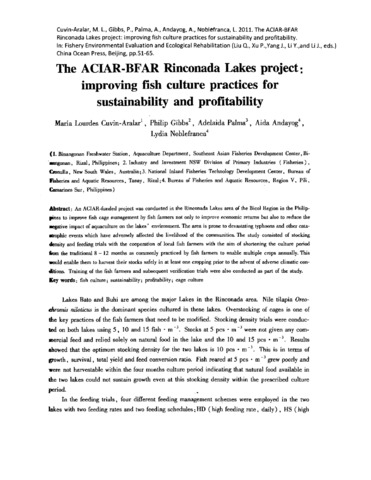
An ACIAR-funded project was conducted in the Rinconada Lakes area of the Bicol Region in the Philippines to improve fish cage management by fish farmers not only to improve economic returns but also to reduce the negative impact of aquaculture on the lakes’ environment The area is prone to devastating typhoons and other catastrophic events which have adversely affected the livelihood of the communities. The study consisted of stocking density and feeding trials with the cooperation of local fish farmers with the aim of shortening the culture period from the traditional 8-12 months as commonly practiced by fish farmers to enable multiple crops annually. This would enable them to harvest their stocks safely in at least one cropping prior to the advent of adverse climatic conditions. Training of the fish farmers and subsequent verification trials were also conducted as part of the study. -
Communicating science information to the fishing community in the Philippines
; ; Superio, Daryl (Taylor and Francis, 2022-11-10)
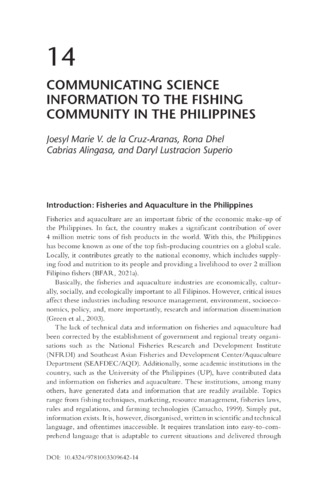
The world is currently experiencing an age of information overload, as information about anything and almost everything is easily obtainable. However, essential information that could help a community strive and survive is often left unread in scientific papers and grey literature, thus unable to reach its intended audience. Fishers, specifically in developing countries such as the Philippines, are still known to be information-poor despite the rich scientific knowledge produced by concerned agencies. This chapter describes and analyses the information needs and seeking behaviour among fishers in the coastal communities in Iloilo, Philippines. Taking the initiative and time to profile how specific groups consume information can help narrow the information gap and aid concerned agencies to create and conceptualise successful, sustainable, and effective information, education, and communication campaigns. -
Edwardsiellosis
Pakingking, Rolando V., Jr.; Viet Nguyen, Vuong (Academic Press, 2022)
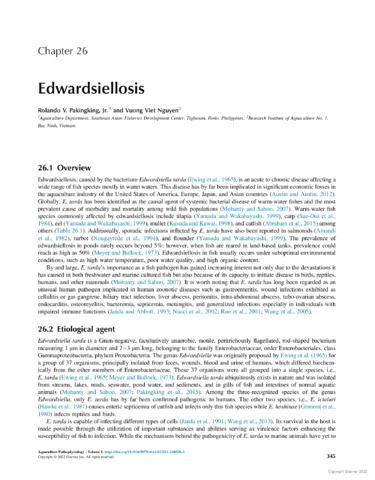
Edwardsiellosis is an acute to chronic systemic disease in fish characterized by exophthalmia, ascites, hernia, and severe lesions of the internal organs. It is caused by Edwardsiella tarda, a Gram-negative intracellular pathogen implicated in enormous economic losses of cultured seawater and freshwater fish species. E. tarda has a broad host range and geographic distribution, and possesses important virulence factors that enhance its survival and pathogenesis in hosts. This chapter discusses some of the recent research on edwardsiellosis in fish including the etiologic agent's identification, pathology, diagnosis, and virulence factors, and as well as novel strategies aimed at preventing and controlling the disease. -
Viral encephalopathy and retinopathy
; Pakingking, Rolando V., Jr. (Academic Press, 2022)
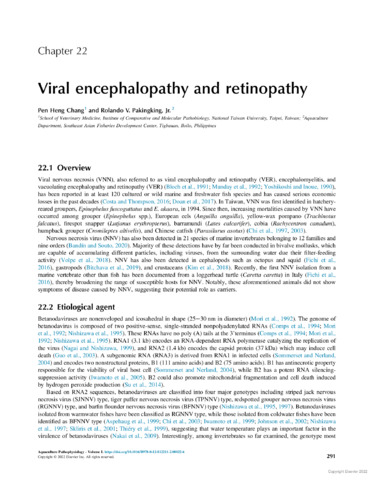
Viral nervous necrosis (VNN), also referred to as viral encephalopathy and retinopathy (VER), has been reported in at least 120 cultured or wild marine and freshwater fish species and has caused serious economic losses among farmed marine fish species in the past decades. Since the first description of this disease at the end of the 1980s, substantial amounts of researches have been instrumental in understanding the mechanisms involved in fish infection, development of reliable diagnostic methods, and disease prevention and control. This chapter presents some important aspects of the disease with particular emphasis on etiologic agent, clinical signs and gross pathology of the disease, histopathology, disease risk factors, virus propagation and identification, molecular diagnostics, and concomitant prevention and control methods. -
Developing technologies for giant grouper (Epinephelus lanceolatus) aquaculture in Vietnam, the Philippines and Australia
Nocillado, Josephine; Elizur, Abigail ; Palma, Peter ; ; ; ; ; ; Anderson, Kelli ; ; Knibb, Wayne ; ; ; (Australian Centre for International Agricultural Research, 2021-06-29)
This project established a sustainable aquaculture industry for giant grouper in Vietnam and the Philippines through the development of captive breeding and larval-rearing techniques. Captive breeding innovations and larval-rearing techniques, developed through a collaborative Fisheries project, are sustaining the aquaculture industry for giant grouper in Vietnam and the Philippines. Groupers are vital to the live reef food-fish trade in South-East Asia, and the giant grouper is a high-value, fast-growing species with significant aquaculture potential. Establishing a sustainable giant grouper aquaculture industry is a high priority for the region, but research is hampered by the high level of investment required to hold and maintain giant grouper broodstock. Lack of commercial production is also due to limited knowledge about the giant grouper’s maturation and spawning behaviour, and low larval survival. -
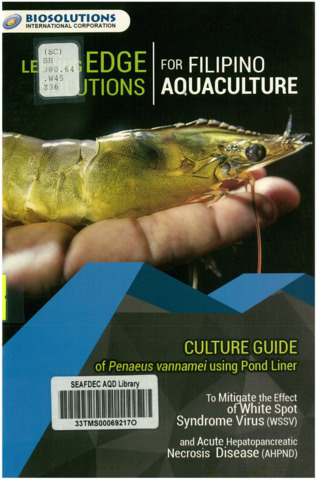
Culture guide of Penaeus vannamei using pond liner to mitigate the effects of white spot syndrome virus (WSSV) and acute hepatopancreatic necrosis disease (AHPND)
(Biosolutions International Corporation, 2016)This manual aims to share the methodologies leading to the success of shrimp farming operations. It is a work in progress to be regularly updated as new techniques are developed to deal with future challenges and diseases that will affect the shrimp industry. -
Series: ACIAR Technical Report; No. 97
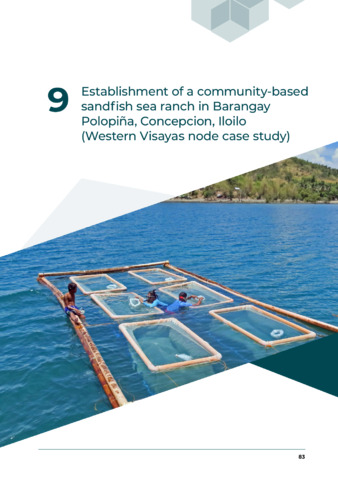
Establishment of a community-based sandfish sea ranch in Barangay Polopiña, Concepcion, Iloilo (Western Visayas node case study)
Altamirano, Jon; Suyo, Jee Grace ; Baylon, Roselyn ; (Australian Centre for International Agricultural Research, 2022)
-
Whole-genome sequencing for identification of bacterial isolates affecting local penaeid shrimp farms: A national survey for the Philippines
Saloma, Cynthia; Penir, Sarah Mae ; ; Amar, Edgar (5M Books Ltd, 2022)
The shrimp aquaculture industry is a major economic player in the food and livelihood sectors, both globally and in the Philippines. The development of industrialized shrimp farming methods has led to a rapid increase in cultured shrimp production since the 1980s, but the industry has also faced challenges from the introduction of opportunistic pathogens. These pose severe limitations in the success of shrimp culture in both hatcheries and grow-out ponds. We extracted genomic DNA from 423 bacterial isolates from shrimp disease outbreaks in local aquaculture farms throughout the Philippines and subjected them to Illumina paired-end whole-genome sequencing at 50–100-fold coverage. Reads were assembled using a de novo approach, and average nucleotide identity measurements were used to establish the identity of the isolates. Outbreak types encountered during the time of sampling include acute hepatopancreatic necrosis disease (AHPND), luminescent vibriosis, white spot disease, and outbreaks of unknown etiology. In both outbreak and non-outbreak sites, members of the genus Vibrio, particularly Vibrio parahaemolyticus, were observed to be the most abundant. The whole-genome sequence data obtained will aid in the design and implementation of novel shrimp bacterial disease outbreak management and control programs. -
Series: Policy Brief; No. 1
Towards a robust and resilient seaweed aquaculture in the Philippines
; Luhan, Maria RovillaThe aim of this national policy brief is to highlight the current challenges facing the seaweed industry of the Philippines based on robust, scientifically proven results from the UK Research and Innovation funded ...; Ferriols, Victor Marco Emmanuel ; Faisan, Joseph P., Jr. ; Mateo, Jonalyn ; Sibonga, Rema ; Suyo, Jee Grace (GlobalSeaweedSTAR Philippines, 2021)
-
Language, conformity, and "playing" in a Peter Solis Nery play: A review of tic-tac-toe
Alayon, Stephen (Peter Solis Nery, 2020)