Magazine and Newsletter Articles by SEAFDEC/AQD Staff: Recent submissions
Now showing items 41-60 of 68
-
Development of a sustainable mangrove crab industry through science-based research
(Secretariat, Southeast Asian Fisheries Development Center, 2017)Farming of mangrove crab (or mud crab) species, e.g. Scylla serrata, S. tranquebarica and S. olivacea has long been established in the Philippines although the preferred species for growing is S. serrata. The Philippines’ ... -
Sustaining environmental integrity in the midst of intensified aquaculture development
(Secretariat, Southeast Asian Fisheries Development Center, 2015)The escalating aquaculture production from Southeast Asia during the past decades seems inevitable notwithstanding its significant contribution to economic growth and guaranteed food security of the countries in the region. ... -
Application of GIS in shrimp disease surveillance and monitoring
(National Mapping and Resource Information Authority, 2009) -
Breeding and seed production of the mangrove red snapper
(Network of Aquaculture Centers, 2002) -
Seed production of the crucifix crab Charybdis feriatus
; Quinitio, Emilia T. ; (Network of Aquaculture Centers, 2002)
-
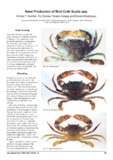
Seed production of mud crab Scylla spp.
Quinitio, Emilia T.; ; (Network of Aquaculture Centers, 2002)
Mud crab farming is an important source of income for fish farmers in the Philippines. The expanding export market for mud crab as an alternative for shrimp has led to intensified collection of wild seed for grow-out and ... -
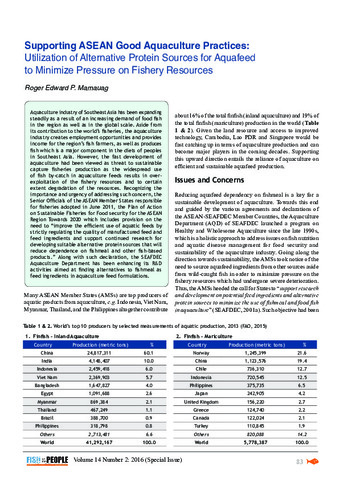
Supporting ASEAN good aquaculture practices: Utilization of alternative protein sources for aquafeed to minimize pressure on fishery resources
Mamauag, Roger Edward (Secretariat, Southeast Asian Fisheries Development Center, 2016)
Aquaculture industry of Southeast Asia has been expanding steadily as a result of an increasing demand of food fish in the region as well as in the global scale. Aside from its contribution to the world’s fisheries, the ... -
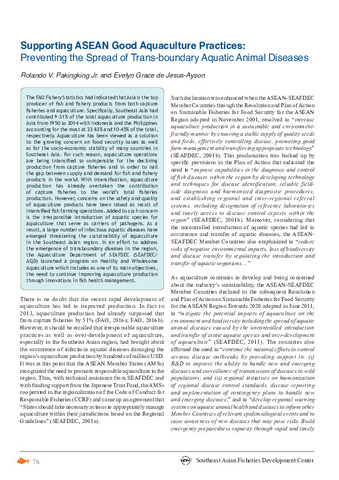
Supporting ASEAN good aquaculture practices: Preventing the spread of trans-boundary aquatic animal diseases
Pakingking, Rolando V., Jr.; (Secretariat, Southeast Asian Fisheries Development Center, 2016)
The FAO Fishery Statistics had indicated that Asia is the top producer of fish and fishery products from both capture fisheries and aquaculture. Specifically, Southeast Asia had contributed 9-31% of the total aquaculture ... -
Seaweed production: Farming Kappaphycus in the Philippines
(Global Aquaculture Alliance, 2002) -
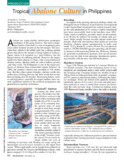
Tropical abalone culture in Philippines
(Global Aquaculture Alliance, 2001) -
DNA markers help manage Nile tilapia stocks
Eguia, Maria Rowena R.; (Global Aquaculture Alliance, 2006)
Determining changes in the genetic diversity of selected hatchery stocks through DNA-level polymorphisms analysis provides aquaculturists with a means to monitor inbreeding, control loss of genetic diversity, and achieve ... -
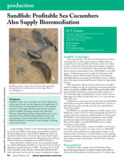
Sandfish: Profitable sea cucumbers also supply bioremediation
(Global Aquaculture Alliance, 2011)Sandfish, a type of sea cucumber, are both a high-value culture species and one that supports the aquaculture of other fish species by cleaning up waste on the bottoms of ponds or sea cages. Hatchery and nursery technologies ... -
Searching for ecological ways to reduce WSSV impact
; Tendencia, Eleonor; ; (Network of Aquaculture Centres in Asia-Pacific, 2014)
White spot syndrome virus (WSSV) has brought financial losses to all shrimp farming systems, and lately the “Early Mortality Syndrome” (EMS) or more accurately termed Acute Hepatopancreatic Necrosis Disease (AHPND) have ... -
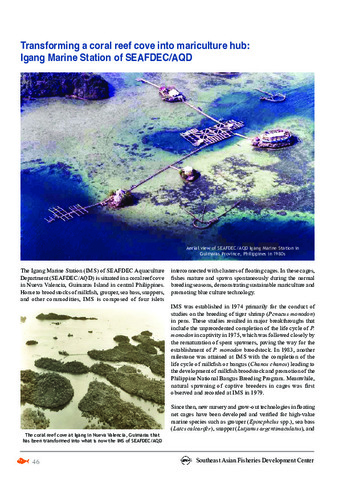
Transforming a coral reef cove into mariculture hub: Igang marine station of SEAFDEC/AQD
(Secretariat, Southeast Asian Fisheries Development Center, 2015) -
Orchestrating the southeast Asian aquaculture towards sustainability: SEAFDEC initiative
(Secretariat, Southeast Asian Fisheries Development Center, 2015)Three years after the Philippines became a signatory to the Agreement Establishing the Southeast Asian Fisheries Development Center (SEAFDEC) in January 1968, the Philippine Government submitted a Position Paper during the ... -
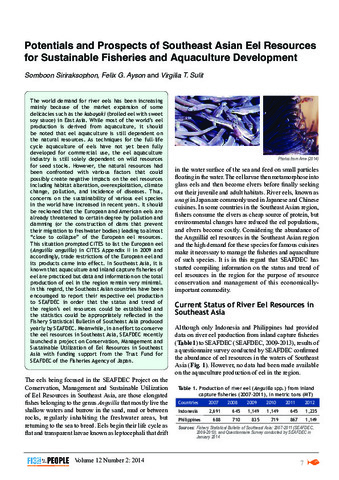
Potentials and prospects of Southeast Asian eel resources for sustainable fisheries and aquaculture development
(Secretariat, Southeast Asian Fisheries Development Center, 2014)The world demand for river eels has been increasing mainly because of the market expansion of some delicacies such as the kabayaki (broiled eel with sweet soy sauce) in East Asia. While most of the world’s eel production ... -
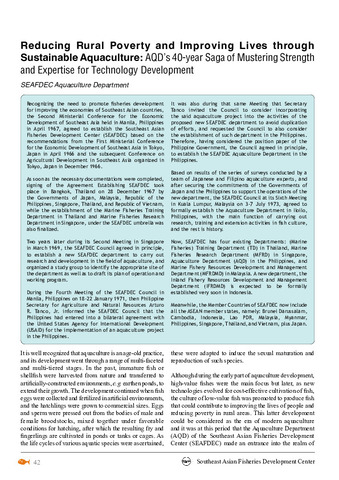
Reducing rural poverty and improving lives through sustainable aquaculture: AQD's 40-year saga of mustering strength and expertise for technology development
(Secretariat, Southeast Asian Fisheries Development Center, 2013)Recognizing the need to promote fisheries development for improving the economies of Southeast Asian countries, the Second Ministerial Conference for the Economic Development of Southeast Asia held in Manila, Philippines ... -
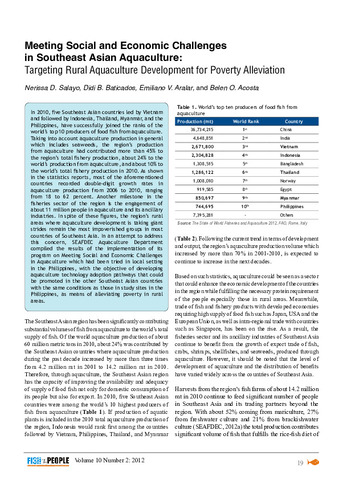
Meeting social and economic challenges in Southeast Asian aquaculture: Targeting rural aquaculture development for poverty alleviation
(Secretariat, Southeast Asian Fisheries Development Center, 2012)In 2010, five Southeast Asian countries led by Vietnam and followed by Indonesia, Thailand, Myanmar, and the Philippines, have successfully joined the ranks of the world’s top 10 producers of food fish from aquaculture. ... -
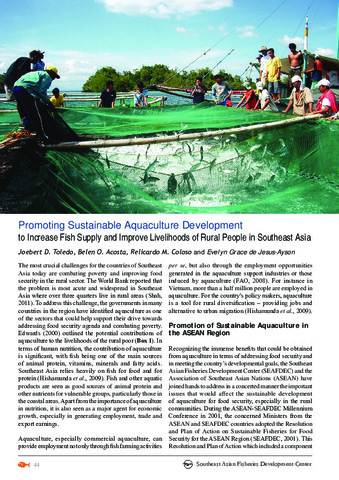
Promoting sustainable aquaculture development to increase fish supply and improve livelihoods of rural people in Southeast Asia
(Secretariat, Southeast Asian Fisheries Development Center, 2011) -
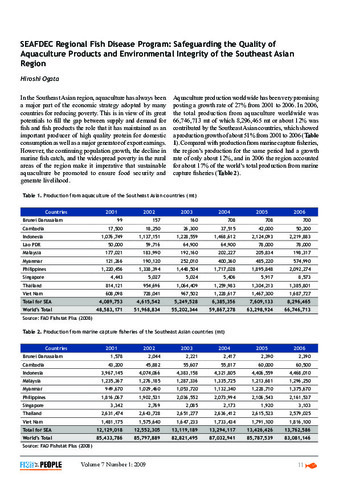
SEAFDEC Regional Fish Disease Program: Safeguarding the quality of aquaculture products and environmental integrity of the southeast Asian region
(Secretariat, Southeast Asian Fisheries Development Center, 2009)