Monographs: Recent submissions
21-34 / 34
-
Perspectives in aquaculture development in Southeast Asia and Japan: Proceedings of the Seminar on Aquaculture Development in Southeast Asia, Iloilo City, Philippines, 8-12 September 1987
(Aquaculture Department, Southeast Asian Fisheries Development Center, 1988)This proceedings is a comprehensive account of the seminar and contains the papers read and discussed at the sessions, and the recommendations reached and formulated. -
Proceedings of the First International Conference on the Culture of Penaeid Prawns/Shrimps, Iloilo City, Philippines, 4-7 December 1984
(Aquaculture Department, Southeast Asian Fisheries Development Center, 1985)Abstracts of the 78 papers presented at the conference are cited individually. -
Sustainable aquaculture development for food security in Southeast Asia towards 2020. Proceedings of the Regional Technical Consultation on Sustainable Aquaculture Development in Southeast Asia Towards 2020
(Aquaculture Department, Southeast Asian Fisheries Development Center, 2011)This publication represents the proceedings of the Regional Technical Consultation (RTC) on Aquaculture held in Bangkok, Thailand last 17-19 March 2010. The RTC was convened by the Southeast Asian Fisheries Development Center Aquaculture Department (SEAFDEC/AQD) as part of the preparatory undertakings for the ASEAN-SEAFDEC Conference on Fisheries held in June 2011. The main objectives of the RTC were to follow-up the developments of aquaculture in Southeast Asia after the 2001 ASEAN-SEAFDEC Millennium Conference on Fisheries and to define the strategic actions for the region s sustainable aquaculture development in the next decade. These proceedings contain 10 country papers and a summary status of implementation of the Resolution and Plan of Actions on six themes (supply of good quality seeds, environment-friendly aquaculture, getting out of the fish meal trap, healthy and wholesome aquaculture, biotechnology and rural aquaculture) which are the outcomes of the 2001 ASEAN-SEAFDEC Millennium Conference on Fisheries. It also presents the thematic papers and a synopsis of discussions on issues and recommendations on four thematic areas: (i) meeting social and economic challenges in aquaculture; (ii) quality seed production for sustainable aquaculture; (iii) healthy and wholesome aquaculture; and (iv) protecting the environment and adapting to climate change. These recommendations are expected to provide baseline information and directions in formulating the Resolution and Plan of Action (aquaculture component) for food security in Southeast Asia towards 2020. -
Culture and use of algae in Southeast Asia. Proceedings of the Symposium on Culture and Utilization of Algae in Southeast Asia, 8-11 December 1981, Tigbauan, Iloilo, Philippines
(Aquaculture Department, Southeast Asian Fisheries Development Center, 1990)Abstracts of the 13 papers presented at the symposium are cited individually. A variety of topics were covered, including the culture of micro and macroalgae, the processing of algal products and their utilization in industry as natural feed for aquaculture animals, the status of seaweed resources and their production, and the biology and use of algal populations as an indicator of the state of the aquatic environment. -
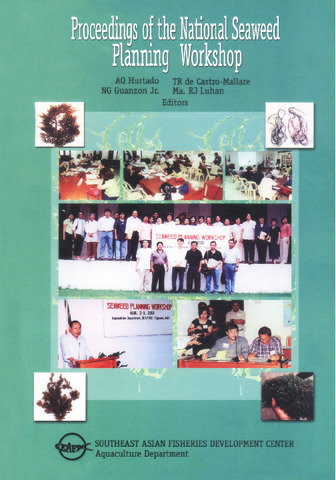
Proceedings of the National Seaweed Planning Workshop held on August 2-3, 2001, SEAFDEC Aquaculture Department, Tigbauan, Iloilo
(Aquaculture Department, Southeast Asian Fisheries Development Center, 2002)Seaweed forming is one of the major livelihoods among coastal communities in the Philippines, particularly to some 180,000 families in the Sulu Archipelago. In 1999, the Philippines exported more than 35,000 tons of dried ... -
Use of Chemicals in Aquaculture in Asia: Proceedings of the Meeting on the Use of Chemicals in Aquaculture in Asia, 20-22 May 1996, Tigbauan, Iloilo, Philippines
(Aquaculture Department, Southeast Asian Fisheries Development Center, 2000)The use of chemicals is common in various aquaculture systems, as it is in many agricultural practices. However, with growing worldwide awareness of the need for responsible practices in aquaculture, governments and aquaculturists are increasingly concerned with the effects of the use of chemicals in aquaculture, especially those which appear likely to be hazardous to man, cultured stock and/or the environment. The need to synthesize and disseminate information on the use and management of double prime aquachemicals double prime was recognized by the Fishery Resources Division of the Food and Agriculture Organization of the United Nations (FAO) and the Southeast Asian Fisheries Development Center (SEAFDEC) Aquaculture Department, who convened double prime The Expert Meeting on the Use of Chemicals in Aquaculture in Asia, double prime which was held 20-22 May 1996 at the SEAFDEC facilities in Tigbauan, Iloilo, the Philippines. Support was provided by FAO, SEAFDEC and the Canadian International Development Agency s (CIDA) ASEAN Fund. The World Health Organization (WHO) supported the participation of a human health expert. The meeting was attended by 27 participants and more than 70 observers from the public and private sectors of 20 countries. Among the attendees were representatives from the Network of Aquaculture Centres in Asia-Pacific (NACA), the Fish Health Section of the Asian Fisheries Society (FHS/AFS), the Japan International Research Center for Agricultural Sciences (JIRCAS), the GESAMP Working Group on Environmental Impacts of Coastal Aquaculture, and the ICES Working Group on Environmental Interactions of Mariculture. The results of this expert workshop are presented in this volume. They include the texts of presentations on a wide range of topics (thematic reviews) related to the use of chemicals in aquaculture, with emphasis on the Asian Region, as well as country overview papers summarizing the use of aquachemicals in Asian countries. The contributions of the selected participants during the meeting are contained in this volume. -
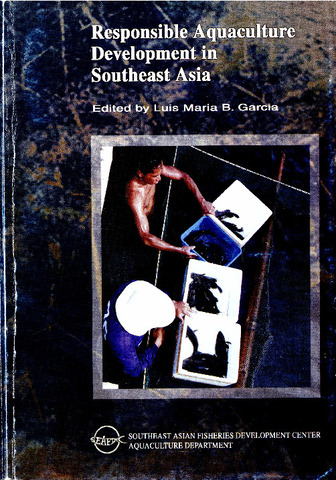
Responsible aquaculture development in Southeast Asia: Proceedings of the seminar-workshop on aquaculture development in Southeast Asia
(Aquaculture Department, Southeast Asian Fisheries Development Center, 2001)This publication documents the proceedings and outputs of the tri-annual seminar-workshop on Aquaculture Development in Southeast Asia (ADSEA). This seminar, ADSEA 99, reviewed the recent developments in aquaculture and provided a forum to discuss strategies to ensure further development of responsible aquaculture in the region. It specifically covered the following: 1) assessment of the progress and development of aquaculture technologies in the region, and research and development in the Department since 1995; 2) review of recent advances in sustainable and responsible aquaculture elsewhere in the world; and, 3) identification of strategies for sustainable and responsible aquaculture in the region. The contributions of selected participants during ADSEA '99 appear in this present volume. -
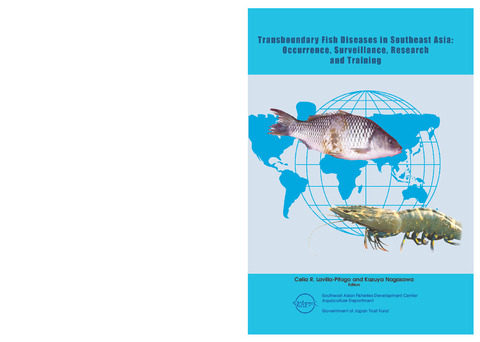
Transboundary fish diseases in Southeast Asia: Occurrence, surveillance, research and training
(Aquaculture Department, Southeast Asian Fisheries Development Center, 2004)The meeting aims to share and collect the most current information on the occurrence of transboundary fish diseases and surveillance, quarantine, diagnosis, monitoring, research and training for aquatic animal diseases in the SEAFDEC member countries. In the meeting, three viruses, namely KHV, WSSV and TSV, were highlighted because of their high virulence and devastating impact to the region. -
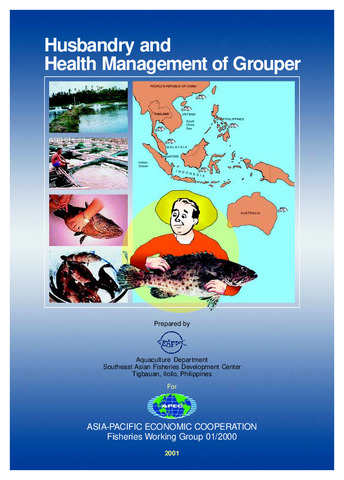
Husbandry and health management of grouper
(Asia-Pacific Economic Cooperation; Aquaculture Department, Southeast Asian Fisheries Development Center, 2001)The groupers (Family Serranidae) are among the most popular species in the live reef food fish industry in the Asia-Pacific region. Groupers are generally fast growing, hardy, suitable for intensive culture, and with excellent characteristics for processing. The high demand for these fishes is due to their unique culinary attributes and scarcity. In 1997, the Asia-Pacific region contributed about 90% to the total world aquaculture production. The regional production of farmed grouper was estimated at 15,000 tons, with China as the biggest producer contributing 8,000 tons followed closely by Indonesia. Other countries in the region commonly produce 1,000-2,000 tons annually in 1990- 1997. Groupers are generally cultured in floating net cages or earthen ponds, but cage culture is more common in Southeast Asia. Grouper pond production is becoming an attractive alternative to intensive shrimp culture in countries where management problems have forced growers to abandon shrimp farming. Although grouper culture is widespread in Asia and the Pacific, its continued development is constrained by the limited availability of fingerlings. Most economies, with the recent exception of Chinese Taipei, rely almost totally on wild-caught fry and fingerlings for stocking. This demand for wild seeds has led to unsustainable and illegal collection practices such as the use of cyanide to capture large numbers of seed with relatively less investment in time and effort. The inadequate supply of seed is further aggravated by the lack of appropriate handling techniques during collection, transport and storage of collected fish, and sometimes by an unregulated management of the wild stocks. There is also the lack of appropriate techniques for efficient grouper culture to marketable sizes. A major production constraint is heavy mortality of groupers during the collection and culture phases due to handling stress and diseases. The utilization of non-destructive devices for grouper collection, proper fish handling and increased efficiency in culture management can result to socio-economic and environmental benefits. A well-developed grouper culture operation complemented by appropriate wild grouper fishery management can provide sustainable employment to many people – from marginal fishers to farmers to traders. Grouper fisheries based on illegal or destructive fishing practices underlines the urgent need for habitat protection and sustainable utilization of natural resources. The objective of this manual is to provide a farmer-friendly practical guide for grouper farmers in the Asia-Pacific economies. It is hoped that this manual will enhance farmers’ ability to culture and handle grouper, as well as to prevent and manage disease outbreaks. -
Series: BRAIS state-of-the-art series; no. 2
Biology and culture of Penaeus monodon
(Aquaculture Department, Southeast Asian Fisheries Development Center, 1988)Abstracts of the 6 chapters included in this publication are cited individually. -
Biology of milkfish (Chanos chanos Forsskal)
Bagarinao, Teodora (Aquaculture Department, Southeast Asian Fisheries Development Center, 1991)
An up-to-date account is given of the biology of milkfish (Chanos chanos) under the following chapter headings: Species identity and history; geographic distribution and variation; life history and habitat; food and feeding habits; age, growth and mortality; reproduction; behavior; environmental physiology; and, community relationships.
(Aquaculture Department, Southeast Asian Fisheries Development Center, 1991)
An up-to-date account is given of the biology of milkfish (Chanos chanos) under the following chapter headings: Species identity and history; geographic distribution and variation; life history and habitat; food and feeding habits; age, growth and mortality; reproduction; behavior; environmental physiology; and, community relationships. -
Research and development for sustainable aquaculture in Southeast Asia : SEAFDEC Aquaculture Department strategic plans 2009-2012
(Aquaculture Department, Southeast Asian Fisheries Development Center, 2009)Outlines the strategic plans of the SEAFDEC/AQD for the years 2009 to 2012. In it, the new mission statement is presented as well as the goals, objectives, and targets of its various research, training, information dissemination, and administrative thrusts. -
Seaweeds of Panay
(Aquaculture Department, Southeast Asian Fisheries Development Center, 1992)This practical book on the seaweeds of Panay, Philippines, acquaints and provides information to members of the academe and research institutions, policy makers, fishermen and businessmen regarding the taxonomy, distribution, ecology and economic importance of these resources. It consists of 4 major parts: (1) Introduction, which reviews the literature, habitat, distribution, morphological structure and reproduction; 2) Classification, which describes the classes to which the seaweeds generally belong; 3) Collection and preservation, which explains the procedure used in treatment of specimens; and, 4) Taxonomic list. A glossary is included, covering technical terms used. All species listed and described in this book are macrobenthic and were collected in Panay and Guimaras Islands. -
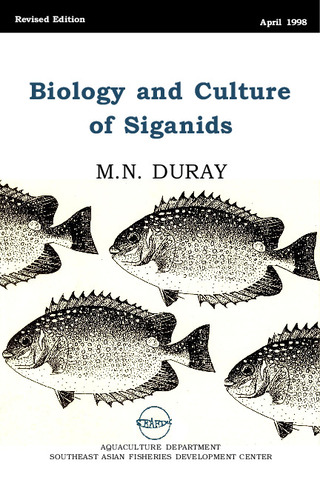
Biology and culture of siganids
(Aquaculture Department, Southeast Asian Fisheries Development Center, 1998)A 53-page monograph updating AQD's 1990 publication of the same title. The book includes siganid morphology, distribution and ecology; reproduction; fisheries; diseases and parasites; genetics. It also covers larval culture; fry and fingerling production; nutrition and feeds; and problem areas in aquaculture.