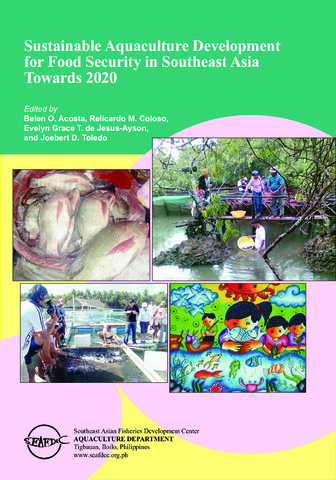
Sustainable aquaculture development for food security in Southeast Asia towards 2020. Proceedings of the Regional Technical Consultation on Sustainable Aquaculture Development in Southeast Asia Towards 2020


Share
Abstract
This publication represents the proceedings of the Regional Technical Consultation (RTC) on Aquaculture held in Bangkok, Thailand last 17-19 March 2010. The RTC was convened by the Southeast Asian Fisheries Development Center Aquaculture Department (SEAFDEC/AQD) as part of the preparatory undertakings for the ASEAN-SEAFDEC Conference on Fisheries held in June 2011. The main objectives of the RTC were to follow-up the developments of aquaculture in Southeast Asia after the 2001 ASEAN-SEAFDEC Millennium Conference on Fisheries and to define the strategic actions for the region s sustainable aquaculture development in the next decade. These proceedings contain 10 country papers and a summary status of implementation of the Resolution and Plan of Actions on six themes (supply of good quality seeds, environment-friendly aquaculture, getting out of the fish meal trap, healthy and wholesome aquaculture, biotechnology and rural aquaculture) which are the outcomes of the 2001 ASEAN-SEAFDEC Millennium Conference on Fisheries. It also presents the thematic papers and a synopsis of discussions on issues and recommendations on four thematic areas: (i) meeting social and economic challenges in aquaculture; (ii) quality seed production for sustainable aquaculture; (iii) healthy and wholesome aquaculture; and (iv) protecting the environment and adapting to climate change. These recommendations are expected to provide baseline information and directions in formulating the Resolution and Plan of Action (aquaculture component) for food security in Southeast Asia towards 2020.
Contributes to SDGs
Suggested Citation
Acosta, B. O., Coloso, R. M., de Jesus-Ayson, E. G. T., & Toledo, J. D. (Eds.). (2011). Sustainable aquaculture development for food security in Southeast Asia towards 2020. Proceedings of the Regional Technical Consultation on Sustainable Aquaculture Development in Southeast Asia Towards 2020. Tigbauan, Iloilo, Philippines: Aquaculture Department, Southeast Asian Fisheries Development Center.
Contents
- Foreword
- Preface
- Acknowledgement
- Thematic papers
- 2010 and beyond: better seeds for sustainable aquatic food production in Asia
- Healthy and wholesome aquaculture
- Effects of CO2-induced ocean environmental changes on marine life: implications for aquaculture
- Meeting social and economic challenges on aquaculture in Southeast Asia
- Key issues and knowledge gaps on aquaculture that need to be addressed in the next decade
- Status of implementation of the resolution and plan of action on aquaculture
- Summary of the status of implementation in SEAFDEC member countries and at SEAFDEC/AQD
- Annexes
- List of participants
- Advisory and organizing committees for the Regional technical consultation on aquaculture
- List of presenters, chairpersons, panelists and rapporteurs
Type
Book; Conference publicationISBN
9789718511992Format
169 p. : col. ill.
Related items
Showing items related by title, author, creator and subject.
-
FAO TCP/INT/3501: Emergency preparedness and response systems capacity and performance self-assessment survey
(Aquaculture Department, Southeast Asian Fisheries Development Center, 2019)The purpose of this survey is to obtain information on national capacity and the agencies mandated to implement emergency preparedness and response systems with respect to aquatic animal diseases. The results of this survey will help guide regional and national strategic planning with respect to improving aquatic EPR systems, thereby improving aquatic animal health more broadly and assuring adequate and rational support services to achieve sustainable aquaculture development. This FAO questionnaire on aquatic EPR system capacity and performance is a country level self-assessment survey with four sections: (1) general administration, (2) operational components, (3) support systems and (4) additional information. -
Towards sustainable aquaculture in Southeast Asia and Japan : proceedings of the Seminar-Workshop on Aquaculture Development in Southeast Asia, Iloilo City, Philippines, 26-28 July 1994
(Aquaculture Department, Southeast Asian Fisheries Development Center, 1995)Documents the presentations at ADSEA '94, the 3rd Seminar-Workshop on Aquaculture Development in Southeast Asia. ADSEA '94 includes reviews of the status of aquaculture development in Southeast Asia and Japan and of the researches conducted by Southeast Asian Fisheries Development Center, Aquaculture Department (SEAFDEC/AQD) to contribute to this development. Topics on responsible aquaculture, mollusc and seaweed culture, integrated farming, shrimp culture, diseases, and health management, and transgenic fish were also discussed. It also lists the research areas of 20 or so commodities prioritized for research at AQD for 1995-1997. -
Health management for sustainable aquaculture
(Aquaculture Department, Southeast Asian Fisheries Development Center, 2001)Aquaculture is a dynamic activity. To be successful and sustainable in this business, new techniques have to be continually developed, and adopted by farmers. Over the last decade, sustainability has become a key word for many different activities, including aquaculture. Many factors are involved in aquaculture sustainability, and health management has an important role among these. In order for aquatic animal health management at the farm level to aid the achievement of optimum yields, the following issues should be considered: suitable site selection, quality of broodstock and seed, reasonable stocking density, feed and feeding programme, water management, prophylactic and therapeutic treatment, and information dissemination. The sustainability of aquaculture at the national and regional levels requires different considerations among which are national policy, assistance priorities for farmers, legislation needs, technology development, and information needs.