Promotion of Sustainable Aquaculture, Aquatic Animal Health, and Resource Enhancement in Southeast Asia (SARSEA): Recent submissions
Now showing items 1-20 of 31
-
Establishment of threshold infection levels of WSSV in different weight ranges of Penaeus vannamei using quantitative PCR (qPCR)
(Aquaculture Department, Southeast Asian Fisheries Development Center, 2021-12)Threshold infection level is the pathogen load of the test animals measured before the appearance of clinical signs and mortality. This study aims to establish the threshold infection levels of WSSV in different weight ranges of Penaeus vannamei using qPCR. Artificial infection experiments were conducted using four weight ranges (3–5 g, 7–8 g, 15–18 g, and 22–25 g). The LD50 of the different weight ranges of shrimps were achieved at viral dilution of 10-6 and 10-5 after 216–240 hpi, and the viral loads of these inoculums have a range of 105–106 WSSV DNA copies/g. The viral loads of the samples in the timecourse infection experiments when the mortalities started was determined at 109 WSSV DNA copies/g, while for the survivors was at 106 WSSV DNA copies/g. The threshold infection level of WSSV in shrimp was determined at 107 to 108 WSSV DNA copies/g. It was also found out that the threshold infection level was not weight dependent. -
Research update on emergent shrimp pathogens in Thailand
(Aquaculture Department, Southeast Asian Fisheries Development Center, 2021-12)Recent evidence suggest that the emergent microsporidian, Enterocytozoon hepatopenaei (EHP) is a component cause of white feces syndrome (WFS) in shrimp. The natural WFS shrimp were found to be infected with EHP. At the laboratory level, shrimp induced to be heavily infected with EHP showed no WFS symptom suggesting that the causes of WFS is complex involved with other cause, not only EHP. The other component causes are under investigation. Better understanding of virulence mechanism of EHP infection in shrimp will assist in establishing innovative strategies to reduce its viability and potential infectivity in shrimp farms. Transmission of microsporidia is involved ingestion of spores in the water and the site of initial infection being the gastrointestinal tract. EHP spore is having a thick, protective chitinous wall around the cell membrane that allows them to survive outside their hosts and involve with the microsporidian pathogenesis. Here we describe successful purification of active EHP spores with a novel spore viability assay based on polar-tube extrusion or germination triggered by Phloxin B. The physical conditions such as temperature and PH, and chemical factors such as KMnO4, and chlorine that affect spore germination were examined as a practical guideline for the inactivation of the spores at a farm level. The potential environmental reservoir of EHP were found to be a mussel of the genus Mytilopsis, which is found frequently in the water canal or pipe in the shrimp rearing system. Recent evidence demonstrates that the mussel can be infected by EHP and can transmit EHP to shrimp in the laboratory model. -
Acute hepatopancreatic necrosis disease (AHPND)) and hepatopancreatic microsporidiosis (HPM):): Two threats to sustainable shrimp aquaculture
(Aquaculture Department, Southeast Asian Fisheries Development Center, 2021-12)Infectious diseases caused by viruses and bacteria are a major threat to sustainable shrimp farming globally. Since early 80’s viral diseases such as White Spot Disease, Taura Syndrome disease have caused enormous losses to shrimp aquaculture both in eastern and western hemisphere. As the shrimp industry tried to recover from the onslaught of these diseases, a bacterial, Acute Hepatopancreatic Necrosis Disease (AHPND), also known as Early Mortality Syndrome, and a fungal disease Hepatopancreatic Microsporidiosis (HPM) caused by Enterocytozoon hepatopenaei (EHP) are now posing new threat to shrimp aquaculture. Acute Hepatopancreatic Necrosis Disease is caused by Vibrio spp. expressing plasmidborne binary toxins, PirA and PirB that is similar to entomopathogenic bacterium, Photorhabdus encoded toxin. In 2009, AHPND emerged in China and since then spread to many countries in East Asia and in the Americas. Another disease that has caused alarm in recent year is Hepatopancreatic Microsporidiosis (HPM) caused by Enterocytozoon penaei (EHP), a microsporidium. While AHPND causes acute infection and large-scale mortalities, EHP causes chronic infection and results growth retardation and size variation in population reducing marketability of the infected shrimp. Both diseases affect hepatopancreas, an organ involved in metabolism and humoral immunity in shrimp. The binary toxin, PirA/ PirB are the primary virulence factor for AHPND, but specific virulence factor(s) for EHP is not known. It is, however, known that EHP does not have mitochondria and appears to transport ATP from the cytoplasm of infected cells as it contains ATP transporter genes in its genome. EHP has been shown to be a risk factor for AHPND. Due to lack of therapeutics, preventative measures remain as a corner stone for managing these diseases and efforts are underway to develop genetically improved lines of shrimp having resistance to AHPND and EHP. -
Department of Animal Health (DAH) report of emergency diseases - prevention and control of shrimp diseases in from 2016 to 2018
(Aquaculture Department, Southeast Asian Fisheries Development Center, 2021-12)Acute Hepatopancreatic Necrosis Disease (AHPND), known as Early Mortality Syndrome (EMS) before 2013, was first reported in Vietnam from the Mekong River Delta without laboratory confirmation in the end of 2010. Vibrio parahaemolyticus was recognized as the causative agent of AHPND reported by Dr. Tran Loc in 2013. From 2010 to 2015, AHPND spread quickly to a wide range of shrimp production areas in Viet Nam. White Spot Disease (WSD), in dual infection with AHPND, cause serious disease, each year nearly 1 % in total culture area stopped operation. Although the diseases decreased significantly from 2013 to 2018, AHPND and WSD are still the most serious problem encountered by shrimp farmers in main shrimp production areas. Both tiger shrimp (Penaeus monodon) and whiteleg shrimp (Litopenaeus vannamei) have been infected with AHPND and WSD; most cases occur 15–60 days after stocking. AHPND and WSD occur year round; however, it is most frequently observed between March to September. Vietnam has alleviated the effect of AHPND and WSD effectively in the current year. This can be attributed to the application of multiple solutions to prevent and control AHPND and WSD such as (1) improve farmers’ production conditions, awareness, facilities and bio-security measures; (2) implement active surveillance in main shrimp production areas for early warning; (3) broodstock and postlarvae are not accepted if positive for any OIE listed diseases; (4) movement control to prevent spreading disease; (5) encourage developing disease-free farms; (6) improve capacities and complete aquatic animal health system. -
Report of aquatic animal diseases in Thailand during January – June 2019
(Aquaculture Department, Southeast Asian Fisheries Development Center, 2021-12)Aquaculture is an important industry in Thailand which has been established more than two decades ago. The cultured species are divided into two main groups; shrimp and finfish farming. The major cultured shrimp species are Penaeus vannamei (Pacific white shrimp), P. monodon (black tiger shrimp) and Macrobrachium rosenbergii (giant freshwater prawn), whereas the finfish are Oreochromis sp., Lates calcarifer and Epinephelus sp. Also, ornamental fish such as Cyprinus carpio (Koi carp), Carassius spp. (goldfish), and Betta splendens (fighting fish or betta). Disease outbreaks are the key factor that affect Thailand’s aquaculture production and resulting in economic losses. The infectious diseases in aquaculture are mainly caused by viral and bacterial pathogens. In 2018, the reported shrimp pathogens are white spot syndrome virus (WSSV), yellow head virus (YHV) genotype 1, Taura syndrome virus (TSV), infectious hypodermal and haematopoietic necrosis virus (IHHNV), Vibrio parahaemolyticus causing acute hepatopancreatic necrosis disease (VPAHPND), and microsporidian Enterocytozoon hepatopenaei (EHP). On the other hand, the reported pathogens in finfish are Betanodavirus causing viral nervous necrosis (VNN), Tilapia lake virus (TiLV) and Streptococcus sp. etc. In Thailand, the Department of Fisheries (DOF) is the competent authority for various aspects of aquatic animals including aquatic animal health. Strategies to prevent and control diseases in aquatic animals include issuance of legislations/regulations, implementation of biosecurity measures, disease surveillance programs, capacity building, cooperation with international and national organizations. Moreover, DOF has developed contingency plan in dealing with aquatic animal disease emergencies through the provincial fisheries officer. The provincial fisheries officer acts as director of emergency aquatic animal disease control center in each province, while Aquatic Animal Health Research and Development Division (AAHRDD) and Songkhla Aquatic Animal Health Research and Development Center (SAAHRC) serve as disease diagnosis and laboratory testing centers. Because of the above actions, we are capable of preventing and controlling disease outbreaks in the country. But during the occurrence of some diseases, we have no treatment to support and completely solve the problem. Example are viral diseases, unlike bacterial diseases which can be treated by using chemical or drug. Furthermore, there are a few researches that could be applied in farm level. Especially shrimp which has no adaptive immunity, so it is difficult to develop vaccine compare to fish. Therefore, DOF mostly recommended farmers to follow the good management practices on aquatic animal health for promoting sustainable aquaculture. -
Country report - Singapore
(Aquaculture Department, Southeast Asian Fisheries Development Center, 2021-12)The aquaculture industry produces about 10 % of Singapore’s annual local fish consumption. By 2030, the country’s goal is for the agri-food industry to produce 30 % of Singapore’s nutritional needs. In order to achieve this, the Marine Aquaculture Centre (MAC) spearheaded several research and development programmes such as the broodstock development of Asian seabass and large-scale fry production technology. MAC also provides technical support to local farms to adopt sustainable farming practices and technology. In 2019, the Singapore Food Agency (SFA) was formed to oversee all matters pertaining to food supply and safety, including seafood production from aquaculture. The National Centre for Food Safety (NCFS) of SFA and Centre for Animal and Veterinary Services (CAVS) under National Parks Board (NParks) provides support via their diagnostic and testing capabilities in the areas of food safety and animal health, respectively. Based on the national surveillance program conducted by the SFA and NParks, the commonly reported diseases are viral, bacterial or parasitic infections. These include Benedeniosis, Big-Belly (BB) Disease Syndrome, infections with Streptococcus iniae and Tenacibaculum maritimum, Norcardiosis, Viral Nervous Necrosis (VNN), and Infectious Spleen and Kidney Necrosis Virus (ISKNV). With the aim to control and manage the aquatic diseases in Singapore, control measures for major pathogens in fin fishes and crustaceans are being implemented. In addition, Aquatic Animal Health Professionals (AAHP) should undergo trainings in aquaculture farm biosecurity. -
Status of aquatic animal health in the Philippines
(Aquaculture Department, Southeast Asian Fisheries Development Center, 2021-12)The national aquatic animal disease surveillance and reporting system is implemented by the Bureau of Fisheries and Aquatic Resources in coordination with other recognized laboratories. It covers the OIE/NACA listed diseases particularly those that cause major problems in aquaculture. The fisheries laboratories continuously enhance their capabilities to support the surveillance activities, controls on transboundary movement of aquatic animals, and provide services to the fish farmers. Programs are implemented to strengthen the aquatic animal health services in the country. Promotion of Good Aquaculture Practice and implementation of biosecurity measures are being done to prevent disease occurrences. Collaboration with other institutions on aquatic animal health programs are also established. The paper provides the information on the country’s status on aquatic animal health management. -
Aquatic animal health in Myanmar
(Aquaculture Department, Southeast Asian Fisheries Development Center, 2021-12)In 2010, several viruses infected Penaeus monodon in the ponds of Myanmar. This includes the White Spot Syndrome Virus (WSSV) which causes the White Spot Disease (WSD). In addition, Taura Syndrome Virus (TSV) and Infectious Hypodermal and Haematopoietic Virus (IHHNV) were detected in P. monodon samples from Ayeyarwaddy Region (western part of Myanmar). In 2014, the Yellowhead Virus (YHV) was also detected in shrimp samples for export. The occurrence of these shrimp diseases has resulted to a devastation of the shrimp industry in Myanmar. Because of this, most of the shrimp farmers have shifted to extensive or traditional shrimp farming. The Aquatic Animal Health and Disease Control Section (AAHDCS) of the Department of Fisheries (DoF) is responsible for formulating action plans to control and prevent aquatic animal diseases. Thus, in order to be updated with the latest techniques on disease detection and management of emerging diseases, the AAHDCS should improve the capacity of the departmental personnel, upgrade the laboratory equipment, and improve the facilities. -
Country report aquatic animal health in Malaysia
(Aquaculture Department, Southeast Asian Fisheries Development Center, 2021-12)The fisheries sector of Malaysia plays a significant role in economic development. It provides employment, foreign exchange and protein supply for the country. In 2017, aquaculture production in Malaysia was 427,022 tonnes, a 4.8 % increase compared to 2016. The increase was driven by population growth, rising demand for seafood and a levelling of production from capture fisheries. However, the rapid growth of aquaculture has been source of anthropogenic change on a massive scale. Aquatic animals cultured in high density are exposed to environment stress leading to diseases. Among major diseases occur in Malaysia are TILV and Streptococcosis in Tilapia, Vibriosis in grouper, and APHND and EHP in shrimp. Losses due to these diseases were reported as USD 0.1 billion for APHND in 2011, MYR 1 million due to Streptococcosis in 2002 and USD 7.4 million in Vibriosis outbreak in 1990. Currently the use of chemicals to overcome these diseases by farmers has led to increase concerns on food safety of food fish. Thus, Malaysia has implemented strict biosecurity measures in fisheries practices to secure not only fish health but also food safety for the consumers. This paper aimed to discuss the status of fish diseases and national diseases response and surveillance in Malaysia. -
Report on aquatic animal health in Lao PDR
(Aquaculture Department, Southeast Asian Fisheries Development Center, 2021-12)Fish production is very important to Lao PDR. It is an important source of protein to its citizens. Lao PDR is fortunate to have numerous water resources. The Mekong River flows through Lao PDR for a length of 1,865 km. Additionally, the country has other rivers, streams, reservoirs which are also used for irrigation and source of hydroelectric power. Swamps, lakes and rice fields during the wet season provide for capture and cultured fish products. In 2018, these water resources produced a total of 179,100 tons of fish; of which 62,700 came from capture fisheries and 116,400 from fish culture. In Lao PDR, as in many countries throughout the world, inland fisheries and aquaculture activities are administered by the Ministry of Agriculture. The Ministry is also responsible for forestry. It is called the Ministry of Agriculture and Forestry and is referred to as MAF. Within the MAF is the Division of Livestock and Fisheries (DLF). The National Fisheries Development Centre (NFDC) is working diligently to prevent outbreaks of aquatic animal diseases but much more must be done. Adequate manpower to address fisheries disease control on fish farms and adequate manpower for drug and chemical testing and inspection are lacking. In addition, communication between central and local governments as well as between local and central governments regarding disease diagnosis and disease control needs to be enhanced. Fish farmers must be trained to recognize and control diseases. -
Status of aquatic animal health in Indonesia
(Aquaculture Department, Southeast Asian Fisheries Development Center, 2021-12)Fish disease is one of the main obstacles in the success of aquaculture production because of the loss caused by it. The outbreak of diseases has resulted to a substantial economic loss which was reported to have reached almost USD 400 million. To minimize the impact of losses caused by fish diseases, the Indonesian government through the Directorate General of Aquaculture, Ministry of Marine Affairs and Fisheries has a fish disease monitoring and surveillance program. The program aims to monitor the occurrence of fish diseases in Indonesia, especially in the fish and shrimp farming centers and to educate on how to control them. In 2018, the monitoring and surveillance program have 34 provinces with 100 districts/cities location targets targeting fish and shrimp diseases. Based on the results of the monitoring and surveillance activities in 2018, the fish and shrimp are affected by the following diseases: White Spot Syndrome Virus (WSSV), Infectious Hypodermal and Haemotopoietic Necrosis Virus (IHHNV), Infectious Myonecrosis Virus (IMNV), Iridovirus, Aeromonas hydrophila, Streptococcus iniae, Streptococcus agalactiae, Edwardsiella ictaluri and Ichthyophthiriasis. The program to control fish diseases in order to minimize the losses has also been carried out by the government including trainings on the application of biosecurity, the use of vaccines, probiotics, immunostimulants and herbal medicines. -
The status of aquatic animal health in Cambodia
(Aquaculture Department, Southeast Asian Fisheries Development Center, 2021-12)Human population in Cambodia keeps increasing from year to year and the demand for food consumption also increases. Food products in Cambodia come from two main sources: terrestrial and aquatic. In this sense, aquaculture has been playing very important roles to produce aquatic food products in order to provide the sustainability of national food security, economy and also minimize the pressure on Cambodia’s capture fisheries. Aquaculture production in Cambodia has grown by an average of 20 % per year over the past decade, increasing from less than 50,000 metric tons in 2008 to 207,443 metric tons in 2017. However, disease is considered as the most serious problem that can limit the aquaculture production in many countries in the world including Cambodia. Previous reports showed that in 1999 intensive shrimp farming systems in Cambodia were severely affected by White Spot Syndrome Virus (WSSV), Monodon Baculovirus (MBV) and Yellow Head Virus (YHV). Hence, shrimp farming areas dropped from 1,000 hectares to 850 hectares in the year 2000 and gradually decreased each year. WSSV is the most serious threat faced by the shrimp farmers in Cambodia and is probably the major cause of direct losses of up to $ 14.5 million per year. During 2011–2013, white leg shrimp (Litopenaeus vannamei) was seriously infected by Early Mortality Syndrome (EMS) in Koh Kong Province. To date, extensive and semi-intensive shrimp farming have started mainly in Kampot, Kep and Preah Sihanouk and Koh Kong. Only one super intensive RAS Indoor white leg shrimp farm in Kampot operated in 2019. Recently, fish health monitoring of freshwater fish farms in 10 provinces and sea bass farms in three coastal provinces were conducted by the cooperation of central officers, officers from Marine Aquaculture Research and Development Center (MARDeC) and provincial officers. Fish samples were diagnosed and analyzed in Aquatic Animal Health Laboratory of MARDeC. The results showed that several of fish pathogens were identified such as fish parasites: Trichodina sp., Ichthyophthirius multifiliis, Epistylis, Apisoma, Dactylogyrus sp., Gyrodactylus sp., Argulus sp., Acanthocephalan, Henneguya sp., Cryptocaryon irritans, Caligus sp., Lernaea sp., Benedinia sp., Ancyrocephalidae sp., Amyloodinium sp. and Myxozoa sp. Pathogenic bacteria: Aeromonas spp., Edwardsiella ictaluri. Fungi: Aphanomyces invadans and Saprolegnia sp. Diagnostic laboratories can perform level I and II but not for all species of aquatic animals and diseases; level III is not yet effectively performed due to the lack of facilities, skills and knowledge. -
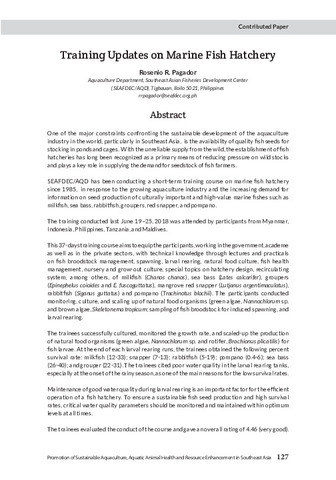
Training updates on marine fish hatchery
(Aquaculture Department, Southeast Asian Fisheries Development Center, 2021-12)One of the major constraints confronting the sustainable development of the aquaculture industry in the world, particularly in Southeast Asia, is the availability of quality fish seeds for stocking in ponds and cages. With the unreliable supply from the wild, the establishment of fish hatcheries has long been recognized as a primary means of reducing pressure on wild stocks and plays a key role in supplying the demand for seedstock of fish farmers. SEAFDEC/AQD has been conducting a short-term training course on marine fish hatchery since 1985, in response to the growing aquaculture industry and the increasing demand for information on seed production of culturally important and high-value marine fishes such as milkfish, sea bass, rabbitfish, groupers, red snapper, and pompano. The training conducted last June 19–25, 2018 was attended by participants from Myanmar, Indonesia, Philippines, Tanzania, and Maldives. This 37-days training course aims to equip the participants, working in the government, academe as well as in the private sectors, with technical knowledge through lectures and practicals on fish broodstock management, spawning, larval rearing, natural food culture, fish health management, nursery and grow-out culture, special topics on hatchery design, recirculating system, among others, of milkfish (Chanos chanos), sea bass (Lates calcarifer), groupers (Epinephelus coioides and E. fuscoguttatus), mangrove red snapper (Lutjanus argentimaculatus), rabbitfish (Siganus guttatus) and pompano (Trachinotus blochii). The participants conducted monitoring, culture, and scaling up of natural food organisms (green algae, Nannochlorum sp. and brown algae, Skeletonema tropicum; sampling of fish broodstock for induced spawning, and larval rearing. The trainees successfully cultured, monitored the growth rate, and scaled-up the production of natural food organisms (green algae, Nannochlorum sp. and rotifer, Brachionus plicatilis) for fish larvae. At the end of each larval rearing runs, the trainees obtained the following percent survival rate: milkfish (12-33); snapper (7-13); rabbitfish (5-19); pompano (0.4-6); sea bass (26-40); and grouper (22-31). The trainees cited poor water quality in the larval rearing tanks, especially at the onset of the rainy season, as one of the main reasons for the low survival rates. Maintenance of good water quality during larval rearing is an important factor for the efficient operation of a fish hatchery. To ensure a sustainable fish seed production and high survival rates, critical water quality parameters should be monitored and maintained within optimum levels at all times. The trainees evaluated the conduct of the course and gave an overall rating of 4.46 (very good). -
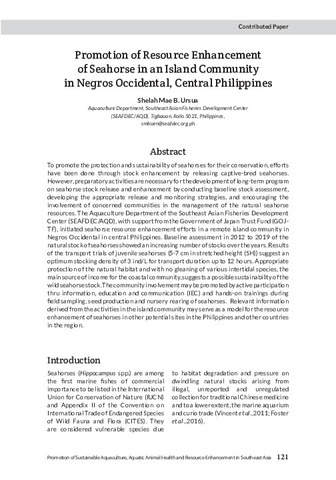
Promotion of resource enhancement of seahorse in an island community in Negros Occidental, Central Philippines
(Aquaculture Department, Southeast Asian Fisheries Development Center, 2021-12)To promote the protection and sustainability of seahorses for their conservation, efforts have been done through stock enhancement by releasing captive-bred seahorses. However, preparatory activities are necessary for the development of long-term program on seahorse stock release and enhancement by conducting baseline stock assessment, developing the appropriate release and monitoring strategies, and encouraging the involvement of concerned communities in the management of the natural seahorse resources. The Aquaculture Department of the Southeast Asian Fisheries Development Center (SEAFDEC/AQD), with support from the Government of Japan Trust Fund (GOJTF), initiated seahorse resource enhancement efforts in a remote island community in Negros Occidental in central Philippines. Baseline assessment in 2012 to 2019 of the natural stock of seahorses showed an increasing number of stocks over the years. Results of the transport trials of juvenile seahorses (5-7 cm in stretched height (SH)) suggest an optimum stocking density of 3 ind/L for transport duration up to 12 hours. Appropriate protection of the natural habitat and with no gleaning of various intertidal species, the main source of income for the coastal community, suggests a possible sustainability of the wild seahorse stock. The community involvement may be promoted by active participation thru information, education and communication (IEC) and hands-on trainings during field sampling, seed production and nursery rearing of seahorses. Relevant information derived from the activities in the island community may serve as a model for the resource enhancement of seahorses in other potential sites in the Philippines and other countries in the region. -
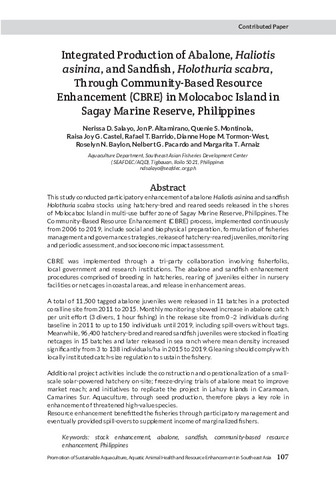
Integrated production of abalone, Haliotis asinina, and sandfish, Holothuria scabra, through Community-Based Resource Enhancement (CBRE) in Molocaboc Island in Sagay Marine Reserve, Philippines
(Aquaculture Department, Southeast Asian Fisheries Development Center, 2021-12)This study conducted participatory enhancement of abalone Haliotis asinina and sandfish Holothuria scabra stocks using hatchery-bred and reared seeds released in the shores of Molocaboc Island in multi-use buffer zone of Sagay Marine Reserve, Philippines. The Community-Based Resource Enhancement (CBRE) process, implemented continuously from 2006 to 2019, include social and biophysical preparation, formulation of fisheries management and governance strategies, release of hatchery-reared juveniles, monitoring and periodic assessment, and socioeconomic impact assessment. CBRE was implemented through a tri-party collaboration involving fisherfolks, local government and research institutions. The abalone and sandfish enhancement procedures comprised of breeding in hatcheries, rearing of juveniles either in nursery facilities or net cages in coastal areas, and release in enhancement areas. A total of 11,500 tagged abalone juveniles were released in 11 batches in a protected coralline site from 2011 to 2015. Monthly monitoring showed increase in abalone catch per unit effort (3 divers, 1 hour fishing) in the release site from 0–2 individuals during baseline in 2011 to up to 150 individuals until 2019, including spill-overs without tags. Meanwhile, 96,400 hatchery-bred and reared sandfish juveniles were stocked in floating netcages in 15 batches and later released in sea ranch where mean density increased significantly from 3 to 138 individuals/ha in 2015 to 2019. Gleaning should comply with locally instituted catch-size regulation to sustain the fishery. Additional project activities include the construction and operationalization of a smallscale solar-powered hatchery on-site; freeze-drying trials of abalone meat to improve market reach; and initiatives to replicate the project in Lahuy Islands in Caramoan, Camarines Sur. Aquaculture, through seed production, therefore plays a key role in enhancement of threatened high-value species. Resource enhancement benefitted the fisheries through participatory management and eventually provided spill-overs to supplement income of marginalized fishers. -
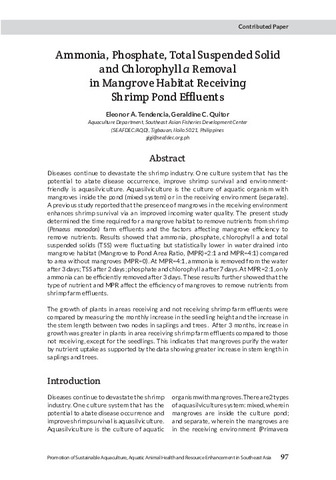
Ammonia, phosphate, total suspended solid and chlorophyll a removal in mangrove habitat receiving shrimp pond effluents
Tendencia, Eleonor ; (Aquaculture Department, Southeast Asian Fisheries Development Center, 2021-12)
Diseases continue to devastate the shrimp industry. One culture system that has the potential to abate disease occurrence, improve shrimp survival and environmentfriendly is aquasilviculture. Aquasilviculture is the culture of aquatic organism with mangroves inside the pond (mixed system) or in the receiving environment (separate). A previous study reported that the presence of mangroves in the receiving environment enhances shrimp survival via an improved incoming water quality. The present study determined the time required for a mangrove habitat to remove nutrients from shrimp (Penaeus monodon) farm effluents and the factors affecting mangrove efficiency to remove nutrients. Results showed that ammonia, phosphate, chlorophyll a and total suspended solids (TSS) were fluctuating but statistically lower in water drained into mangrove habitat (Mangrove to Pond Area Ratio, (MPR)=2:1 and MPR=4:1) compared to area without mangroves (MPR=0). At MPR=4:1, ammonia is removed from the water after 3 days; TSS after 2 days; phosphate and chlorophyll a after 7 days. At MPR=2:1, only ammonia can be efficiently removed after 3 days. These results further showed that the type of nutrient and MPR affect the efficiency of mangroves to remove nutrients from shrimp farm effluents. The growth of plants in areas receiving and not receiving shrimp farm effluents were compared by measuring the monthly increase in the seedling height and the increase in the stem length between two nodes in saplings and trees. After 3 months, increase in growth was greater in plants in area receiving shrimp farm effluents compared to those not receiving, except for the seedlings. This indicates that mangroves purify the water by nutrient uptake as supported by the data showing greater increase in stem length in saplings and trees.
; (Aquaculture Department, Southeast Asian Fisheries Development Center, 2021-12)
Diseases continue to devastate the shrimp industry. One culture system that has the potential to abate disease occurrence, improve shrimp survival and environmentfriendly is aquasilviculture. Aquasilviculture is the culture of aquatic organism with mangroves inside the pond (mixed system) or in the receiving environment (separate). A previous study reported that the presence of mangroves in the receiving environment enhances shrimp survival via an improved incoming water quality. The present study determined the time required for a mangrove habitat to remove nutrients from shrimp (Penaeus monodon) farm effluents and the factors affecting mangrove efficiency to remove nutrients. Results showed that ammonia, phosphate, chlorophyll a and total suspended solids (TSS) were fluctuating but statistically lower in water drained into mangrove habitat (Mangrove to Pond Area Ratio, (MPR)=2:1 and MPR=4:1) compared to area without mangroves (MPR=0). At MPR=4:1, ammonia is removed from the water after 3 days; TSS after 2 days; phosphate and chlorophyll a after 7 days. At MPR=2:1, only ammonia can be efficiently removed after 3 days. These results further showed that the type of nutrient and MPR affect the efficiency of mangroves to remove nutrients from shrimp farm effluents. The growth of plants in areas receiving and not receiving shrimp farm effluents were compared by measuring the monthly increase in the seedling height and the increase in the stem length between two nodes in saplings and trees. After 3 months, increase in growth was greater in plants in area receiving shrimp farm effluents compared to those not receiving, except for the seedlings. This indicates that mangroves purify the water by nutrient uptake as supported by the data showing greater increase in stem length in saplings and trees. -
Potential use of agricultural wastes in aquafeed production
Aya, Frolan; ; ; Romana-Eguia, Maria Rowena R. ; (Aquaculture Department, Southeast Asian Fisheries Development Center, 2021-12)
Disposal of agricultural wastes are posing environmental hazards which leads to efforts of efficiently utilizing them. This study surveyed a sugar central and a fruit processing plant to collect data on the volume of wastes from representative agricultural crops (e.g. mango, citrus, pineapple, sugarcane, papaya and soybean) in the Philippines during the 2012–2013 and 2014–2015 seasons, respectively. Their potential use in aquafeed was examined in terms of nutritional quality, presence of anti-nutritional factors (ANFs) and pesticide residues. About 40 to 60 % of agricultural wastes generated after processing were peels, pulps or brans, seeds, bagasse, molasses and okara. Most of the agricultural wastes had high levels of fiber and carbohydrate, and low levels of protein, although okara (25 % crude protein) and citrus by-products (11–16 % crude protein) showed acceptable nutritional quality. ANFs such as lignin are largely present in all agricultural wastes, whereas high levels of phenols, and saponins and alkaloids were found in mango seeds and mango peels, respectively. Pesticide residues were detected only in mango and citrus peels but at levels below the maximum residue limits of FAO Codex Alimentarius. From both nutritional and environmental perspectives, agricultural wastes have potential use in aquafeed production but their suitability should be further elucidated in diets for omnivorous fish species such as tilapia. -
Resource enhancement: Concepts, learnings, and future directions
Altamirano, Jon; (Aquaculture Department, Southeast Asian Fisheries Development Center, 2021-12)
Fish and fishery products are always in high demand causing pressure on world fish supply. The world’s wild capture fisheries resources ultimately reached its peak around the early 90s and plateaued at around 90 million tonnes. The stagnancy in wild fisheries production poses an alarm to the ever-growing human population. Fortunately, at around the same time, aquaculture production has filled some gap in seafood supply with over 100 million tonnes produced annually. However, there are various concerns about aquaculture and its sustainability. This is where the idea of aquatic resource enhancement comes in, not only to increase fish yield for food but also to compensate for losses caused by anthropogenic interventions, while promoting environmental rehabilitation and conservation. Resource enhancement, as a whole, can include various concepts on sustainable development, habitat conservation and improvement, ecological management, and aquaculturebased stock enhancement. This paper highlights the development of some resource enhancement programs worldwide and provide some examples particularly those from the Southeast Asian Region. We will attempt to tackle some successes and failures, as well as review past and recent experiences to extract important learnings. Based on these lessons, future directions of how resource enhancement initiatives can be made more efficient and sustainable. As a general rule, we recommend that in order to increase chances of success for programs on resource enhancement, it has to be science-based, there needs to be inclusive and participatory planning and management involving all stakeholders and adheres to responsible culture practices. Moreover, there should be concurrent efforts in reducing fishing pressures, as well as in protecting and rehabilitating natural ecosystems. -
Problems and challenges of aquaculture in Japan
(Aquaculture Department, Southeast Asian Fisheries Development Center, 2021-12)This paper describes the present status of aquaculture in Japan. The production volumes of many of the wide variety of aquatic organisms cultured in Japan, including finfishes, bivalves, crustaceans and seaweeds, are on a continuing decreasing trend. According to the national statistical data published by the Ministry of Agriculture, Forestry and Fisheries, the total marine aquaculture production decreased by 20 % by volume in 20 years since 1996 (1.3 million t). In fed aquaculture of marine finfishes, productions of the red seabream (Pagrus major), Japanese flounder (Paralichthys olivaceus) and horse mackerel (Trachurus japonicus) have declined markedly in both volume and value. On the other hand, productions of Pacific bluefin tuna (Thunnus orientalis), which has been included in the statistics since 2012, is increasing remarkably because of the strong affinity of Japanese consumers and the dwindling wild population. Production of white trevally (Pseudocaranx dentex), which is recognized as a luxury foodstuff, is also increasing. Productions of yellowtails (Seriola spp.) and pufferfish (Tetradontidae spp.) are rather stable in terms of volume and value. International demand for yellowtails is growing, and the export is expanding. As for unfed culture of bivalves, productions of oysters (Crassostrea spp.) and Japanese scallop (Mizuhopecten yessoensis) were severely impacted by the Great East Japan Earthquake in 2011, and the production of the oysters, which is on a long-term decreasing trend, has not recovered to the level prior to the earthquake. Production of the major seaweeds (Pyropia yezoensis, P. tenera, Saccharina japonica, S. angustata and Undaria pinntifida) are all on a continuous decreasing trend both by volume and value. Inland (freshwater) aquaculture production is only about 3 % of the marine aquaculture production by volume. About 70 % of the freshwater aquaculture production value comes from Japanese eel (Anguilla japonica), which has been increasing since 2002 due to the increasing unit price despite the decreasing production volume. The insufficient supply of wild glass eel is a problem for the eel aquaculture. The reduced aquaculture production is partially due to socio-economic and environmental reasons. For fed aquaculture, increasing feed cost and international competition are the major issues. Diseases also remain to be a problem. Prevalence of vaccination has reduced the disease damage from about 10 to 4 % of the total production value since around 2000, but the emergence of new diseases continues to occur. Infectious diseases have long been a problem in kuruma prawn (Marsupenaeus japonicus) aquaculture. Red tides still occur almost every year, causing damages mostly in western Japan. For unfed aquaculture, the reduced production is considered to be related with oligotrophication of coastal waters. Intensive reduction of terrestrial nutrient loads by advances in wastewater treatment is thought to have reduced the seaweed productivity, as well as other primary production, resulting in reduced productivity of not only unfed aquaculture of bivalves but coastal fisheries in general. Social factors are also involved. Production declines of many of these species are partially attributed to the reduced labor force due to aging and insufficient recruitment of farmers. The number of management body of oyster aquaculture, for example, decreased from 4,349 in 1963 to 2,018 in 2013. Structure of aquaculture industry in Japan (mostly privately-owned small business) and strong Japanese currency bring about the weak international market competitiveness. -
Report on sustainable aquaculture and resource enhancement in Thailand
(Aquaculture Department, Southeast Asian Fisheries Development Center, 2021-12)Aquaculture in Thailand has continuously developed to become an important aquaculture producer in the world. This is possible because of Thailand’s geographical location which is suitable for aquaculture, climate, and experienced farmers. The types of aquaculture in Thailand consist of natural, semi-intensive, intensive and super-intensive farming. The main freshwater aquatic species cultured in Thailand are Nile tilapia (Oreochromis niloticus), hybrid catfish (Clarias macrocephalus x C. gariepinus), and giant river prawn (Macrobrachium rosenbergii); Pacific white shrimp (Litopenaeus vannamei), giant tiger shrimp (Penaeus monodon), Asian sea bass (Lates calcarifer) and grouper (Epinephelus sp), in brackish water. Yield from marine shrimp (Litopenaeus vannamei, Peneaus monodon) culture comprised 64 % of the total marine aquaculture production. Shrimp aquaculture, a development of the agricultural industry, is income generating and creates jobs in various parts of the country. The rapid growth in shrimp production resulted in problems with cumulative impacts; one of the issues is the occurrence of epidemic diseases. Diseases have emerged as a major constraint to the sustainable growth of the shrimp aquaculture industry. Shrimp diseases have caused significant losses in production and jobs, reduced earning, export restrictions, failure and closing of business and decreased the confidence of consumers. Aquaculture, in this digital period of technology is mainly used in the aquaculture of marine shrimp — development of feeding applications, notification of aquatic animal diseases, proper aquaculture management. Technology is also used in the aquatic animal health examination to get accurate information to timely solve underlying problem (s); and thus reduces severe damage to the crop. The new fisheries law and legal policies in Thailand recognize the importance of the aquaculture industry. The new order has a clear direction to prevent aquatic animal diseases from importing controlled aquatic animals, including the standard law for Pacific white shrimp hatchery including promoting environmentally friendly practices. The present Department of Fisheries (DOF), Thailand has encouraged standard farm to shrimp farmer including Good Aquaculture Practice (GAP), Code of Conduct (CoC), Thai Agriculture Standard (TAS): 7401, 7422, 7432 and 9000, Compartment (Biosecurity system) and Organic standard farm. The DOF has promoted aquaculture to achieve sustainability and enhancement of fishery resources, Therefore developed monitoring system, controlling system, surveillance system, and traceability system for aquaculture. To encourage farmers to have environmentally friendly aquaculture and products safe for consumers.