
Proceedings of the 1st Scientific Conference on the Agusan Marsh
最新登録資料
-
Social and economic aspects of the Agusan marsh key biodiversity area
(2008)Considered a significant wetland ecosystem, the Agusan Marsh has been designated a Key Biodiversity Area (KBA) in the country by the Department of Environment and Natural Resources (CI-Philippines, DENR-PAWB and Haribon, 2006) and a Ramsar site. It is bound on the north by Agusan del Norte, on the east by Surigao Sur, on the south by Davao del Norte, and on the west by Bukidnon and Misamis Oriental. Virgin forests still exist on the western side along the Agusan-Bukidnon boundary. On the eastern part, a portion of the buffer zone is planted to palm oil Elaeis guineensis. The total land size of the Agusan Marsh KBA is 143.73 sq km which is 1.7% of the total land area (8,297.19 sq km) of Agusan del Sur (DENR, 2004). The municipalities which have portions within this KBA are Bunawan (30% of land area within the KBA), La Paz (28.42%), Rosario (21.52%), Loreto, San Francisco, Veruela, and Talacogon. Outside this KBA are three other municipalities of Agusan del Sur - Esperanza, Sta. Josefa and San Luis. Playing a vital role in the socioeconomic development of the provinces of Agusan del Norte and Agusan del Sur, the KBA can be reached through a road running west from the national highway to Talacogon. It is accessed through the interior towns of Talacogon and La Paz, and through the Agusan River and its tributaries, Gibong River and Adgawan River. Bunawan is the usual jump-off area to the Marsh on the southeastern side; it can be reached by bus from Davao City or Butuan City in about three hours. The Marsh can also be reached by pumpboat from Bunawan via Simulao River to the Agusan River which runs from south to north. The biological and ecological features of the Agusan Marsh are discussed elsewhere in this volume. -
Distribution of the avifauna of Agusan marsh, Agusan del Sur, Philippines
(2008)The Agusan Marsh is the 1009th RAMSAR site, a wildlife sanctuary which serves as wintering ground for migratory and wetland birds from Asian and Western countries, and is considered one of the most ecologically significant wetland ecosystems in the Philippines. This study assessed species diversity and distribution of birds in four habitat types of the Agusan Marsh. Sago, Terminalia, Mixed Swamp and Peat Swamp forests in the Marsh were surveyed from August 2005 to January 2006 using a combination of mist netting (3,337 net days) and transect walk methods. One hundred twenty-six species of birds were identified consisting of 26 migrants, 69 non-endemics, and 31 endemics (23.81% endemism) of which seven species are categorized as threatened. The Mixed Swamp Forest had the highest species richness (S=92) while the Peat Swamp Forest had the highest number of migratory birds (S=26). Highest endemicity was recorded in the Terminalia Forest (20.63%) while the Sago Forest had the least number of bird species. Migratory birds were recorded at the start of sampling in August, their numbers considerably increasing thereafter and reaching a peak in November. In contrast, the number of endemic species declined in the same month. Previously recorded only in Luzon, the migratory Siberian Rubythroat (Luscinea calliope) was also found in Agusan Marsh, indicating that this bird may be found in other places in the Philippines. Forty-six species of birds, which include six migratory species, were reported to be of socioeconomic importance. Changes in structural and floristic composition brought about by forest degradation, such as conversion of forest into agriculture, logging and hunting, were seen as threats to the birds in Agusan Marsh. Results indicate that the Marsh supports a considerable number of endemic, threatened, and migratory bird species. Conservation of the different Marsh habitats is necessary for the protection of the broadest avifaunal diversity. -
Species richness, abundance and distribution of aquatic insects of Agusan marsh, Mindanao, Philippines
(2008)A total of 59 species of aquatic insects was recorded from the major habitats in the flood-plain of Agusan Marsh. Species richness was greater in natural habitats than their respective adjoining ricefields, and did not differ among the natural habitats and between seasons. The water beetles had the highest species richness with 28 species, followed by aquatic and semi-aquatic bugs with 17 species, and dragonflies with 11 species, mostly libellulids. While most of the aquatic insects were fairly distributed in many habitats, several species appeared to be unique to one or two natural habitats. Water beetles were the most numerous insects in both wet and dry seasons. Aquatic insects were more abundant in the natural habitats than their adjacent ricefields; they were most abundant in Sedge-dominated Swamps. In ricefields, the site near the Fern-dominated Swamp had the highest abundance, while the site adjacent to the Bangkal Forest had the lowest. -
Hydrology and ecology-related aspects of managing the Agusan marsh
(2008)This paper presents the basin hydrology of Agusan Marsh and the Agusan River Basin. Also presented are basic considerations in the management of the Agusan River Basin environment and discussions on the interaction of hydrology, geomorphology and ecology. In the last few years, there have been interest and plans for water resources developments in the Agusan River Basin. The paper likewise discusses the implications and impacts of these developments on the hydrology, geomorphology and ecology of Agusan Marsh and Agusan River Basin. -
Indicators and possible driving mechanisms of shifts in the position of Agusan river along the Butuan coastal plain
(2008)The Butuan coastal plain is a fan-delta formed by deposition of Agusan River sediments in the past 7,400 radiocarbon years (ky). Traces of paleochannels that scar the coastal plain, seen in satellite images, indicate past river positions. Immediately prior to the present, Masao River was the active distributary as suggested by its well-defined and still continuous paleochannel. Numerous sudden shifts of river position have likely originated in the San Vicente area, the apex region of the fan-delta. These shifts could have been self driven or induced by floods or tectonics. Sediment input from rivers along the eastern flank of the Butuan coastal plain forced a number of downstream shifts. The function of the Agusan Marsh in buffering flashy river discharges in the Butuan coastal plain is threatened by present-day elevated sediment loads of rivers upstream. -
Agusan marsh: A brief history
(2008) -
Inventory of aquatic fauna of Agusan marsh with notes on introduced species and their potential impacts on biodiversity
; ; Primavera, Jurgenne (UNESCO Jakarta Office, Philippine Council for Aquatic and Marine Research and Development, 2008)
An important region of biodiversity in the country is the Agusan Marsh, located in northeastern Mindanao, southern Philippines. The Marsh aquatic fauna are not well studied and majority of available information is dispersed and sporadic. This study presents an updated systematic list comprising aquatic faunal species collected from seven Marsh localities during a 2006 survey. Of a total of 64 species of aquatic fauna distributed in 45 genera and 37 families, about 59.3% are fishes, 17.2% crustaceans, 14.1% molluscs, and 9.4% reptiles. Most of the aquatic fauna are native and migratory. Flowing rivers, lakes and creeks are the primary habitats of these organisms; majority of them thrive in lakes and upper streams. Fish species reported in earlier literature are also included. The Indigenous Knowledge System (IKS) was applied to integrate species known to the native Manobo, but not found in earlier studies nor the present survey. Fishery-related problems include the decline in fishery stocks, displacement of native species, and destruction of habitats. These problems are attributed to illegal fishing (e.g., electrofishing, use of chemicals and ichthyotoxic plants), overfishing, introduced or exotic or invasive alien species, pollution (e.g., heavy metal contamination), habitat degradation (e.g., conversion of marshland to agriculture), and human disturbance. The deliberate or accidental introductions of exotic species such as carps and the janitor fish now pose serious threats to species diversity. Conservation measures and strict enforcement of wildlife and environmental laws are needed to save the biodiversity of Agusan Marsh for future generations.
(UNESCO Jakarta Office, Philippine Council for Aquatic and Marine Research and Development, 2008)
An important region of biodiversity in the country is the Agusan Marsh, located in northeastern Mindanao, southern Philippines. The Marsh aquatic fauna are not well studied and majority of available information is dispersed and sporadic. This study presents an updated systematic list comprising aquatic faunal species collected from seven Marsh localities during a 2006 survey. Of a total of 64 species of aquatic fauna distributed in 45 genera and 37 families, about 59.3% are fishes, 17.2% crustaceans, 14.1% molluscs, and 9.4% reptiles. Most of the aquatic fauna are native and migratory. Flowing rivers, lakes and creeks are the primary habitats of these organisms; majority of them thrive in lakes and upper streams. Fish species reported in earlier literature are also included. The Indigenous Knowledge System (IKS) was applied to integrate species known to the native Manobo, but not found in earlier studies nor the present survey. Fishery-related problems include the decline in fishery stocks, displacement of native species, and destruction of habitats. These problems are attributed to illegal fishing (e.g., electrofishing, use of chemicals and ichthyotoxic plants), overfishing, introduced or exotic or invasive alien species, pollution (e.g., heavy metal contamination), habitat degradation (e.g., conversion of marshland to agriculture), and human disturbance. The deliberate or accidental introductions of exotic species such as carps and the janitor fish now pose serious threats to species diversity. Conservation measures and strict enforcement of wildlife and environmental laws are needed to save the biodiversity of Agusan Marsh for future generations. -
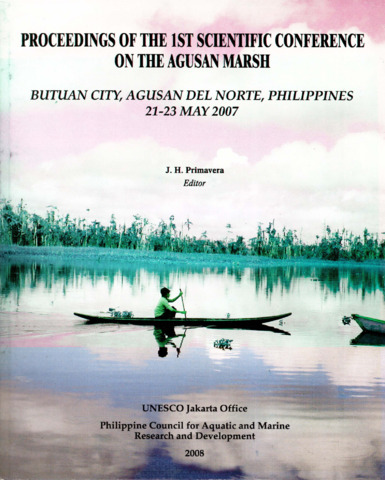
Proceedings of the 1st Scientific Conference on the Agusan Marsh: Butuan City, Agusan del Norte, Philippines, 21-23 May 2007
(UNESCO Jakarta Office, Philippine Council for Aquatic and Marine Research and Development, 2008) -
The Agusan marsh: A situationer with focus on scientific aspects
Primavera, Jurgenne; (UNESCO Jakarta Office, Philippine Council for Aquatic and Marine Research and Development, 2008)
The Agusan Marsh is an extensive floodplain in the middle of the Agusan River Basin in eastern Mindanao where rivers, creeks and tributaries mainly in the provinces of Agusan del Norte, Agusan del Sur and Compostela Valley converge and drain northward to the Agusan River and into Butuan Bay. The main habitats of the Marsh are the freshwater swamp forest (with Terminalia, peat swamp and sago palm forest subtypes), secondary scrub, herbaceous swamp, open water (oxbow/floodplain lakes, pools), and flowing water (rivers, streams). Peat forests have been confirmed in Bunawan and Caimpugan. Over 200 bird species have been known to spend at least part of the year in the Marsh, making it an important site for migratory birds from northern Asia and Siberia. As one of the Philippines' ecologically significant wetlands, the Marsh has been declared a protected site under NIP AS (1994), Presidential Proclamation 913 (1996), and RAMSAR (1999). The Agusan Marsh Wildlife Sanctuary covers -111,540 ha in 8 municipalities of Agusan del Sur. Recently the Agusan Marsh was placed high on the list of Philippine nominations to the World Heritage Natural Sites. Despite all these, very few scientific studies have been conducted on the Marsh but this has not stopped drainage and development for agriculture, construction of dams and reservoirs for irrigation, deliberate or accidental introductions of exotic species, e.g., tilapia, carps, janitor fish, and golden apple snail, and logging in the watershed areas. The latter have been legitimized by Integrated Forest Management Agreements despite the presence of primary forests. The latest proposed intervention is the Agusan River Basin Development Project. There is need for scientific research to provide baseline information on hydrology, sediment dynamics and ecology as prerequisite to any interventions and developments in the Agusan Marsh.
 RSS 1.0