Arachidonic acid distribution in mangrove organisms in the Philippines, Malaysia and Japan
View/
Date
2006Page views
763ASFA keyword

AGROVOC keyword
Geographic names

Metadata
Show full item recordShare
Abstract
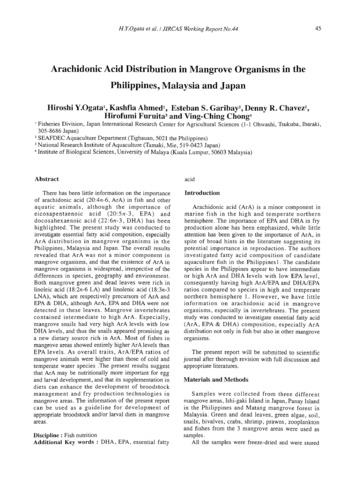
There has been little information on the importance of arachidonic acid (20:4n-6, ArA) in fish and other aquatic animals, although the importance of eicosapentaenoic acid (20:5n-3, EPA) and docosahexaenoic acid (22:6n-3, DHA) has been highlighted. The present study was conducted to investigate essential fatty acid composition, especially ArA distribution in mangrove organisms in the Philippines, Malaysia and Japan. The overall results revealed that ArA was not a minor component in mangrove organisms, and that the existence of ArA in mangrove organisms is widespread, irrespective of the differences in species, geography and environment. Both mangrove green and dead leaves were rich in linoleic acid (18:2n-6 LA) and linolenic acid (18:3n-3 LNA), which are respectively precursors of ArA and EPA & DHA, although ArA, EPA and DHA were not detected in these leaves. Mangrove invertebrates contained intermediate to high ArA. Especially, mangrove snails had very high ArA levels with low DHA levels, and thus the snails appeared promising as a new dietary source rich in ArA. Most of fishes in mangrove areas showed entirely higher ArA levels than EPA levels. As overall traits, ArA/EPA ratios of mangrove animals were higher than those of cold and temperate water species .The present results suggest that ArA may be nutritionally more important for egg and larval development, and that its supplementation in diets can enhance the development of broodstock management and fry production technologies in mangrove areas. The information of the present report can be used as a guideline for development of appropriate broodstock and/or larval diets in mangrove areas.
Keywords
DHA EPA essential fatty acidType
Book chapterISSN
1341-710XSeries
JIRCAS Working Report; No. 44Collections
- Books and Book Chapters [123]
Related items
Showing items related by title, author, creator and subject.
-
Philippine thraustochytrids from mangroves: A rich new source of essential fatty acids for human nutrition
(Marine Science Institute, University of the Philippines, 2007) -
Evaluation of dietary freeze-dried Chaetoceros calcitrans supplementation to control Vibrio harveyi infection on Penaeus monodon juvenile
; ; ; ; Amar, Edgar (Elsevier, 2014)
Effects of supplementation of diets with freeze-dried Chaetoceros calcitrans to control Vibrio harveyi infection are evaluated through immune responses, and disease resistance of juvenile Penaeus monodon. Total lipid and fatty acid profile of Chaetoceros calcitrans is also analyzed. A challenge infection with 107 cfu/mL concentration of Vibrio harveyi is intramuscularly injected to juvenile Penaeus monodon after 45 days of feeding of diets supplemented with 15 g/kg and 30 g/kg dried Chaetoceros calcitrans. The use of dried Chaetoceros calcitrans is compared with that of ß-1,3 glucan Curdlan, a commercial immune enhancer. Incorporation of 30 g/kg Chaetoceros calcitrans in the diet enhances the immune system of shrimp as effected by high prophenoloxidase activity and plasma protein concentration and is better compared to the commercially available Curdlan. Chaetoceros calcitrans also contains polyunsaturated fatty acids (PUFAs) such as linolenic acid and eicosapentanoic acid (EPA) which are responsible for its antibacterial action against Vibrio harveyi. All these biological activities of Chaetoceros calcitrans add up to increase resistance of the juvenile Penaeus monodon to vibriosis as shown by its high survival rate from the challenge infection with Vibrio harveyi. Therefore, it is worthwhile to use Chaetoceros calcitrans as supplementary feed. Its effect in increasing the immune competence coupled with its antibacterial action, make the shrimp resistant to luminous vibriosis that continues to affect the industry, thereby augmenting aquaculture production.
(Elsevier, 2014)
Effects of supplementation of diets with freeze-dried Chaetoceros calcitrans to control Vibrio harveyi infection are evaluated through immune responses, and disease resistance of juvenile Penaeus monodon. Total lipid and fatty acid profile of Chaetoceros calcitrans is also analyzed. A challenge infection with 107 cfu/mL concentration of Vibrio harveyi is intramuscularly injected to juvenile Penaeus monodon after 45 days of feeding of diets supplemented with 15 g/kg and 30 g/kg dried Chaetoceros calcitrans. The use of dried Chaetoceros calcitrans is compared with that of ß-1,3 glucan Curdlan, a commercial immune enhancer. Incorporation of 30 g/kg Chaetoceros calcitrans in the diet enhances the immune system of shrimp as effected by high prophenoloxidase activity and plasma protein concentration and is better compared to the commercially available Curdlan. Chaetoceros calcitrans also contains polyunsaturated fatty acids (PUFAs) such as linolenic acid and eicosapentanoic acid (EPA) which are responsible for its antibacterial action against Vibrio harveyi. All these biological activities of Chaetoceros calcitrans add up to increase resistance of the juvenile Penaeus monodon to vibriosis as shown by its high survival rate from the challenge infection with Vibrio harveyi. Therefore, it is worthwhile to use Chaetoceros calcitrans as supplementary feed. Its effect in increasing the immune competence coupled with its antibacterial action, make the shrimp resistant to luminous vibriosis that continues to affect the industry, thereby augmenting aquaculture production. -
Advanced broodstock diets for the mangrove red snapper and a potential importance of arachidonic acid in eggs and fry
(Springer Verlag, 2003)Mangrove red snapper fed advanced broodstock diets containing squid meal and squid oil exhibited higher hatching rates, cumulative survival and survival activity index than those fed a basal diet or a basal diet supplemented with mixture of antioxidants. On the other hand, fatty acid analyses of ovaries and fry of wild fish and eggs and larvae of broodstock fed raw fish revealed high arachidonic acid (ARA) and docosahexaenoic acid (DHA) levels and relatively lower eicosapentaenoic acid (EPA) levels consequently showing high ARA/EPA and DHA/EPA ratios compared to cold water species. This suggests that ARA may be nutritionally more important for egg and larval development and survival in tropical marine fish and its supplementation in broodstock diets may enhance reproductive performance of mangrove red snapper.