Browsing Institutional Reports by Issue Date
Now showing items 1-20 of 180
-
First annual report of the Aquaculture Department of the Southeast Asian Fisheries Development Center (SEAFDEC) for the fiscal year ending December 31, 1973
(Aquaculture Department, Southeast Asian Fisheries Development Center, 1974)An illustrated account is presented, covering background (establishment of the department), plan of operation (functions; activities), project site development (Leganes Station, Tigbauan Station, construction of buildings, infrastructure development), research (prawn fry stocking, collection of prawn spawners, research staffing, research tie-up with Mindanao State University, Japanese fisheries experts), equipment (preparation of the list of Japanese donated equipment), organization of the department, funding. -
Annual report 1974
(Aquaculture Department, Southeast Asian Fisheries Development Center, 1975)The 1974 report describes the development of project sites at Tigbauan and Leganes, where new ponds and labs have been established. The facilities of these labs include covered and open ponds, wet and field labs, a food preparation building, as well as dormitories and housing units. A substation is now operating at Nueva Valencia, investigating the life cycle of tiger prawn, Penaeus monodon, and 5 further substations also exist. Organisational aspects are described, covering scientific staff, equipment, funding etc. The Department s activities are described in detail; these are mainly concerned with shellfish culture and the associated problems. Notes are included on the First Aquaculture Research Conference (April 1974)and 7th SEAFDEC Council Meeting (Dec 1974). Finally, the new and continuing research projects to be conducted during 1975 are listed. -
Annual report 1975
(Aquaculture Department, Southeast Asian Fisheries Development Center, 1976) -
Notes on ovarian rematuration of ablated sugpo (prawn) Penaeus monodon Fabricius
Primavera, Jurgenne ; (Aquaculture Department, Southeast Asian Fisheries Development Center, 1977)
To what extent spent P. monodon females can remature and spawn successive broods is an important question in terms of recycling spawners in a commercially viable operation. Corollary to this is the quantity and quality of fry from rematured females in comparison to those from first spawning. Of 347 experimental females, only 10.1% had a second spawning, and 1.4% a third spawning. To a large degree the low rate of rematuration is due to high spawner mortality - average survival period after spawning was only 6 days in a sample of 176 spawners. It took an average of 23 days after ablation for a prawn with undeveloped ovaries to mature and spawn. An ablated female may have another spawning in as little as 5 days after the previous one. Average fecundity was 180,000 eggs per second spawning, and 140,000 eggs per third spawning. The average number of eggs from first spawning ablated females was 110-120,000. Hatching rate was lower for rematuration: 44% for second spawnings, and 35% for third spawnings, as compared to 64% for first maturation.
; (Aquaculture Department, Southeast Asian Fisheries Development Center, 1977)
To what extent spent P. monodon females can remature and spawn successive broods is an important question in terms of recycling spawners in a commercially viable operation. Corollary to this is the quantity and quality of fry from rematured females in comparison to those from first spawning. Of 347 experimental females, only 10.1% had a second spawning, and 1.4% a third spawning. To a large degree the low rate of rematuration is due to high spawner mortality - average survival period after spawning was only 6 days in a sample of 176 spawners. It took an average of 23 days after ablation for a prawn with undeveloped ovaries to mature and spawn. An ablated female may have another spawning in as little as 5 days after the previous one. Average fecundity was 180,000 eggs per second spawning, and 140,000 eggs per third spawning. The average number of eggs from first spawning ablated females was 110-120,000. Hatching rate was lower for rematuration: 44% for second spawnings, and 35% for third spawnings, as compared to 64% for first maturation. -
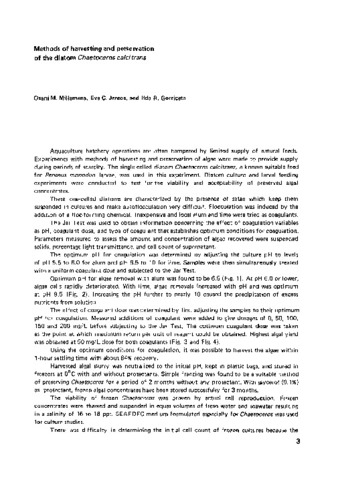
Methods of harvesting and preservation of the diatom Chaetoceros calcitrans
(Aquaculture Department, Southeast Asian Fisheries Development Center, 1977)Diatom culture and larval feeding experiments were conducted to test the viability and acceptability of preserved algal concentrates. C. calcitrans is characterised by the presence of setae which keep them suspended in cultures and make autoflocculation very difficult. Flocculation was induced by the addition of a floc-forming chemical. Using the optimum conditions, it was possible to harvest the algae within 1-h settling time and with about 84% recovery. The viability of frozen Chaetoceros was determined by actual cell reproduction. Preliminary feeding experiments showed that Chaetoceros can be successfully used as a substitute for fresh diatoms as feed for Penaeus monodon larvae. Simple freezing techniques, with or without the use of protectants has been found convenient for preserving algal concentrates in small volumes for both feeding and culture purposes. -
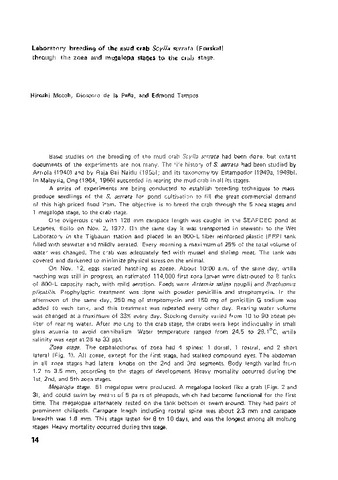
Laboratory breeding of the mud crab Scylla serrata (Forskal) through the zoea and megalopa stages to the crab stage
(Aquaculture Department, Southeast Asian Fisheries Development Center, 1977)A series of experiments is being conducted to establish breeding techniques to mass-produce seedlings of S. serrata for pond cultivation to meet the commercial demand for the crab. The objective is to culture the crab through the 5 zoea stages and 1 megalopa stage to the crab stage. A brief resume of the experiments is presented. Heavy mortality occurred at the 1st, 2nd and 5th zoea stages, and during the megalopa stage. Initial mortality is attributed to unfavourable rearing conditions, and later mortality to cannibalism. -
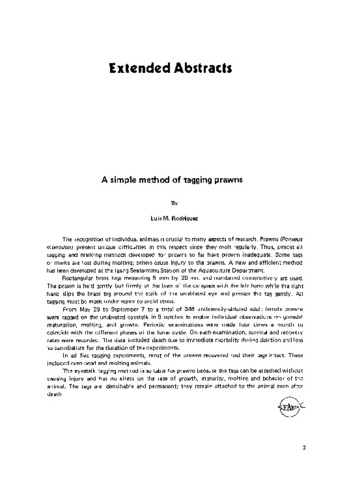
A simple method of tagging prawns
(Aquaculture Department, Southeast Asian Fisheries Development Center, 1977)The recognition of individual animals is crucial to many aspects of research. Prawns (Penaeus monodon) present unique difficulties in this respect since they molt regularly. Thus, almost all tagging and marking methods developed for prawns so far have proven inadequate. Some tags or marks are lost during molting; others cause injury to the prawns. A new and efficient method has been developed at the Igang Seafarming Station of the Aquaculture Department. Rectangular brass tags measuring 5 mm by 20 mm and numbered consecutively are used. The prawn is held gently but firmly at the base of the carapace with the left hand while the right hand slips the brass tag around the stalk of the unablated eye and presses the tag gently. All tagging must be made under water to avoid stress. From May 29 to September 7 to a total of 348 unilaterally-ablated adult female prawns were tagged on the unablated eyestalk in 5 batches to enable individual observations on gonadal maturation, molting, and growth. Periodic examinations were made four times a month to coincide with the different phases of the lunar cycle. On each examination, survival and recovery rates were recorded. The data included death due to immediate mortality during ablation and loss to cannibalism for the duration of the experiments. In all five tagging experiments, most of the prawns recovered had their tags intact. These included even dead and molting animals. The eyestalk tagging method is suitable for prawns because the tags can be attached without causing injury and has no effect on the rate of growth, maturity, molting and behavior of the animal. The tags are identifiable and permanent; they remain attached to the animal even after death. -
Annual report 1976
(Aquaculture Department, Southeast Asian Fisheries Development Center, 1977) -
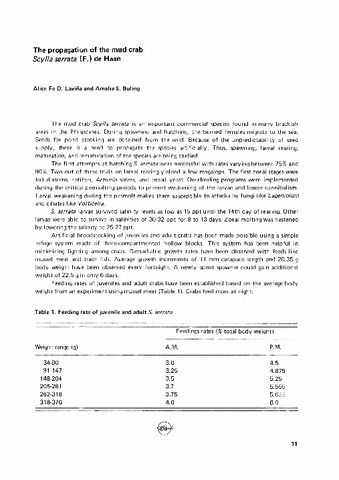
The propagation of the mud crab Scylla serrata (F.) de Haan
(Aquaculture Department, Southeast Asian Fisheries Development Center, 1977)The mud crab Scylla serrata is an important commercial species found in many brackish areas in the Philippines. During spawning and hatching, the berried females migrate to the sea. Seeds for pond stocking are obtained from the wild. Because of the unpredictability of seed supply, there is a need to propagate the species artificially. Thus, spawning, larval rearing, maturation, and rematuration of the species are being studied. The first attempts at hatching S. serrata were successful with rates varying between 75% and 90%. Two out of three trials on larval rearing yielded a few megalops. The first zoeal stages were fed diatoms, rotifers, Artemia salina, and bread yeast. Overfeeding programs were implemented during the critical premolting periods to prevent weakening of the larvae and lessen cannibalism. Larval weakening during the premolt makes them susceptible to attacks by fungi like Lagenidium and ciliates like Vorticella. S. serrata larvae survived salinity levels as low as 15 ppt until the 14th day of rearing. Other larvae were able to survive in salinities of 30-32 ppt for 8 to 13 days. Zoeal molting was hastened by lowering the salinity to 25-27 ppt. Artificial broodstocking of juveniles and adult crabs has been made possible using a simple refuge system made of three-compartmented hollow blocks. This system has been helpful in minimizing fighting among crabs. Remarkable growth rates have been observed with feeds like mussel meat and trash fish. Average growth increments of 11 mm carapace length and 20 . 35 g body weight have been observed every fortnight. A newly spent spawner could gain additional weight of 22.5 g in only 6 days. Feeding rates of juveniles and adult crabs have been established based on the average body weight from an experiment using mussel meat. Crabs feed more at night. In another experiment, eyestalk ablation was found to be effective in inducing growth and mating. Aside from hastening the molting process, copulation is induced even among the small crabs (average carapace length = 55 mm). Natural mating lasts about 26 hr. A copulation which lasted for seven days with a break in between was observed. -
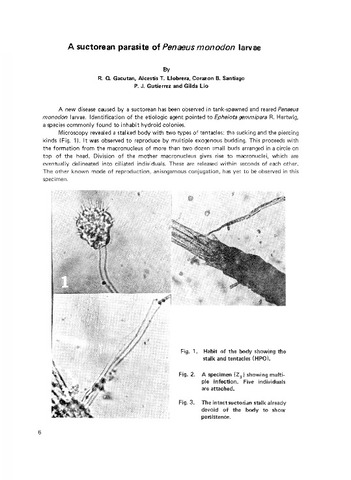
A suctorean parasite of Penaeus monodon larvae
(Aquaculture Department, Southeast Asian Fisheries Development Center, 1977)A new disease caused by a suctorean has been observed in tank-spawned and reared P. monodon larvae. Identification of the etiologic agent pointed to Ephelota gemmipara R. Hertwig, a species commonly found to inhabit hydroid colonies. -
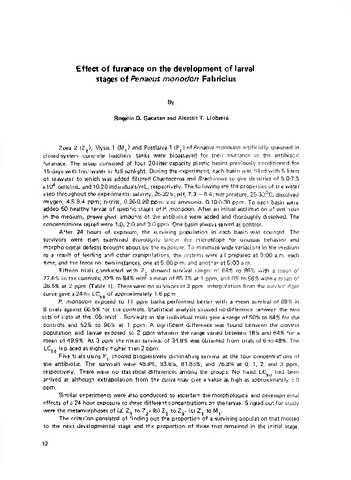
Effect of furanace on the development of larval stages of Penaeus monodon Fabricius
(Aquaculture Department, Southeast Asian Fisheries Development Center, 1977)Zoea 2 (Z2), Mysis 1 (M1) and Postlarva 1 (P1) of P. monodon artificially spawned in closed-system concrete hatchery tanks were bioassayed for their tolerance to the antibiotic furanace. The setup consisted of four 20-liter capacity plastic basins previously conditioned for 15 days with freshwater in full sunlight. During the experiment, each basin was filled with 5 liters of seawater to which was added filtered Chaetoceros and Brachionus to give densities of 5 . 0-7 . 5 x 10⁻⁴ cells/ml and 10-20 individuals/ml, respectively. The following are the properties of the water used throughout the experiments: salinity, 26-32%; pH, 7 . 3-8 . 4; temperature, 25-30 degree C; dissolved oxygen, 4 . 5-8 . 4 ppm; nitrite, 0 . 36-0 . 99 ppm; and ammonia, 0 . 10-0 . 30 ppm. To each basin were added 50 healthy larvae of specific stages of P. monodon. After an initial acclimation of one hour in the medium, preweighed amounts of the antibiotic were added and thoroughly dissolved. The concentrations tested were 1 . 0, 2 . 0 and 3 . 0 ppm. One basin always served as control. After 24 hours of exposure, the surviving population in each basin was counted. The survivors were then examined thoroughly under the microscope for unusual behavior and morphological defects brought about by the exposure. To minimize wide variations in the medium as a result of feeding and other manipulations, the systems were all prepared at 9:00 a.m. each time, and the feeds on two instances, one at 5:00 p.m. and another at 5:00 a.m. Fifteen trials conducted with Z2 showed survival ranges of 68% to 98% with a mean of 77 . 6% in the controls; 32% to 94% with a mean of 65 . 7% at 1 ppm, and 0% to 56% with a mean of 36.5% at 2 ppm. There were no survivors at 3 ppm. Interpolation from the survival-dose curve gave a 24-hr LC50 of approximately 1.6 ppm. -
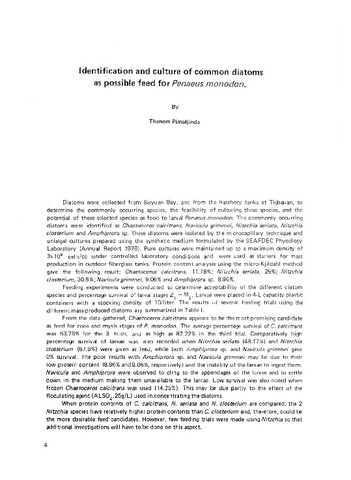
Identification and culture of common diatoms as possible feed for Penaeus monodon
(Aquaculture Department, Southeast Asian Fisheries Development Center, 1977)Diatoms were collected from Buyuan Bay, and from the hatchery tanks at Tigbauan, to determine the commonly occurring species, the feasibility of culturing these species, and the potential of these selected species as food for larval P. monodon. The commonly occurring diatoms were identified as Chaetoceros calcitrans, Navicula grimmei, Nitzchia seriata, Nitzchia closterium and Amphiprora sp. These diatoms were isolated and unialgal cultures prepared. Protein content analysis using the micro-Kjildahl method gave the following result: C. calcitrans, 11 . 78%; Nitzchia seriata, 25%; Nitzchia closterium, 30 . 5%; Navicula grimmei, 9 . 06% and Amphiprora sp. 8 . 96%. Feeding experiments were conducted to determine acceptability of the different diatom species and percentage survival of larval stages Z1 - M2. Larvae were placed in 4-l capacity plastic containers with a stocking density of 10/l. The results of several feeding trials using the different mass-produced diatoms are summarized. From the data gathered, C. calcitrans appears to be the most promising candidate as feed for zoea and mysis stages of P. monodon. The average percentage survival of C. calcitrans was 63 . 76% for the 3 trials, and as high as 82 . 22% in the third trial. Comparatively high percentage survival of larvae was also recorded when Nitzchia seriata (48 . 17%) and Nitzchia closterium (67 . 6%) were given as feed, while both Amphiprora sp. and Navicula grimmei gave 0% survival. The poor results with Amphiprora sp. and Navicula grimmei may be due to their low protein content (8 . 96% and 9 . 06%, respectively) and the inability of the larvae to ingest them. Navicula and Amphiprora were observed to cling to the appendages of the larvae and to settle down in the medium making them unavailable to the larvae. Low survival was also noted when frozen C. calcitrans was used (14 . 25%). This may be due partly to the effect of the floculating agent (ALSO4.25 g/l) used in concentrating the diatoms. When protein contents of C. calcitrans, N. seriata and N. closterium are compared, the 2 Nitzchia species have relatively higher protein contents than C. calcitrans and, therefore, could be the more desirable feed candidates. However, few feeding trials were made using Nitzchia so that additional investigations will have to be done on this aspect. -
Effect of nitrite, ammonia, and temperature on P. monodon larvae
(Aquaculture Department, Southeast Asian Fisheries Development Center, 1977)P. monodon larvae were studied for the effects of temperature, ammonia, and nitrite on survival. Toxicity levels of nitrite were found to vary with larval stage. Larvae could tolerate ammonia up to about 10 ppm, with the effect more clearly shown by the zoea stage. Survival and growth were not significantly affected by temperature, although moulting was enhanced at temperatures higher than 29°C. Larvae of P. monodon have lower tolerance toward nitrite and ammonia compared to postlarvae. Although high survival was obtained at low levels of nitrite and ammonia, it is still necessary to know their effects on metabolism, in order to examine possible biochemical parameters for diagnosing sublethal toxicity or stress. -
Isolation and culture in artificial media of Lagenidium from Penaeus monodon larvae
(Aquaculture Department, Southeast Asian Fisheries Development Center, 1977)Fungal infection of P. monodon larvae is a problem in hatchery operations. The fungus, which attacks the nauplius to postlarval stages and causes up to 100% mortality, has been tentatively identified as belonging to the genus Lagenidium. This pathogenic organism has recently been isolated and cultured. A description is given of the fungus, and features of its biology and pathology are discussed. -
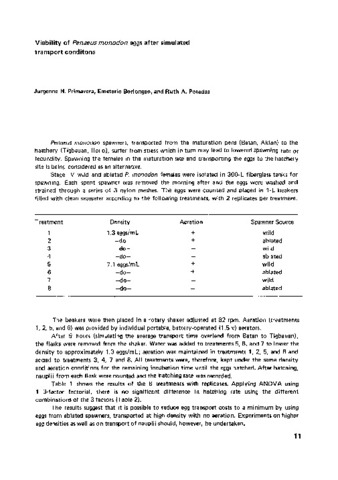
Viability of Penaeus monodon eggs after simulated transport conditions
Primavera, Jurgenne; ; (Aquaculture Department, Southeast Asian Fisheries Development Center, 1977)
P. monodon spawners, transported from maturation pens suffer from stress which in turn may lead to lowered spawning rate or fertility. Spawning the females in the maturation site and transporting the eggs to the hatchery site is being considered as an alternative. Egg transport costs may be reduced to a minimum by using eggs from ablated spawners, transported at high density with no aeration. Experiments on higher egg densities as well as on transport of nauplii should, however, be undertaken. -
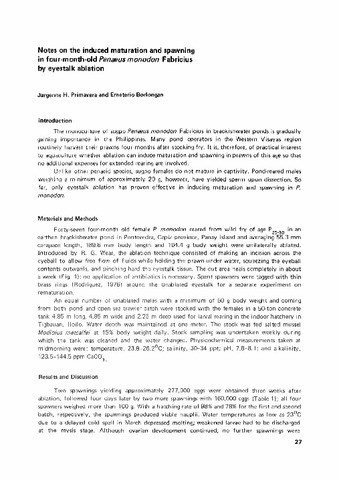
Notes on the induced maturation and spawning in four-month-old Penaeus monodon Fabricius by eyestalk ablation
Primavera, Jurgenne; (Aquaculture Department, Southeast Asian Fisheries Development Center, 1977)
The ablation technique consisted of making an incision across the eyeball to allow free flow of fluids while holding the prawn under water, squeezing the eyeball contents outwards, and pinching hard the eyestalk tissue. The cut area heals completely in about a week; no application of antibiotics is necessary. Spent spawners were tagged with thin brass rings (Rodriguez, 1976) around the unablated eyestalk for a separate experiment on rematuration. Two spawning yielding approximately 277,000 eggs were obtained three weeks after ablation, followed four days later by two more spawnings with 160,000 eggs; all four spawners weighed more than 100 g. With a hatching rate of 98% and 78% for the first and second batch, respectively, the spawnings produced viable nauplii. Water temperatures as low as 23°C due to a delayed cold spell in March depressed molting; weakened larvae had to be discharged at the mysis stage. Although ovarian development continued, no further spawnings were obtained due mainly to the onset of bacterial and fungal disease. Infection is initiated in injured portions of the exoskeleton, sometimes penetrating right through the muscles to the ovarian tissues. The non-flowthrough conditions and mussel meat feeding led to fouling of the culture water resulting in consecutive mortalities caused by disease. Female P.monodon held in maturation pens were ablated at the age of 15 months (Santiago, et al., 1976); they averaged only 16 g body weight after four months growth in ponds. In another experiment, pond-reared P.monodon females ranging from 50 to 80 g were ablated at approximately seven months (Aquacop, 1977). The present results show a minimum age of four months from postlarve that P.monodon is capable of ovarian development and spawning upon ablation. However, maturation is probably affected by size as well as age - the four-month old females weighed an average of 100 g in contrast to the smaller animals in the earlier experiments. -
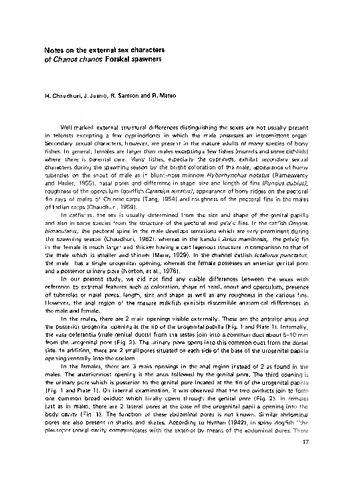
Notes on the external sex characters of Chanos chanos Forskal spawners
(Aquaculture Department, Southeast Asian Fisheries Development Center, 1977)In this study, the authors did not find any visible differences between the sexes with reference to external features such as coloration, shape of head, snout and operculum, presence of tubercles or nasal pores, length, size and shape as well as any roughness in the various fins. However, the anal region of the mature milkfish exhibits discernible anatomical differences in the male and female. In the males, there are 2 main openings visible externally. These are the anterior anus and the posterior urogenital opening at the tip of the urogenital papilla. Internally, the vasa deferentia (male genital ducts) from the testes join into a common duct about 5-10 mm from the urogenital pore. The urinary pore opens into this common duct from the dorsal side. In addition, there are 2 small pores situated on each side of the base of the urogenital papilla opening ventrally into the coelom. In the females, there are 3 main openings in the anal region instead of 2 as found in the males. The anteriormost opening is the anus followed by the genital pore. The third opening is the urinary pore which is posterior to the genital pore located at the tip of the urogenital papilla. -
Bioenergetics of the freshwater prosobranch Idiopoma angularis Muller in Laguna de Bay
(Aquaculture Department, Southeast Asian Fisheries Development Center, 1977)This study was made as an attempt to investigate some of the ecological aspects of the freshwater snail Idiopoma angularis Muller in a modern framework of energy flow and mathematical models. It offers the first investigation of respiration (as related to temperature and body size), production (growth), and excretion in the prosobranch I. angularis in Laguna Lake. -
Effect of temperature on the oxygen consumption of Penaeus monodon postlarvae
(Aquaculture Department, Southeast Asian Fisheries Development Center, 1977)Extended abstract only. -
Biology and farming of the green mussel Mytilus smaragdinus
(Aquaculture Department, Southeast Asian Fisheries Development Center, 1977)Biological investigations were carried out in Sapian Bay, Capiz from November 1975 to December 1976 with samplings conducted fortnightly. Histological studies on the gonad reveal a high percentage of ripe and spent females during the month of April and May, and ripe to near ripe during November to December. However, larval counts were highest on February 25, 1976 with 253 mytilid larvae per haul compared to 0-79 per haul during all other months. The high larval count was followed by the highest spat settlement during the next sampling period two weeks later, with the spat collector set in the water during the February 25 sampling. The four materials tested, blue polypropylene fiber rope, black polypropylene fiber, and coir rope, all had their highest spat counts during this period with an average of 471 spats per standard 10 cm rope piece. The range during the other time periods is 2-283 spats. Of the 4 materials tested, the black fibrillated polypropylene film had the highest larval counts in 15 out of a total of 25 sampling periods. The blue rope was the poorest spat collector. Coconut husk was tested later on and it proved to have a very high catchability, with spats completely enveloping the husk surface. Growth monitored from one cohort in Sapian Bay averaged 10 mm per month. 50-60 mm is considered marketable size. Trial growth experiments with transplanted mussels were also conducted at Igang Bay in Guimaras Island, Makato River in Aklan, and a milkfish pond in Leganes, Iloilo. Survival in Igang was less than 50% after the second week, and the condition of the surviving mussels can be described only as watery with the mantle completely transparent. Mortality was minimal in Makato but the growth rate was only 30% that of Sapian Bay. The pond experiments were terminated due to severe crab predation.