Conference Proceedings: Recent submissions
Now showing items 1-20 of 767
-
Understanding current challenges and future prospects in Integrated Multi-trophic Aquaculture (IMTA) research. Proceedings of the JIRCAS-SEAFDEC/AQD Joint Workshop on IMTA research held at SEAFDEC/AQD, Tigbauan Main Station, Iloilo, Philippines on 6-8 August 2019
(Aquaculture Department, Southeast Asian Fisheries Development Center; Japan International Research Center for Agricultural Sciences, 2022-07)This proceeding is a compilation of the 10-year achievements in IMTA research conducted by JIRCAS and SEAFDEC/AQD researchers and their collaborators, covering topics such as ecological characterization of target species, ... -
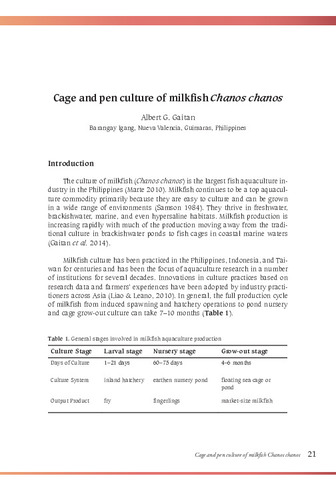
Cage and pen culture of milkfish Chanos chanos
(Aquaculture Department, Southeast Asian Fisheries Development Center; Japan International Research Center for Agricultural Sciences, 2022-07) -
IMTA as a possible countermeasure for reduced aquaculture productivity in Japan
Watanabe, Satoshi ; ; ; Hasegawa, Natsuki ; (Aquaculture Department, Southeast Asian Fisheries Development Center; Japan International Research Center for Agricultural Sciences, 2022-07)
-
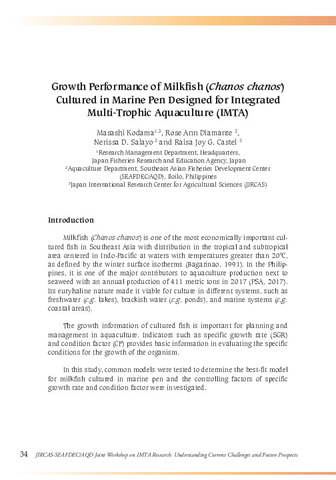
Growth performance of milkfish (Chanos chanos) cultured in marine pen designed for integrated multi-trophic aquaculture (IMTA)
(Aquaculture Department, Southeast Asian Fisheries Development Center; Japan International Research Center for Agricultural Sciences, 2022-07)In this study, common models were tested to determine the best-fit model for milkfish cultured in marine pen and the controlling factors of specific growth rate and condition factor were investigated. -
Environmental impact and growth performance of IMTA species in marine pen culture system
(Aquaculture Department, Southeast Asian Fisheries Development Center; Japan International Research Center for Agricultural Sciences, 2022-07)In this study, locally available marine species were tested, milkfish (Chanos chanos) as the fed species, seaweed (Kappaphycus alvarezii) as inorganic-extractive species for the water column, and sandfish (Holothuria scabra) as organic-extractive species on the sediments. This study aims to verify and improve IMTA systems suitable for farm conditions in coastal areas in the Philippines, with emphasis on mitigating the environmental impacts of mariculture of milkfish. -
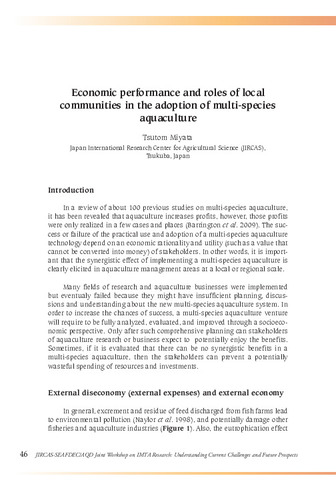
Economic performance and roles of local communities in the adoption of multi-species aquaculture
Miyata, Tsutom (Aquaculture Department, Southeast Asian Fisheries Development Center; Japan International Research Center for Agricultural Sciences, 2022-07)
-
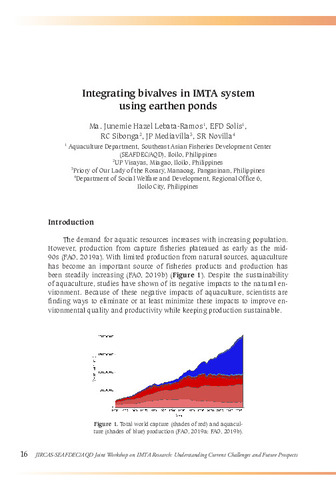
Integrating bivalves in IMTA system using earthen ponds
Lebata-Ramos, Ma. Junemie Hazel; Solis, Ellen Flor ; Sibonga, Rema ; ; (Aquaculture Department, Southeast Asian Fisheries Development Center; Japan International Research Center for Agricultural Sciences, 2022-07)
This study aimed to integrate the mangrove clam Anodontia philippiana, which has the capacity to assimilate sulfide in a pond culture system with milkfish Chanos chanos and seaweeds Gracilariopsis heteroclada. Specifically, it aimed to know the effects of integrating other commodities on the growth and survival of milkfish, the primary culture species in IMTA in ponds. -
Small-scale IMTA of milkfish in pens: The Pandaraonan, Guimaras, Philippines experience
(Aquaculture Department, Southeast Asian Fisheries Development Center; Japan International Research Center for Agricultural Sciences, 2022-07)This study examines IMTA as an option for small-scale fish farmers to grow multiple species in the same area in the coastal waters of Barangay Pandaraonan in Nueva Valencia, Guimaras, Philippines. The study aimed to explore the feasibility of an economically profitable IMTA system where milkfish are grown with sandfish and seaweeds. -
Sandfish biology and ecology: Prospects and challenges for IMTA in the tropics
Altamirano, Jon (Aquaculture Department, Southeast Asian Fisheries Development Center; Japan International Research Center for Agricultural Sciences, 2022-07)
-
Evaluation of livelihood assets in community-based on-farm demonstration of IMTA in milkfish mariculture in Guimaras, Philippines
(Aquaculture Department, Southeast Asian Fisheries Development Center; Japan International Research Center for Agricultural Sciences, 2022-07)This study showed the need to develop the livelihood assets of rural communities to enable them to engage in aquaculture-based income generating activities. The SLA evaluation showed that the benefits in terms of its contribution to livelihood asset build-up is generally positive. While human, social and environmental capacities were improved, the financial and physical assets were dissipated and insufficient for many stakeholders with keen interest to participate in the communal project. Therefore, the recommendation is to organize more and bigger collaborative projects, such as this IMTA of milkfish, with emphasis on sustainable livelihood asset development to create significant economic impact to target beneficiaries. -
Gracilariopsis heteroclada as an extractive species in an aquaculture system
Luhan, Maria Rovilla (Aquaculture Department, Southeast Asian Fisheries Development Center; Japan International Research Center for Agricultural Sciences, 2022-07)
The study was conducted within the integrated finfish broodstock facility complex of SEAFDEC/AQD at Tigbauan, Iloilo, Philippines. The broodstock facility has a water recirculating system. The 500-ton capacity broodstock/spawning tanks were stocked with 25 grouper (Epinephelus coioides) and 90 milkfish (Chanos chanos) breeders. Water from the broodstock tanks passes through the sedimentation tank, then through the filter tank before it goes back to the broodstock tanks. The filter tank has an area of 20 m2, a water depth of 25 cm, and a water flow rate of 43 L sec-1 (≈3720 m3 day-1). -
Overview and history of IMTA, from ancient to modern times
(Aquaculture Department, Southeast Asian Fisheries Development Center; Japan International Research Center for Agricultural Sciences, 2022-07) -
Establishment of threshold infection levels of WSSV in different weight ranges of Penaeus vannamei using quantitative PCR (qPCR)
(Aquaculture Department, Southeast Asian Fisheries Development Center, 2021-12)Threshold infection level is the pathogen load of the test animals measured before the appearance of clinical signs and mortality. This study aims to establish the threshold infection levels of WSSV in different weight ranges of Penaeus vannamei using qPCR. Artificial infection experiments were conducted using four weight ranges (3–5 g, 7–8 g, 15–18 g, and 22–25 g). The LD50 of the different weight ranges of shrimps were achieved at viral dilution of 10-6 and 10-5 after 216–240 hpi, and the viral loads of these inoculums have a range of 105–106 WSSV DNA copies/g. The viral loads of the samples in the timecourse infection experiments when the mortalities started was determined at 109 WSSV DNA copies/g, while for the survivors was at 106 WSSV DNA copies/g. The threshold infection level of WSSV in shrimp was determined at 107 to 108 WSSV DNA copies/g. It was also found out that the threshold infection level was not weight dependent. -
Research update on emergent shrimp pathogens in Thailand
(Aquaculture Department, Southeast Asian Fisheries Development Center, 2021-12)Recent evidence suggest that the emergent microsporidian, Enterocytozoon hepatopenaei (EHP) is a component cause of white feces syndrome (WFS) in shrimp. The natural WFS shrimp were found to be infected with EHP. At the laboratory level, shrimp induced to be heavily infected with EHP showed no WFS symptom suggesting that the causes of WFS is complex involved with other cause, not only EHP. The other component causes are under investigation. Better understanding of virulence mechanism of EHP infection in shrimp will assist in establishing innovative strategies to reduce its viability and potential infectivity in shrimp farms. Transmission of microsporidia is involved ingestion of spores in the water and the site of initial infection being the gastrointestinal tract. EHP spore is having a thick, protective chitinous wall around the cell membrane that allows them to survive outside their hosts and involve with the microsporidian pathogenesis. Here we describe successful purification of active EHP spores with a novel spore viability assay based on polar-tube extrusion or germination triggered by Phloxin B. The physical conditions such as temperature and PH, and chemical factors such as KMnO4, and chlorine that affect spore germination were examined as a practical guideline for the inactivation of the spores at a farm level. The potential environmental reservoir of EHP were found to be a mussel of the genus Mytilopsis, which is found frequently in the water canal or pipe in the shrimp rearing system. Recent evidence demonstrates that the mussel can be infected by EHP and can transmit EHP to shrimp in the laboratory model. -
Acute hepatopancreatic necrosis disease (AHPND)) and hepatopancreatic microsporidiosis (HPM):): Two threats to sustainable shrimp aquaculture
(Aquaculture Department, Southeast Asian Fisheries Development Center, 2021-12)Infectious diseases caused by viruses and bacteria are a major threat to sustainable shrimp farming globally. Since early 80’s viral diseases such as White Spot Disease, Taura Syndrome disease have caused enormous losses to shrimp aquaculture both in eastern and western hemisphere. As the shrimp industry tried to recover from the onslaught of these diseases, a bacterial, Acute Hepatopancreatic Necrosis Disease (AHPND), also known as Early Mortality Syndrome, and a fungal disease Hepatopancreatic Microsporidiosis (HPM) caused by Enterocytozoon hepatopenaei (EHP) are now posing new threat to shrimp aquaculture. Acute Hepatopancreatic Necrosis Disease is caused by Vibrio spp. expressing plasmidborne binary toxins, PirA and PirB that is similar to entomopathogenic bacterium, Photorhabdus encoded toxin. In 2009, AHPND emerged in China and since then spread to many countries in East Asia and in the Americas. Another disease that has caused alarm in recent year is Hepatopancreatic Microsporidiosis (HPM) caused by Enterocytozoon penaei (EHP), a microsporidium. While AHPND causes acute infection and large-scale mortalities, EHP causes chronic infection and results growth retardation and size variation in population reducing marketability of the infected shrimp. Both diseases affect hepatopancreas, an organ involved in metabolism and humoral immunity in shrimp. The binary toxin, PirA/ PirB are the primary virulence factor for AHPND, but specific virulence factor(s) for EHP is not known. It is, however, known that EHP does not have mitochondria and appears to transport ATP from the cytoplasm of infected cells as it contains ATP transporter genes in its genome. EHP has been shown to be a risk factor for AHPND. Due to lack of therapeutics, preventative measures remain as a corner stone for managing these diseases and efforts are underway to develop genetically improved lines of shrimp having resistance to AHPND and EHP. -
Department of Animal Health (DAH) report of emergency diseases - prevention and control of shrimp diseases in from 2016 to 2018
(Aquaculture Department, Southeast Asian Fisheries Development Center, 2021-12)Acute Hepatopancreatic Necrosis Disease (AHPND), known as Early Mortality Syndrome (EMS) before 2013, was first reported in Vietnam from the Mekong River Delta without laboratory confirmation in the end of 2010. Vibrio parahaemolyticus was recognized as the causative agent of AHPND reported by Dr. Tran Loc in 2013. From 2010 to 2015, AHPND spread quickly to a wide range of shrimp production areas in Viet Nam. White Spot Disease (WSD), in dual infection with AHPND, cause serious disease, each year nearly 1 % in total culture area stopped operation. Although the diseases decreased significantly from 2013 to 2018, AHPND and WSD are still the most serious problem encountered by shrimp farmers in main shrimp production areas. Both tiger shrimp (Penaeus monodon) and whiteleg shrimp (Litopenaeus vannamei) have been infected with AHPND and WSD; most cases occur 15–60 days after stocking. AHPND and WSD occur year round; however, it is most frequently observed between March to September. Vietnam has alleviated the effect of AHPND and WSD effectively in the current year. This can be attributed to the application of multiple solutions to prevent and control AHPND and WSD such as (1) improve farmers’ production conditions, awareness, facilities and bio-security measures; (2) implement active surveillance in main shrimp production areas for early warning; (3) broodstock and postlarvae are not accepted if positive for any OIE listed diseases; (4) movement control to prevent spreading disease; (5) encourage developing disease-free farms; (6) improve capacities and complete aquatic animal health system. -
Report of aquatic animal diseases in Thailand during January – June 2019
(Aquaculture Department, Southeast Asian Fisheries Development Center, 2021-12)Aquaculture is an important industry in Thailand which has been established more than two decades ago. The cultured species are divided into two main groups; shrimp and finfish farming. The major cultured shrimp species are Penaeus vannamei (Pacific white shrimp), P. monodon (black tiger shrimp) and Macrobrachium rosenbergii (giant freshwater prawn), whereas the finfish are Oreochromis sp., Lates calcarifer and Epinephelus sp. Also, ornamental fish such as Cyprinus carpio (Koi carp), Carassius spp. (goldfish), and Betta splendens (fighting fish or betta). Disease outbreaks are the key factor that affect Thailand’s aquaculture production and resulting in economic losses. The infectious diseases in aquaculture are mainly caused by viral and bacterial pathogens. In 2018, the reported shrimp pathogens are white spot syndrome virus (WSSV), yellow head virus (YHV) genotype 1, Taura syndrome virus (TSV), infectious hypodermal and haematopoietic necrosis virus (IHHNV), Vibrio parahaemolyticus causing acute hepatopancreatic necrosis disease (VPAHPND), and microsporidian Enterocytozoon hepatopenaei (EHP). On the other hand, the reported pathogens in finfish are Betanodavirus causing viral nervous necrosis (VNN), Tilapia lake virus (TiLV) and Streptococcus sp. etc. In Thailand, the Department of Fisheries (DOF) is the competent authority for various aspects of aquatic animals including aquatic animal health. Strategies to prevent and control diseases in aquatic animals include issuance of legislations/regulations, implementation of biosecurity measures, disease surveillance programs, capacity building, cooperation with international and national organizations. Moreover, DOF has developed contingency plan in dealing with aquatic animal disease emergencies through the provincial fisheries officer. The provincial fisheries officer acts as director of emergency aquatic animal disease control center in each province, while Aquatic Animal Health Research and Development Division (AAHRDD) and Songkhla Aquatic Animal Health Research and Development Center (SAAHRC) serve as disease diagnosis and laboratory testing centers. Because of the above actions, we are capable of preventing and controlling disease outbreaks in the country. But during the occurrence of some diseases, we have no treatment to support and completely solve the problem. Example are viral diseases, unlike bacterial diseases which can be treated by using chemical or drug. Furthermore, there are a few researches that could be applied in farm level. Especially shrimp which has no adaptive immunity, so it is difficult to develop vaccine compare to fish. Therefore, DOF mostly recommended farmers to follow the good management practices on aquatic animal health for promoting sustainable aquaculture. -
Country report - Singapore
(Aquaculture Department, Southeast Asian Fisheries Development Center, 2021-12)The aquaculture industry produces about 10 % of Singapore’s annual local fish consumption. By 2030, the country’s goal is for the agri-food industry to produce 30 % of Singapore’s nutritional needs. In order to achieve this, the Marine Aquaculture Centre (MAC) spearheaded several research and development programmes such as the broodstock development of Asian seabass and large-scale fry production technology. MAC also provides technical support to local farms to adopt sustainable farming practices and technology. In 2019, the Singapore Food Agency (SFA) was formed to oversee all matters pertaining to food supply and safety, including seafood production from aquaculture. The National Centre for Food Safety (NCFS) of SFA and Centre for Animal and Veterinary Services (CAVS) under National Parks Board (NParks) provides support via their diagnostic and testing capabilities in the areas of food safety and animal health, respectively. Based on the national surveillance program conducted by the SFA and NParks, the commonly reported diseases are viral, bacterial or parasitic infections. These include Benedeniosis, Big-Belly (BB) Disease Syndrome, infections with Streptococcus iniae and Tenacibaculum maritimum, Norcardiosis, Viral Nervous Necrosis (VNN), and Infectious Spleen and Kidney Necrosis Virus (ISKNV). With the aim to control and manage the aquatic diseases in Singapore, control measures for major pathogens in fin fishes and crustaceans are being implemented. In addition, Aquatic Animal Health Professionals (AAHP) should undergo trainings in aquaculture farm biosecurity. -
Status of aquatic animal health in the Philippines
(Aquaculture Department, Southeast Asian Fisheries Development Center, 2021-12)The national aquatic animal disease surveillance and reporting system is implemented by the Bureau of Fisheries and Aquatic Resources in coordination with other recognized laboratories. It covers the OIE/NACA listed diseases particularly those that cause major problems in aquaculture. The fisheries laboratories continuously enhance their capabilities to support the surveillance activities, controls on transboundary movement of aquatic animals, and provide services to the fish farmers. Programs are implemented to strengthen the aquatic animal health services in the country. Promotion of Good Aquaculture Practice and implementation of biosecurity measures are being done to prevent disease occurrences. Collaboration with other institutions on aquatic animal health programs are also established. The paper provides the information on the country’s status on aquatic animal health management. -
Aquatic animal health in Myanmar
(Aquaculture Department, Southeast Asian Fisheries Development Center, 2021-12)In 2010, several viruses infected Penaeus monodon in the ponds of Myanmar. This includes the White Spot Syndrome Virus (WSSV) which causes the White Spot Disease (WSD). In addition, Taura Syndrome Virus (TSV) and Infectious Hypodermal and Haematopoietic Virus (IHHNV) were detected in P. monodon samples from Ayeyarwaddy Region (western part of Myanmar). In 2014, the Yellowhead Virus (YHV) was also detected in shrimp samples for export. The occurrence of these shrimp diseases has resulted to a devastation of the shrimp industry in Myanmar. Because of this, most of the shrimp farmers have shifted to extensive or traditional shrimp farming. The Aquatic Animal Health and Disease Control Section (AAHDCS) of the Department of Fisheries (DoF) is responsible for formulating action plans to control and prevent aquatic animal diseases. Thus, in order to be updated with the latest techniques on disease detection and management of emerging diseases, the AAHDCS should improve the capacity of the departmental personnel, upgrade the laboratory equipment, and improve the facilities.