タイトル のブラウズ: Books
1-20 / 142
-
50 years of DOST, 30 annual meetings of NAST
(Aquaculture Department, Southeast Asian Fisheries Development Center, 2010)First emailed to senior officials and faculty members of the University of the Philippines, science organizations and institutions in the Philippines and abroad, columnists and other media people, and the Philmarsci ... -
Adapting to climate change through research and education
(Aquaculture Department, Southeast Asian Fisheries Development Center, 2010)Plenary Lecture, CHED National Conference on Research in Higher Education, Davao City, Philippines, 12-13 November 2009. -
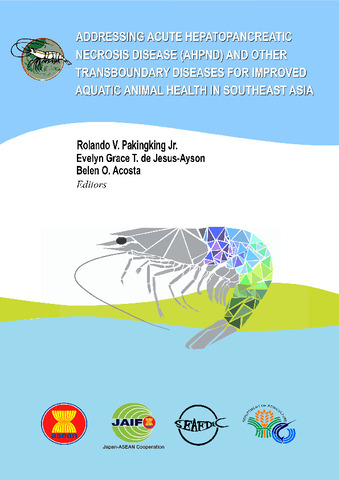
Addressing acute hepatopancreatic necrosis disease (AHPND) and other transboundary diseases for improved aquatic animal health in Southeast Asia: Proceedings of the ASEAN Regional Technical Consultation on EMS/AHPND and Other Transboundary Diseases for Improved Aquatic Animal Health in Southeast Asia, 22-24 February 2016, Makati City, Philippines
(Aquaculture Department, Southeast Asian Fisheries Development Center, 2016) -
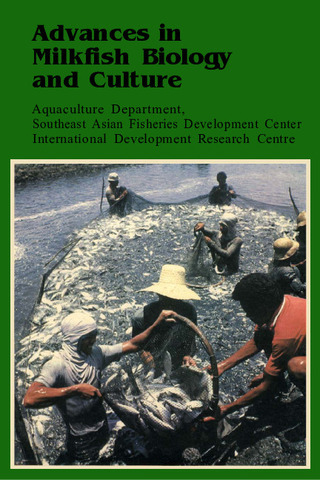
Advances in milkfish biology and culture: proceedings of the Second International Milkfish Aquaculture Conference, 4-8 October 1983, Iloilo City, Philippines
(Aquaculture Department, Southeast Asian Fisheries Development Center; International Development Research Centre; Island Publishing House, Inc., 1984)Abstracts of the 17 papers presented at the conference are cited individually in this issue. -
Airing laundry: The value of critical evaluation in science
(Aquaculture Department, Southeast Asian Fisheries Development Center, 2010)Originally published in the Philippine Star on 16 April 2009. Edited and reprinted with permission. -
Aquaculture marketing
(Aquaculture Department, Southeast Asian Fisheries Development Center, 2009) -
Aquafeed: formulation, processing of feed ingredients and feed preparation
(Aquaculture Department, Southeast Asian Fisheries Development Center, 2009) -
Asking good questions
(Aquaculture Department, Southeast Asian Fisheries Development Center, 2010)Originally published in the Philippine Star on 5 February 2009. Edited and reprinted with permission. -
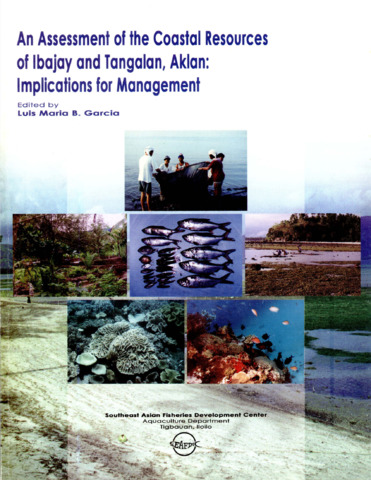
An assessment of the coastal resources of Ibajay and Tangalan, Aklan: Implications for management
(Aquaculture Department, Southeast Asian Fisheries Development Center, 2001)This report describes the present state of marine resources in several coastal barangays of Ibajay and Tangalan, Aklan (Philippines). Field data were obtained from rapid surveys conducted from July to September 1998. Recommendations based on analyses of the data will guide fisherfolk and other stakeholders, particularly the local government units, in their development plans for these neighboring municipalities. Both land and marine products in the area are mainly harvested for the local market. All coastal barangays are dependent on fishing for their livelihood. The medium-scale municipal fishery of Tangalan employs several passive (encircling gill net, bag net, fish corral) and active gears (baby purse seine) compared with the traditional fishing methods employed by Ibajay fishers. Pond aquaculture in mangrove areas is well-developed in Ibajay West (barangays Aquino and Ondoy) and in Tangalan. However, ownership of these ponds is limited to a few individuals and families, unlike in Barangay Bugtong Bato where informal ownership distributed among families has been the traditional rule. Nonetheless, the introduction of so-called environment-friendly methods of utilizing mangroves (e.g., aquasilviculture) and other shared coastal resources may seriously undermine the informal rights-based social structures in the barangays. Without proper rules and enforcement, the application of these methods may be misused, aggravating the already poor overall state of their coastal resources. Major problems affecting their fishing livelihood include siltation of nearshore waters due to illegal deforestation upland, encroachment of municipal fishing grounds by commercial and other fishers elsewhere, and the lack of capital to finance the fishery. Weak inter-organizational links among government and non-government organizations have hampered the implementation of solutions to these common problems in coastal barangays. For instance, a conflict between fishers from these neighboring municipalities over territorial boundaries of common fishing grounds in Pangayawan and Pungtod reefs has not been resolved over the years. Likewise, the introduction of aquasilviculture in mangrove areas may become a potent source of conflict among resource-users who maintain informal rights over the mangrove resource. The overall state of coastal resources in these municipalities is in immediate need of a unified plan to promote both their preservation and conservation. To achieve this end, a joint resource management council representing all resource-users from both municipalities must be organized and convened. To address the presently weak inter-organizational links among existing organizations, this joint council may provide a legitimate forum to identify, resolve, integrate, implement, and enforce guidelines on the common use of resources, both marine and inland. Low estimated yields from the reef fishery, conversion of mangroves for aquaculture beyond the allowable limit, a persistent conflict over fishing rights in several reefs offshore, the limited resources for seaweed and fish mariculture, and threats on existing traditional social structures by progressive resource-users are several issues that require thorough discussions to formulate popularly approved and acceptable management strategies. These strategies include community-based approaches of co-managing resources such as "no-take zones" (sanctuaries), ecotourism development, and livelihood schemes to mitigate, in part, the pressure of over-exploitation of fishery resources. -
Bacterial diseases
Tendencia, Eleonor ; (Aquaculture Department, Southeast Asian Fisheries Development Center, 2010)
Fish and crustaceans that are not weakened by poor environmental conditions, or by other causes, such as parasitic infestation, nutritional deficiency, handling stress, or chemical intoxication, are more resistant to bacterial infections. This is due to the presence of a large amount of bactericidal substances in the blood, which helps overcome infections. So, the best precaution against the occurrence of bacterial infections is to provide the fish with optimum environmental conditions, adequate amounts of the right kinds of food and avoidance of stress, including overcrowding. Vaccination/ immunization and genetic manipulation (i.e., the development of specific pathogen resistant fry) are also some ways of preventing bacterial diseases. The use of antibiotics should always be an option of the last resort.
; (Aquaculture Department, Southeast Asian Fisheries Development Center, 2010)
Fish and crustaceans that are not weakened by poor environmental conditions, or by other causes, such as parasitic infestation, nutritional deficiency, handling stress, or chemical intoxication, are more resistant to bacterial infections. This is due to the presence of a large amount of bactericidal substances in the blood, which helps overcome infections. So, the best precaution against the occurrence of bacterial infections is to provide the fish with optimum environmental conditions, adequate amounts of the right kinds of food and avoidance of stress, including overcrowding. Vaccination/ immunization and genetic manipulation (i.e., the development of specific pathogen resistant fry) are also some ways of preventing bacterial diseases. The use of antibiotics should always be an option of the last resort. -
Bacterial diseases
Tendencia, Eleonor; (Aquaculture Department, Southeast Asian Fisheries Development Center, 2001)
Fish and crustaceans that are not weakened by poor environmental conditions, or by other causes, such as parasitic infestation, nutritional deficiency, handling stress, or chemical intoxication, are more resistant to bacterial infections. This is due to the presence of a large amount of bactericidal substances in the blood, which helps overcome infections. So, the best precaution against the occurrence of bacterial infections is to provide the fish with optimum environmental conditions, adequate amounts of the right kinds of food and avoidance of stress, including overcrowding. Vaccination/ immunization and genetic manipulation (i.e., the development of specific pathogen resistant fry) are also some ways of preventing bacterial diseases. The use of antibiotics should always be an option of the last resort. -
Bacterial isolation, identification and storage
; Tendencia, Eleonor (Aquaculture Department, Southeast Asian Fisheries Development Center, 2004)
Bacterial isolation, purification and identification are the first steps to bacteriological studies. Isolation is done to obtain pure bacterial cultures. Bacteria are usually isolated from fish kidney and spleen; and from the hepatopancreas, lymphoid organ and muscles of shrimp. These tissues are monitor organs that usually harbor the disease-causing bacteria during infection. -
Basic epidemiological concepts for surveillance in aquaculture
(Aquaculture Department, Southeast Asian Fisheries Development Center, 2010) -
Beach forest species and mangrove associates in the Philippines
Primavera, Jurgenne; (Aquaculture Department, Southeast Asian Fisheries Development Center, 2012)
This new publication supported by UNESCO’s Man and Biosphere Programme introduces researchers and the general public to beach forest species and mangroves associates and describes their medicinal, traditional and commercial uses based on recent research and the older, hard-to-access literature. The shorelines and riverbanks of the Philippines were among the first sites opened for human settlement. Not surprisingly, vegetation in the coastal forest was the first to disappear, followed by mangroves and other forest types. Due to their early loss, beach forests are not well studied as other flora and therefore not familiar to the average Filipino. The 2004 Indian Ocean tsunami, and sea-level rise associated with global warming, have highlighted the role of beach forest-mangrove greenbelts in conferring protection on coastal communities. The publication is a collection of 140 species both familiar and poorly known, with around 100 treated exhaustively including scientific names, English names, local/regional names, botanical descriptions and folk uses. -
Series: BRAIS state-of-the-art series; no. 2
Biology and culture of Penaeus monodon
(Aquaculture Department, Southeast Asian Fisheries Development Center, 1988)Abstracts of the 6 chapters included in this publication are cited individually. -
Biology and culture of siganids
(Aquaculture Department, Southeast Asian Fisheries Development Center, 1998)A 53-page monograph updating AQD's 1990 publication of the same title. The book includes siganid morphology, distribution and ecology; reproduction; fisheries; diseases and parasites; genetics. It also covers larval culture; fry and fingerling production; nutrition and feeds; and problem areas in aquaculture. -
Biology of milkfish (Chanos chanos Forsskal)
Bagarinao, Teodora (Aquaculture Department, Southeast Asian Fisheries Development Center, 1991)
An up-to-date account is given of the biology of milkfish (Chanos chanos) under the following chapter headings: Species identity and history; geographic distribution and variation; life history and habitat; food and feeding habits; age, growth and mortality; reproduction; behavior; environmental physiology; and, community relationships. -
Business planning and management for sustainable small-scale rural aquaculture
(Aquaculture Department, Southeast Asian Fisheries Development Center, 2009) -
Celebrating the UP centennial
(Aquaculture Department, Southeast Asian Fisheries Development Center, 2010)First emailed to senior officials and faculty members of the University of the Philippines, science organizations and institutions in the Philippines and abroad, columnists, and other media people in June 2007; and posted ... -
Common edible molluscs of the Philippines: A field guide
(Aquaculture Department, Southeast Asian Fisheries Development Center, 1981)The Molluscs comprise the largest phylum of marine invertebrates, with over 80,000 species described (Barnes, 1974). They are soft-bodied animals, which, in most cases, secrete a protective outer "shell." Two major classes ...