SEAFDEC/AQD Institutional Repository: Recent submissions
Now showing items 1281-1300 of 4221
-
Seagrasses
(Aquaculture Department, Southeast Asian Fisheries Development Center, 2009) -
Mangroves
Lebata-Ramos, Ma. Junemie Hazel L. (Aquaculture Department, Southeast Asian Fisheries Development Center, 2009)
-
Sustainable rural aquaculture: concepts and approaches
(Aquaculture Department, Southeast Asian Fisheries Development Center, 2009)This introductory chapter will discuss principles and concepts on community-based aquaculture. The Regional code of conduct for responsible aquaculture will be part of it. -
Guide to readers
(Aquaculture Department, Southeast Asian Fisheries Development Center, 2009)In the ASEAN region, fisheries play an important role in producing food, generating income, and accelerating national social and economic development. Ironically, the fishing communities are the least benefited from the bounties of the vast fishery resources in the region. To make it worse, the fisherfolk were further marginalized in the development and exploitation of the fishery resources especially in aquaculture during the past decades. In fact, they are now suffering from the destruction of fishery resources caused by illegal and irresponsible fishing and aquaculture practices. Fishery communities are exposed to multiple dimensions of poverty (inadequate services, low level of education, politically poorly organized communities, and vulnerability), which are complicated to solve within a short term. In order to address the grinding poverty among the fisherfolk, access to technology may need to be improved. One way is disseminating the science-based technologies on aquaculture that were developed by SEAFDEC Aquaculture Department after 35 years of research-and-development. Hence, this handbook, which gives fisherfolk communities a lot of options to earn from aquaculture. The important thing though is that this handbook presents the technologies in the context of prudent resource management and resource use such that communities and aquaculture entrepreneurs will make sustainable living and enable future generations to do the same. -
Oil spill
(Aquaculture Department, Southeast Asian Fisheries Development Center, 2006)Text in Hiligaynon and in English. -
The Malalison experience: empowering an island community in west central Philippines
; ; ; Amar, Edgar C.; (Aquaculture Department, Southeast Asian Fisheries Development Center, 2009)
A 64-page booklet that describes SEAFDEC/AQD’s community fishery resources management project from 1991 to 1998 with a post project assessment in 2009. -
Breeding and seed production of the mangrove red snapper
(Network of Aquaculture Centers, 2002) -
Seed production of the crucifix crab Charybdis feriatus
; Quinitio, Emilia T.; (Network of Aquaculture Centers, 2002)
-
Seed production of mud crab Scylla spp.
Quinitio, Emilia T.; ; (Network of Aquaculture Centers, 2002)
Mud crab farming is an important source of income for fish farmers in the Philippines. The expanding export market for mud crab as an alternative for shrimp has led to intensified collection of wild seed for grow-out and has threatened the wild stocks. To ensure the sustainability of crab farming and reduce the fishing pressure on wild stocks, the SEAFDEC Aquaculture Department developed a technology for large-scale production of juvenile mud crabs, Scylla serrata (giant mud crab), S. olivacea (orange mud crab) and S. tranquebarica (purple mud crab). -
Optimum low salinity to reduce cannibalism and improve survival of the larvae of freshwater African catfish Clarias gariepinus
; Bagarinao, Teodora; ; ; ; (Springer Verlag, 2017)
The freshwater African catfish Clarias gariepinus is carnivorous and cannibalistic even during the larval and juvenile stages and this behavior causes economic losses in aquaculture. This study examined for the first time the effect of salinity on cannibalism, survival, and growth of African catfish larvae in the hatchery. Larvae (4 days old, median 7.8 mm TL, 2.8 mg BW) of the African catfish were reared for 21 days at nominal salinity 0, 1, 2, 3, 4, 5, 6, and 7 ppt. After 21 days, they grew to 10–39 mm (median 22 mm) and 10–490 mg (median 90 mg), with no significant difference by salinity treatments. Survival ratios were similarly low (24–31%) at 0, 1, 3, and 7 ppt and significantly higher (49–55%) at 2, 4, 5, and 6 ppt. Cannibalism was significantly lower, 15–30% at 4–6 ppt, than the 40–50% at 0–3 and 7 ppt. Size variation was lower at 4–6 ppt and higher at 0–3 and 7 ppt. We recommend hatchery rearing of African catfish at the optimum low salinity of 4–6 ppt rather than in full fresh water at least up to 21 days. This rearing method fosters larval welfare and improves hatchery production. -
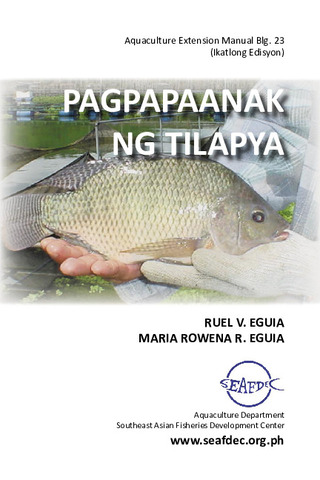
Series: Aquaculture extension manual; No. 23
Pagpapaanak ng tilapya
; Eguia, Maria Rowena R. (Aquaculture Department, Southeast Asian Fisheries Development Center, 2007)
This 52-page revised edition of the 1996 manual, discusses the spawning of tilapia in concrete tank hatcheries, hapa hatcheries in ponds and lakes and the hatchery operations of tilapia. -
Nutritional evaluation of distiller's dried grain with soluble as replacement to soybean meal in diets of milkfish, Chanos chanos and its effect on fish performance and intestinal morphology
Mamauag, Roger Edward; ; (Wiley, 2017)
A 90-day feeding trial was conducted on milkfish, Chanos chanos with an initial mean body weight of 3.07 ± 0.17 g (mean ± standard error of mean). Six treatment diets were formulated to contain 0 g/kg (Diet 1), 150 g/kg (Diet 2), 25 g/kg (Diet 3), 300 g/kg (Diet 4), 350 g/kg (Diet 5) and 450 g/kg (Diet 6) distiller's dried grain with soluble (DDGS). All the dietary treatments were isonitrogenous (350 g/kg crude protein) and isolipidic (6% crude lipid). Result of the feeding trial indicated that growth rates, feed intake and feed efficiency were not significantly (p > .05) affected by inclusion levels of DDGS by up to 450 g/kg in the feed. Proximate body composition (crude protein, crude lipid, ash, fibre) in fish fed the dietary treatments were not significantly (p > .05) affected as well. The DDGS when used as a milkfish ingredient has a protein digestibility of 910 g/kg, fat disgetsibility of 850 g/kg, carbohydrate digestibility of 750 g/kg and a dry matter digestibility of 520 g/kg Results from the intestinal morphology displayed no apparent pathological changes in the digestive tract of fish fed all dietary treatments. These results indicate that DDGS can be efficiently utilized by milkfish by up to 450 g/kg without negatively affecting performance parameters and intestinal morphology. -
Reforming Philippine science
(Aquaculture Department, Southeast Asian Fisheries Development Center, 2010)This book discusses the importance of science as the foundation of technological development and economic progress. It also describes the past and current situation of scientific research in the Philippines. The book also illustrates the usefulness of a properly published scientific research to the entire country. -
Prospects of host-associated microorganisms in fish and penaeids as probiotics with immunomodulatory functions
(Elsevier, 2015)Aquatic animals harbor a great number of microorganisms with interesting biological and biochemical diversity. Besides serving as the natural defense system of the host, the utilization potential of this microbial association has been identified particularly as reservoirs of candidate probiotics. Host-derived probiotics have gained popularity in recent years as they offer an alternative source of beneficial microbes to the industry that is customarily dependent on the use of terrestrial microorganisms. At present, there is an overwhelming number of candidate probiotics in aquaculture but their large-scale application is restricted by bio-technological concerns and fragmentary documented probiotic actions. This paper presents the current understanding on the use of probiotics as a sustainable alternative that promotes health and welfare in fish and penaeids. In particular, this paper discusses the relevance of host microbiota and its potential as a source of candidate probiotics. It also revisits the interaction between probiotics and host immunity to provide the foundation of the immunomodulatory functions of host-derived probiotics. Several studies demonstrating the immunomodulatory capabilities of host-derived candidate probiotics are given to establish the current knowledge and provide avenues for future research and development in this thematic area of probiotics research in aquaculture. -
Colour discrimination in dim light by the larvae of the African catfish Clarias gariepinus
; Bagarinao, Teodora; ; ; (Springer, 2017)
Many demersal fish species undergo vertical shifts in habitats during ontogeny especially after larval metamorphosis. The visual spectral sensitivity shifts with the habitat, indicating a change in colour vision. Colour vision depends on sufficient ambient light and becomes ineffective at a particular low light intensity. It is not known how fishes see colour in dim light. By means of a behavioural experiment on larval African catfish Clarias gariepinus in the laboratory, we determined colour vision and colour discrimination in dim light. Light-adapted larvae were subjected to classical conditioning to associate a reward feed with a green or a red stimulus placed among 7 shades of grey. The larvae learned this visual task after 70 and 90 trials. A different batch of larvae were trained to discriminate between green and red and then tested for the ability to discriminate between these colours, as the light intensity was reduced. The larvae learned this visual task after 110 trials in bright light and were able to discriminate colours, as light was dimmed until 0.01 lx, the minimal illuminance measurable in this study, and similar to starlight. The retinae of the larvae were found to be light adapted at 0.01 lx; thus indicating cone-based colour vision at this illuminance. For comparison, three human subjects were tested under similar conditions and showed a colour vision threshold at between 1.5 and 0.1 lx. For the larvae of C. gariepinus, the ability of colour discrimination in dim light is probably due to its retinal tapetum, which could increase the sensitivity of cones. -
SEAFDEC/AQD highlights 2015
(Aquaculture Department, Southeast Asian Fisheries Development Center, 2016)The SEAFDEC Aquaculture Department is mandated to: 1) conduct scientific research to generate aquaculture technologies appropriate for Southeast Asia; 2) develop managerial, technical and skilled manpower for the aquaculture sector; and, 3) disseminate and exchange aquaculture information. The Aquaculture Department in the Philippines maintains 4 stations: the Tigbauan Main Station and Dumangas Brackishwater Station in Iloilo; the Igang Marine Station in Guimaras; and, the Binangonan Freshwater Station in Rizal. Highlights are provided of the seven research programmes and activities conducted by the department during the year 2015. -
Biological evaluation of frozen zooplankton as food for milkfish (Chanos chanos) fry
(Verlag Paul Parey, 1991)Milkfish fry with an average standard length and weight of 13.88 mm and 3.95 mg, respectively, were reared for 30 days using live and frozen Moina macrocopa and Brachionus plicatilis at feeding densities of 10–20 individuals per ml. Growth, survival and yield were used as indicators of the overall performances of the various treatment groups. Fry fed live M. macrocopa showed gains (both length and weight), growth and survival rates and yields significantly higher than fry fed with other treatment groups (P < 0.05). However, significant reductions in growth and survival rates resulted when fry were fed frozen M. macrocopa. On the other hand, there were no significant differences in growth and survival rates (P < 0.05) in fry fed live or frozen B. plicatilis. The results of the current study showed that although milkfish fry could be grown successfully using B. plicatilis, feeding with live Moina significantly improved growth, survival rate and yield (P < 0.05). Frozen Moina was found to be unsuitable as a feed for rearing milkfish fry because it reduced growth rates and increased mortality. Comparisons between live and frozen rotifers have proven the suitability of frozen rotifers as feed for rearing milkfish fry. By freezing surplus rotifers this would permit short term storage in anticipation of high hatchery demand and overcome any unpredictable failures with live cultures. -
Series: Aquaculture extension manual; No. 34
Biology and hatchery of mud crabs Scylla spp.
Quinitio, Emilia T.; (Aquaculture Department, Southeast Asian Fisheries Development Center, 2008)
This manual includes the biology of mud crab, and describes principles and procedures for spawning the mature crabs (Scylla serrata, S. tranquebarica, and S. olivacea) and rearing the zoea to fly size crabs. It focuses on the hatchery rearing of S. serrata as this species is more economically viable than the two other species. The techniques may be modified depending on the conditions or problems encountered in a specific site. -
Arachidonic acid is a major fatty acid in gonads of coral reef fishes and improves larval survival of rabbitfish Sigunus gutattus
(Nova Science Publishers, 2016)The supply of wild fry of coral reef fishes for aquaculture has resulted in the deterioration of their natural stock status, causing public concern. Through a series of studies on the establishment of artificial-fry production technologies for coral reef fishes, we found that ovary, testis, eggs and fry of coral reef fishes have high or intermediate levels of arachidonic acid (ArA), which is a relatively minor component in temperate and cold-water species. In gonadal polar lipids of selected coral reef, in particular demersal fishes (19 species), ArA, eicosapentaenoic acid (EPA), and docosahexaenoic acid (DHA) levels ranged from 6.0% to 19.4%, from 0.9% to 6.2%, and from 7.9% to 27.8%, respectively. It is notable that the major highly unsaturated fatty acids (HUFA) of polar lipids in all coral reef fish gonads are DHA and ArA (not EPA) in a ratio of about 2:1. This result allowed us to speculate that not only DHA but also ArA may be nutritionally much important for egg development and larval growth in coral reef fishes. Thus, feeding trials were conducted to investigate the effects of dietary ArA supplementation on reproductive performance of coral reef rabbitfish (Siganus guttatus) broodstock. The number of spawning and the number of hatched larvae tended to be better in broodstock fed diets with ArA than in those fed a diet without ArA. Next, larval rearing tests were conducted to investigate survival and growth in rabbitfish fry fed live rotifers which had been enriched with or without ArA. Fry fed the rotifers enriched with a combination of DHA Protein Selco (Inve Aquaculture, Baasrode, Belgium) + 5% ArA (VEVODAR CRUDE ARACHIDONIC OIL, DSM Food Specialties, Delft, the Netherlands) showed significantly the best survival (44.4 ± 4.5% for Day 17 fry), although growth was not different among treatments. The present study indicates that ArA is not a minor component in coral reef fishes, and that dietary ArA is very promising for the improvement of fry production technologies of the coral reef fishes. -
Important diseases of Penaeid shrimps
(National Taiwan Ocean University; The Fisheries Society of Taiwan; Asian Fisheries Society; World Aquaculture Society, 2016)In tropical Asia, the two main species of penaeid shrimps that are widely cultured are the black tiger shrimp (Penaeus monodon) and the Pacific white shrimp (Penaeus (Litopenaeus) vannamei). The former species is indigenous in most Asian countries while the latter is indigenous in the Americas and was introduced to Asian countries in the late 1990s. In this chapter, only details of the economically-important microbial infections in Asia in these two penaeid shrimps are presented and arbitrarily grouped as viral, bacterial, fungal and parasitic diseases. Viral infections are divided further into two groups: DNA viruses; and, RNA viruses. The infections attributed to DNA viruses are: White Spot Disease (WSD) Disease, Penaeus stylirostris densovirus (PstDNV) previously known as Infectious Hypodermal and Hematopoietic Necrosis Virus (IHHNV) Disease, Penaeus monodon densovirus (PmDNV) formerly known as Hepatopancreatic Parvo-like Virus (HPV) Disease and Penaeus monodon nucleopoly-hedrovirus (PemoNPV) previously known as Monodon Baculovirus (MBV) Disease. The shrimp infections caused by RNA viruses are: Yellow Head Virus (YHV) Disease, Taura Syndrome Virus (TSV) Disease, and Infectious Myonecrosis Virus (IMNV) Disease. For bacterial diseases, the list includes Luminous Bacterial Disease, Non-luminous Vibrio Infections, and Acute Hepatopancreatic Necrosis Disease (AHPND). Fungal disease includes Larval mycosis, while parasitic disease includes the current emerging threat to the shrimp industry, the Hepatopancreatic Microsporidiosis caused by Enterocytozoon hepatopenaei (EHP).