SEAFDEC/AQD Institutional Repository: Recent submissions
Now showing items 2201-2220 of 4221
-
Proceedings of the Seminar-Workshop on Aquaculture Development in Southeast Asia and Prospects for Seafarming and Searanching, 19-23 August 1991, Iloilo City, Philippines
(Aquaculture Department, Southeast Asian Fisheries Development Center, 1994)Documents the presentations at ADSEA '91, the 2nd Seminar-Workshop on Aquaculture Development in Southeast Asia. ADSEA '91 includes reviews of the status of the researches conducted by Southeast Asian Fisheries Development Center, Aquaculture Department (SEAFDEC/AQD) on the following cultured species sea bass, groupers, snappers, milkfish, rabbitfish, mullet, tilapia, carp, catfish, bivalves and the seaweed Gracilaria. Topics on aquaculture development in Southeast Asia and Japan were also discussed. The status and development of seafarming and searanching in different SEAFDEC member countries and their ecological, social and economic implications were also presented. The contributions of the selected participants during the meeting which are contained in this volume are cited individually. -
Reducing and managing disaster risk through coastal resource management: A Philippine case
(Asian Fisheries Society, 2013)Recently, disaster risk reduction and management was adopted by the national and local governments in the Philippines to prevent or mitigate the impacts of hazards. As a consequence, the Local Government Units of the coastal municipalities of Guimbal and Tigbauan, Iloilo Province, initiated disaster risk reduction and management activities. It is contended in this article that the condition of coastal and marine resources is fundamental in fostering community resilience to hazards, as exemplified by activities in Guimbal and Tigbauan. However, five major issues that remain to be addressed by the Local Government Units were identified through Key Informant Interviews and Focus Group Discussions. These include the overlapping roles of personnel, poor data management, weak coordination between Local Government Units and communities, lack of comprehensive plans, and a failure to understand the connection between disasters and the management of coastal and marine resources. Policy recommendations are made for amending the disaster risk reduction and management and coastal and marine resources programmes of municipalities. -
Clearance rates and ingestion efficiency of the Japanese scallop Patinopecten yessoensis
Aya, Frolan ; ; (Plankton Society of Japan, 2013)
In coastal ecosystems, variations in food quantity may have significant effects on the clearance and ingestion rates of suspension-feeding bivalves. In this study, clearance rates and ingestion efficiencies were determined for Japanese scallop (Patinopecten yessoensis) juveniles (60.6±4.5 mm in shell height) under laboratory conditions. Scallops were kept individually in glass beakers at 15°C and fed with different cell numbers of Pavlova sp. (0.8 to 57.60×10⁶ cells) to provide a wide range of food quantity as particulate organic carbon (POC). Clearance rates (CR) and ingestion efficiencies (IE) were estimated by monitoring POC concentration over a two-day period, and from 2 to 14 days of feeding, respectively. Both CR and IE were significantly influenced by POC concentration. CR ranged from 15.8 to 38.5 mL ind-1 h-1 (or 8.9 to 49.6 mg Ch-1 g dry weight-1) with maximum values at high POC concentrations. IE varied from 40 to 71% and differed significantly between the lowest (2,900 μg C L-1) and highest (8,000 μg C L-1) food rations. The feeding response of juvenile scallops to different POC concentrations was fitted to a power curve equation: \(\mathsf{IE}\,(\%)=0.9272 \times \mathsf{POC}^{0.5105}, r=0.98\). Extrapolated field-based estimates of IE ranged from 7.8 to 12.7% in response to seasonal changes in POC concentration (64.5 to 168.6 μg C L-1). It is concluded that particle filtration rates by juvenile scallops are related to food quantity, as suggested by both field and laboratory-derived feeding rates.
; ; (Plankton Society of Japan, 2013)
In coastal ecosystems, variations in food quantity may have significant effects on the clearance and ingestion rates of suspension-feeding bivalves. In this study, clearance rates and ingestion efficiencies were determined for Japanese scallop (Patinopecten yessoensis) juveniles (60.6±4.5 mm in shell height) under laboratory conditions. Scallops were kept individually in glass beakers at 15°C and fed with different cell numbers of Pavlova sp. (0.8 to 57.60×10⁶ cells) to provide a wide range of food quantity as particulate organic carbon (POC). Clearance rates (CR) and ingestion efficiencies (IE) were estimated by monitoring POC concentration over a two-day period, and from 2 to 14 days of feeding, respectively. Both CR and IE were significantly influenced by POC concentration. CR ranged from 15.8 to 38.5 mL ind-1 h-1 (or 8.9 to 49.6 mg Ch-1 g dry weight-1) with maximum values at high POC concentrations. IE varied from 40 to 71% and differed significantly between the lowest (2,900 μg C L-1) and highest (8,000 μg C L-1) food rations. The feeding response of juvenile scallops to different POC concentrations was fitted to a power curve equation: \(\mathsf{IE}\,(\%)=0.9272 \times \mathsf{POC}^{0.5105}, r=0.98\). Extrapolated field-based estimates of IE ranged from 7.8 to 12.7% in response to seasonal changes in POC concentration (64.5 to 168.6 μg C L-1). It is concluded that particle filtration rates by juvenile scallops are related to food quantity, as suggested by both field and laboratory-derived feeding rates. -
Series: FAO fisheries and aquaculture technical paper; No. 583
On-farm feed management practices for Nile tilapia (Oreochromis niloticus) in the Philippines
Romana-Eguia, Maria Rowena R.; ; (Food and Agriculture Organization, 2013)
The contribution of the Philippines to tilapia production in Asia has increased steadily in the past five years as it addresses hunger and poverty alleviation in the region. Commercial tilapia aquaculture in the Philippines has improved as farmers have become aware of the importance of adopting innovative husbandry technologies. These include the use of intensive culture, using novel feed ingredients, improving the quality of industrial aquafeeds, adopting cost- effective feeding strategies and efficient pond fertilization methods, and culturing improved genetic strains. A case study was conducted to: a) assess current tilapia feed management practices; b) determine recent nutrition-based innovations that include the use of alternative feed ingredients, the adoption of nutritionally complete commercial tilapia feeds, and improvements to feed management practices; and c) evaluate these factors in terms of improved production efficiencies. Thirty-two farmers from selected tilapia cage hatcheries, pond hatcheries, grow- out cages and ponds in Regions III and IV-A (known major tilapia producing regions in the Philippines) were interviewed. The issues addressed included their farm management practices, with particular focus on tilapia feed preferences; quality, procurement and storage methods; and feeding strategies. Their responses were collated and analysed in the context of information simultaneously gathered from the scientific literature, popular publications and relevant websites. The results from the case study highlight the importance of farmers being trained and remaining well-informed about recent improvements in feed technologies and the use of efficient cost-saving feeding strategies to optimize the production of seed and marketable tilapia. Recommendations on how to increase tilapia production through improved feed and feed management practices are described. Finally, recommendations for local regulatory agencies to implement aquafeed quality and nutrient standards are provided. -
Series: Aquaculture extension manual; No. 50
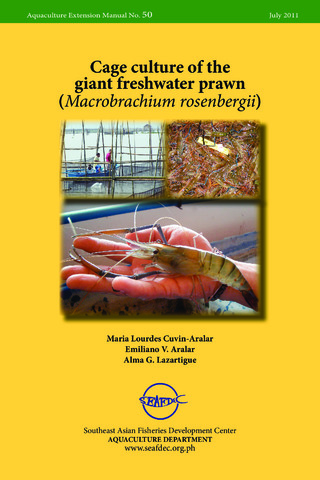
Cage culture of the giant freshwater prawn (Macrobrachium rosenbergii)
(Aquaculture Department, Southeast Asian Fisheries Development Center, 2011)An extension manual describing biology, site requirement, grow-out operations, health management, harvest, post harvest handling and processing, and economic analysis. -
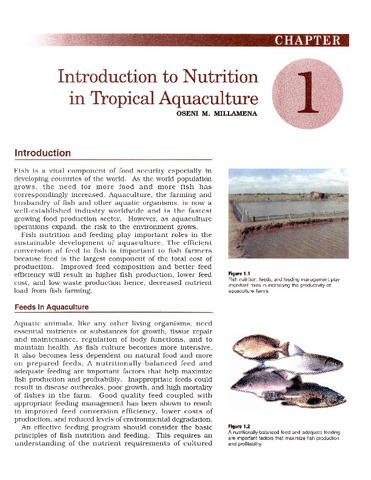
Introduction to nutrition in tropical aquaculture
(Aquaculture Department, Southeast Asian Fisheries Development Center, 2002)Fish is a vital component of food security especially in developing countries of the world. As the world population grows, the need for more food and more fish has correspondingly increased. Aquaculture, the farming and husbandry of fish and other aquatic organisms, is now a well-established industry worldwide and is the fastest growing food production sector. However, as aquaculture operations expand, the risk to the environment grows. Fish nutrition and feeding play important roles in the sustainable development of aquaculture. The efficient conversion of feed to fish is important to fish farmers because feed is the largest component of the total cost of production. Improved feed composition and better feed efficiency will result in higher fish production, lower feed cost, and low waste production hence, decreased nutrient load from fish farming. -
Series: Aquaculture extension manual; No. 49
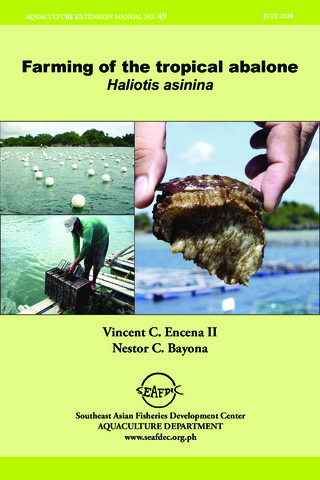
Farming of the tropical abalone Haliotis asinina
(Aquaculture Department, Southeast Asian Fisheries Development Center, 2010)This manual was written to provide abalone growers a practical guide on how to culture abalone based on the studies and trials conducted by SEAFDEC Aquaculture Department. -
Series: Aquaculture extension manual; No. 48
Seed production of sandfish (Holothuria scabra) in Vietnam
(Aquaculture Department, Southeast Asian Fisheries Development Center, 2010)An extension manual describing broodstock management, larval rearing, and management of nursery systems. -
Series: Aquaculture extension manual; No. 47
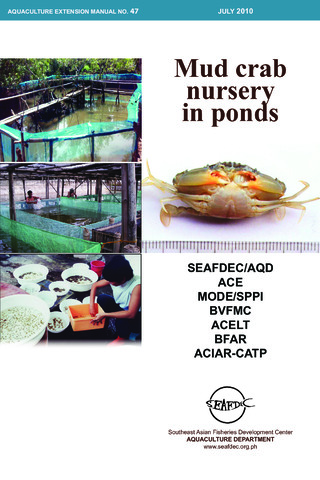
Mud crab nursery in ponds
Quinitio, Emilia T.An extension manual that is highly illustrated, detailing the biology, nursery, harvest, marketing, costs-and-returns of mudcrab nursery in ponds.; ; ; ; ; ; (Aquaculture Department, Southeast Asian Fisheries Development Center, 2010)
-
Series: Aquaculture extension manual; No. 46
Intensive culture of sea bass, Lates calcarifer Bloch, in brackishwater earthen ponds
(Aquaculture Department, Southeast Asian Fisheries Development Center, 2010)An extension manual describing criteria for site selection, monoculture and polyculture operations including feeds and feeding, harvest, common diseases, economic analysis. -
Series: Aquaculture extension manual; No. 44
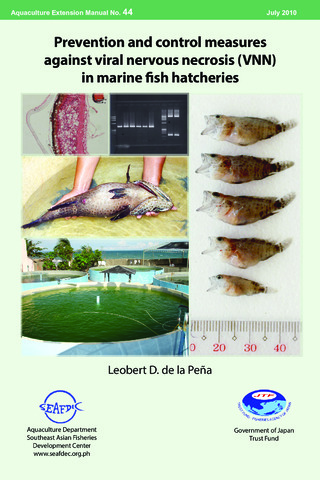
Prevention and control measures against viral nervous necrosis (VNN) in marine fish hatcheries
(Aquaculture Department, Southeast Asian Fisheries Development Center, 2010)An extension manual that describes the clinical signs, behavioral changes, geographical distribution, and species affected by the virus; detection, prevention and control methods especially in the hatchery phase are also included. -
Series: Aquaculture extension manual; No. 43
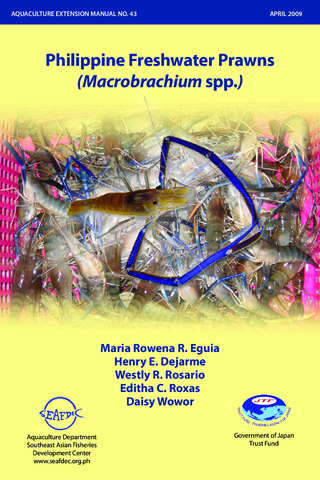
Philippine freshwater prawns (Macrobrachium spp.)
Eguia, Maria Rowena R.; ; ; ; (Aquaculture Department, Southeast Asian Fisheries Development Center, 2009)
This manual provides information on the biology, morphology, natural distribution, habitat, and economic importance of 22 notable species of Macrobrachium in the Philippines. -
Series: Aquaculture extension manual; No. 42
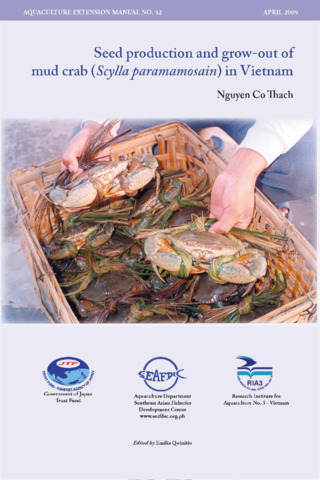
Seed production and grow-out of mud crab (Scylla paramamosain) in Vietnam
(Aquaculture Department, Southeast Asian Fisheries Development Center, 2009)This manual provides information on the biology and techniques in the larval rearing, nursery and grow-out of the mud crab Scylla paramamosain. -
Series: Aquaculture extension manual; No. 40
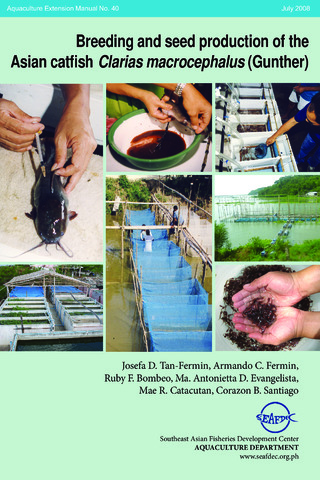
Breeding and seed production of the Asian catfish Clarias macrocephalus (Gunther)
(Aquaculture Department, Southeast Asian Fisheries Development Center, 2008)Among the topics discussed in this 28-page manual are broodstock development and management, hatchery and nursery, health management and financial analyses of the breeding and seed production of the Asian catfish. This manual was published to disseminate science-based aquaculture technologies developed by AQD to assist catfish nursery and hatchery growers in producing high-quality fingerlings. Researchers in the field of fisheries, students and teachers could benefit from the information on the breeding and seed production of this important aquaculture commodity. -
Series: Aquaculture extension manual; No. 39
Abalone hatchery
(Aquaculture Department, Southeast Asian Fisheries Development Center, 2008)This manual contains information on abalone hatchery operation, including site selection, design, culture of natural food, broodstock management, spawning, nursery, packing and transport, and profitability analyses. -
Series: Aquaculture extension manual; No. 38
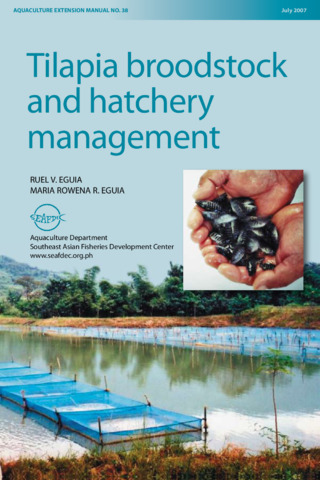
Tilapia broodstock and hatchery management
; Eguia, Maria Rowena R. (Aquaculture Department, Southeast Asian Fisheries Development Center, 2007)
This manual will surely assist tilapia operators and technicians in producing good-quality fry and fingerlings which the industry currently needs. Fisheries researchers, teachers, and students will also find this manual as a good source of basic informarion regarding tilapia broodstock and hatchery management. -
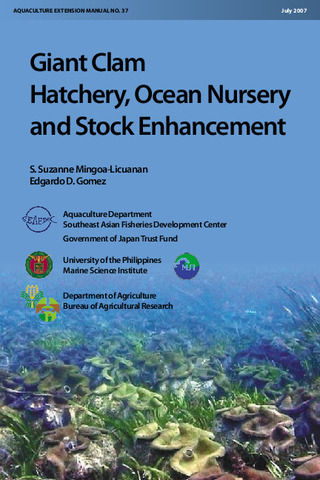
Series: Aquaculture extension manual; No. 37
Giant clam hatchery, ocean nursery and stock enhancement
(Aquaculture Department, Southeast Asian Fisheries Development Center, 2007)This manual is meant to serve as a guide to the culture of giant clams (Bivalvia, Subfamily Tridacninae). The first part focuses on hatchery methods. The second part is about the ocean nursery. The first two sections refer to selection and setting the ocean nursery site. Clam transport is introduced next although this is further tackled in the last part of this manual. Finally, the third and last part discusses the purposes of stock enhancement, survey methods for stock assessment, transport, monitoring and record keeping. -
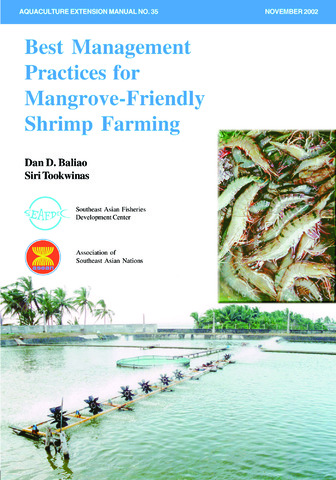
Series: Aquaculture extension manual; No. 35
Best management practices for a mangrove-friendly shrimp farming
(Aquaculture Department, Southeast Asian Fisheries Development Center; Association of Southeast Asian Nations, 2002)This 50-page manual puts together the best practices that SEAFDEC/AQD has developed with the Department of Fisheries in Thailand. These practices include the use of biomanipulators and greenwater system, the use of settling ... -
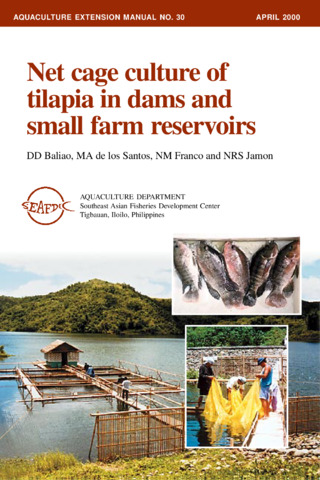
Series: Aquaculture extension manual; No. 30
Net cage culture of tilapia in dams and small farm reservoirs
(Aquaculture Department, Southeast Asian Fisheries Development Center, 2000)The manual describes the net cage of tilapia in dams and small farm reservoirs, which has been found to be a low-cost yet high-income earning farm activity and offers an excellent option as an alternative livelihood for poor inland fisherfolks. The following aspects are covered: 1) Characteristics of a suitable site; 2) Design of the net cages - the floating cage, the stationary/fixed cage; 3) Stocking the net cages - source of juveniles, stocking rate, stocking time, acclimation; 4) Management of the cages - feeds and feeding, monitoring activities; 5) Harvesting - partial harvest, total harvest; and, 6) Profitability analysis. -
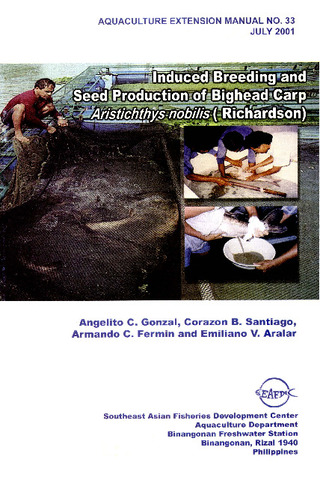
Series: Aquaculture extension manual; No. 33
Induced breeding and seed production of bighead carp Aristichthys nobilis (Richardson)
(Aquaculture Department, Southeast Asian Fisheries Development Center, 2001)A 40-page manual that details the advanced induced spawning technology for Bighead carp developed at SEAFDEC/AQD through the years. This handbook emphasizes the adoption of efficient carp hatchery techniques for optimal ...