SEAFDEC/AQD Institutional Repository: Recent submissions
Now showing items 2081-2100 of 4221
-
Notes on the external sex characters of Chanos chanos Forskal spawners
(Aquaculture Department, Southeast Asian Fisheries Development Center, 1977)In this study, the authors did not find any visible differences between the sexes with reference to external features such as coloration, shape of head, snout and operculum, presence of tubercles or nasal pores, length, size and shape as well as any roughness in the various fins. However, the anal region of the mature milkfish exhibits discernible anatomical differences in the male and female. In the males, there are 2 main openings visible externally. These are the anterior anus and the posterior urogenital opening at the tip of the urogenital papilla. Internally, the vasa deferentia (male genital ducts) from the testes join into a common duct about 5-10 mm from the urogenital pore. The urinary pore opens into this common duct from the dorsal side. In addition, there are 2 small pores situated on each side of the base of the urogenital papilla opening ventrally into the coelom. In the females, there are 3 main openings in the anal region instead of 2 as found in the males. The anteriormost opening is the anus followed by the genital pore. The third opening is the urinary pore which is posterior to the genital pore located at the tip of the urogenital papilla. -
The biology and control of Caligus sp., an ectoparasite of the adult milkfish Chanos chanos Forskal
(Aquaculture Department, Southeast Asian Fisheries Development Center, 1977)One unidentified species of copepod belonging to the genus Caligus of the family Caligidae was found to infest the adult milkfish broodstock. To control the parasites infesting the adult milkfish, tests were made using the chemical (2,2,2-trichloro-1-hydroxyl)-phosphonic acid-dimethylethol (Neguvon) at a concentration of 0.25 ppm. It is noted that a concentration of 0.25 ppm of Neguvon maintained for 12-24 hours in the sabalo-containing tanks in a closed water system but with aeration is effective in controlling the parasites. Fish mortality during the experiment was due to inadequate aeration in the tanks. -
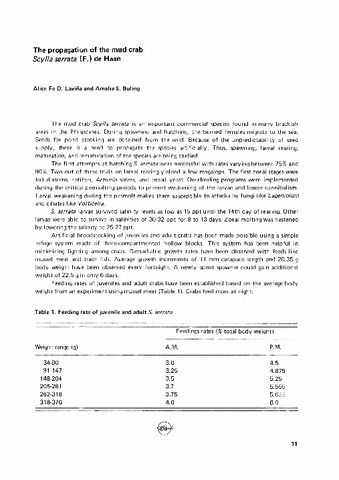
The propagation of the mud crab Scylla serrata (F.) de Haan
(Aquaculture Department, Southeast Asian Fisheries Development Center, 1977)The mud crab Scylla serrata is an important commercial species found in many brackish areas in the Philippines. During spawning and hatching, the berried females migrate to the sea. Seeds for pond stocking are obtained from the wild. Because of the unpredictability of seed supply, there is a need to propagate the species artificially. Thus, spawning, larval rearing, maturation, and rematuration of the species are being studied. The first attempts at hatching S. serrata were successful with rates varying between 75% and 90%. Two out of three trials on larval rearing yielded a few megalops. The first zoeal stages were fed diatoms, rotifers, Artemia salina, and bread yeast. Overfeeding programs were implemented during the critical premolting periods to prevent weakening of the larvae and lessen cannibalism. Larval weakening during the premolt makes them susceptible to attacks by fungi like Lagenidium and ciliates like Vorticella. S. serrata larvae survived salinity levels as low as 15 ppt until the 14th day of rearing. Other larvae were able to survive in salinities of 30-32 ppt for 8 to 13 days. Zoeal molting was hastened by lowering the salinity to 25-27 ppt. Artificial broodstocking of juveniles and adult crabs has been made possible using a simple refuge system made of three-compartmented hollow blocks. This system has been helpful in minimizing fighting among crabs. Remarkable growth rates have been observed with feeds like mussel meat and trash fish. Average growth increments of 11 mm carapace length and 20 . 35 g body weight have been observed every fortnight. A newly spent spawner could gain additional weight of 22.5 g in only 6 days. Feeding rates of juveniles and adult crabs have been established based on the average body weight from an experiment using mussel meat. Crabs feed more at night. In another experiment, eyestalk ablation was found to be effective in inducing growth and mating. Aside from hastening the molting process, copulation is induced even among the small crabs (average carapace length = 55 mm). Natural mating lasts about 26 hr. A copulation which lasted for seven days with a break in between was observed. -
Bioenergetics of the freshwater prosobranch Idiopoma angularis Muller in Laguna de Bay
(Aquaculture Department, Southeast Asian Fisheries Development Center, 1977)This study was made as an attempt to investigate some of the ecological aspects of the freshwater snail Idiopoma angularis Muller in a modern framework of energy flow and mathematical models. It offers the first investigation of respiration (as related to temperature and body size), production (growth), and excretion in the prosobranch I. angularis in Laguna Lake. -
Biology and farming of the green mussel Mytilus smaragdinus
(Aquaculture Department, Southeast Asian Fisheries Development Center, 1977)Biological investigations were carried out in Sapian Bay, Capiz from November 1975 to December 1976 with samplings conducted fortnightly. Histological studies on the gonad reveal a high percentage of ripe and spent females during the month of April and May, and ripe to near ripe during November to December. However, larval counts were highest on February 25, 1976 with 253 mytilid larvae per haul compared to 0-79 per haul during all other months. The high larval count was followed by the highest spat settlement during the next sampling period two weeks later, with the spat collector set in the water during the February 25 sampling. The four materials tested, blue polypropylene fiber rope, black polypropylene fiber, and coir rope, all had their highest spat counts during this period with an average of 471 spats per standard 10 cm rope piece. The range during the other time periods is 2-283 spats. Of the 4 materials tested, the black fibrillated polypropylene film had the highest larval counts in 15 out of a total of 25 sampling periods. The blue rope was the poorest spat collector. Coconut husk was tested later on and it proved to have a very high catchability, with spats completely enveloping the husk surface. Growth monitored from one cohort in Sapian Bay averaged 10 mm per month. 50-60 mm is considered marketable size. Trial growth experiments with transplanted mussels were also conducted at Igang Bay in Guimaras Island, Makato River in Aklan, and a milkfish pond in Leganes, Iloilo. Survival in Igang was less than 50% after the second week, and the condition of the surviving mussels can be described only as watery with the mantle completely transparent. Mortality was minimal in Makato but the growth rate was only 30% that of Sapian Bay. The pond experiments were terminated due to severe crab predation. -
Bacteria from seawater used in Penaeus monodon larval cultures
(Aquaculture Department, Southeast Asian Fisheries Development Center, 1977)Bacteria in the seawater used in P. monodon hatchery operations were isolated on Bachmann's agar. The total plate counts in 25 isolations ranged from 1.0 - 5.0 x 10² to 5.1 -10.0 x 10⁵ cells per ml. Out of 124 isolates, 98 (79 percent) were Gram-positive and 26 (21 percent) were Gram-negative. Micrococcus and Staphylococcus were dominant in the former group, while Acinetobacter, Moraxella, Flavobacterium and Alcaligenes were most numerous in the latter. Twenty-nine of the Gram-positive isolates closely resembled Peptostreptococcus, Planococcus, and Pediococcus. -
Reduction in Chaetoceros populations by furanace
(Aquaculture Department, Southeast Asian Fisheries Development Center, 1977)One of the most promising prophylactic agents being tested to control Penaeus monodon larval diseases is furanace (6-hydroxymethyl-2 2(5-nitro-2-furyl) vinyl pyridine). To evaluate further its suitability as a chemotherapeutic agent, its effects on the population growth of Chaetoceros calcitrans, the diatom used as feed for the zoeal stages, was examined. Chaetoceros populations of uniform density (initial density in all runs: 130-141x10 -3 cells /ml) were placed in nine white, circular (382 sq cm), plastic basins. The physio-chemical characteristics of the culture water were as follows: salinity, 28 . 5-30 . 0 ppt; pH, 8 . 62-8 . 72; temperature, 23-25 . 5 degree C; dissolved oxygen, 7 . 1-9 . 3 ppm; nitrate, 0 . 03-0 . 07 ppm; and ammonia, 0 . 005-0 . 03 ppm. Preweighed furanace granules were dissolved in the culture water, with resulting concentrations of 1 and 2 mg/l (3 replicates each). A set of replicates without furanace served as the control. Population counts of the diatom were taken after 2, 4, 6, 8, and 10 hr exposures. After 4 hr, the population decreased in all three levels. The population in 2 mg/l furanace showed the lowest count and that in control the highest. The population means are not statistically different from one another. The results of the study show that the furanace causes reductions in Chaetoceros population at all durations of exposure. -
Effects of furanace on Brachionus
(Aquaculture Department, Southeast Asian Fisheries Development Center, 1977)Tiger prawn P.monodon) larvae utilize Brachionus a rotifer, as food in the Zoea 3 and mysis stages when they change from an herbivorous to an omnivorous diet. The present work aims to show the effects of furanace on the population growth of Brachionus. Cultures of Brachionus were obtained and fed with Chlorella at a density of 1-2x10 SUP-6 cells/ml. Five liters of the culture water were placed in each of 4 white, circular, 152x304 mm plastic basins. The mean initial densities of the rotifer ranged from 26 . 5 to 38 . 5 individuals/ml. The concentrations of furanace were 0, 1, 2 and 3 mg /l. The cultures were vigorously aerated. Population growth was observed after 3, 6, and 9 hours of exposure. The cultures were thoroughly mixed before samples were taken to ensure an almost equal distribution of the rotifers in the water. To facilitate the counting of the rotifer, one drop of Lugol s solution was added to each sample. This immobilizes the rotifer as well as stops further reproduction. Individuals with only the lorica left or with badly deformed lorica were considered dead. Population counts were done using a Sedgwick-Rafter counting chamber. Among the different durations of exposure, the percentage survival of the populations in the furanace baths were highest after 3 hr. There were slight increases in the control and 2 mg/l and slight decreases in 1 and 3 mg/l. The differences in the mean densities are statistically insignificant at . 01 significance level. After a 6-hr exposure, the control population reached its peak density with a survival of 89%. Populations in furanace baths decreased to 88 . 5% in both 2 and 3 mg /l followed closely by 87% in 1 mg/l. Again, no statistical differences exist among all the levels. The mean percentage survival in 1 and 2 mg/l increased (89% and 91%, respectively) after a 9-hr expsoure, while those in the control and 3 mg/l decreased to 86 . 5% and 88 . 25%, respectively. There were no marked differences in appearance noted among the individuals in furanace baths and those in the control. -
Preliminary biological evaluation of some formulated feeds for P. monodon
(Aquaculture Department, Southeast Asian Fisheries Development Center, 1977)Rice bran is widely used by fish farmers as supplementary feed while soybean cake is used both as feed and as fertilizer in fishponds. Both fish meal and shrimp head have been found acceptable as feed ingredients. However, not much is known of the acceptability and efficiency of a mixture of these ingredients as feed for Penaeus monodon larvae. Ninety 127-day old P. monodon were measured for length and weight and were randomly divided into nine aquaria each containing 20 liters of water. These were fed lampirong for two months previous to the study. There were three replications for each treatment. Length, weight, and survival rates were used to compare the efficiency of the diets. Weighed amounts of pellets equivalent to 100% of the body weight were fed during the first three days and reduced to 50% thereafter. A stopwatch was used to determine the length of time that elapsed before the shrimps would approach the pellet. Ten shrimps approximately 4 months in age were placed in 10 liters of water in a 25-liter aquarium. Two grams of each pellet type were placed simultaneously on opposite sides of the aquarium. The time that elapsed from the moment the pellets sunk to the bottom up to the time that any one shrimp approached the pellets was recorded. The group fed the imported pellets gained the most. Those fed FP-2s-77 elongated faster than those fed FP-1s-77. Survival rate of those fed FP-2s-77 was 37% while those fed imported pellets was 73%. Both 1s and 2s pellets disintegrated in water easily but the imported pellets were stable even after six hours in water. The attractability test for the pellets showed that the prawns were more readily attracted to the pellets 1s and 2s than to the imported pellets. -
Preliminary chemical and physical evaluation of some formulated feeds for P. monodon
(Aquaculture Department, Southeast Asian Fisheries Development Center, 1977)The culture of Penaeus monodon has explicitly defined the need for diet formulations or supplementary feeds that would promote optimum growth and survival of the animal. A total of 28 feed combinations were developed for P. monodon. Fish meal, shrimp head meal, squid head meal, Ascetes spp. rice bran, and soybean cake were used as primary ingredients in these feeds. The commercial vitamin mix No. 22 was added to the dry ingredients. Gelatinized corn starch and wheat flour were used as binders. The pellets were extruded using a portable kitchen grinder with a diameter of 4 mm. The products were either sun-dried for 8 hours or oven-dried overnight at 50 degree C to stabilize moisture at 8-10%. The pellets were then kept in covered glass bottles and stored in the laboratory at room temperature. The cost of the feeds excluding labour were also computed. The pellets were analyzed for protein, fat, carbohydrate, crude fiber, ash, and moisture contents using standard procedures. They were also analyzed for water stability. To test the stability of pellets in water, 2-g samples were placed in plankton nets (mesh #40) and suspended in water for two, and six hours. The undissolved samples were then vacuum-dried and the moisture determined. Cost of the feeds ranged from P1.10 to P2.60 per kg depending on the feed ingredient. Squid and Ascetes spp. were rather expensive for use as basic ingredients. Proximate analysis of dry weight showed percentage protein content ranged from 20-63 g; fat, 8-20 g; carbohydrate (by difference), 11-36 g; ash, 8-28 g; moisture, 6-11 g; and crude fiber, 5 . 13 g. Stability tests showed that after two hours, 35-88% of solids remained intact and after 6 hours, 20-55% of the pellets remained undissolved. When a pellet disintegrates easily, pollution of the water occurs. Chances for the shrimp to feed on the pellet is minimized when the pellet is unstable. Thus, the search for a more compact feed pellet has to be continued. -
The effect of various protein levels on the growth and survival rates of Penaeus monodon Fabricius
(Aquaculture Department, Southeast Asian Fisheries Development Center, 1977)Postlarvae of tiger prawns, P. monodon , were fed with various protein levels of 0; 30; 40 and 50%, fish meal and rice bran were combined and pelletized for 16 wks. Prawns used had an average mean length of 1.2 mm and an average mean weight of 5.5 mg. Nitrite, ammonia, dissolved oxygen content, temperature and pH were monitored. After one month of feeding, growth increments of postlarvae fed with 30% protein diet were significantly different from those given 0; 40 and 50%. Survival rate of the group fed 40% protein was higher (81.7%) but was not significantly different from those fed 30% (68.0%). The highest feed efficiency was obtained from the 30% protein pellets (4.6). At the end of 16 weeks, growth increment of 40% protein level was significantly different from the 30% and 50% protein levels, but the survival rate was not signficantly different from the 30% protein level. Feed conversion for the 40% protein diet was 2.8. -
Tolerance of Penaeus monodon larvae to cupric sulfate added in bath
(Aquaculture Department, Southeast Asian Fisheries Development Center, 1977)Copper is used to deter the growth of bacterial, fungal and protozoan disease organism in fishes. Zoeae (Z1), myses (M1) and postlarvae (P1) were exposed to copper sulfate at concentrations of 0 . 025, 0 . 05, 0 . 75, 0 . 1 and 0 . 2 ppm from 24 to 96 hours. The number of surviving larvae were counted at the end of each 24-hour period and the percentage of survival is determined for each dose level. The LC SUB-50 for each of the larval stages was interpolated from the data whenever possible. Three trials with 2 replicates per trial were conducted. The physico-chemical characteristics of the bath taken before and at the end of the experimental period show insignificant differences between initial and final values in each trial. Results indicate that mortality rates of all larval stages increased with exposure time and that mortality rates of the experimental group is higher than the control. Interpolation of the LC SUB-50 is possible only for the 48-h and 72-h exposure times for both zoeae and myses and for the 48-h exposure time for the postlarvae. This is due to the high survival percentage of the 24-h group and the low survival percentage (below 50%) of the larvae exposed for 96 hours. The 48-hour LC50 for Z1, M1 and P1 are 0 . 225, 0 . 350 and 0 . 125 ppm respectively. Postlarvae seem to be more sensitive than either of the 2 larval stages having a lower 48-h LC50 and a low survival rate after 72 hours. The larvae were observed to lose their balance and were lethargic, producing few swimming movements so that they were mostly confined to the bottom of the aquaria. Moribund larvae observed under the microscope had a faster but weak heartbeat compared to healthy larvae. Slight or complete loss of feeding ability indicated by empty guts and delayed molting of Z1 to Z 2 were also noted. -
Effect of furanace on the development of larval stages of Penaeus monodon Fabricius
(Aquaculture Department, Southeast Asian Fisheries Development Center, 1977)Zoea 2 (Z2), Mysis 1 (M1) and Postlarva 1 (P1) of P. monodon artificially spawned in closed-system concrete hatchery tanks were bioassayed for their tolerance to the antibiotic furanace. The setup consisted of four 20-liter capacity plastic basins previously conditioned for 15 days with freshwater in full sunlight. During the experiment, each basin was filled with 5 liters of seawater to which was added filtered Chaetoceros and Brachionus to give densities of 5 . 0-7 . 5 x 10⁻⁴ cells/ml and 10-20 individuals/ml, respectively. The following are the properties of the water used throughout the experiments: salinity, 26-32%; pH, 7 . 3-8 . 4; temperature, 25-30 degree C; dissolved oxygen, 4 . 5-8 . 4 ppm; nitrite, 0 . 36-0 . 99 ppm; and ammonia, 0 . 10-0 . 30 ppm. To each basin were added 50 healthy larvae of specific stages of P. monodon. After an initial acclimation of one hour in the medium, preweighed amounts of the antibiotic were added and thoroughly dissolved. The concentrations tested were 1 . 0, 2 . 0 and 3 . 0 ppm. One basin always served as control. After 24 hours of exposure, the surviving population in each basin was counted. The survivors were then examined thoroughly under the microscope for unusual behavior and morphological defects brought about by the exposure. To minimize wide variations in the medium as a result of feeding and other manipulations, the systems were all prepared at 9:00 a.m. each time, and the feeds on two instances, one at 5:00 p.m. and another at 5:00 a.m. Fifteen trials conducted with Z2 showed survival ranges of 68% to 98% with a mean of 77 . 6% in the controls; 32% to 94% with a mean of 65 . 7% at 1 ppm, and 0% to 56% with a mean of 36.5% at 2 ppm. There were no survivors at 3 ppm. Interpolation from the survival-dose curve gave a 24-hr LC50 of approximately 1.6 ppm. -
A suctorean parasite of Penaeus monodon larvae
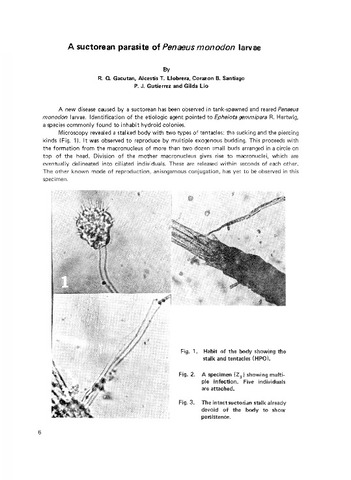
(Aquaculture Department, Southeast Asian Fisheries Development Center, 1977)A new disease caused by a suctorean has been observed in tank-spawned and reared P. monodon larvae. Identification of the etiologic agent pointed to Ephelota gemmipara R. Hertwig, a species commonly found to inhabit hydroid colonies. -
Identification and culture of common diatoms as possible feed for Penaeus monodon
(Aquaculture Department, Southeast Asian Fisheries Development Center, 1977)Diatoms were collected from Buyuan Bay, and from the hatchery tanks at Tigbauan, to determine the commonly occurring species, the feasibility of culturing these species, and the potential of these selected species as food for larval P. monodon. The commonly occurring diatoms were identified as Chaetoceros calcitrans, Navicula grimmei, Nitzchia seriata, Nitzchia closterium and Amphiprora sp. These diatoms were isolated and unialgal cultures prepared. Protein content analysis using the micro-Kjildahl method gave the following result: C. calcitrans, 11 . 78%; Nitzchia seriata, 25%; Nitzchia closterium, 30 . 5%; Navicula grimmei, 9 . 06% and Amphiprora sp. 8 . 96%. Feeding experiments were conducted to determine acceptability of the different diatom species and percentage survival of larval stages Z1 - M2. Larvae were placed in 4-l capacity plastic containers with a stocking density of 10/l. The results of several feeding trials using the different mass-produced diatoms are summarized. From the data gathered, C. calcitrans appears to be the most promising candidate as feed for zoea and mysis stages of P. monodon. The average percentage survival of C. calcitrans was 63 . 76% for the 3 trials, and as high as 82 . 22% in the third trial. Comparatively high percentage survival of larvae was also recorded when Nitzchia seriata (48 . 17%) and Nitzchia closterium (67 . 6%) were given as feed, while both Amphiprora sp. and Navicula grimmei gave 0% survival. The poor results with Amphiprora sp. and Navicula grimmei may be due to their low protein content (8 . 96% and 9 . 06%, respectively) and the inability of the larvae to ingest them. Navicula and Amphiprora were observed to cling to the appendages of the larvae and to settle down in the medium making them unavailable to the larvae. Low survival was also noted when frozen C. calcitrans was used (14 . 25%). This may be due partly to the effect of the floculating agent (ALSO4.25 g/l) used in concentrating the diatoms. When protein contents of C. calcitrans, N. seriata and N. closterium are compared, the 2 Nitzchia species have relatively higher protein contents than C. calcitrans and, therefore, could be the more desirable feed candidates. However, few feeding trials were made using Nitzchia so that additional investigations will have to be done on this aspect. -
A simple method of tagging prawns
(Aquaculture Department, Southeast Asian Fisheries Development Center, 1977)The recognition of individual animals is crucial to many aspects of research. Prawns (Penaeus monodon) present unique difficulties in this respect since they molt regularly. Thus, almost all tagging and marking methods developed for prawns so far have proven inadequate. Some tags or marks are lost during molting; others cause injury to the prawns. A new and efficient method has been developed at the Igang Seafarming Station of the Aquaculture Department. Rectangular brass tags measuring 5 mm by 20 mm and numbered consecutively are used. The prawn is held gently but firmly at the base of the carapace with the left hand while the right hand slips the brass tag around the stalk of the unablated eye and presses the tag gently. All tagging must be made under water to avoid stress. From May 29 to September 7 to a total of 348 unilaterally-ablated adult female prawns were tagged on the unablated eyestalk in 5 batches to enable individual observations on gonadal maturation, molting, and growth. Periodic examinations were made four times a month to coincide with the different phases of the lunar cycle. On each examination, survival and recovery rates were recorded. The data included death due to immediate mortality during ablation and loss to cannibalism for the duration of the experiments. In all five tagging experiments, most of the prawns recovered had their tags intact. These included even dead and molting animals. The eyestalk tagging method is suitable for prawns because the tags can be attached without causing injury and has no effect on the rate of growth, maturity, molting and behavior of the animal. The tags are identifiable and permanent; they remain attached to the animal even after death. -
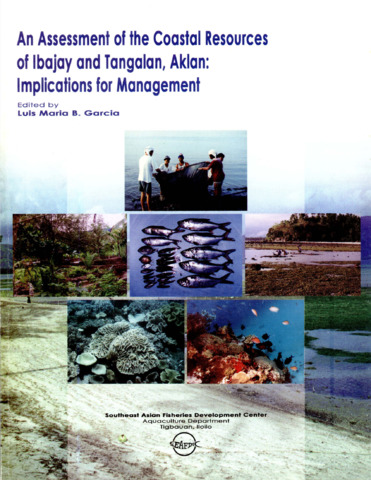
An assessment of the coastal resources of Ibajay and Tangalan, Aklan: Implications for management
(Aquaculture Department, Southeast Asian Fisheries Development Center, 2001)This report describes the present state of marine resources in several coastal barangays of Ibajay and Tangalan, Aklan (Philippines). Field data were obtained from rapid surveys conducted from July to September 1998. Recommendations based on analyses of the data will guide fisherfolk and other stakeholders, particularly the local government units, in their development plans for these neighboring municipalities. Both land and marine products in the area are mainly harvested for the local market. All coastal barangays are dependent on fishing for their livelihood. The medium-scale municipal fishery of Tangalan employs several passive (encircling gill net, bag net, fish corral) and active gears (baby purse seine) compared with the traditional fishing methods employed by Ibajay fishers. Pond aquaculture in mangrove areas is well-developed in Ibajay West (barangays Aquino and Ondoy) and in Tangalan. However, ownership of these ponds is limited to a few individuals and families, unlike in Barangay Bugtong Bato where informal ownership distributed among families has been the traditional rule. Nonetheless, the introduction of so-called environment-friendly methods of utilizing mangroves (e.g., aquasilviculture) and other shared coastal resources may seriously undermine the informal rights-based social structures in the barangays. Without proper rules and enforcement, the application of these methods may be misused, aggravating the already poor overall state of their coastal resources. Major problems affecting their fishing livelihood include siltation of nearshore waters due to illegal deforestation upland, encroachment of municipal fishing grounds by commercial and other fishers elsewhere, and the lack of capital to finance the fishery. Weak inter-organizational links among government and non-government organizations have hampered the implementation of solutions to these common problems in coastal barangays. For instance, a conflict between fishers from these neighboring municipalities over territorial boundaries of common fishing grounds in Pangayawan and Pungtod reefs has not been resolved over the years. Likewise, the introduction of aquasilviculture in mangrove areas may become a potent source of conflict among resource-users who maintain informal rights over the mangrove resource. The overall state of coastal resources in these municipalities is in immediate need of a unified plan to promote both their preservation and conservation. To achieve this end, a joint resource management council representing all resource-users from both municipalities must be organized and convened. To address the presently weak inter-organizational links among existing organizations, this joint council may provide a legitimate forum to identify, resolve, integrate, implement, and enforce guidelines on the common use of resources, both marine and inland. Low estimated yields from the reef fishery, conversion of mangroves for aquaculture beyond the allowable limit, a persistent conflict over fishing rights in several reefs offshore, the limited resources for seaweed and fish mariculture, and threats on existing traditional social structures by progressive resource-users are several issues that require thorough discussions to formulate popularly approved and acceptable management strategies. These strategies include community-based approaches of co-managing resources such as "no-take zones" (sanctuaries), ecotourism development, and livelihood schemes to mitigate, in part, the pressure of over-exploitation of fishery resources. -
Marine protected areas in the Philippines: The case of Malalison island in community-based management of reef fisheries
Garcia, Luis Maria ; Primavera, Jurgenne (UNESCO Office, 2004)
The extensive Philippine coastline of more than 22,540 k m provides the natural habitat of a variety of flora and fauna that make the Philippine archipelago one of the centers of marine biodiversity in the world. Resource-use conflicts, overexploitation, and the pressure to feed the teeming population in many fishing communities have however degraded these habitats, seriously threatening marine biodiversity that supports the biological productivity of the country's coastal fishery. Encouraged by recent enabling national legislation (e.g., the Local Government Code of 1991, the National Integrated Protected Areas System Act of 1992, the Philippine Fisheries Code of 1998), grassroots advocacy in many municipalities has grown to address this threat, resulting in the establishment of marine protected areas (MPAs), particularly in coral reef management. The over 550 MPA s catalogued in the Philippines to date were established primarily to enhance local fishery yields for artisanal fishers and secondarily to protect coastal habitats for biodiversity conservation and multiple economic uses. Enforcement in a majority of these MPAs is a serious problem however. Many government and donor-assisted projects, such as the UNESCO Biosphere Reserves in Puerto Galera and Palawan, have promoted integrated management of both upland and coastal habitats, but these too suffer from persistent conflicts in multiple resource-use and the lack of sustained enforcement by stakeholders. Our recent experience in Malalison Island, central Philippines describes the efforts of empowering the island fishers themselves to be effective and responsible managers of their marine resources. Grassroots empowerment required organizing the island fisherfolks in 1991 into a working association to promote collective action on a number of local reef fishery management initiatives, particularly the establishment of exclusive-use rights over the island's reef fishing grounds, which entailed influencing the municipal government and neighboring villages. Specific interventions that followed were highlighted by the establishment of a no-take marine reserve and the deployment of concrete artificial habitats in one of their fishing grounds in Gui-ob reef in 1995-1996. Indicators of equity, efficiency, and sustainability suggest that island fisherfolks have gained greater control over their reef fishery resources, allocated their fair share of access rights, and influenced the formulation of fishery co-management policies through direct participation. In the process of empowerment, the island community leaders and many members have become bold and confident in publicly articulating their vision of sustaining harvest from their reef fisheries, a trait that they have not openly displayed prior to 1991. The experience in Malalison Island has demonstrated that fishery co-management, as exemplified by sustained protection of a no-take marine reserve, can be an achievable goal in the Philippines. It may serve as a valuable model to be followed by other coastal fishing communities in Southeast Asia and elsewhere.
; Primavera, Jurgenne (UNESCO Office, 2004)
The extensive Philippine coastline of more than 22,540 k m provides the natural habitat of a variety of flora and fauna that make the Philippine archipelago one of the centers of marine biodiversity in the world. Resource-use conflicts, overexploitation, and the pressure to feed the teeming population in many fishing communities have however degraded these habitats, seriously threatening marine biodiversity that supports the biological productivity of the country's coastal fishery. Encouraged by recent enabling national legislation (e.g., the Local Government Code of 1991, the National Integrated Protected Areas System Act of 1992, the Philippine Fisheries Code of 1998), grassroots advocacy in many municipalities has grown to address this threat, resulting in the establishment of marine protected areas (MPAs), particularly in coral reef management. The over 550 MPA s catalogued in the Philippines to date were established primarily to enhance local fishery yields for artisanal fishers and secondarily to protect coastal habitats for biodiversity conservation and multiple economic uses. Enforcement in a majority of these MPAs is a serious problem however. Many government and donor-assisted projects, such as the UNESCO Biosphere Reserves in Puerto Galera and Palawan, have promoted integrated management of both upland and coastal habitats, but these too suffer from persistent conflicts in multiple resource-use and the lack of sustained enforcement by stakeholders. Our recent experience in Malalison Island, central Philippines describes the efforts of empowering the island fishers themselves to be effective and responsible managers of their marine resources. Grassroots empowerment required organizing the island fisherfolks in 1991 into a working association to promote collective action on a number of local reef fishery management initiatives, particularly the establishment of exclusive-use rights over the island's reef fishing grounds, which entailed influencing the municipal government and neighboring villages. Specific interventions that followed were highlighted by the establishment of a no-take marine reserve and the deployment of concrete artificial habitats in one of their fishing grounds in Gui-ob reef in 1995-1996. Indicators of equity, efficiency, and sustainability suggest that island fisherfolks have gained greater control over their reef fishery resources, allocated their fair share of access rights, and influenced the formulation of fishery co-management policies through direct participation. In the process of empowerment, the island community leaders and many members have become bold and confident in publicly articulating their vision of sustaining harvest from their reef fisheries, a trait that they have not openly displayed prior to 1991. The experience in Malalison Island has demonstrated that fishery co-management, as exemplified by sustained protection of a no-take marine reserve, can be an achievable goal in the Philippines. It may serve as a valuable model to be followed by other coastal fishing communities in Southeast Asia and elsewhere. -
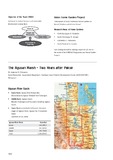
The Agusan Marsh - two years after Pakse
Primavera, Jurgenne (UNESCO Office, 2008)
-
Bridging traditional knowledge with mainstream technology to sustain cultural and biological diversity in the product development of wild honey: Focus on the indigenous peoples of the Palawan Biosphere Reserve, Philippines
; Primavera, Jurgenne (UNESCO Office, 2008)
Declared a Man and Biosphere Reserve in 1991, the Palawan Biosphere Reserve in the Philippines is a biologically diverse province and home to a number of Indigenous Peoples particularly the Pala’wan, Tagbanua and Batak tribes. These IPs are dependent on their traditional wildlife hunting and gathering practices for food. The province-wide federation of the Indigenous Peoples, the Nagkakaisang Mga Tribung Palawan (NATRIPAL) or the United Tribes of Palawan, is undertaking projects in the area of education, health, organizing, advocacy and livelihood programs towards building a better future for the tribal peoples. A key initiative is the development for the mainstream market of specialty products such as the wild honey traditionally gathered for household consumption and at a limited scale for the local market. The opportunities, challenges and strategies in the development of this specialty product based on customary knowledge and practices of gathering enhanced by mainstream technology and enterprise management scheme(s) is discussed in the context of sustaining cultural and biological diversity of the indigenous peoples of Palawan Biosphere Reserve.