SEAFDEC/AQD Institutional Repository: Recent submissions
Now showing items 3781-3800 of 4221
-
Recirculating aquaculture systems: experiences, concepts, designs, and equipment
(Philippine Association for the Advancement of Science (PhilAAS), 2002)In a general sense, recirculating aquaculture system are designed tp approximate the fundamental aspects of natural system in order to support aquatic life. They may involve tank, pund, and other culture system where water is reused. In fish culture, the waste load mainly results from excreta and wasted feed, shich obviously cause water quality deterioration if unchecked. System management requires major attention to water quality, mainly dissolved oxygen, total ammonia nitrogen, nitrite, biochemical oxygen demand, and suspended solids. The processes required and options for water treatment in recirculating systems have been clearly recognized. Among the critical processes are gas exchange (aeration and degasification), solids removal, and biological filtration or biofiltration. Solids removal is a solid-liquid separation process, and may onvolve garavity separation, filtration (screen, granual media, porous media), and flotation for finr organics and other solids (foam fractionation, protein skimming, froth flotation, and air stripping are other terms used). Biofiltration involves the use of living organisms to treat the wate. In tank recirculating system, it refers primarily to nitrification, which is the conversion of toxic ammonia and intermediate form nitrite to relatively harmless nitrate. In pund system and integrated system, biofiltration also includes the utilizationof aquatic plants and animals other than the culture species. Other treatment processes include pH and alkalinity control, denitrification, and ultraviolet (UV) sterilization. Heaters and/ or chillersmay be proviede for trmperature control. While the processes and equipment are provided for specific purposes, thet are complementary, and a complex interrelationship exists in recirculating system. System design, components, and sizing criteria vary widely, and are mainly provided to comply with specific production needs, Recirculating systems for fish production are generally meant to be intensive. The paramount objectives is to design reliabel and cost-effective system. -
Institutional capacity development for sustainable aquaculture and fisheries: Strategic partnership with local institutions
(Terrapub, 2008)Many people living in the rural areas in the Philippines, as in other developing countries in Southeast Asia, depend on aquatic resources for their food and livelihood. For the past two decades, the Aquaculture Department of the Southeast Asian Fisheries Development Center (SEAFDEC-AQD) has been working with fishing communities and people’s organizations, business sector, local government units, national government agencies, non-government organizations (NGOs) and academic and other research institutions to promote the efficient conservation, management and sustainable development of the country’s fisheries and aquatic resources so that these may continue to serve the needs of the people today and tomorrow. Using the lessons learned from those two decades of multi-sectoral and inter-disciplinary collaborations, SEAFDEC-AQD launched in late 2006 a project called Institutional Capacity Development for Sustainable Aquaculture (ICDSA) to hasten the transfer to and adoption by coastal villagers of appropriate technologies that would enhance the productivity of aquatic resources and at the same time safeguard the fragile balance of the aquatic ecology. The experience of SEAFDEC in coastal resource management shows that it is important to engage the collaboration of the local government units and other “on-the-ground” institutions, such as NGOs and people’s organizations, to be able to introduce effectively any social and technological interventions to target community-beneficiaries. However, before a fruitful collaboration among these institutions could be attained, there is a need to build their capacities, and those of the beneficiaries, for the vital roles that they play in the implementation of livelihood projects and environmental management programs. As of January 2008, SEAFDEC-AQD is implementing ICDSA projects in four provinces—Antique, Capiz, Guimaras and Northern Samar in central Philippines. In the pipeline are similar projects for a province in southern Philippines and two provinces in the north. -
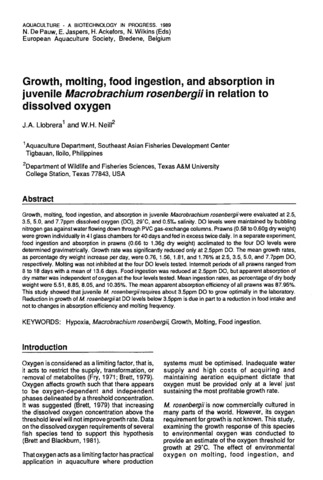
Growth, molting, food ingestion, and absorption in juvenile Macrobrachium rosebergii in relation to dissolved oxygen
(European Aquaculture Society, 1989)Growth, molting, food ingestion, and absorption in juvenile Macrobrachium rosenbergii were evaluated at 2.5, 3.5, 5.0, and 7.7ppm dissolved oxygen (DO), 29°C, and 0.5°/oo salinity. DO levels were maintained by bubbling nitrogen gas against water flowing down through PVC gas-exchange columns. Prawns (0.58 to 0.60g dry weight) were grown individually in 4 l glass chambers for 40 days and fed in excess twice daily. In a separate experiment, food ingestion and absorption in prawns (0.66 to 1.36g dry weight acclimated to the tour DO levels were determined gravimetrically. Growth rate was significantly reduced only at 2.5ppm DO. The mean growth rates, as percentage dry weight increase per day, were 0.76, 1.56, 1.81, and 1.76% at 2.5, 3.5, 5.0, and 7.7ppm DO, respectively. Molting was not inhibited at the tour DO levels tested. Intermolt periods of all prawns ranged trom 8 to 18 days with a mean of 13.6 days. Food ingestion was reduced at 2.5ppm DO, but apparent absorption of dry matter was independent of oxygen at the tour levels tested. Mean ingestion rates, as percentage of dry body weight were 5.51, 8.85, 8.05, and 10.35%. The mean apparent absorption efficiency of all prawns was 87.95%. This study showed that juvenile M. rosenbergii requires about 3.5ppm DO to grow optimally in the laboratory. Reduction in growth of M. rosenbergii at DO levels below 3.5ppm is due in part to a reduction in food intake and not to changes in absorption efficiency and molting frequency. -
Recent developments in design and management of small-scale hatchery for Penaeus monodon in the Philippines
(South China Sea Fisheries Development and Coordinating Programme, 1982)It is a common belief that the zoea of Penaeus monodon are completely filter feeders. Thus, diatoms like chaetoceros and phytoflagellates are maintained at high feeding densities as much as 80 000 cells/ml in hatchery tanks during the zoeal states of the P.monodon. This feeding scheme often results in the reddening of the larvae followed by weakening, loss of appetite and eventual mass mortality. It was found out recently that zoea larvae are not completely filter feeders. It was observed as early as Zoae 1, the mouth parts of the larvae are already functional and can eat food particles as big as Artimeia and Brachionus. Based on this observation, a new feeding scheme was developed. Boiled egg yolk is fed to the larvae at 15-22 particles (as big as Brachionus) per ml from Zoea 2 to Mysis 3 stages. Tetraselmis is given from Zoea 1 to Mysis 3 stages at a low density level of 5 000 cells/ml. Artemia is also fed at 10-15 individuals/ml from Mysis 1 to Postlarvae 5. If Tetraselmis is not available, bread yeast is given from Zoea 1 to 3 at 0.1-03 g/ton as supplementery feed. With this new feeding scheme, the hatchery producers have been greatly simplified considering that the most difficult and tedious part in larval rearing is the maintenance of algal food especially diatoms. This feeding scheme was tested in a private hatchery in Bataan, Aklan province by the SEAFDEC Aquaculture Department from July to October 1981. All 44 runs were successful, yielding survival rates ranging from 22 to 75 percent and an average rate of 52.9 percent. The hatchery system was further simplified when experiments at the Bataan Substation of the SEAFDEC AQD revealed that as high as 60 percent survival can be attained with minimal aeration. Instead of centralized aeration system using compressors or blowers, portable aquarium-type aerators (5-watt) could be use thus minimizing energy consumption. Based on these developments, a new model for a small-scale hatchery system is proposed. based -
Depuration of molluscs
(Philippine Council for Agriculture, Forestry and Natural Resources Research and Development; Bureau of Fisheries and Aquatic Resources, 1987)The experimental system put up at SEAFDEC [Southeast Asian Fisheries Development Center; Philippines] consisted of six rectangular (96 x 196 x 42 cm) fiberglass-coated tanks made of marine plywood. It can depurate about 230 to 310 kg bivalves in two days. Initial findings showed that under normal seawater conditions (salinity 29-32 ppt, temperature 27-30 degrees Celsius; oxygen content 3-6.2 mg/L; and pH 7.4-8.3) and moderate rate of flow (7-10 L/min), highly contaminated oysters (MPN 1.0 x 10 to the fifth power to 2.0 x 10 to the sixth power/100 g meat) can be depurated within 48 hr or less. A short flume type of tank with a volume of about 250 L was designed, tested and showed to cleanse oysters under normal conditions in only 24 hr with a flow rate of 7L/min and with very little resulting mortality. More important, the tank can be lifted and moved by only two men of average body built. -
Survey on the use of natural food and supplemental feed in commercial milkfish farms on Panay, Philippines
(Stuttgart University, 2000)This study evaluated the feed intake of the milkfish (Chanos chanos Forsskål) in commercial brackishwater ponds under different management regimes. Feed intake and growth were compared between a rather intensive culture management in a fish farm of 1 ha pond size and a semi-intensive one, with a total pond area of 30 ha. The data suggested a direct consumption of only 12 % of the supplemental feed in the intensive farm, leading to a wastage of high quality fish feed and a significantly lower specific and metabolic growth rate (P< 0.001) than in the semi-intensive system without any supplementation and only relying on abundant natural food through fertilization. These results suggest that a heavy reduction in, or even the abandonment of the use of, supplemental feed for milkfish culture would be more cost-effective. -
Development of broodstock for small-scale shrimp hatchery (with particular reference to Penaeus monodon)
Primavera, Jurgenne (South China Sea Fisheries Development and Coordinating Programme, 1982)
To be self-sufficient in spawner/larval supply, a small-scale Penaeus monodon hatchery should have the following: 1) broodstock tanks or pens depending on location and other factors; 2) pond sources of broodstock of appropriate size and age; and 3) maturation by ablation (optional for P. indicus and P. merguensis).
(South China Sea Fisheries Development and Coordinating Programme, 1982)
To be self-sufficient in spawner/larval supply, a small-scale Penaeus monodon hatchery should have the following: 1) broodstock tanks or pens depending on location and other factors; 2) pond sources of broodstock of appropriate size and age; and 3) maturation by ablation (optional for P. indicus and P. merguensis). -
Status of Macrobrachium farming in the Philippines
; Primavera, Jurgenne; (South China Sea Fisheries Development and Coordinating Programme, 1982)
Research on larval rearing of Macrobrachium is reviewed. The future of prawn culture is discussed. -
A primer on putian.
Primavera, Jurgenne (Fishfarmers Technical Assistance Foundation, Inc, 1986)
With the growing interest among fishfarmars in the culture of sugpo or Penaeus monodon, some attention is being focused on the lesser known prawns and shrimps such as putian, Hipong puti (Tagalog), putian (Cebuano, Ilongo), lunhan (Cebuano) and udang putih (Indonesia) are collective names given to two closely related species -- Penaeus indicus, so named bacause it is the Indian prawn and P. merguiensis or the banana prawn which gets its specific name from the Mergui Archipelago in Thailand, its type locality. Both are also called white prawn referring to their light color and almost transparent shell. Aside from the Philippines and Indonesia, the distribution of these Indo-West Pacific species extends from Southest Africa for P. indicus and the Persian Gulf for P. merguiensis to India, South China, Southeast Asia, North Australia and New Guinea. Very similar in apperance, the two species can be differentiated by means of a straight rostrum and high traingular rostral crest for P. merguiensis and curved rostrum amd low rostral crest for P. indicus. More convenient for a laymen is to associate yellowish to greenish antennae with P. indicus and a brown or raddish antennae with P. merguiensis. The maximum recorded body weight is 50 g and 35 g, respectively, for P. merguiensis and P. indicus. -
Handling and rearing of hatchery-produced shrimp postlarvae from small-scale hatchery
(South China Sea Fisheries Development and Coordinating Programme, 1982)This paper discusses the handling and rearing of hatchery-produced Penaeus post larvae. The survival and growth of hatchery produced fry and wild caught fry are discussed. -
Fisheries
(Institute of Developing Economies, 1996) -
Seaweed research at SEAFDEC Aquaculture Department
(Seaweed Industry Association of the Philippines, 2003)Seaweed research at the Aquaculture Department of SEAFDEC focuses mainly on 2 genera of agarophytes (Gracilaria and Gracilariopsis) and carrageenophytes (Eucheuma and Kappaphycus). From 1988 to 1998, research works were mainly on Gracilaria and Gracilariopsis along these areas: (1) refinement of culture technique, (2) basic biology, production ecology, and corp management, (3) product utilization, (4) screening and characterization of natural products, and (5) economics of farming system. Four years ago, the Seaweed Program of the Department re-focused its thrust on Advanced Aquaculture Technologies (Biotechnology) to include also Eucheuma and Kappaphycus in answer to the needs of the industry. This paper briefly describes the highlights of the different studies done on biotechnology. -
Formulated feeds for Penaeus monodon
(ASEAN/UNDP/FAO Regional Small-Scale Coastal Fisheries Development Project, 1989)The paper discusses the food and feeding habits of Penaeus monodon , present knowledge of nutrient requirements and available formulation in the market including those developed at the Aquaculture Department, Southeast Asian Fisheries Development Center. Economics of feeding is also presented. Further research on the use of indigenous feed ingredients and nutritional requirement studies should be carried out to lower cost of feed and increase profits for the farmers. -
Infectious diseases of warmwater fish in fresh water
(CAB International, 2002) -
Shrimp farming in the Asia-Pacific: environment and trade issues and regional cooperation
Primavera, Jurgenne (Nautilus Institute for Security and Sustainable Development, 1995)
Production of farmed shrimp has grown at the phenomenal rate of 20-30% per year in the last two decades. The leading shrimp producers are in the Asia-Pacific region while the major markets are in Japan, the U.S.A. and Europe. The dramatic failures of shrimp farms in Taiwan, Thailand, Indonesia and China within the last five years have raised concerns about the sustainability of shrimp aquaculture, in particular intensive farming. After a brief background on shrimp farming, this paper reviews its environmental impacts and recommends measures that can be undertaken on the farm, country and regional levels to promote long-term sustainability of the industry. Among the environmental effects of shrimp culture are the loss of mangrove goods and services as a result of conversion, salinization of soil and water, discharge of effluents resulting in pollution of the pond system itself and receiving waters, and overuse or misuse of chemicals. Recommendations include the protection and restoration of mangrove habitats and wild shrimp stocks, management of pond effluents, regulation of chemical use and species introductions, and an integrated coastal area management approach. Regional cooperation is needed in research and information sharing, and trade in supplies and equipment. The contribution of farming to global shrimp production has dramatically risen from a mere 6% in 1970 to 26% in 1990 (FAO, 1993). In terms of value, this has meant a 16-fold increase from US$300 million in 1980 to $7 billion worth of cultured shrimp by 1993 (Rosenberry, 1993). Annual growth rate of farmed shrimp has been 20-30% in the last 20 years (Table 1). In contrast, increases in commercial landings of shrimp have stabilized at 2-3% yearly due to the full or close to full exploitation of most wild stocks and high fuel costs. However, the recent failures of shrimp crops in Taiwan followed by China and Indonesia have raised concerns about the sustainability of shrimp aquaculture. This paper will a) give a background of the shrimp farming industry, b) review the different shrimp culture systems, c) evaluate the environmental impacts of shrimp farming, and d) recommend actions to promote long-term sustainability in the industry including suggestions for regional cooperation. -
The status of grouper culture in Southeast Asia
(Marine Resources Division, Secretariat of the Pacific Community, 2002)Full-cycle aquaculture (the use of hatchery-reared fingerlings) of many grouper species is becoming more common throughout Asia. Grouper are cultured at various scales in every country of Southeast Asia — Hong Kong, Indonesia, Malaysia, Philippines, Taiwan, Thailand and Vietnam. While currently making up only about 10–15 per cent of the total trade, there is an increasing supply of full-cycle, cultured fish. The most important source countries are Taiwan, Indonesia and Thailand. Grouper culture is also ongoing in Australia and the People’s Republic of China, although the industry in these countries will not be discussed here. -
Egg and larval quality of cage-reared milkfish broodstock
(European Aquaculture Society. EAS Special Publication No. 21, 1996) -
Studies on the efficacy of Sarafin® (sarafloxacin hydrochloride) on vibrios associated with vibriosis in black tiger shrimp (Penaeus monodon)
Pakingking, Rolando V., Jr.; ; (Fish Health Section, Asian Fisheries Society, 2002)
In vitro activity of Sarafin® (sarafloxacin hydrochloride) was determined against 7 luminous Vibrio harveyi isolates and 3 non-luminous Vibrio species (V. parahaemolyticus, V. alginolyticus and Vibrio species) isolated from diseased shrimp (Penaeus monodon) and rearing water, a strain of V. anguillarum from diseased marine fish, 1 strain each of V. alginolyticus, V. vulnificus, and V. mimicus from diseased grouper (Epinephelus coioides), and V. alginolyticus from diseased seabass (Lates calcarifer). Bacterial susceptibility was expressed as minimum inhibitory concentration (MIC) and minimum bactericidal concentration (MBC). The MIC and MBC values obtained for all V. harveyi isolates ranged from <0.3 to 1.25 µg/ml. For the non-luminous Vibrio species, MIC and MBC values ranged from <0.08 to 1.25 µg/ml. In vivo tolerance levels (24 h static bioassay) of larval and postlarval stages of P. monodon for Sarafin® were <10 µg/ml for nauplii, mysis, and postlarvae and ≤1 µg/ml for zoeae. Morphological deformities in the carapace, rostrum, and setae were noted among larvae exposed to >50 µg/ml Sarafin®. These results indicate that Sarafin® is a potential candidate as a chemotherapeutic agent against luminous vibriosis in P. monodon. -
Swollen hindgut syndrome (SHG) in hatchery-reared Penaeus monodon postlarvae
(Fish Health Section, Asian Fisheries Society, 2002)In the course of routine microscopic analysis of hatchery-reared Penaeus monodon postlarvae, several batches were found with hindgut abnormalities not previously described in shrimp postlarvae. The abnormality was named swollen hindgut syndrome (SHG) because it affected mainly the hindgut. Postlarvae with SHG showed enlargement and distention of the hindgut folds and its junction with the midgut, although in some cases swelling also occurred in the midgut of the sixth abdominal segment. Over a five-year period, the yearly prevalence of SHG ranged from 6 to 13% of all batches examined. No seasonal pattern was observed as SHG occurred year-round. Despite the numerous samples obtained, SHG has not been associated with specific predisposing factors in the hatchery. The abnormality caused cessation of the rhythmic movements of the hindgut-midgut junction resulting to failure of affected postlarvae to excrete fecal pellets. Swollen hindgut syndrome, although reversible to some extent, caused mortality and significant size variation within batches of postlarvae resulting in their unsuitability for stocking in grow-out farms. -
Mararison Island
Garcia, Luis Maria; ; (Goodwill Trading Co., Inc. (Goodwill Bookstore), 2002)