Seed production and the prawn industry in the Philippines


Share
抄録
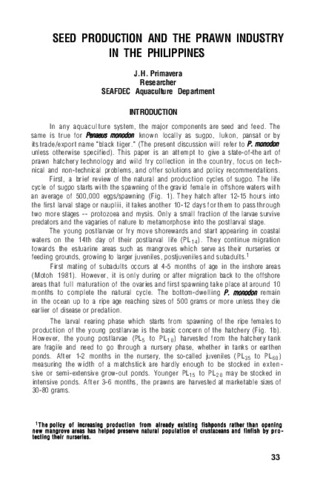
In any aquaculture system, the major components are seed and feed. The same is true for Penaeus monodon known locally as sugpo, lukon, pansat or by its trade/export name "black tiger". This paper is an attempt to give a state-of-the-art of prawn hatchery technology and wild fry collection in the country, focus on technical and non-technical problems, and offer solutions and policy recommendations.
Suggested Citation
Primavera, J. H. (1984). Overview of the industry. In Prawn industry development in the Philippines: Proceedings of the National Prawn Industry Development Workshop, 10-13 April 1984, Iloilo City, Philippines (pp. 33-53). Tigbauan, Iloilo, Philippines: Southeast Asian Fisheries Development Center, Aquaculture Department.
Type
Conference paperCollections
Related items
Showing items related by title, author, creator and subject.
-
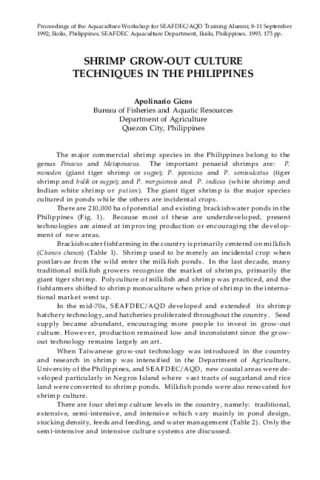
Shrimp grow-out culture techniques in the Philippines
(Aquaculture Department, Southeast Asian Fisheries Development Center, 1993)The major commercial shrimp species in the Philippines belong to the genus Penaeus and Metapenaeus. The important penaeid shrimps are: P. monodon (giant tiger shrimp or sugpo); P. japonicus and P. semisulcatus (tiger shrimp and bulik or sugpo); and P. merguiensis and P. indicus (white shrimp and Indian white shrimp or putian). The giant tiger shrimp is the major species cultured in ponds while the others are incidental crops. There are 210,000 ha of potential and existing brackishwater ponds in the Philippines (Fig. 1). Because most of these are underdeveloped, present technologies are aimed at improving production or encouraging the development of new areas. Brackishwater fishfarming in the country is primarily centered on milkfish (Chanos chanos) (Table 1). Shrimp used to be merely an incidental crop when postlarvae from the wild enter the milkfish ponds. In the last decade, many traditional milkfish growers recognize the market of shrimps, primarily the giant tiger shrimp. Polyculture of milkfish and shrimp was practiced, and the fishfarmers shifted to shrimp monoculture when price of shrimp in the international market went up. In the mid-70s, SEAFDEC/AQD developed and extended its shrimp hatchery technology, and hatcheries proliferated throughout the country. Seed supply became abundant, encouraging more people to invest in grow-out culture. However, production remained low and inconsistent since the growout technology remains largely an art. When Taiwanese grow-out technology was introduced in the country and research in shrimp was intensified in the Department of Agriculture, University of the Philippines, and SEAFDEC/AQD, new coastal areas were developed particularly in Negros Island where vast tracts of sugarland and rice land were converted to shrimp ponds. Milkfish ponds were also renovated for shrimp culture. There are four shrimp culture levels in the country, namely: traditional, extensive, semi-intensive, and intensive which vary mainly in pond design, stocking density, feeds and feeding, and water management (Table 2). Only the semi-intensive and intensive culture systems are discussed. -
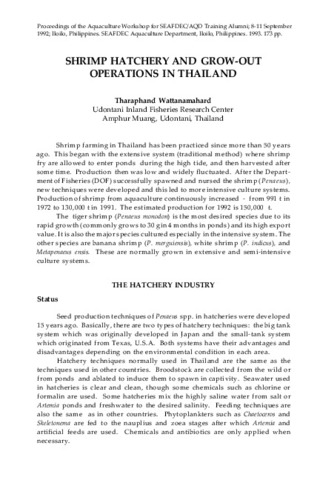
Shrimp hatchery and grow-out operations in Thailand
(Aquaculture Department, Southeast Asian Fisheries Development Center, 1993)Shrimp farming in Thailand has been practiced since more than 50 years ago. This began with the extensive system (traditional method) where shrimp fry are allowed to enter ponds during the high tide, and then harvested after some time. Production then was low and widely fluctuated. After the Department of Fisheries (DOF) successfully spawned and nursed the shrimp (Penaeus, )new techniques were developed and this led to more intensive culture systems. Production of shrimp from aquaculture continuously increased - from 991 t in 1972 to 130,000 t in 1991. The estimated production for 1992 is 150,000 t. The tiger shrimp (Penaeus monodon) is the most desired species due to its rapid growth (commonly grows to 30 g in 4 months in ponds) and its high export value. It is also the major species cultured especially in the intensive system. The other species are banana shrimp (P. merguiensis), white shrimp (P. indicus), and Metapenaeus ensis. These are normally grown in extensive and semi-intensive culture systems. -
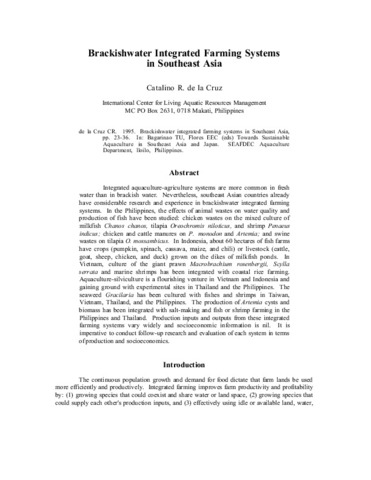
Brackishwater integrated farming systems in Southeast Asia
(Aquaculture Department, Southeast Asian Fisheries Development Center, 1995)Integrated aquaculture-agriculture systems are more common in fresh water than in brackish water. Nevertheless, southeast Asian countries already have considerable research and experience in brackishwater integrated farming systems. In the Philippines, the effects of animal wastes on water quality and production of fish have been studied: chicken wastes on the mixed culture of milkfish Chanos chanos, tilapia Oreochromis niloticus, and shrimp Penaeus indicus; chicken and cattle manures on P. monodon and Artemia; and swine wastes on tilapia O. mossambicus. In Indonesia, about 60 hectares of fish farms have crops (pumpkin, spinach, cassava, maize, and chili) or livestock (cattle, goat, sheep, chicken, and duck) grown on the dikes of milkfish ponds. In Vietnam, culture of the giant prawn Macrobrachium rosenbergii, Scylla serrata and marine shrimps has been integrated with coastal rice farming. Aquaculture-silviculture is a flourishing venture in Vietnam and Indonesia and gaining ground with experimental sites in Thailand and the Philippines. The seaweed Gracilaria has been cultured with fishes and shrimps in Taiwan, Vietnam, Thailand, and the Philippines. The production of Artemia cysts and biomass has been integrated with salt-making and fish or shrimp farming in the Philippines and Thailand. Production inputs and outputs from these integrated farming systems vary widely and socioeconomic information is nil. It is imperative to conduct follow-up research and evaluation of each system in terms of production and socioeconomics.